












Prepared by:
Hiranmayee Bannerjee
Johnsy Rani
Deepika Tripathi
Sukanya G Roy
Swati Atri
PGDBM IInd Year (2013-2015)
Annuities
Policy
Whole
Life
Policy
Endowment
Policy
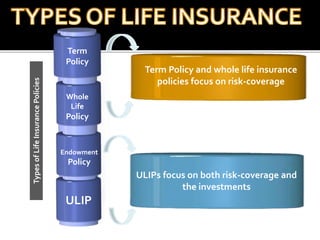
TypesofLifeInsurancePolicies
.
Term
Policy
Term Policy and whole life insurance
policies focus on risk-coverage
Endowment policy and annuities
insurance policies focus on
investments
ULIPs focus on both risk-coverage and
the investments
ULIP
Premium for ULIP
Investment as Unit Life Coverage
 A category of goal-based financial solutions
 Safety of insurance protection + wealth creation
opportunities.
 In ULIPs, a part of the investment goes towards
providing life cover. The residual portion of the ULIP
is invested in a fund which in turn invests in stocks
or bonds;
 The value of investments alters with the performance of
the underlying fund opted.
ULIPs are structured in such a way that the protection
element and the savings element are distinguishable,
and hence managed according to the specific needs of
the customer. In this way, the ULIP plan offers
unprecedented flexibility and transparency. The
investment is denoted as units and is represented by the
value that it has attained called as Net Asset Value
(NAV).
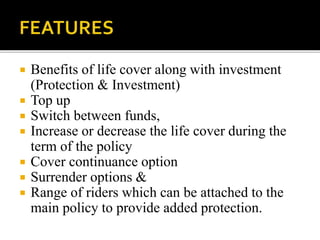
 Benefits of life cover along with investment
(Protection & Investment)
 Top up
 Switch between funds,
 Increase or decrease the life cover during the
term of the policy
 Cover continuance option
 Surrender options &
 Range of riders which can be attached to the
main policy to provide added protection.
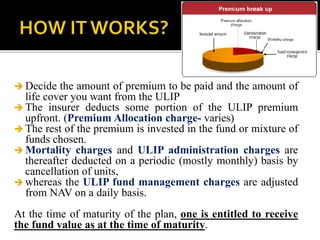
 Decide the amount of premium to be paid and the amount of
life cover you want from the ULIP
 The insurer deducts some portion of the ULIP premium
upfront. (Premium Allocation charge- varies)
 The rest of the premium is invested in the fund or mixture of
funds chosen.
 Mortality charges and ULIP administration charges are
thereafter deducted on a periodic (mostly monthly) basis by
cancellation of units,
 whereas the ULIP fund management charges are adjusted
from NAV on a daily basis.
At the time of maturity of the plan, one is entitled to receive
the fund value as at the time of maturity.
 A 30 Year old
 SA- 5,00,000
 Term- 20 Years
In a ULIP- Premium: INR 25,000- 30,000
In a term plan- Premium: INR 40,000-50,000
Difference??
 Cost of Distribution
 Cost of administration
 Margin of the insurer
In a ULIP, costs and margins are recovered
commonly between the investment portion and
the insurance portion. However, if you were to
buy a term policy and a mutual fund, the insurance
company will recover its costs of distribution and
administration as well as margins. The mutual fund
would again recover the same costs from your
investment portion.
Please Note: If the Life cover amount required is low then large sum of money will get
invested in stock market. Most ULIPs have classification in terms of investment i.e.
whether you want to invest in stocks or govt bonds so that it goes with your risk profile.
If you invest 100rs in ULIP and 20 is going as a
cost for the cover, over the years your 80 will
get 12-15% of returns and will wipe off the cost
and still get you good returns.
“The reason why ULIPs have become popular is because
they offer huge amount of flexibility during the course of
the policy. You can vary your mix between protection and
savings or within savings, your fund mix.”
 A ULIP gives the flexibility of increasing the life cover, while maintaining the same
premium.
Eg: If you have a term policy and would like to increase your life cover, your only
option would be to buy another term policy. This would mean paying administration
charges all over again.
 With a ULIP there is no fear that the policy will lapse if the premium is not paid.
The cost of insurance will be taken out of the existing investment to keep the policy
going. However in case of failure of premium payment in a term policy, it will
lapse.
1) For Retirement planning
2) For Long-term wealth creation
1) Single Vs Regular premium Plans
2) Guarantee Vs Non Guarantee Plans
3) Life-staged Vs Non-Life staged plans
3) For child education
Aggressive funds (Primarily invested in equities with the general
aim of capital appreciation)
Conservative funds (invested in cash, bank deposits and money
market instruments with aim of capital preservation)
This helps to decide to invest money in line with the market
outlook, time-horizon and the individual investment preferences
and needs.
High risk appetite  More aggressive investment option
Additionally there is an advantage of switching fund options to
make the investments work in tandem with the market.
These days, various ULIPs also offer the options of life stage
strategy which keep dynamically altering themselves without
having to monitor.
 It is an expensive deal !!
 Investment risk lies with the policyholder and
not the Insurance company.
Unit-Linked Insurance Plans (ULIPs) are meant to help
achieve financial goals over the long-term. As a short
term investment tool, they will not give a considerable
return on investments, because of a product cost
structure which is higher in the initial years. However,
overall charge structure for the term comes down
substantially if spread over a number of years.
 Potential for better returns
 Greater transparency
 Flexibility in investments
 To invest money the way you want
 To change fund allocation
 To invest more via Top-Ups
 To skip premium
 Flexibility in insurance coverage
 Choose coverage
 Increase risk cover
 Higher liquidity- Better exit options!
 Similar in structure and functioning
ULIPs Mutual Funds
Investment
amounts
Determined by the investor and can be modified as
well
Minimum investment amounts are determined by the
fund house
Expenses
No upper limits, expenses determined by the
insurance company
Upper limits for expenses chargeable to investors have
been set by the regulator
Portfolio
disclosure Not mandatory* Quarterly disclosures are mandatory
Modifying asset
allocation Generally permitted for free or at a nominal cost Entry/exit loads have to be borne by the investor
Tax benefits
Section 80C benefits are available on all ULIP
investments
Section 80C benefits are available only on investments
in tax-saving funds
QUESTIONS??

ULIPs

  • 1.
    Prepared by: Hiranmayee Bannerjee JohnsyRani Deepika Tripathi Sukanya G Roy Swati Atri PGDBM IInd Year (2013-2015)
  • 2.
    Annuities Policy Whole Life Policy Endowment Policy TypesofLifeInsurancePolicies . Term Policy Term Policy andwhole life insurance policies focus on risk-coverage Endowment policy and annuities insurance policies focus on investments ULIPs focus on both risk-coverage and the investments ULIP
  • 3.
    Premium for ULIP Investmentas Unit Life Coverage  A category of goal-based financial solutions  Safety of insurance protection + wealth creation opportunities.  In ULIPs, a part of the investment goes towards providing life cover. The residual portion of the ULIP is invested in a fund which in turn invests in stocks or bonds;  The value of investments alters with the performance of the underlying fund opted.
  • 4.
    ULIPs are structuredin such a way that the protection element and the savings element are distinguishable, and hence managed according to the specific needs of the customer. In this way, the ULIP plan offers unprecedented flexibility and transparency. The investment is denoted as units and is represented by the value that it has attained called as Net Asset Value (NAV).
  • 5.
     Benefits oflife cover along with investment (Protection & Investment)  Top up  Switch between funds,  Increase or decrease the life cover during the term of the policy  Cover continuance option  Surrender options &  Range of riders which can be attached to the main policy to provide added protection.
  • 6.
     Decide theamount of premium to be paid and the amount of life cover you want from the ULIP  The insurer deducts some portion of the ULIP premium upfront. (Premium Allocation charge- varies)  The rest of the premium is invested in the fund or mixture of funds chosen.  Mortality charges and ULIP administration charges are thereafter deducted on a periodic (mostly monthly) basis by cancellation of units,  whereas the ULIP fund management charges are adjusted from NAV on a daily basis. At the time of maturity of the plan, one is entitled to receive the fund value as at the time of maturity.
  • 7.
     A 30Year old  SA- 5,00,000  Term- 20 Years In a ULIP- Premium: INR 25,000- 30,000 In a term plan- Premium: INR 40,000-50,000 Difference??  Cost of Distribution  Cost of administration  Margin of the insurer In a ULIP, costs and margins are recovered commonly between the investment portion and the insurance portion. However, if you were to buy a term policy and a mutual fund, the insurance company will recover its costs of distribution and administration as well as margins. The mutual fund would again recover the same costs from your investment portion.
  • 8.
    Please Note: Ifthe Life cover amount required is low then large sum of money will get invested in stock market. Most ULIPs have classification in terms of investment i.e. whether you want to invest in stocks or govt bonds so that it goes with your risk profile. If you invest 100rs in ULIP and 20 is going as a cost for the cover, over the years your 80 will get 12-15% of returns and will wipe off the cost and still get you good returns.
  • 9.
    “The reason whyULIPs have become popular is because they offer huge amount of flexibility during the course of the policy. You can vary your mix between protection and savings or within savings, your fund mix.”  A ULIP gives the flexibility of increasing the life cover, while maintaining the same premium. Eg: If you have a term policy and would like to increase your life cover, your only option would be to buy another term policy. This would mean paying administration charges all over again.  With a ULIP there is no fear that the policy will lapse if the premium is not paid. The cost of insurance will be taken out of the existing investment to keep the policy going. However in case of failure of premium payment in a term policy, it will lapse.
  • 10.
    1) For Retirementplanning 2) For Long-term wealth creation 1) Single Vs Regular premium Plans 2) Guarantee Vs Non Guarantee Plans 3) Life-staged Vs Non-Life staged plans 3) For child education
  • 11.
    Aggressive funds (Primarilyinvested in equities with the general aim of capital appreciation) Conservative funds (invested in cash, bank deposits and money market instruments with aim of capital preservation) This helps to decide to invest money in line with the market outlook, time-horizon and the individual investment preferences and needs. High risk appetite  More aggressive investment option Additionally there is an advantage of switching fund options to make the investments work in tandem with the market. These days, various ULIPs also offer the options of life stage strategy which keep dynamically altering themselves without having to monitor.
  • 13.
     It isan expensive deal !!  Investment risk lies with the policyholder and not the Insurance company. Unit-Linked Insurance Plans (ULIPs) are meant to help achieve financial goals over the long-term. As a short term investment tool, they will not give a considerable return on investments, because of a product cost structure which is higher in the initial years. However, overall charge structure for the term comes down substantially if spread over a number of years.
  • 14.
     Potential forbetter returns  Greater transparency  Flexibility in investments  To invest money the way you want  To change fund allocation  To invest more via Top-Ups  To skip premium  Flexibility in insurance coverage  Choose coverage  Increase risk cover  Higher liquidity- Better exit options!
  • 15.
     Similar instructure and functioning ULIPs Mutual Funds Investment amounts Determined by the investor and can be modified as well Minimum investment amounts are determined by the fund house Expenses No upper limits, expenses determined by the insurance company Upper limits for expenses chargeable to investors have been set by the regulator Portfolio disclosure Not mandatory* Quarterly disclosures are mandatory Modifying asset allocation Generally permitted for free or at a nominal cost Entry/exit loads have to be borne by the investor Tax benefits Section 80C benefits are available on all ULIP investments Section 80C benefits are available only on investments in tax-saving funds
  • 17.