Debt Funds GROUP MEMBERS AMIT JOSHI ANIL KUMAR AVDHESH RAJPUT NIKHIL GUPTA NILESH KUMAR RAHUL SOODEY RISHAP KUNDRA TOPIC PRESENTATION
An investment pool, such as a mutual fund or  exchange-traded fund, in which core holdings are fixed income investments . A debt fund may invest in short-term or long-term bonds, securitized products, money market instruments or floating rate debt . The aim of income funds is to provide regular and steady income to investors. More emphasis on income distribution than capital appreciation
The longer the term to maturity, higher will be the yield. In order to ensure regular income to investors debt funds distribute large fraction of there surplus to investors . Returns through interest earnings and trading of securities in secondary market .
There are several reasons why one should look at debt  as an asset class to invest in. Some of the main reasons are: Need to balance risk and return - The Risk/Return    Tradeoff . Need to diversify - Portfolio Diversification and Asset    Allocation.
 
Government securities :  Issued by RBI & is guaranteed by government. Used as benchmark because of minimal risk & high level of marketability. Central or state government has substantial equity holding & payments guaranteed by government. Less risky than corporate bonds.
Corporate bonds: Issued by financial institutions ,banks, public sector undertakings.(PSU’s) & private sector companies.  Corporate bonds attracts stamp duty but it varies from state to state. Medium & low rated companies  have no access to corporate bond market.
 
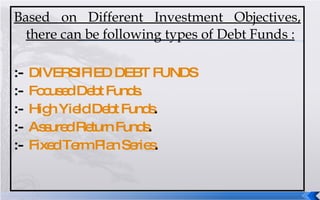
Based on Different Investment Objectives, there can be following types of Debt Funds : :-  DIVERSIFIED DEBT FUNDS :-  Focused Debt Funds. :-  High Yield Debt Funds . :-  Assured Return Funds . :-  Fixed Term Plan Series .
Invest in all securities issued by entities belonging to all sectors of market. Investments are properly diversified into all sectors which results in risk reduction Any loss incurred, on account of debt issuer, is shared by all investors further reducing the risk.
Narrow focus funds more confined to investments in certain selected industries of specific sectors or industry or origin. Because of there narrow orientation they are more risky as compared with diversified debt funds.
These funds prefer securities issued by those issuers that are considered to be of “below investment grade” Sole motive is to earn higher interest returns from these issuers. More volatile and bear higher default risk. Although they may earn at times higher returns for investors .
Funds that come with a locking period and offer assurance of annual return to investors during the lock-in period. It provides low risk & safe guard the interest of the investors. SEBI permits assured returns to those funds who has adequate net worth to guarantee returns in the future .
Usually are closed ended schemes having short term maturity periods. Offers  a series of plans and issue units to investors at regular intervals. Not listed in exchanges. Main objective is to gratify investors by generating  expected returns in short duration of time.
Offers  all benefits  associated with mutual funds in general. Like :  Transparency in operation. :  Professional management. :  Diversification. :  Liquidity. :  Convenience & Low cost. They are towards lower ends of risk spectrum. Provide an alternative for diversification of one’s portfolio. More predictable performance in comparison with equity as an asset class.
Name of scheme HSBC Flexi Debt Fund Investment objective To deliver returns in the form of  interest income and capital gains, along with high liquidity, commensurate with the current view on the markets & interest rate cycle, through active investment  in debt & money market instruments Plan/options Regular & Institutional option Sub options Regular & Institutional :Fortnightly,Montly, Quarterly & half yearly dividend(payout /reinvestment) & growth sub option Dividends  Declaration of dividends & its frequency will inter alia depend upon the distributable surplus Minimum application amount Regular  : Rs  10000 per application Institutional : Rs  5,000,000 per application Minimum additional investment Rs 1000 & multiples of Re 1 for regular option, Rs 10000 & multiples of Rs 10000 thereafter  for institutional option. Minimum redemption amount Regular Rs 1000 & multiples of Re 1 there after. Bench mark index CRISIL  Composite Bond Fund Index Loads Entry Load : NIL Exit  load :0.75% in regular option Liquidity/ ongoing subscription Purchased /redeemed on every business day at NAV prices
THANK YOU

Mutual Funds Presentation

  • 1.
    Debt Funds GROUPMEMBERS AMIT JOSHI ANIL KUMAR AVDHESH RAJPUT NIKHIL GUPTA NILESH KUMAR RAHUL SOODEY RISHAP KUNDRA TOPIC PRESENTATION
  • 2.
    An investment pool,such as a mutual fund or exchange-traded fund, in which core holdings are fixed income investments . A debt fund may invest in short-term or long-term bonds, securitized products, money market instruments or floating rate debt . The aim of income funds is to provide regular and steady income to investors. More emphasis on income distribution than capital appreciation
  • 3.
    The longer theterm to maturity, higher will be the yield. In order to ensure regular income to investors debt funds distribute large fraction of there surplus to investors . Returns through interest earnings and trading of securities in secondary market .
  • 4.
    There are severalreasons why one should look at debt as an asset class to invest in. Some of the main reasons are: Need to balance risk and return - The Risk/Return Tradeoff . Need to diversify - Portfolio Diversification and Asset Allocation.
  • 5.
  • 6.
    Government securities : Issued by RBI & is guaranteed by government. Used as benchmark because of minimal risk & high level of marketability. Central or state government has substantial equity holding & payments guaranteed by government. Less risky than corporate bonds.
  • 7.
    Corporate bonds: Issuedby financial institutions ,banks, public sector undertakings.(PSU’s) & private sector companies. Corporate bonds attracts stamp duty but it varies from state to state. Medium & low rated companies have no access to corporate bond market.
  • 8.
  • 9.
    Based on DifferentInvestment Objectives, there can be following types of Debt Funds : :- DIVERSIFIED DEBT FUNDS :- Focused Debt Funds. :- High Yield Debt Funds . :- Assured Return Funds . :- Fixed Term Plan Series .
  • 10.
    Invest in allsecurities issued by entities belonging to all sectors of market. Investments are properly diversified into all sectors which results in risk reduction Any loss incurred, on account of debt issuer, is shared by all investors further reducing the risk.
  • 11.
    Narrow focus fundsmore confined to investments in certain selected industries of specific sectors or industry or origin. Because of there narrow orientation they are more risky as compared with diversified debt funds.
  • 12.
    These funds prefersecurities issued by those issuers that are considered to be of “below investment grade” Sole motive is to earn higher interest returns from these issuers. More volatile and bear higher default risk. Although they may earn at times higher returns for investors .
  • 13.
    Funds that comewith a locking period and offer assurance of annual return to investors during the lock-in period. It provides low risk & safe guard the interest of the investors. SEBI permits assured returns to those funds who has adequate net worth to guarantee returns in the future .
  • 14.
    Usually are closedended schemes having short term maturity periods. Offers a series of plans and issue units to investors at regular intervals. Not listed in exchanges. Main objective is to gratify investors by generating expected returns in short duration of time.
  • 15.
    Offers allbenefits associated with mutual funds in general. Like : Transparency in operation. : Professional management. : Diversification. : Liquidity. : Convenience & Low cost. They are towards lower ends of risk spectrum. Provide an alternative for diversification of one’s portfolio. More predictable performance in comparison with equity as an asset class.
  • 16.
    Name of schemeHSBC Flexi Debt Fund Investment objective To deliver returns in the form of interest income and capital gains, along with high liquidity, commensurate with the current view on the markets & interest rate cycle, through active investment in debt & money market instruments Plan/options Regular & Institutional option Sub options Regular & Institutional :Fortnightly,Montly, Quarterly & half yearly dividend(payout /reinvestment) & growth sub option Dividends Declaration of dividends & its frequency will inter alia depend upon the distributable surplus Minimum application amount Regular : Rs 10000 per application Institutional : Rs 5,000,000 per application Minimum additional investment Rs 1000 & multiples of Re 1 for regular option, Rs 10000 & multiples of Rs 10000 thereafter for institutional option. Minimum redemption amount Regular Rs 1000 & multiples of Re 1 there after. Bench mark index CRISIL Composite Bond Fund Index Loads Entry Load : NIL Exit load :0.75% in regular option Liquidity/ ongoing subscription Purchased /redeemed on every business day at NAV prices
  • 17.