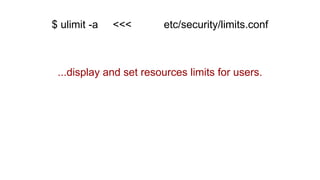
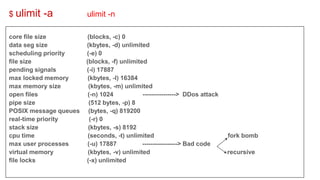
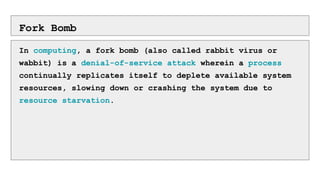
The document discusses the ulimit command, which is used to set resource limits for users on Linux systems. It lists the different options for ulimit like -n to set the maximum number of open files, -u for the maximum processes per user, and -t for the maximum CPU time. It then explains that exceeding these limits through things like a fork bomb, which is a denial of service attack where a process continuously replicates itself, can slow down or crash a system through resource starvation. Examples of fork bombs in different programming languages like Bash, Python, and Brainfuck are also provided.


![Syntax
ulimit [-abcdefHilmnpqrsStTuvx] [limit]
Key
-S Set a soft limit for the given resource.
-H Set a hard limit for the given resource.
-a All current limits are reported.
-l The maximum size that can be locked into memory.
-m The maximum resident set size.
-n The maximum number of open file descriptors.
-p The pipe buffer size.
-q The maximum number of bytes in POSIX message queues.
-r The maximum real-time scheduling priority.
-s The maximum stack size.
-t The maximum amount of cpu time in seconds.
-T The maximum number of threads.
-u The maximum number of processes available to a single user.
-v The maximum amount of virtual memory available to the process.
-x The maximum number of file locks.](https://image.slidesharecdn.com/ulimit-200209131727/85/ulimit-4-320.jpg)
![Fork Bomb examples
jAVA
PERL
RUBY
.
.
.
BASH
:(){ :|:& };:
PYTHON
import os
while True:
os.fork()
Brainfuck
+[>+]](https://image.slidesharecdn.com/ulimit-200209131727/85/ulimit-6-320.jpg)


![[2017.03.18] hst binary training part 1](https://cdn.slidesharecdn.com/ss_thumbnails/2017-170324055826-thumbnail.jpg?width=640&height=640&fit=bounds)


![The Practice of Alluxio in Near Real-Time Data Platform at VIPShop [Chinese]](https://cdn.slidesharecdn.com/ss_thumbnails/alluxiofinal-181211205217-thumbnail.jpg?width=640&height=640&fit=bounds)


![[COSCUP 2018] uTensor C++ Code Generator](https://cdn.slidesharecdn.com/ss_thumbnails/coscuputensor-180813100051-thumbnail.jpg?width=640&height=640&fit=bounds)


