DR BHAVIN MANDOWARA
TREATMENT OF MILD TO
MODERATE ULCERATIVE
COLITIS
OUTLINE OF PRESENTATION
Ø PRETREATMENT EVALUATION
Ø TREATMENT OF MILDLY OR MODERATELY ACTIVE DISEASE
Ø MANAGEMENT OF PERSISTENT SYMPTOMS
Ø SYMPTOMATIC TREATMENT
Ø OTHER MANAGEMENT ISSUES
Ø SUMMARY
PRETREATMENT EVALUATION

q Definition of disease extent :
• Ulcerative proctitis
• Ulcerative proctosigmoiditis 
• Left-sided or distal ulcerative colitis
• Extensive colitis
• Pancolitis

 Mild
 Four or fewer stools per day
 With or without blood
 No signs of systemic toxicity, and a normal erythrocyte sedimentation
rate (ESR).
 Mild crampy pain, tenesmus, and periods of constipation
are also common, but severe abdominal pain, profuse
bleeding, fever, and weight loss are not part of the
spectrum of mild disease.
Assessment of clinical severity
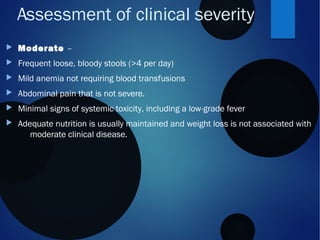
 Moderate –
 Frequent loose, bloody stools (>4 per day)
 Mild anemia not requiring blood transfusions
 Abdominal pain that is not severe.
 Minimal signs of systemic toxicity, including a low-grade fever
 Adequate nutrition is usually maintained and weight loss is not associated with
moderate clinical disease.
Assessment of clinical severity
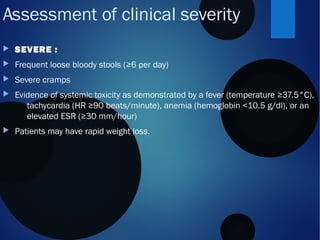
 SEVERE :
 Frequent loose bloody stools (≥6 per day)
 Severe cramps
 Evidence of systemic toxicity as demonstrated by a fever (temperature ≥37.5°C),
tachycardia (HR ≥90 beats/minute), anemia (hemoglobin <10.5 g/dl), or an
elevated ESR (≥30 mm/hour)
 Patients may have rapid weight loss. 
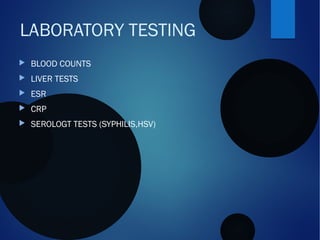
LABORATORY TESTING
 BLOOD COUNTS
 LIVER TESTS
 ESR
 CRP
 SEROLOGT TESTS (SYPHILIS,HSV)
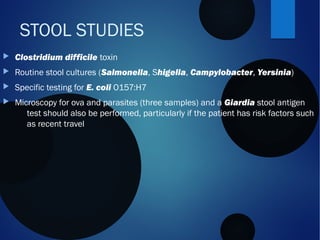
STOOL STUDIES
 Clostridium difficile toxin
 Routine stool cultures (Salmonella, Shigella, Campylobacter, Yersinia)
 Specific testing for E. coli O157:H7
 Microscopy for ova and parasites (three samples) and a Giardia stool antigen
test should also be performed, particularly if the patient has risk factors such
as recent travel
COLONOSCOPY

For Presence, severity, and extent of
inflammation and to exclude the presence
of an infection such as CMV with histology
and culture of the tissue obtained on biopsy.

 Cultures for Neisseria gonorrhea and HSV should be
performed in patients with severe rectal symptoms.
Ileocolonoscopy with biopsies in the ileum and the colon is
also important in differentiating between ulcerative colitis
and Crohn disease
 Ulcerative proctitis or proctosigmoiditis
 - Initial approach
 - Subsequent and alternative approaches
 - Maintenance therapy
 Left-sided colitis, extensive colitis, and
pancolitis
 - Initial approach
 - Subsequent approach
 - Maintenance therapy
TREATMENT OF MILDLY OR
MODERATELY ACTIVE
DISEASE
 INITIAL APPROACH:
 Topical 5-ASA -1st line for willing patients
 WHY TOPICAL?WHY TOPICAL?
 5-ASA 90% remission
 Mesalamine 93% remission
 Maintain remission in 75% of individuals
 QUICKER RESPOSNE TIME AND LESS FREQUENT DOSING AS
COMPARED TO ORAL.
TREATMENT OF ULCERATIVE
PROCTITIS OR
PROCTOSIGMOIDITIS
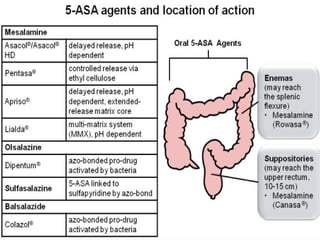
 SUPPOSITORIES 5-8 cm of distal rectum
 FOAM & GEL PREPARATION  mid sigmoid colon
 ENEMA  upto splenic flexure

 Topical 5-ASA are preferred over topical steroids BECAUSE:
 Better induction of remission and improves endoscopic and histologic severity
 More efficacy and side effect profile is less
 Low cost

TREATMENT OF ULCERATIVE
PROCTITIS OR PROCTOSIGMOIDITIS
●
Mild to moderate disease( upto 5-8cm) – topical mesalamine/5-ASA
once/twice daily
●
Mild to moderate disease ( >8cm ) or proctosigmoiditis 5ASA suppository BD
+5ASA enema BD
●
Foam instead of enema in case of rectal irritability
●
Complete healing occurs in 4-6 weeks
TREATMENT OF ULCERATIVE
PROCTITIS OR PROCTOSIGMOIDITIS
 SUBSEQUENT AND ALTERNATIVE APPROACHES
q
Cannot tolerate topical 5-ASA  steroid foam preparations and steroid
suppositories
q
Unwilling or unable to tolerate any topical medication  oral 5-ASA
medications
q
No respone to topical 5-ASA medications combination topical 5-ASA and
steroid foam preparation
q
No response to topical medications  combination therapy with oral and
topical 5-ASA agents and topical steroids 
TREATMENT OF ULCERATIVE
PROCTITIS OR
PROCTOSIGMOIDITIS
 Oral 5-ASA medications should be started at the lower dose and increased to
the maximum tolerated dose in patients who remain symptomatic
 Patients with moderate symptoms, those with previous steroid use, those
with frequent relapses, and those previously treated with oral
mesalamine, rectal therapy, or multiple medications are more likely to
benefit from a higher dose
TREATMENT OF ULCERATIVE
PROCTITIS OR
PROCTOSIGMOIDITIS
 Oral mesalazine generally acts in two to four weeks. Patients who fail to
respond to combination therapy with oral 5-ASA and topical 5-
ASA/steroids require treatment with oral glucocorticoids, as
discussed under left-sided colitis below
TREATMENT OF ULCERATIVE PROCTITIS
OR PROCTOSIGMOIDITIS
Maintainance :
not recommended in patients with a first
episode of mild ulcerative proctitis that
has promptly responded to treatment
TREATMENT OF ULCERATIVE PROCTITIS
OR PROCTOSIGMOIDITIS
 MAINTAINANCE TREATMENT recommended in:
• Relapse more than once a year
• Proctosigmoiditis
 Discontinuation for the above patients if remission is more than 2 years

TREATMENT OF ULCERATIVE
PROCTITIS OR
PROCTOSIGMOIDITIS
 Maintainance regimen:
 Proctitis: once daily 5-ASA suppository
 Proctosigmoiditis : once daily 5-ASA enema

TREATMENT OF ULCERATIVE
PROCTITIS OR
PROCTOSIGMOIDITIS
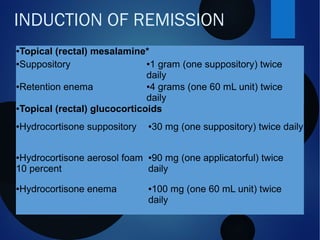
INDUCTION OF REMISSION
●Topical (rectal) mesalamine*
●Suppository ●1 gram (one suppository) twice
daily
●Retention enema ●4 grams (one 60 mL unit) twice
daily
●Topical (rectal) glucocorticoids
●Hydrocortisone suppository ●30 mg (one suppository) twice daily
●Hydrocortisone aerosol foam
10 percent
●90 mg (one applicatorful) twice
daily
●Hydrocortisone enema ●100 mg (one 60 mL unit) twice
daily
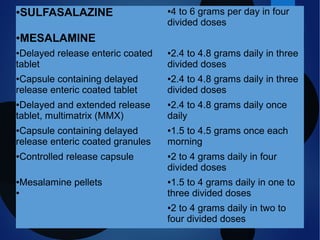
●SULFASALAZINE ●4 to 6 grams per day in four
divided doses
●MESALAMINE
●Delayed release enteric coated
tablet
●2.4 to 4.8 grams daily in three
divided doses
●Capsule containing delayed
release enteric coated tablet
●2.4 to 4.8 grams daily in three
divided doses
●Delayed and extended release
tablet, multimatrix (MMX)
●2.4 to 4.8 grams daily once
daily
●Capsule containing delayed
release enteric coated granules
●1.5 to 4.5 grams once each
morning
●Controlled release capsule ●2 to 4 grams daily in four
divided doses
●Mesalamine pellets
●
●1.5 to 4 grams daily in one to
three divided doses
●2 to 4 grams daily in two to
four divided doses
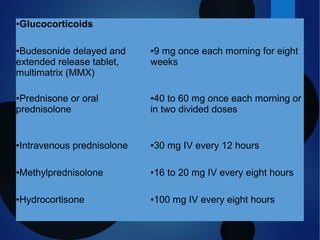
●Glucocorticoids
●Budesonide delayed and
extended release tablet,
multimatrix (MMX)
●9 mg once each morning for eight
weeks
●Prednisone or oral
prednisolone
●40 to 60 mg once each morning or
in two divided doses
●Intravenous prednisolone ●30 mg IV every 12 hours
●Methylprednisolone ●16 to 20 mg IV every eight hours
●Hydrocortisone ●100 mg IV every eight hours
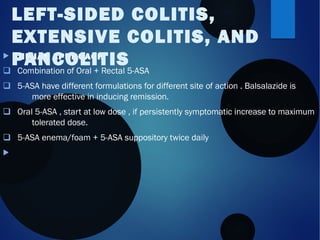
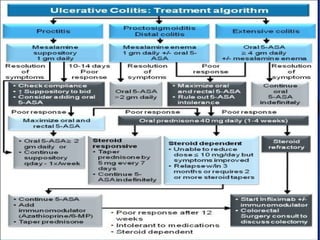
 INITIAL APPROACH
q Combination of Oral + Rectal 5-ASA
q 5-ASA have different formulations for different site of action . Balsalazide is
more effective in inducing remission.
q Oral 5-ASA , start at low dose , if persistently symptomatic increase to maximum
tolerated dose.
q 5-ASA enema/foam + 5-ASA suppository twice daily

LEFT-SIDED COLITIS,
EXTENSIVE COLITIS, AND
PANCOLITIS

q SUBSEQUENT APPROACH
q If no response in 2-4 weeks budesonide-MMX
q Failure to respond to budesonide-MMX or severe symptoms  oral
prednisolone
q Prednisolone more effective than sulfasalazine

LEFT-SIDED COLITIS,
EXTENSIVE COLITIS, AND
PANCOLITIS
 MAINTAINANCE THERAPY:
 ALL PATIENTS REQUIRES
 ORAL 5-ASA  3gm/day
 5-ASA enema/suppository  once/twice daily
 Steriod enema should be avoided for maintenance
 Budesonide-MMX may be given for 8 weeks
LEFT-SIDED COLITIS,
EXTENSIVE COLITIS, AND
PANCOLITIS
 MAINTAINANCE THERAPY:
 Glucocorticoids should be tapered OFF after the patient has been
stable for two to four weeks. Steroids should be tapered over eight
weeks by decreasing the dose by 5 to 10 mg every week until a daily
dose of 20 mg is reached, and then by 2.5 mg every week

 Rapid reduction  early relapse, adrenal insufficiency 

 STERIOD DEPENDENT UC(10MG>3 MONTHS)
LEFT-SIDED COLITIS,
EXTENSIVE COLITIS, AND
PANCOLITIS
 Patients who fail to response are
• Alternate or concomitant diagnosis (IBD+IBS)
• Non compliance
• Persistent symptoms inspite of optimal therapy
 STERIOD REFRACTORY ULCERATIVE COLITIS(no clinical
respsonse to oral >30day or iv >10 days)

MANAGEMENT OF PERSISTENT
SYMPTOMS
 Mild intermittent diarrhea without signs of systemic toxicity 
Loperamide
 Abdominal cramping without signs of systemic toxicity dicyclomine,
hyoscyamine

 Avoid Opiods masks signs and symptoms
 Avoid NSAIDS  exacerbated IBD
SYMPTOMATIC TREATMENT
 Routine health maintenance
 Screening and prevention of other diseases
 Monitoring for side effects of therapy

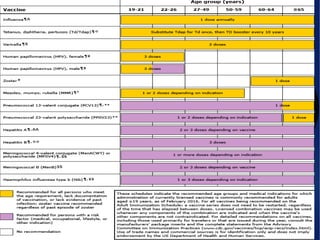
 IMMUNIZATION
OTHER MANAGEMENT ISSUES
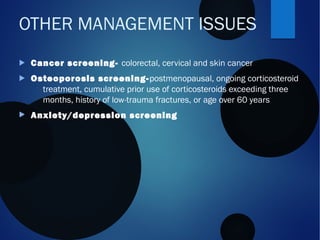
 Cancer screening- colorectal, cervical and skin cancer
 Osteoporosis screening-postmenopausal, ongoing corticosteroid
treatment, cumulative prior use of corticosteroids exceeding three
months, history of low-trauma fractures, or age over 60 years
 Anxiety/depression screening
OTHER MANAGEMENT ISSUES
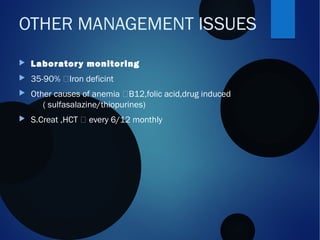
 Laboratory monitoring
 35-90% Iron deficint
 Other causes of anemia B12,folic acid,drug induced
( sulfasalazine/thiopurines)
 S.Creat ,HCT  every 6/12 monthly
OTHER MANAGEMENT ISSUES
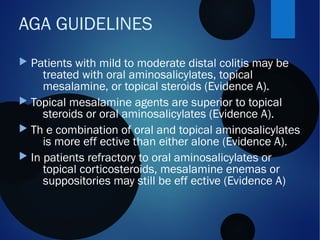
 Patients with mild to moderate distal colitis may be
treated with oral aminosalicylates, topical
mesalamine, or topical steroids (Evidence A).
 Topical mesalamine agents are superior to topical
steroids or oral aminosalicylates (Evidence A).
 Th e combination of oral and topical aminosalicylates
is more eff ective than either alone (Evidence A).
 In patients refractory to oral aminosalicylates or
topical corticosteroids, mesalamine enemas or
suppositories may still be eff ective (Evidence A)
AGA GUIDELINES
 Th e unusual patient who is refractory to all of the above agents in
maximal doses, or who is systemically ill, may require treatment with
oral prednisone in doses up to 40 – 60 mg per day, or infl iximab
with an induction regimen of 5 mg / kg at weeks 0, 2, and 6,
although the latter two agents have not been studied specifi cally in
patients with distal disease (Evidence C).
AGA GUIDELINES
 Mesalamine suppositories are eff ective in the maintenance of
remission in patients with proctitis, whereas mesalamine enemas
are eff ective in patients with distal colitis when dosed even as
infrequently as every third night (Evidence A). Sulfasalazine,
mesalamine compounds, and balsalazide are also eff ective in
maintaining remission; the combination of oral and topical
mesalamine is more eff ective than either one alone (Evidence A)
AGA GUIDELINES
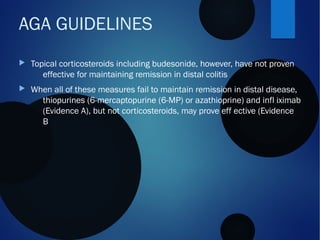
 Topical corticosteroids including budesonide, however, have not proven
effective for maintaining remission in distal colitis
 When all of these measures fail to maintain remission in distal disease,
thiopurines (6-mercaptopurine (6-MP) or azathioprine) and infl iximab
(Evidence A), but not corticosteroids, may prove eff ective (Evidence
B
AGA GUIDELINES
 Patients with mild to moderate extensive colitis should
begin therapy with oral sulfasalazine in daily doses
titrated up to 4 – 6 g per day, or an alternate
aminosalicylate in doses up to 4.8 g per day of the
active 5-aminosalicylate acid (5-ASA) moiety (Evidence
A). Oral steroids are generally reserved for patients who
are refractory to oral aminosalicylates in combination
with topical therapy, or for patients whose symptoms are
so troubling as to demand rapid improvement (Evidence
B). 6-MP and azathioprine are eff ective for patients who
do not respond to oral steroids, and continue to have
moderate disease, and are not so acutely ill as to require
intravenous therapy (Evidence A).
AGA GUIDELINES
 Infl iximab is an eff ective treatment for patients who are steroid
refractory or steroid dependent despite adequate doses of a
thiopurine, or who are intolerant of these medications. Th e infl
iximab induction dose is 5 mg / kg intravenously at weeks 0, 2, and
6 weeks (Evidence A). Infl iximab is contraindicated in patients with
active infection, untreated latent TB, preexisting demyelinating
disorder or optic neuritis, moderate to severe congestive heart
failure, or current or recent malignancies.

AGA GUIDELINES
 Once the acute attack is controlled, a maintenance regimen is usually
required, especially in patients with extensive or relapsing disease.
Sulfasalazine, olsalazine, mesalamine, and balsalazide are all eff
ective in reducing relapses (Evidence A). Patients should not be
treated chronically with steroids.
AGA GUIDELINES
 Azathioprine or 6-MP may be useful as steroid-sparing agents for
steroid-dependent patients and for maintenance of remission not
adequately sustained by aminosalicylates, and occasionally for
patients who are steroid dependent but not acutely ill (Evidence A).
Infl iximab is eff ective in maintaining improvement and remission in
the patients responding to the infl iximab induction regimen
(Evidence A).

AGA GUIDELINES

THANK YOU

ULCERATIVE COLITIS ( MILD TO MODERATE) MANAGEMENT

  • 1.
    DR BHAVIN MANDOWARA TREATMENTOF MILD TO MODERATE ULCERATIVE COLITIS
  • 2.
    OUTLINE OF PRESENTATION ØPRETREATMENT EVALUATION Ø TREATMENT OF MILDLY OR MODERATELY ACTIVE DISEASE Ø MANAGEMENT OF PERSISTENT SYMPTOMS Ø SYMPTOMATIC TREATMENT Ø OTHER MANAGEMENT ISSUES Ø SUMMARY
  • 3.
    PRETREATMENT EVALUATION  q Definitionof disease extent : • Ulcerative proctitis • Ulcerative proctosigmoiditis  • Left-sided or distal ulcerative colitis • Extensive colitis • Pancolitis 
  • 4.
     Mild  Fouror fewer stools per day  With or without blood  No signs of systemic toxicity, and a normal erythrocyte sedimentation rate (ESR).  Mild crampy pain, tenesmus, and periods of constipation are also common, but severe abdominal pain, profuse bleeding, fever, and weight loss are not part of the spectrum of mild disease. Assessment of clinical severity
  • 5.
     Moderate – Frequent loose, bloody stools (>4 per day)  Mild anemia not requiring blood transfusions  Abdominal pain that is not severe.  Minimal signs of systemic toxicity, including a low-grade fever  Adequate nutrition is usually maintained and weight loss is not associated with moderate clinical disease. Assessment of clinical severity
  • 6.
    Assessment of clinicalseverity  SEVERE :  Frequent loose bloody stools (≥6 per day)  Severe cramps  Evidence of systemic toxicity as demonstrated by a fever (temperature ≥37.5°C), tachycardia (HR ≥90 beats/minute), anemia (hemoglobin <10.5 g/dl), or an elevated ESR (≥30 mm/hour)  Patients may have rapid weight loss. 
  • 7.
    LABORATORY TESTING  BLOODCOUNTS  LIVER TESTS  ESR  CRP  SEROLOGT TESTS (SYPHILIS,HSV)
  • 8.
    STOOL STUDIES  Clostridiumdifficile toxin  Routine stool cultures (Salmonella, Shigella, Campylobacter, Yersinia)  Specific testing for E. coli O157:H7  Microscopy for ova and parasites (three samples) and a Giardia stool antigen test should also be performed, particularly if the patient has risk factors such as recent travel
  • 9.
    COLONOSCOPY  For Presence, severity,and extent of inflammation and to exclude the presence of an infection such as CMV with histology and culture of the tissue obtained on biopsy.   Cultures for Neisseria gonorrhea and HSV should be performed in patients with severe rectal symptoms. Ileocolonoscopy with biopsies in the ileum and the colon is also important in differentiating between ulcerative colitis and Crohn disease
  • 11.
     Ulcerative proctitisor proctosigmoiditis  - Initial approach  - Subsequent and alternative approaches  - Maintenance therapy  Left-sided colitis, extensive colitis, and pancolitis  - Initial approach  - Subsequent approach  - Maintenance therapy TREATMENT OF MILDLY OR MODERATELY ACTIVE DISEASE
  • 12.
     INITIAL APPROACH: Topical 5-ASA -1st line for willing patients  WHY TOPICAL?WHY TOPICAL?  5-ASA 90% remission  Mesalamine 93% remission  Maintain remission in 75% of individuals  QUICKER RESPOSNE TIME AND LESS FREQUENT DOSING AS COMPARED TO ORAL. TREATMENT OF ULCERATIVE PROCTITIS OR PROCTOSIGMOIDITIS
  • 13.
     SUPPOSITORIES 5-8cm of distal rectum  FOAM & GEL PREPARATION  mid sigmoid colon  ENEMA  upto splenic flexure   Topical 5-ASA are preferred over topical steroids BECAUSE:  Better induction of remission and improves endoscopic and histologic severity  More efficacy and side effect profile is less  Low cost  TREATMENT OF ULCERATIVE PROCTITIS OR PROCTOSIGMOIDITIS
  • 14.
    ● Mild to moderatedisease( upto 5-8cm) – topical mesalamine/5-ASA once/twice daily ● Mild to moderate disease ( >8cm ) or proctosigmoiditis 5ASA suppository BD +5ASA enema BD ● Foam instead of enema in case of rectal irritability ● Complete healing occurs in 4-6 weeks TREATMENT OF ULCERATIVE PROCTITIS OR PROCTOSIGMOIDITIS
  • 15.
     SUBSEQUENT ANDALTERNATIVE APPROACHES q Cannot tolerate topical 5-ASA  steroid foam preparations and steroid suppositories q Unwilling or unable to tolerate any topical medication  oral 5-ASA medications q No respone to topical 5-ASA medications combination topical 5-ASA and steroid foam preparation q No response to topical medications  combination therapy with oral and topical 5-ASA agents and topical steroids  TREATMENT OF ULCERATIVE PROCTITIS OR PROCTOSIGMOIDITIS
  • 16.
     Oral 5-ASAmedications should be started at the lower dose and increased to the maximum tolerated dose in patients who remain symptomatic  Patients with moderate symptoms, those with previous steroid use, those with frequent relapses, and those previously treated with oral mesalamine, rectal therapy, or multiple medications are more likely to benefit from a higher dose TREATMENT OF ULCERATIVE PROCTITIS OR PROCTOSIGMOIDITIS
  • 17.
     Oral mesalazinegenerally acts in two to four weeks. Patients who fail to respond to combination therapy with oral 5-ASA and topical 5- ASA/steroids require treatment with oral glucocorticoids, as discussed under left-sided colitis below TREATMENT OF ULCERATIVE PROCTITIS OR PROCTOSIGMOIDITIS
  • 18.
    Maintainance : not recommendedin patients with a first episode of mild ulcerative proctitis that has promptly responded to treatment TREATMENT OF ULCERATIVE PROCTITIS OR PROCTOSIGMOIDITIS
  • 19.
     MAINTAINANCE TREATMENTrecommended in: • Relapse more than once a year • Proctosigmoiditis  Discontinuation for the above patients if remission is more than 2 years  TREATMENT OF ULCERATIVE PROCTITIS OR PROCTOSIGMOIDITIS
  • 20.
     Maintainance regimen: Proctitis: once daily 5-ASA suppository  Proctosigmoiditis : once daily 5-ASA enema  TREATMENT OF ULCERATIVE PROCTITIS OR PROCTOSIGMOIDITIS
  • 21.
    INDUCTION OF REMISSION ●Topical(rectal) mesalamine* ●Suppository ●1 gram (one suppository) twice daily ●Retention enema ●4 grams (one 60 mL unit) twice daily ●Topical (rectal) glucocorticoids ●Hydrocortisone suppository ●30 mg (one suppository) twice daily ●Hydrocortisone aerosol foam 10 percent ●90 mg (one applicatorful) twice daily ●Hydrocortisone enema ●100 mg (one 60 mL unit) twice daily
  • 22.
    ●SULFASALAZINE ●4 to6 grams per day in four divided doses ●MESALAMINE ●Delayed release enteric coated tablet ●2.4 to 4.8 grams daily in three divided doses ●Capsule containing delayed release enteric coated tablet ●2.4 to 4.8 grams daily in three divided doses ●Delayed and extended release tablet, multimatrix (MMX) ●2.4 to 4.8 grams daily once daily ●Capsule containing delayed release enteric coated granules ●1.5 to 4.5 grams once each morning ●Controlled release capsule ●2 to 4 grams daily in four divided doses ●Mesalamine pellets ● ●1.5 to 4 grams daily in one to three divided doses ●2 to 4 grams daily in two to four divided doses
  • 23.
    ●Glucocorticoids ●Budesonide delayed and extendedrelease tablet, multimatrix (MMX) ●9 mg once each morning for eight weeks ●Prednisone or oral prednisolone ●40 to 60 mg once each morning or in two divided doses ●Intravenous prednisolone ●30 mg IV every 12 hours ●Methylprednisolone ●16 to 20 mg IV every eight hours ●Hydrocortisone ●100 mg IV every eight hours
  • 24.
     INITIAL APPROACH qCombination of Oral + Rectal 5-ASA q 5-ASA have different formulations for different site of action . Balsalazide is more effective in inducing remission. q Oral 5-ASA , start at low dose , if persistently symptomatic increase to maximum tolerated dose. q 5-ASA enema/foam + 5-ASA suppository twice daily  LEFT-SIDED COLITIS, EXTENSIVE COLITIS, AND PANCOLITIS
  • 25.
     q SUBSEQUENT APPROACH qIf no response in 2-4 weeks budesonide-MMX q Failure to respond to budesonide-MMX or severe symptoms  oral prednisolone q Prednisolone more effective than sulfasalazine  LEFT-SIDED COLITIS, EXTENSIVE COLITIS, AND PANCOLITIS
  • 26.
     MAINTAINANCE THERAPY: ALL PATIENTS REQUIRES  ORAL 5-ASA  3gm/day  5-ASA enema/suppository  once/twice daily  Steriod enema should be avoided for maintenance  Budesonide-MMX may be given for 8 weeks LEFT-SIDED COLITIS, EXTENSIVE COLITIS, AND PANCOLITIS
  • 27.
     MAINTAINANCE THERAPY: Glucocorticoids should be tapered OFF after the patient has been stable for two to four weeks. Steroids should be tapered over eight weeks by decreasing the dose by 5 to 10 mg every week until a daily dose of 20 mg is reached, and then by 2.5 mg every week   Rapid reduction  early relapse, adrenal insufficiency    STERIOD DEPENDENT UC(10MG>3 MONTHS) LEFT-SIDED COLITIS, EXTENSIVE COLITIS, AND PANCOLITIS
  • 29.
     Patients whofail to response are • Alternate or concomitant diagnosis (IBD+IBS) • Non compliance • Persistent symptoms inspite of optimal therapy  STERIOD REFRACTORY ULCERATIVE COLITIS(no clinical respsonse to oral >30day or iv >10 days)  MANAGEMENT OF PERSISTENT SYMPTOMS
  • 30.
     Mild intermittentdiarrhea without signs of systemic toxicity  Loperamide  Abdominal cramping without signs of systemic toxicity dicyclomine, hyoscyamine   Avoid Opiods masks signs and symptoms  Avoid NSAIDS  exacerbated IBD SYMPTOMATIC TREATMENT
  • 33.
     Routine healthmaintenance  Screening and prevention of other diseases  Monitoring for side effects of therapy   IMMUNIZATION OTHER MANAGEMENT ISSUES
  • 34.
  • 35.
     Cancer screening-colorectal, cervical and skin cancer  Osteoporosis screening-postmenopausal, ongoing corticosteroid treatment, cumulative prior use of corticosteroids exceeding three months, history of low-trauma fractures, or age over 60 years  Anxiety/depression screening OTHER MANAGEMENT ISSUES
  • 36.
     Laboratory monitoring 35-90% Iron deficint  Other causes of anemia B12,folic acid,drug induced ( sulfasalazine/thiopurines)  S.Creat ,HCT  every 6/12 monthly OTHER MANAGEMENT ISSUES
  • 37.
     Patients withmild to moderate distal colitis may be treated with oral aminosalicylates, topical mesalamine, or topical steroids (Evidence A).  Topical mesalamine agents are superior to topical steroids or oral aminosalicylates (Evidence A).  Th e combination of oral and topical aminosalicylates is more eff ective than either alone (Evidence A).  In patients refractory to oral aminosalicylates or topical corticosteroids, mesalamine enemas or suppositories may still be eff ective (Evidence A) AGA GUIDELINES
  • 38.
     Th eunusual patient who is refractory to all of the above agents in maximal doses, or who is systemically ill, may require treatment with oral prednisone in doses up to 40 – 60 mg per day, or infl iximab with an induction regimen of 5 mg / kg at weeks 0, 2, and 6, although the latter two agents have not been studied specifi cally in patients with distal disease (Evidence C). AGA GUIDELINES
  • 39.
     Mesalamine suppositoriesare eff ective in the maintenance of remission in patients with proctitis, whereas mesalamine enemas are eff ective in patients with distal colitis when dosed even as infrequently as every third night (Evidence A). Sulfasalazine, mesalamine compounds, and balsalazide are also eff ective in maintaining remission; the combination of oral and topical mesalamine is more eff ective than either one alone (Evidence A) AGA GUIDELINES
  • 40.
     Topical corticosteroidsincluding budesonide, however, have not proven effective for maintaining remission in distal colitis  When all of these measures fail to maintain remission in distal disease, thiopurines (6-mercaptopurine (6-MP) or azathioprine) and infl iximab (Evidence A), but not corticosteroids, may prove eff ective (Evidence B AGA GUIDELINES
  • 41.
     Patients withmild to moderate extensive colitis should begin therapy with oral sulfasalazine in daily doses titrated up to 4 – 6 g per day, or an alternate aminosalicylate in doses up to 4.8 g per day of the active 5-aminosalicylate acid (5-ASA) moiety (Evidence A). Oral steroids are generally reserved for patients who are refractory to oral aminosalicylates in combination with topical therapy, or for patients whose symptoms are so troubling as to demand rapid improvement (Evidence B). 6-MP and azathioprine are eff ective for patients who do not respond to oral steroids, and continue to have moderate disease, and are not so acutely ill as to require intravenous therapy (Evidence A). AGA GUIDELINES
  • 42.
     Infl iximabis an eff ective treatment for patients who are steroid refractory or steroid dependent despite adequate doses of a thiopurine, or who are intolerant of these medications. Th e infl iximab induction dose is 5 mg / kg intravenously at weeks 0, 2, and 6 weeks (Evidence A). Infl iximab is contraindicated in patients with active infection, untreated latent TB, preexisting demyelinating disorder or optic neuritis, moderate to severe congestive heart failure, or current or recent malignancies.  AGA GUIDELINES
  • 43.
     Once theacute attack is controlled, a maintenance regimen is usually required, especially in patients with extensive or relapsing disease. Sulfasalazine, olsalazine, mesalamine, and balsalazide are all eff ective in reducing relapses (Evidence A). Patients should not be treated chronically with steroids. AGA GUIDELINES
  • 44.
     Azathioprine or6-MP may be useful as steroid-sparing agents for steroid-dependent patients and for maintenance of remission not adequately sustained by aminosalicylates, and occasionally for patients who are steroid dependent but not acutely ill (Evidence A). Infl iximab is eff ective in maintaining improvement and remission in the patients responding to the infl iximab induction regimen (Evidence A).  AGA GUIDELINES
  • 45.