Designing for Understandability:
the Raft Consensus Algorithm
Diego Ongaro
John Ousterhout
Stanford University
August 29, 2016 The Raft Consensus Algorithm Slide 2
Algorithms Should Be Designed For ...
Correctness?
Efficiency?
Conciseness?
Understandability!
August 29, 2016 The Raft Consensus Algorithm Slide 3
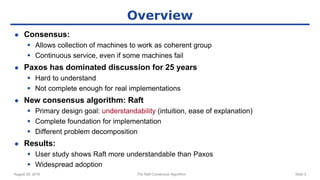
Overview
● Consensus:
 Allows collection of machines to work as coherent group
 Continuous service, even if some machines fail
● Paxos has dominated discussion for 25 years
 Hard to understand
 Not complete enough for real implementations
● New consensus algorithm: Raft
 Primary design goal: understandability (intuition, ease of explanation)
 Complete foundation for implementation
 Different problem decomposition
● Results:
 User study shows Raft more understandable than Paxos
 Widespread adoption
August 29, 2016 The Raft Consensus Algorithm Slide 4
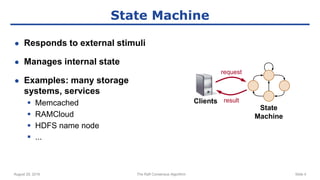
State Machine
● Responds to external stimuli
● Manages internal state
● Examples: many storage
systems, services
 Memcached
 RAMCloud
 HDFS name node
 ...
request
result
Clients
State
Machine
Log
Consensus
Module
State
Machine
x←1 y←3 x←4
August 29, 2016 The Raft Consensus Algorithm Slide 5
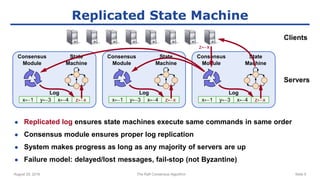
Replicated State Machine
● Replicated log ensures state machines execute same commands in same order
● Consensus module ensures proper log replication
● System makes progress as long as any majority of servers are up
● Failure model: delayed/lost messages, fail-stop (not Byzantine)
Clients
Servers
Log
Consensus
Module
State
Machine
x←1 y←3 x←4
Log
Consensus
Module
State
Machine
x←1 y←3 x←4
z←x
z←x z←x z←x
August 29, 2016 The Raft Consensus Algorithm Slide 6
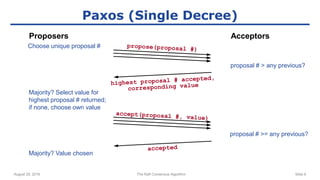
Paxos (Single Decree)
Proposers Acceptors
proposal # > any previous?
Majority? Select value for
highest proposal # returned;
if none, choose own value
proposal # >= any previous?
Majority? Value chosen
Choose unique proposal #
August 29, 2016 The Raft Consensus Algorithm Slide 7
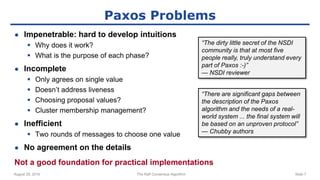
Paxos Problems
● Impenetrable: hard to develop intuitions
 Why does it work?
 What is the purpose of each phase?
● Incomplete
 Only agrees on single value
 Doesn’t address liveness
 Choosing proposal values?
 Cluster membership management?
● Inefficient
 Two rounds of messages to choose one value
● No agreement on the details
Not a good foundation for practical implementations
“The dirty little secret of the NSDI
community is that at most five
people really, truly understand every
part of Paxos :-)”
— NSDI reviewer
“There are significant gaps between
the description of the Paxos
algorithm and the needs of a real-
world system ... the final system will
be based on an unproven protocol”
— Chubby authors
August 29, 2016 The Raft Consensus Algorithm Slide 8
Raft Challenge
● Is there a different consensus algorithm that’s easier to
understand?
● Make design decisions based on understandability:
 Which approach is easier to explain?
● Techniques:
 Problem decomposition
 Minimize state space
● Handle multiple problems with a single mechanism
● Eliminate special cases
● Maximize coherence
● Minimize nondeterminism
August 29, 2016 The Raft Consensus Algorithm Slide 9
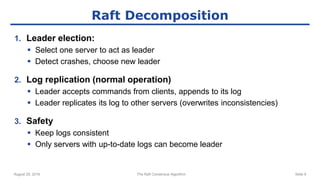
Raft Decomposition
1. Leader election:
 Select one server to act as leader
 Detect crashes, choose new leader
2. Log replication (normal operation)
 Leader accepts commands from clients, appends to its log
 Leader replicates its log to other servers (overwrites inconsistencies)
3. Safety
 Keep logs consistent
 Only servers with up-to-date logs can become leader
August 29, 2016 The Raft Consensus Algorithm Slide 10
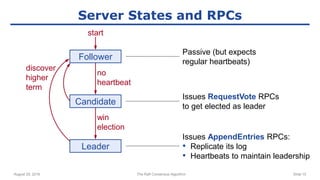
Server States and RPCs
Candidate
Follower
Leader
start
no
heartbeat
win
election
discover
higher
term
Passive (but expects
regular heartbeats)
Issues RequestVote RPCs
to get elected as leader
Issues AppendEntries RPCs:
• Replicate its log
• Heartbeats to maintain leadership
August 29, 2016 The Raft Consensus Algorithm Slide 11
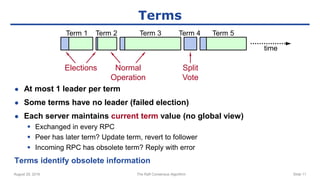
Terms
● At most 1 leader per term
● Some terms have no leader (failed election)
● Each server maintains current term value (no global view)
 Exchanged in every RPC
 Peer has later term? Update term, revert to follower
 Incoming RPC has obsolete term? Reply with error
Terms identify obsolete information
Term 1 Term 3 Term 4 Term 5
Term 2
time
Elections Normal
Operation
Split
Vote
August 29, 2016 The Raft Consensus Algorithm Slide 12
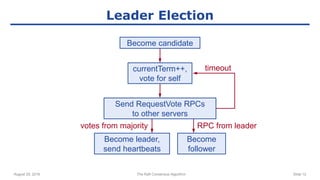
Leader Election
Become candidate
currentTerm++,
vote for self
Send RequestVote RPCs
to other servers
timeout
votes from majority
Become leader,
send heartbeats
Become
follower
RPC from leader
August 29, 2016 The Raft Consensus Algorithm Slide 13
Election Correctness
● Safety: allow at most one winner per term
 Each server gives only one vote per term (persist on disk)
 Majority required to win election
● Liveness: some candidate must eventually win
 Choose election timeouts randomly in [T, 2T] (e.g. 150-300 ms)
 One server usually times out and wins election before others time out
 Works well if T >> broadcast time
● Randomized approach simpler than ranking
Voted for
candidate A
B can’t also
get majority
Servers
August 29, 2016 The Raft Consensus Algorithm Slide 14
Normal Operation
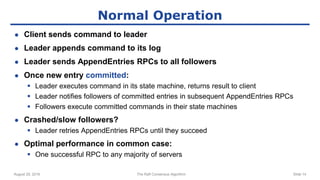
● Client sends command to leader
● Leader appends command to its log
● Leader sends AppendEntries RPCs to all followers
● Once new entry committed:
 Leader executes command in its state machine, returns result to client
 Leader notifies followers of committed entries in subsequent AppendEntries RPCs
 Followers execute committed commands in their state machines
● Crashed/slow followers?
 Leader retries AppendEntries RPCs until they succeed
● Optimal performance in common case:
 One successful RPC to any majority of servers
August 29, 2016 The Raft Consensus Algorithm Slide 15
Log Structure
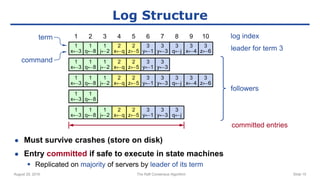
● Must survive crashes (store on disk)
● Entry committed if safe to execute in state machines
 Replicated on majority of servers by leader of its term
1
x←3 leader for term 3
log index
term
command
1
q←8
1
j←2
2
x←q
3
y←1
3
y←3
3
q←j
3
x←4
3
z←6
2
z←5
1 2 3 4 5 6 7 8 9 10
followers
committed entries
1
x←3
1
q←8
1
j←2
2
x←q
3
y←1
3
y←3
2
z←5
1
x←3
1
q←8
1
j←2
2
x←q
3
y←1
3
y←3
3
q←j
3
x←4
3
z←6
2
z←5
1
x←3
1
q←8
1
x←3
1
q←8
1
j←2
2
x←q
3
y←1
3
y←3
3
q←j
2
z←5
August 29, 2016 The Raft Consensus Algorithm Slide 16
Log Inconsistencies
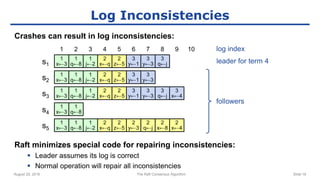
Crashes can result in log inconsistencies:
Raft minimizes special code for repairing inconsistencies:
 Leader assumes its log is correct
 Normal operation will repair all inconsistencies
1
x←3 leader for term 4
log index
1
q←8
1
j←2
2
x←q
3
y←1
3
y←3
3
q←j
2
z←5
1 2 3 4 5 6 7 8 9 10
followers
1
x←3
1
q←8
1
j←2
2
x←q
3
y←1
3
y←3
2
z←5
1
x←3
1
q←8
1
j←2
2
x←q
3
y←1
3
y←3
3
q←j
3
x←4
2
z←5
1
x←3
1
q←8
1
x←3
1
q←8
1
j←2
2
x←q
2
z←5
2
y←3
2
q←j
2
x←8
2
x←4
s1
s2
s3
s4
s5
August 29, 2016 The Raft Consensus Algorithm Slide 17
Log Matching Property
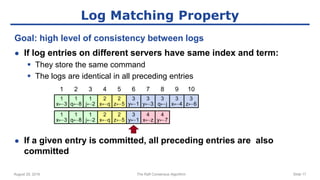
Goal: high level of consistency between logs
● If log entries on different servers have same index and term:
 They store the same command
 The logs are identical in all preceding entries
● If a given entry is committed, all preceding entries are also
committed
1
x←3
1
q←8
1
j←2
2
x←q
3
y←1
3
y←3
3
q←j
3
x←4
3
z←6
2
z←5
1 2 3 4 5 6 7 8 9 10
1
x←3
1
q←8
1
j←2
2
x←q
3
y←1
4
x←z
2
z←5
4
y←7
August 29, 2016 The Raft Consensus Algorithm Slide 18
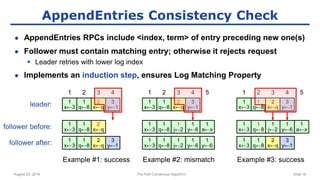
AppendEntries Consistency Check
● AppendEntries RPCs include <index, term> of entry preceding new one(s)
● Follower must contain matching entry; otherwise it rejects request
 Leader retries with lower log index
● Implements an induction step, ensures Log Matching Property
1
x←3
1
q←8
2
x←q
3
y←1
1 2 3 4
1
x←3
1
q←8
2
x←q
leader:
follower before:
follower after: 1
x←3
1
q←8
2
x←q
3
y←1
Example #1: success
1
x←3
1
q←8
2
x←q
3
y←1
1 2 3 4 5
1
x←3
1
q←8
1
j←2
1
x←3
1
q←8
2
x←q
3
y←1
1
y←6
1
a←x
Example #3: success
1
x←3
1
q←8
2
x←q
3
y←1
1 2 3 4 5
1
x←3
1
q←8
1
j←2
1
x←3
1
q←8
1
j←2
1
y←6
1
y←6
1
a←x
1
y←6
Example #2: mismatch
August 29, 2016 The Raft Consensus Algorithm Slide 19
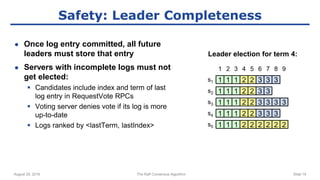
Safety: Leader Completeness
● Once log entry committed, all future
leaders must store that entry
● Servers with incomplete logs must not
get elected:
 Candidates include index and term of last
log entry in RequestVote RPCs
 Voting server denies vote if its log is more
up-to-date
 Logs ranked by <lastTerm, lastIndex>
1 2 3 4 5 6 7 8 9
1 1 1 2 2 3 3 3
s1
1 1 1 2 2 3 3
s2
1 1 1 2 2 3 3 3 3
s3
1 1 1 2 2 3 3 3
s4
1 1 1 2 2
s5 2 2 2 2
Leader election for term 4:
August 29, 2016 The Raft Consensus Algorithm Slide 20
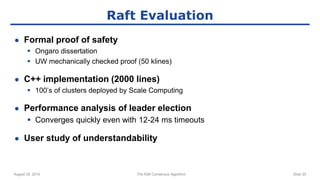
Raft Evaluation
● Formal proof of safety
 Ongaro dissertation
 UW mechanically checked proof (50 klines)
● C++ implementation (2000 lines)
 100’s of clusters deployed by Scale Computing
● Performance analysis of leader election
 Converges quickly even with 12-24 ms timeouts
● User study of understandability
August 29, 2016 The Raft Consensus Algorithm Slide 21
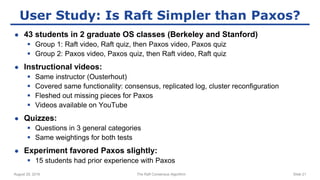
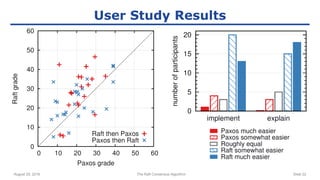
User Study: Is Raft Simpler than Paxos?
● 43 students in 2 graduate OS classes (Berkeley and Stanford)
 Group 1: Raft video, Raft quiz, then Paxos video, Paxos quiz
 Group 2: Paxos video, Paxos quiz, then Raft video, Raft quiz
● Instructional videos:
 Same instructor (Ousterhout)
 Covered same functionality: consensus, replicated log, cluster reconfiguration
 Fleshed out missing pieces for Paxos
 Videos available on YouTube
● Quizzes:
 Questions in 3 general categories
 Same weightings for both tests
● Experiment favored Paxos slightly:
 15 students had prior experience with Paxos
August 29, 2016 The Raft Consensus Algorithm Slide 22
User Study Results
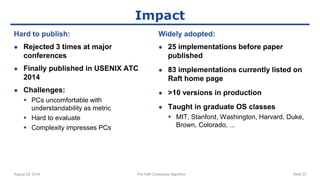
Impact
Hard to publish:
● Rejected 3 times at major
conferences
● Finally published in USENIX ATC
2014
● Challenges:
 PCs uncomfortable with
understandability as metric
 Hard to evaluate
 Complexity impresses PCs
Widely adopted:
● 25 implementations before paper
published
● 83 implementations currently listed on
Raft home page
● >10 versions in production
● Taught in graduate OS classes
 MIT, Stanford, Washington, Harvard, Duke,
Brown, Colorado, ...
August 29, 2016 The Raft Consensus Algorithm Slide 23
August 29, 2016 The Raft Consensus Algorithm Slide 24
Additional Information
● Other aspects of Raft (see paper or Ongaro dissertation):
 Communication with clients (linearizability)
 Cluster liveness
 Log truncation
● Other consensus algorithms:
 Viewstamped Replication (Oki & Liskov, MIT)
 ZooKeeper (Hunt, Konar, Junqueira, Read, Yahoo!)
August 29, 2016 The Raft Consensus Algorithm Slide 25
Conclusions
● Understandability deserves more emphasis in algorithm design
 Decompose the problem
 Minimize state space
● Making a system simpler can have high impact
● Raft better than Paxos for teaching and implementation:
 Easier to understand
 More complete
The Raft Consensus Algorithm
August 29, 2016 Slide 26
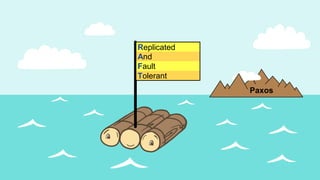
Why “Raft”?
Paxos
Replicated
And
Fault
Tolerant
Extra Slides
August 29, 2016 The Raft Consensus Algorithm Slide 28
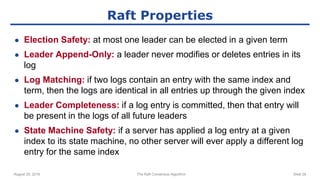
Raft Properties
● Election Safety: at most one leader can be elected in a given term
● Leader Append-Only: a leader never modifies or deletes entries in its
log
● Log Matching: if two logs contain an entry with the same index and
term, then the logs are identical in all entries up through the given index
● Leader Completeness: if a log entry is committed, then that entry will
be present in the logs of all future leaders
● State Machine Safety: if a server has applied a log entry at a given
index to its state machine, no other server will ever apply a different log
entry for the same index
August 29, 2016 The Raft Consensus Algorithm Slide 29
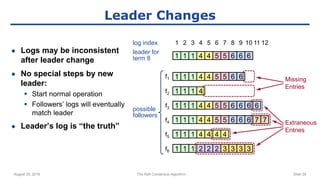
Leader Changes
● Logs may be inconsistent
after leader change
● No special steps by new
leader:
 Start normal operation
 Followers’ logs will eventually
match leader
● Leader’s log is “the truth”
1 2 3 4 5 6 7 8 9 10
1 1 1 4 4 5 5 6 6 6
11 12
1 1 1 4 4 5 5 6 6
1 1 1 4
1 1 1 4 4 5 5 6 6 6
1 1 1 4 4 5 5 6 6 7
1 1 1 4 4
1 1 1 2
6
7
6
4 4
2 2 3 3 3 3
log index
leader for
term 8
possible
followers
f1
f2
f3
f4
f5
f6
Extraneous
Entries
Missing
Entries

uiuc2016.pdf

  • 1.
    Designing for Understandability: theRaft Consensus Algorithm Diego Ongaro John Ousterhout Stanford University
  • 2.
    August 29, 2016The Raft Consensus Algorithm Slide 2 Algorithms Should Be Designed For ... Correctness? Efficiency? Conciseness? Understandability!
  • 3.
    August 29, 2016The Raft Consensus Algorithm Slide 3 Overview ● Consensus:  Allows collection of machines to work as coherent group  Continuous service, even if some machines fail ● Paxos has dominated discussion for 25 years  Hard to understand  Not complete enough for real implementations ● New consensus algorithm: Raft  Primary design goal: understandability (intuition, ease of explanation)  Complete foundation for implementation  Different problem decomposition ● Results:  User study shows Raft more understandable than Paxos  Widespread adoption
  • 4.
    August 29, 2016The Raft Consensus Algorithm Slide 4 State Machine ● Responds to external stimuli ● Manages internal state ● Examples: many storage systems, services  Memcached  RAMCloud  HDFS name node  ... request result Clients State Machine
  • 5.
    Log Consensus Module State Machine x←1 y←3 x←4 August29, 2016 The Raft Consensus Algorithm Slide 5 Replicated State Machine ● Replicated log ensures state machines execute same commands in same order ● Consensus module ensures proper log replication ● System makes progress as long as any majority of servers are up ● Failure model: delayed/lost messages, fail-stop (not Byzantine) Clients Servers Log Consensus Module State Machine x←1 y←3 x←4 Log Consensus Module State Machine x←1 y←3 x←4 z←x z←x z←x z←x
  • 6.
    August 29, 2016The Raft Consensus Algorithm Slide 6 Paxos (Single Decree) Proposers Acceptors proposal # > any previous? Majority? Select value for highest proposal # returned; if none, choose own value proposal # >= any previous? Majority? Value chosen Choose unique proposal #
  • 7.
    August 29, 2016The Raft Consensus Algorithm Slide 7 Paxos Problems ● Impenetrable: hard to develop intuitions  Why does it work?  What is the purpose of each phase? ● Incomplete  Only agrees on single value  Doesn’t address liveness  Choosing proposal values?  Cluster membership management? ● Inefficient  Two rounds of messages to choose one value ● No agreement on the details Not a good foundation for practical implementations “The dirty little secret of the NSDI community is that at most five people really, truly understand every part of Paxos :-)” — NSDI reviewer “There are significant gaps between the description of the Paxos algorithm and the needs of a real- world system ... the final system will be based on an unproven protocol” — Chubby authors
  • 8.
    August 29, 2016The Raft Consensus Algorithm Slide 8 Raft Challenge ● Is there a different consensus algorithm that’s easier to understand? ● Make design decisions based on understandability:  Which approach is easier to explain? ● Techniques:  Problem decomposition  Minimize state space ● Handle multiple problems with a single mechanism ● Eliminate special cases ● Maximize coherence ● Minimize nondeterminism
  • 9.
    August 29, 2016The Raft Consensus Algorithm Slide 9 Raft Decomposition 1. Leader election:  Select one server to act as leader  Detect crashes, choose new leader 2. Log replication (normal operation)  Leader accepts commands from clients, appends to its log  Leader replicates its log to other servers (overwrites inconsistencies) 3. Safety  Keep logs consistent  Only servers with up-to-date logs can become leader
  • 10.
    August 29, 2016The Raft Consensus Algorithm Slide 10 Server States and RPCs Candidate Follower Leader start no heartbeat win election discover higher term Passive (but expects regular heartbeats) Issues RequestVote RPCs to get elected as leader Issues AppendEntries RPCs: • Replicate its log • Heartbeats to maintain leadership
  • 11.
    August 29, 2016The Raft Consensus Algorithm Slide 11 Terms ● At most 1 leader per term ● Some terms have no leader (failed election) ● Each server maintains current term value (no global view)  Exchanged in every RPC  Peer has later term? Update term, revert to follower  Incoming RPC has obsolete term? Reply with error Terms identify obsolete information Term 1 Term 3 Term 4 Term 5 Term 2 time Elections Normal Operation Split Vote
  • 12.
    August 29, 2016The Raft Consensus Algorithm Slide 12 Leader Election Become candidate currentTerm++, vote for self Send RequestVote RPCs to other servers timeout votes from majority Become leader, send heartbeats Become follower RPC from leader
  • 13.
    August 29, 2016The Raft Consensus Algorithm Slide 13 Election Correctness ● Safety: allow at most one winner per term  Each server gives only one vote per term (persist on disk)  Majority required to win election ● Liveness: some candidate must eventually win  Choose election timeouts randomly in [T, 2T] (e.g. 150-300 ms)  One server usually times out and wins election before others time out  Works well if T >> broadcast time ● Randomized approach simpler than ranking Voted for candidate A B can’t also get majority Servers
  • 14.
    August 29, 2016The Raft Consensus Algorithm Slide 14 Normal Operation ● Client sends command to leader ● Leader appends command to its log ● Leader sends AppendEntries RPCs to all followers ● Once new entry committed:  Leader executes command in its state machine, returns result to client  Leader notifies followers of committed entries in subsequent AppendEntries RPCs  Followers execute committed commands in their state machines ● Crashed/slow followers?  Leader retries AppendEntries RPCs until they succeed ● Optimal performance in common case:  One successful RPC to any majority of servers
  • 15.
    August 29, 2016The Raft Consensus Algorithm Slide 15 Log Structure ● Must survive crashes (store on disk) ● Entry committed if safe to execute in state machines  Replicated on majority of servers by leader of its term 1 x←3 leader for term 3 log index term command 1 q←8 1 j←2 2 x←q 3 y←1 3 y←3 3 q←j 3 x←4 3 z←6 2 z←5 1 2 3 4 5 6 7 8 9 10 followers committed entries 1 x←3 1 q←8 1 j←2 2 x←q 3 y←1 3 y←3 2 z←5 1 x←3 1 q←8 1 j←2 2 x←q 3 y←1 3 y←3 3 q←j 3 x←4 3 z←6 2 z←5 1 x←3 1 q←8 1 x←3 1 q←8 1 j←2 2 x←q 3 y←1 3 y←3 3 q←j 2 z←5
  • 16.
    August 29, 2016The Raft Consensus Algorithm Slide 16 Log Inconsistencies Crashes can result in log inconsistencies: Raft minimizes special code for repairing inconsistencies:  Leader assumes its log is correct  Normal operation will repair all inconsistencies 1 x←3 leader for term 4 log index 1 q←8 1 j←2 2 x←q 3 y←1 3 y←3 3 q←j 2 z←5 1 2 3 4 5 6 7 8 9 10 followers 1 x←3 1 q←8 1 j←2 2 x←q 3 y←1 3 y←3 2 z←5 1 x←3 1 q←8 1 j←2 2 x←q 3 y←1 3 y←3 3 q←j 3 x←4 2 z←5 1 x←3 1 q←8 1 x←3 1 q←8 1 j←2 2 x←q 2 z←5 2 y←3 2 q←j 2 x←8 2 x←4 s1 s2 s3 s4 s5
  • 17.
    August 29, 2016The Raft Consensus Algorithm Slide 17 Log Matching Property Goal: high level of consistency between logs ● If log entries on different servers have same index and term:  They store the same command  The logs are identical in all preceding entries ● If a given entry is committed, all preceding entries are also committed 1 x←3 1 q←8 1 j←2 2 x←q 3 y←1 3 y←3 3 q←j 3 x←4 3 z←6 2 z←5 1 2 3 4 5 6 7 8 9 10 1 x←3 1 q←8 1 j←2 2 x←q 3 y←1 4 x←z 2 z←5 4 y←7
  • 18.
    August 29, 2016The Raft Consensus Algorithm Slide 18 AppendEntries Consistency Check ● AppendEntries RPCs include <index, term> of entry preceding new one(s) ● Follower must contain matching entry; otherwise it rejects request  Leader retries with lower log index ● Implements an induction step, ensures Log Matching Property 1 x←3 1 q←8 2 x←q 3 y←1 1 2 3 4 1 x←3 1 q←8 2 x←q leader: follower before: follower after: 1 x←3 1 q←8 2 x←q 3 y←1 Example #1: success 1 x←3 1 q←8 2 x←q 3 y←1 1 2 3 4 5 1 x←3 1 q←8 1 j←2 1 x←3 1 q←8 2 x←q 3 y←1 1 y←6 1 a←x Example #3: success 1 x←3 1 q←8 2 x←q 3 y←1 1 2 3 4 5 1 x←3 1 q←8 1 j←2 1 x←3 1 q←8 1 j←2 1 y←6 1 y←6 1 a←x 1 y←6 Example #2: mismatch
  • 19.
    August 29, 2016The Raft Consensus Algorithm Slide 19 Safety: Leader Completeness ● Once log entry committed, all future leaders must store that entry ● Servers with incomplete logs must not get elected:  Candidates include index and term of last log entry in RequestVote RPCs  Voting server denies vote if its log is more up-to-date  Logs ranked by <lastTerm, lastIndex> 1 2 3 4 5 6 7 8 9 1 1 1 2 2 3 3 3 s1 1 1 1 2 2 3 3 s2 1 1 1 2 2 3 3 3 3 s3 1 1 1 2 2 3 3 3 s4 1 1 1 2 2 s5 2 2 2 2 Leader election for term 4:
  • 20.
    August 29, 2016The Raft Consensus Algorithm Slide 20 Raft Evaluation ● Formal proof of safety  Ongaro dissertation  UW mechanically checked proof (50 klines) ● C++ implementation (2000 lines)  100’s of clusters deployed by Scale Computing ● Performance analysis of leader election  Converges quickly even with 12-24 ms timeouts ● User study of understandability
  • 21.
    August 29, 2016The Raft Consensus Algorithm Slide 21 User Study: Is Raft Simpler than Paxos? ● 43 students in 2 graduate OS classes (Berkeley and Stanford)  Group 1: Raft video, Raft quiz, then Paxos video, Paxos quiz  Group 2: Paxos video, Paxos quiz, then Raft video, Raft quiz ● Instructional videos:  Same instructor (Ousterhout)  Covered same functionality: consensus, replicated log, cluster reconfiguration  Fleshed out missing pieces for Paxos  Videos available on YouTube ● Quizzes:  Questions in 3 general categories  Same weightings for both tests ● Experiment favored Paxos slightly:  15 students had prior experience with Paxos
  • 22.
    August 29, 2016The Raft Consensus Algorithm Slide 22 User Study Results
  • 23.
    Impact Hard to publish: ●Rejected 3 times at major conferences ● Finally published in USENIX ATC 2014 ● Challenges:  PCs uncomfortable with understandability as metric  Hard to evaluate  Complexity impresses PCs Widely adopted: ● 25 implementations before paper published ● 83 implementations currently listed on Raft home page ● >10 versions in production ● Taught in graduate OS classes  MIT, Stanford, Washington, Harvard, Duke, Brown, Colorado, ... August 29, 2016 The Raft Consensus Algorithm Slide 23
  • 24.
    August 29, 2016The Raft Consensus Algorithm Slide 24 Additional Information ● Other aspects of Raft (see paper or Ongaro dissertation):  Communication with clients (linearizability)  Cluster liveness  Log truncation ● Other consensus algorithms:  Viewstamped Replication (Oki & Liskov, MIT)  ZooKeeper (Hunt, Konar, Junqueira, Read, Yahoo!)
  • 25.
    August 29, 2016The Raft Consensus Algorithm Slide 25 Conclusions ● Understandability deserves more emphasis in algorithm design  Decompose the problem  Minimize state space ● Making a system simpler can have high impact ● Raft better than Paxos for teaching and implementation:  Easier to understand  More complete
  • 26.
    The Raft ConsensusAlgorithm August 29, 2016 Slide 26 Why “Raft”? Paxos Replicated And Fault Tolerant
  • 27.
  • 28.
    August 29, 2016The Raft Consensus Algorithm Slide 28 Raft Properties ● Election Safety: at most one leader can be elected in a given term ● Leader Append-Only: a leader never modifies or deletes entries in its log ● Log Matching: if two logs contain an entry with the same index and term, then the logs are identical in all entries up through the given index ● Leader Completeness: if a log entry is committed, then that entry will be present in the logs of all future leaders ● State Machine Safety: if a server has applied a log entry at a given index to its state machine, no other server will ever apply a different log entry for the same index
  • 29.
    August 29, 2016The Raft Consensus Algorithm Slide 29 Leader Changes ● Logs may be inconsistent after leader change ● No special steps by new leader:  Start normal operation  Followers’ logs will eventually match leader ● Leader’s log is “the truth” 1 2 3 4 5 6 7 8 9 10 1 1 1 4 4 5 5 6 6 6 11 12 1 1 1 4 4 5 5 6 6 1 1 1 4 1 1 1 4 4 5 5 6 6 6 1 1 1 4 4 5 5 6 6 7 1 1 1 4 4 1 1 1 2 6 7 6 4 4 2 2 3 3 3 3 log index leader for term 8 possible followers f1 f2 f3 f4 f5 f6 Extraneous Entries Missing Entries