AADHAAR
brand name of UIDAI


   KU COLLEGE OF ENGINEERING AND
            TECHNOLOGY


               TEAM:
             D.SAIPRIYA
             B.SNIGDHA
CONTENTS
What is AADHAAR??
Goals and missions of UIDAI
Projected benefits of AADHAAR
Practical risks involved in this
 project
SOLUTIONS to overcome these
 threats
CONCLUSION
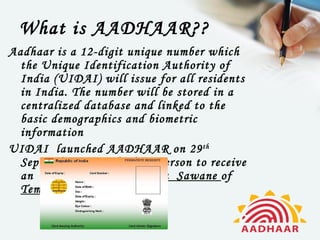
What is AADHAAR??
Aadhaar is a 12-digit unique number which
  the Unique Identification Authority of
  India (UIDAI) will issue for all residents
  in India. The number will be stored in a
  centralized database and linked to the
  basic demographics and biometric
  information
UIDAI launched AADHAAR on 29 th
  September 2010.The first person to receive
  an AADHAAR was Rajana Sawane of
  Tembhli village.
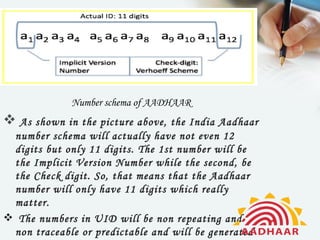
Number schema of AADHAAR
 As shown in the picture above, the India Aadhaar
 number schema will actually have not even 12
 digits but only 11 digits. The 1st number will be
 the Implicit Version Number while the second, be
 the Check digit. So, that means that the Aadhaar
 number will only have 11 digits which really
 matter.
 The numbers in UID will be non repeating and
 non traceable or predictable and will be generated
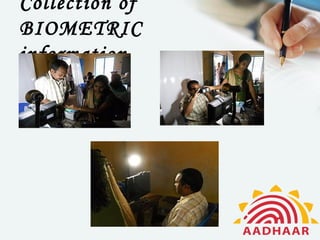
Collection of
BIOMETRIC
information
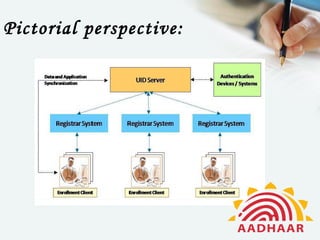
Pictorial perspective:
UIDAI will provide AADHAAR
to residentsand missions of
Goals of India that                      UIDAI
       can be verified easily,
quickly and in cost effective way
           can eliminate duplicate
and fake identities


The UIDAI intends to cover all
residents of the country, but the
focus will be on enrolling the India's
Continued… .

The UIDAI will offer a strong form of
authentication where agencies can compare
demographic and biometric information of the
resident with record stored in central data base


This central data base is stored in a computer
which will be linked to all government and
private agencies like banks
Projected benefits
Aadhaar will become the single source of identity
verification. Residents would be spared the hassle
of repeatedly providing supporting identity
documents each time they wish to access services
such as obtaining a bank account, passport, driving
license and so on.

Financial inclusion with deeper penetration of
banks, insurance and easy distribution of benefits
of government schemes.
Continued….

 By providing a clear proof of identity,
  Aadhaar will also facilitate entry for
  poor and underprivileged residents into
  the formal banking system and the
  opportunity to avail services provided by
  the government and the private sector.

 Giving migrants mobility of identity.
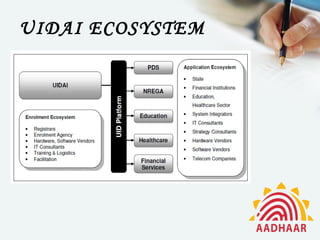
UIDAI ECOSYSTEM
Practical risks of
 AADHAAR
  1. India has been facing various
   hacking problems from inside and
   abroad. Many times our government
   sites were also being hacked by
   hackers .This is very clear that our
   cyber security is not safe.
2. We are having a lot of corrupted
   people in India especially in
   government department. Everyone
   know that for money, maximum of
   government official leak any kind of
   information. Then what will be surely
Continued…
 3.It is proposed that UIN will
 be used as PAN for income tax
  purpose. If this happen than
 PAN will be available easily
 to any body and one may use
 other UIN or say PAN for any
 transaction. Today at least
 one can't find easily others
 PAN no.
 4.Village people will be
 offered Rs.100 for getting
 their Unique Identity Number.
 Every one know very well how
Proposed solutions
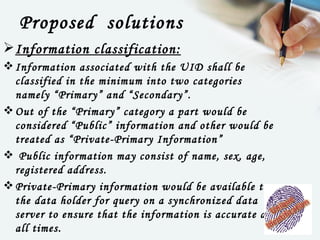
 Information classification:
 Information associated with the UID shall be
  classified in the minimum into two categories
  namely “Primary” and “Secondary”.
 Out of the “Primary” category a part would be
  considered “Public” information and other would be
  treated as “Private-Primary Information”
  Public information may consist of name, sex, age,
  registered address.
 Private-Primary information would be available to
  the data holder for query on a synchronized data
  server to ensure that the information is accurate at
  all times.
 Secondary Information would be kept in paper format in
multiple locations. One copy would also be kept in digital format
with strong encryption in an offline media with DRP support.
This would be available to authorized UID employees only for
grievance redressal and under appropriate audit trail recordings.

 Within UIDAI no employee would be provided access to all
aspects of the data base.

The elements of the data base would be broken into multiple
parts and scattered with an algorithm across the data base. They
would be assembled only by authorized employees.
Information storage security:
Information under storage is kept in encrypted.
Access shall be backed up by data integrity control, audit trail
monitoring and archival.

Information transmission security:
Transmission of Information into and out of the systems
would be monitored by a suitable Firewall and appropriate
polices and procedures shall be implemented to ensure that
viruses and other malicious codes are filtered.
Al l transmissions of data including confidential mails in
the name of UIDAI should be encrypted and digitally signed.
Logical access security:
Policies and Procedures shall be implemented for
ensuring that access to any IT device is made
available only with appropriate access authentication
such as Passwords.

Appropriate measures shall be initiated for
ensuring that a strong password policy is maintained
across the organization.

Use of hardware tokens with biometric and RFID
tags shall be used where considered necessary.
Employee consent:
 “ Agents” of UIDAI must be subjected to a
 very strict selection criteria including
 background checks, privacy declarations,
 indemnity etc should be obtained from every
 individual who is involved in this  activity.
 Any mistake observed and corrected will also
 be recorded as a “Security Breach” and the
 responsibility for the same would be fixed on
 the concerned person.
Employee awareness
Employee cyber usage
  policy:
• Employees would be subject to appropriate
  restrictions in use of Computers so that UID
  information is not subject to risk elements
  from Cyber space.
•  All access would be based on multi factor
  authentication of the employee and with
  archival of audit trail with a trusted third
  party with adequate security.
•  In particular, no computer which has access
  to secondary data will have access to Internet
Continued…
In particular, no storage media (such as cell
phones)would be allowed to be used by the
employees  in the ordinary course. All computers
would work on the network with dumb terminals.

 UIDAI shall retain all Policy documents related
 to information security for a period of a minimum
 of 3 years either in print or electronic form.    Data
 which is part of a security breach incident, is kept
 permanently.
CONCLUSION

“… Theconscious and intelligent
 manipulation of the organized habits
 and opinions of the masses is an
 important element in democratic
 society. Those who manipulate this
 unseen mechanism of society
 constitute an invisible government
 which is the true ruling power of our
THANK YOU
Print master
    QUERIES??
• Your Text here

• Lorem ipsum dolor sit amet, consectetuer
  adipiscing elit, sed diam nonummy nibh euismod
  tincidunt ut laoreet dolore magna aliquam erat
  volutpat. Ut wisi enim ad minim veniam, quis
  nostrud exerci tation ullamcorper suscipit lobortis
  nisl ut aliquip ex ea commodo consequat.

• Duis autem vel eum iriure dolor in hendrerit in
  vulputate velit esse molestie consequat, vel illum
  dolore eu feugiat nulla facilisis at vero eros et
  accumsan et iusto odio dignissim qui blandit
  praesent luptatum zzril delenit augue duis dolore
  te feugait nulla facilisi.

practical risks in aadhaar project and measures to overcome them

  • 1.
    AADHAAR brand name ofUIDAI KU COLLEGE OF ENGINEERING AND TECHNOLOGY TEAM: D.SAIPRIYA B.SNIGDHA
  • 2.
    CONTENTS What is AADHAAR?? Goalsand missions of UIDAI Projected benefits of AADHAAR Practical risks involved in this project SOLUTIONS to overcome these threats CONCLUSION
  • 3.
    What is AADHAAR?? Aadhaaris a 12-digit unique number which the Unique Identification Authority of India (UIDAI) will issue for all residents in India. The number will be stored in a centralized database and linked to the basic demographics and biometric information UIDAI launched AADHAAR on 29 th September 2010.The first person to receive an AADHAAR was Rajana Sawane of Tembhli village.
  • 4.
    Number schema ofAADHAAR  As shown in the picture above, the India Aadhaar number schema will actually have not even 12 digits but only 11 digits. The 1st number will be the Implicit Version Number while the second, be the Check digit. So, that means that the Aadhaar number will only have 11 digits which really matter.  The numbers in UID will be non repeating and non traceable or predictable and will be generated
  • 5.
  • 6.
  • 7.
    UIDAI will provideAADHAAR to residentsand missions of Goals of India that UIDAI  can be verified easily, quickly and in cost effective way  can eliminate duplicate and fake identities The UIDAI intends to cover all residents of the country, but the focus will be on enrolling the India's
  • 8.
    Continued… . The UIDAIwill offer a strong form of authentication where agencies can compare demographic and biometric information of the resident with record stored in central data base This central data base is stored in a computer which will be linked to all government and private agencies like banks
  • 9.
    Projected benefits Aadhaar willbecome the single source of identity verification. Residents would be spared the hassle of repeatedly providing supporting identity documents each time they wish to access services such as obtaining a bank account, passport, driving license and so on. Financial inclusion with deeper penetration of banks, insurance and easy distribution of benefits of government schemes.
  • 10.
    Continued….  By providinga clear proof of identity, Aadhaar will also facilitate entry for poor and underprivileged residents into the formal banking system and the opportunity to avail services provided by the government and the private sector.  Giving migrants mobility of identity.
  • 11.
  • 12.
    Practical risks of AADHAAR 1. India has been facing various hacking problems from inside and abroad. Many times our government sites were also being hacked by hackers .This is very clear that our cyber security is not safe. 2. We are having a lot of corrupted people in India especially in government department. Everyone know that for money, maximum of government official leak any kind of information. Then what will be surely
  • 13.
    Continued… 3.It isproposed that UIN will be used as PAN for income tax purpose. If this happen than PAN will be available easily to any body and one may use other UIN or say PAN for any transaction. Today at least one can't find easily others PAN no. 4.Village people will be offered Rs.100 for getting their Unique Identity Number. Every one know very well how
  • 14.
    Proposed solutions  Informationclassification:  Information associated with the UID shall be classified in the minimum into two categories namely “Primary” and “Secondary”.  Out of the “Primary” category a part would be considered “Public” information and other would be treated as “Private-Primary Information”   Public information may consist of name, sex, age, registered address.  Private-Primary information would be available to the data holder for query on a synchronized data server to ensure that the information is accurate at all times.
  • 15.
     Secondary Information wouldbe kept in paper format in multiple locations. One copy would also be kept in digital format with strong encryption in an offline media with DRP support. This would be available to authorized UID employees only for grievance redressal and under appropriate audit trail recordings.  Within UIDAI no employee would be provided access to all aspects of the data base. The elements of the data base would be broken into multiple parts and scattered with an algorithm across the data base. They would be assembled only by authorized employees.
  • 16.
    Information storage security: Informationunder storage is kept in encrypted. Access shall be backed up by data integrity control, audit trail monitoring and archival. Information transmission security: Transmission of Information into and out of the systems would be monitored by a suitable Firewall and appropriate polices and procedures shall be implemented to ensure that viruses and other malicious codes are filtered. Al l transmissions of data including confidential mails in the name of UIDAI should be encrypted and digitally signed.
  • 17.
    Logical access security: Policiesand Procedures shall be implemented for ensuring that access to any IT device is made available only with appropriate access authentication such as Passwords. Appropriate measures shall be initiated for ensuring that a strong password policy is maintained across the organization. Use of hardware tokens with biometric and RFID tags shall be used where considered necessary.
  • 18.
    Employee consent:  “Agents” of UIDAI must be subjected to a very strict selection criteria including background checks, privacy declarations, indemnity etc should be obtained from every individual who is involved in this  activity.  Any mistake observed and corrected will also be recorded as a “Security Breach” and the responsibility for the same would be fixed on the concerned person. Employee awareness
  • 19.
    Employee cyber usage policy: • Employees would be subject to appropriate restrictions in use of Computers so that UID information is not subject to risk elements from Cyber space. •  All access would be based on multi factor authentication of the employee and with archival of audit trail with a trusted third party with adequate security. •  In particular, no computer which has access to secondary data will have access to Internet
  • 20.
    Continued… In particular, nostorage media (such as cell phones)would be allowed to be used by the employees  in the ordinary course. All computers would work on the network with dumb terminals. UIDAI shall retain all Policy documents related to information security for a period of a minimum of 3 years either in print or electronic form.    Data which is part of a security breach incident, is kept permanently.
  • 21.
    CONCLUSION “… Theconscious andintelligent manipulation of the organized habits and opinions of the masses is an important element in democratic society. Those who manipulate this unseen mechanism of society constitute an invisible government which is the true ruling power of our
  • 22.
  • 23.
    Print master QUERIES?? • Your Text here • Lorem ipsum dolor sit amet, consectetuer adipiscing elit, sed diam nonummy nibh euismod tincidunt ut laoreet dolore magna aliquam erat volutpat. Ut wisi enim ad minim veniam, quis nostrud exerci tation ullamcorper suscipit lobortis nisl ut aliquip ex ea commodo consequat. • Duis autem vel eum iriure dolor in hendrerit in vulputate velit esse molestie consequat, vel illum dolore eu feugiat nulla facilisis at vero eros et accumsan et iusto odio dignissim qui blandit praesent luptatum zzril delenit augue duis dolore te feugait nulla facilisi.