COME AND
YOUR
F I N D
PLACEUndergraduate 2017
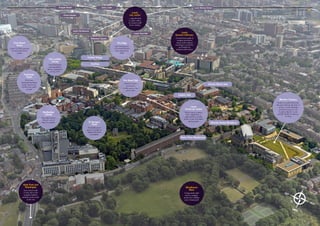
Parkinson
Tower
The iconic
landmark building
of the University,
visible from miles
around
First Direct
Arena
Leeds’ 13,500 capacity
theatre-style music
venue
Hyde Park and
Headingley
Just a short walk
or bus ride to the
popular student
suburbs in the north
of the city
Woodhouse
Moor
A large park right
next to campus,
perfect for chilling
out or keeping fit
The Edge
Swimming pool,
250-station fitness
suite and sports
halls
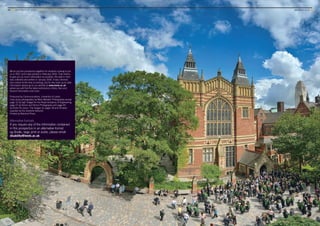
The Great Hall
Venue for your
graduation
ceremony in a few
years' time
Leeds
University Union
Shops, music venues,
bars, nightclubs, a
supermarket and the
home of our 300 clubs
and societiesSt George's
Field
Beautiful green
space to escape to,
right at the heart
of campus
Brotherton
Library
Stunning historic
library, one of
four on campus
Leeds
city centre
...and all it has
to offer, only a
10-minute walk
from campus
Leeds
General Infirmary
Located just south of
campus and where
much of the clinical
teaching for medicine
and healthcare
students takes place
	 www.leeds.ac.uk ■ 1
Kirkgate Market
Western Campus
Home to Leeds University
Business School, the School
of Law, Leeds Institute
of Health Sciences, the
Gryphon Sports Centre
and the Marks & Spencer
Archive
The Laidlaw
Library
Our brand new
undergraduate
library, opened in
spring 2015
CitySide
SOUTH
WEST
EAST
NORTH
Contents
Welcome to Leeds 3
YOUR LEEDS 4
Be inspired 5
Outstanding learning and teaching 5
Research-based learning 5
Broadening your horizons 5
Research excellence 13
Academic facilities 14
Enrichment opportunities 16
Study abroad 16
Work experience 16
Enterprise at Leeds 17
Clubs, societies and volunteering 17
Preparing for your future 26
Leeds for Life 26
Career planning 26
Join a global network of Leeds graduates 30
Accommodation 34
Choosing your new home – things to consider 34
Getting around Leeds 36
A quick guide to our residences 37
YOUR CAMPUS 40
Campus life 41
A creative and cultural campus 41
Be part of our global community 42
Your students’ union 46
Sport and fitness 50
Student support and wellbeing 51
Leeds the city 56
YOUR APPLICATION 60
Costs to consider 61
Student funding 64
Applying to study here 66
Visit us and find out more 68
YOUR STUDY 70
Single honours courses 71
International Foundation Year options 71
Part-time study 71
Joint honours courses 71
Extended degree courses with foundation year 71
Subjects and courses Click here
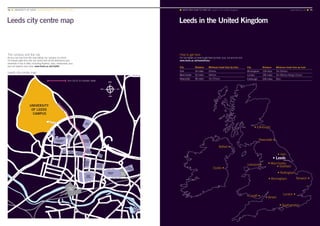
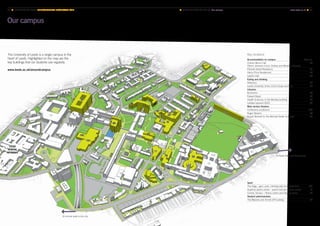
Maps and how to find us	 72
2 ■ UNIVERSITY OF LEEDS UNDERGRADUATE PROSPECTUS 2017
Welcome to Leeds
■ Welcome to Leeds	 www.leeds.ac.uk ■ 3
This prospectus will give you an idea of what it’s
like to be a University of Leeds student. It covers
everything you need to know, including details
of our courses, the opportunities available to you
and the groundbreaking research happening right
here on campus.
You’ll also find information on things such as our
facilities, student accommodation and what the
city of Leeds is like, as well as how to apply. You’ll
learn all about what our graduates have achieved
and what our students say about studying here.
For the most current information on our courses,
entry requirements, fees and student funding,
take a look at our website at www.leeds.ac.uk
or give us a call on 0113 243 1751.
It’s easy to find out more
The best way to find out more is to come and visit
us on one of our open days. It’s a great way to
explore our campus and meet some of the staff
who will be teaching you. You’ll also be able to
chat to current students and find out what life is
really like in our city and at our University.
Important Information
Information provided by the University such as in presentations, University brochures and the University website, is accurate at the
time of first disclosure. However, courses, University services and content of publications remain subject to change. Changes may
be necessary to comply with the requirements of accrediting bodies or to keep courses contemporary through updating practices
or areas of study. Circumstances may arise outside the reasonable control of the University, leading to required changes. Such
circumstances include, industrial action, unexpected student numbers, significant staff illness (where a course is reliant upon a
person’s expertise), unexpected lack of funding, severe weather, fire, civil disorder, political unrest, government restrictions and
serious concern with regard to the transmission of serious illness making a course unsafe to deliver. After a student has taken up a
place with the University, the University will look to give early notification of any changes and try to minimise their impact, offering
suitable alternative arrangements or forms of compensation where it believes there is a fair case to do so. Offers of a place to study
at the University will provide up to date information on courses. The latest key information on courses and entry requirements can
be found at www.leeds.ac.uk/coursefinder. Fees information can be found at www.leeds.ac.uk/yourfinances. Please check these
websites before making any decisions.
/universityofleeds
@comingtoleeds
YOUR LEEDS
4 ■ UNIVERSITY OF LEEDS UNDERGRADUATE PROSPECTUS 2017
Be inspired
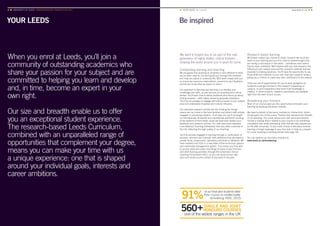
When you enrol at Leeds, you’ll join a
community of outstanding academics who
share your passion for your subject and are
committed to helping you learn and develop
and, in time, become an expert in your
own right.
Our size and breadth enable us to offer
you an exceptional student experience.
The research-based Leeds Curriculum,
combined with an unparalleled range of
opportunities that complement your degree,
means you can make your time with us
a unique experience: one that is shaped
around your individual goals, interests and
career ambitions.
■ YOUR LEEDS Be inspired	www.leeds.ac.uk ■ 5
We want to inspire you to be part of the next
generation of highly skilled, critical thinkers –
shaping the world around you in years to come.
Outstanding learning and teaching
We recognise that studying at university is very different to what
you’ve been used to, but we’ll guide you through this transition
and help you adjust to university life. We’ll work closely with you
to ensure we meet your expectations, respond to your feedback
and let you know what we expect in return.
Our approach to learning and teaching is to develop your
knowledge and skills, so you become an enquiring and critical
thinker. You’ll learn how to define problems and how to go about
finding answers – skills highly valued by graduate employers.
You’ll be encouraged to engage with ethical issues in your subject
area and understand its global and cultural influence.
Our extensive research activity and the funding this brings
means we can invest in the best facilities and attract staff actively
engaged in pioneering research. From day one, you’ll be taught
by internationally renowned and inspirational academics working
at the forefront of their fields; some will have even written your
textbooks and research articles. Our staff have been awarded
more National Teaching Fellowships than any other university in
the UK, reflecting the high quality of our teaching.
You’ll be actively engaged in learning through a combination of
lectures, seminars and tutorials, with additional time allocated to
private study, project work, laboratory practicals or fieldwork. We
have invested over £2m in a new state-of-the-art lecture capture
and multimedia management system. This means you’ll be able
to access video and audio recordings of many of your lectures
and other learning activities through the University’s Virtual
Learning Environment (VLE), so you can study at your own
pace and revisit course content at any point in the year.
Research-based learning
Whichever subject you choose to study, research will be at the
heart of your learning and you’ll be close to breakthroughs that
are having a real impact in the world – sometimes even before
they’ve been published. We’ll explore with you how research has
influenced your subject area and the research methods that are
essential to making advances. You’ll have the opportunity to use
those skills and methods in your own final-year research project,
giving you a chance to make your own contribution to the subject.
There are lots of opportunities for you to work alongside our
academics and get involved in the research happening on
campus, so you’ll experience first-hand how knowledge is
created. In some subjects, research placements are available
right from the start of your course.
Broadening your horizons
Most of our courses give you the opportunity to broaden your
learning by studying discovery modules.
We have hundreds of discovery modules to choose from, which
are grouped into 10 Discovery Themes that represent the breadth
of our teaching. You could pursue your own personal interests,
choose a module that is related to your course or try something
completely new, while developing skills that will help prepare you
for life after university. Or you could choose a discovery module
learning a foreign language in your first year, to help you prepare
for a year studying or working abroad (see page 16).
You can explore our discovery modules at
www.leeds.ac.uk/broadening
6 ■ UNIVERSITY OF LEEDS UNDERGRADUATE PROSPECTUS 2017 ■ YOUR LEEDS Be inspired	www.leeds.ac.uk ■ 7
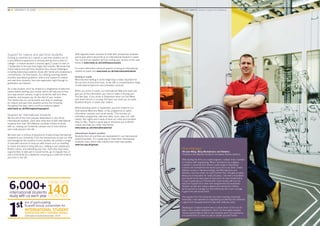
Richard Cruttenden
4th year MBChB Medicine and Surgery and Intercalated
Master of Research in Medicine
Pictured in the Leeds Institute of Biomedical and Clinical Sciences
at St James’s University Hospital
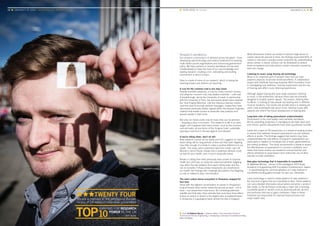
The opportunities for research at Leeds are incredible and you
can really push the boundaries of knowledge. This summer I did
an eight-week internship at the Leeds Institute of Biomedical and
Clinical Sciences looking at Photodynamic Therapy as a means of
diagnosing colorectal cancer. In those eight weeks alone I learned
laboratory skills, how to conduct research and how to write up and
present my research findings.
This year, as part of my degree, I am doing a Masters in Research.
I’m conducting my research on the effects of hypoxia and high
altitude on the human body. By looking at an enzyme called ACE
(angiotensin-converting enzyme), we’re hoping to find ways to
combat not just altitude sickness, but patients with hypoxia too.
The majority of my data collection will take place on an Army
medical research expedition to Dhaulagiri, Nepal.
Both my supervisors are experts in their fields; they’re always on
hand if I need a push in the right direction. Academics here are
happy to supervise students who are interested in doing research.
As part of my involvement with LEADERS, a student-run medical
research society, we organise a Summer School for students who
are interested in doing supervised research over the summer.
Research can really help you stand out and focus on what you
want to do in the future.
8 ■ UNIVERSITY OF LEEDS UNDERGRADUATE PROSPECTUS 2017 ■ YOUR LEEDS Be inspired	www.leeds.ac.uk ■ 9
Dr Luke Burns
Teaching fellow and lecturer in Geographical
Information Systems
Pictured in a School of Geography seminar room
My main research interests are in the application of
geodemographics and Geographical Information Systems (GIS)
to real-world problems. Both use information and data to make
spatial decisions, often by analysing areas based on the people
who live in them. When you see a new retail development, wind
farm or marketing campaign, it has often been underpinned by
GIS and geodemographics.
For some of my research, I work with students who are on work
placements as part of their course – it’s important that students
see how the subject is applied in industry. We’ve worked with
Huddersfield Town Football Club to map where their supporters
live; the geodemographics helped them to identify other areas
where they could target their marketing.
I try to make my lectures interactive and use learning technology
to encourage students to get involved. During my lectures students
can tweet answers or ask questions, which appear live on the
screen and they can vote from their mobile phones or by social
media. Using social media is great as it creates a community
where the conversation often continues once the lecture has
finished. I’ve also designed interactive e-learning video tutorials
ranging from quick ‘how to’ guides to full practical exercises –
these have proved popular with students as they’re nice ‘go to’
resources that they can always refer to.
10 ■ UNIVERSITY OF LEEDS UNDERGRADUATE PROSPECTUS 2017 ■ YOUR LEEDS Be inspired	www.leeds.ac.uk ■ 11
Reece Parker and Joshua John
2nd year BA English Literature / BA International Development
Reece (left) and Joshua (right) pictured in the newly redesigned
Language Zone, part of the Language Centre
Joshua: I couldn’t believe how many discovery modules there
were to choose from. I knew I wanted to learn a new language
and my course offers a semester abroad in Hong Kong so I chose
beginners’ Mandarin to get a good grounding for that. On my
course, you could continue with the discovery module throughout
your studies and all the way to advanced level if you wanted to.
Reece: For me, I’ve always been interested in teaching English as
a foreign language and travelling the world, so I thought beginners’
Mandarin would give me a good start. I also chose computer
coding and introduction to logic because I think it’s important to
learn as many different skills as you can at university to help you
choose a career path.
Joshua: Reece was in the same seminars as me so we’d just
chat to each other and became good friends. The course was
challenging, but good in a way. I had to do a lot of speaking
exercises with people I’d never met before, so it definitely improved
my confidence in public speaking.
Reece: It’s good to take a risk and use the discovery modules to
find out what you like or to learn something new.
Research excellence
Our research community is in demand across the globe – from
developing new technology and medical treatments to advising
multi-million-pound organisations and influencing government
policy. We have partners in industry worldwide and we work
collaboratively to make the most of our vast knowledge and
leading research, creating a rich, stimulating and exciting
environment in which to learn.
Here is a taste of some of our research, which is having far-
reaching impact and informs our teaching:
A cure for the common cold is one step closer
Despite scientific advances, a cure for many common viruses,
including the common cold, has evaded scientists – until now.
A breakthrough, led by the University of Leeds in partnership
with the University of York, has discovered what’s been dubbed
the ‘Viral Enigma Machine’. Like the infamous German cypher
machine used to encrypt wartime messages, researchers have
discovered previously hidden signals within the strands of genetic
material that enable viruses to assemble new particles and
spread rapidly in their hosts.
Not only can these codes now be read, they can be jammed
– stopping a virus in its tracks. This research is still in its early
stages, but it appears that many viruses, such as the common
cold and polio, all use forms of the ‘Enigma Code’, potentially
opening a new front in the war against viral disease.
If you’re sitting down, don’t sit still
New research carried out by Leeds and UCL suggests it’s best to
avoid sitting still for long periods of time and that even fidgeting
may offer enough of a break to make a positive difference to our
health. The study, which examined data from Leeds’ own UK
Women’s Cohort Study, reveals that a sedentary lifestyle could
be bad for your health, even if you’re physically active.
Breaks in sitting time have previously been shown to improve
health but until now, no study has examined whether fidgeting
may affect the link between time spent sitting down and the
risk of mortality. If these simple movements are beneficial to
our health, the findings also challenge perceptions that fidgeting
is rude or related to poor concentration.
The most carbon-dense ecosystem in Amazonia mapped for
first time
Areas with the highest concentration of carbon in Amazonia’s
tropical forests store carbon below the ground as peat – not in
trees – our researchers have found. By combining extensive
satellite and field data, they estimate that more than three billion
tonnes of carbon is stored in the largest area of peatland forest
in Amazonia in a geological basin almost the size of England.
While Amazonian forests are known to harbour large stores of
carbon above the ground in trees, the findings reveal that 90% of
carbon in this area is actually stored underfoot. By understanding
where carbon is stored, policies can be developed to protect
these ecosystems and help reduce carbon emissions caused by
land use change.
Listening to music using hearing aid technology
Music is an important part of people’s lives and can have
powerful physical, social and emotional effects. A collaborative
project with Sheffield Teaching Hospitals NHS Foundation Trust
is investigating how deafness, hearing impairments and the use
of hearing aids affect music listening experiences.
Although digital hearing aids have vastly improved, listening
to music is still problematic because these aids are primarily
designed to amplify speech signals. The project, Hearing Aids
for Music, is looking at how people use hearing aids in different
musical situations. The results will provide advice to hearing aid
users, help audiologists talk about music listening issues with
patients and inform the future development of hearing aids.
Long-term risks of taking paracetamol underestimated
Paracetamol is the most widely used painkiller worldwide.
But its painkilling properties in managing acute lower back pain
and chronic painful osteoarthritis have been questioned recently.
Leeds led a team of UK researchers in a review of existing studies
to assess links between frequent paracetamol use and adverse
effects in adults. The findings suggest that doctors may have
underestimated the side effects of long-term paracetamol use,
particularly in relation to increased risk of heart, gastrointestinal
and kidney problems. The study recommends a review to assess
the effectiveness of paracetamol in common conditions, and
states that future studies are needed to ensure that the side
effects attributed to paracetamol don’t reflect the use of other
over-the-counter painkillers.
New glass technology that is impossible to counterfeit
Dr Matthew Murray – winner of the prestigious 2015 Royal
Academy of Engineering-ERA Foundation Entrepreneurs’ Award
– is spearheading the commercialisation of a new method of
counterfeit-proofing glass through his spin-out, Ultramatis.
Laser technology is used to create patterns of new material in
the structure of glass that are impossible to fake. These patterns
can carry detailed information about where and when a product
was made, so the technique could play a major role in tackling
counterfeit goods in sectors such as pharmaceuticals, alcohol
and perfumes that rely on glass containers. Fakes in these
industries are responsible for massive financial losses and
major health risks.
12 ■ UNIVERSITY OF LEEDS UNDERGRADUATE PROSPECTUS 2017 ■ YOUR LEEDS Be inspired	 www.leeds.ac.uk ■ 13
■ (Left) Dr Matthew Murray, a research fellow in the University’s School of
Chemical and Process Engineering, is developing a new way of counterfeit-proofing
glass packaging
Montana Wright
3rd year BA Broadcast Journalism
Pictured in the Laidlaw Library
The Laidlaw Library is really modern and light inside, so it’s a
great environment to study in. I really like the quirky individual
study areas, especially the big comfy single chairs. It has all of the
facilities you need and there are always spare plug sockets for your
laptop and phone charger. The group study areas have extra-large
PC screens, which makes it easier when you’re working on group
projects. And if you need a break from studying, there’s always
the café on the ground floor.
I’ve never had any issues with getting any books or resources
I need; there are plenty available in the libraries and there are
thousands available online. The libraries on campus are open
every day and most are open really late, which is great when
you’ve got deadlines approaching.
Finding a computer to work on is easy, as there’s clusters all
over campus – some are open 24 hours, so you can use them
whenever you need to. Even when I’m off campus, I use the
Desktop Anywhere service to access my files and resources.
The apps are really useful too; I can see my timetable, get any course
announcements and book classes at The Edge wherever I am.
Academic facilities
We have all the facilities you’ll need to support and enhance your
academic studies and we’re investing millions of pounds each
year to ensure we maintain a first-class academic environment.
From brand new laboratories and lecture theatres to one of
the largest and most impressive libraries in the UK, you’ll find
everything you need for your studies right here on campus.
Visiting the campus is a great way to see the facilities on offer
for yourself – see page 68 for our open day dates or go to
www.leeds.ac.uk/campustours
University Library
Our Library is one of the major academic research libraries in the
UK and attracts students and academics from around the world.
Its rich and growing print and online collections, gathered over
100 years, include some of the UK’s most outstanding collections
of rare books and manuscripts.
As well as access to all the books you’ll need for your course,
you’ll have a host of electronic resources, including 540,000
online books and more than 35,000 online journals at your
fingertips, accessible from wherever you are.
Four libraries on campus provide a variety of different working
environments, including flexible group study areas and silent
individual study spaces. They’re open seven days a week and
have a variety of opening times to suit your needs. Library staff
are always on hand to help, providing information and advice,
as well as academic skills support, to help you develop important
skills such as effective communication and time management.
The new Laidlaw Library, which opened in spring 2015, has
been designed specifically for undergraduate students. With
1,000 seats, dedicated IT zones and study facilities with the
latest technology, including bookable rooms for group work and
interactive presentation equipment, you can find a place to work
that’s right for you.
www.leeds.ac.uk/library
Computers and IT
We have some of the best computing resources in the country
according to the Guardian University Guide, 2016.
Our IT facilities are centred on you – a single login will give you
access to all the University’s IT services, including our two mobile
apps. You’ll find over 1,800 centrally provided, networked PCs
available for you to use across campus; you can find them in
computer clusters and in most of our cafés. These clusters have
a range of opening hours, with some available 24/7, ensuring
you can study when it suits you. If you would rather use your
own laptop, most areas have free, high-speed wi-fi, and with our
Desktop Anywhere service, you’ll always have secure access to
your resources, files and a wide range of software from anywhere
in the world.
You’ll be provided with an email account on the Microsoft Office
365 service, offering secure access, wherever you are, to your
email, calendar, contacts and tasks. As part of the Microsoft
Office 365 suite of services, you can install up to five copies
of Office Pro Plus completely free of charge.
With our Blackboard Mobile Learn app you can access the
University’s Virtual Learning Environment, where you can
view announcements, get module information, participate in
discussion boards and check your grades. The UniLeeds app
brings together useful information, such as your personalised
timetable and library record, the full library catalogue, campus
maps, computer cluster availability, information from the
students’ union, and much more.
Our experienced IT Service Desk staff are available seven days
a week to give you IT support by phone, email or in person.
www.leeds.ac.uk/it
The Language Centre
Our Language Centre offers resources for independent language
study and English language courses. If you’re an international
student, our pre-sessional English language courses will help you
prepare for study in the UK. English language development and
academic study skills support is also available through part-time
in-sessional classes and workshops, which you can do alongside
your degree.
Open to all students, facilities include the newly redesigned
Language Zone. The Zone has learning materials in over 45
languages, including computer-assisted language learning,
a dedicated space where you can study independently, an
extensive collection of foreign language films and documentaries,
and access to over 50 TV channels in 20 languages. If you want
to practise your conversation skills, our Language Exchange
Scheme can put you in touch with native speakers.
www.leeds.ac.uk/languages
14 ■ UNIVERSITY OF LEEDS UNDERGRADUATE PROSPECTUS 2017 ■ YOUR LEEDS Be inspired	 www.leeds.ac.uk ■ 15
Enrichment opportunities
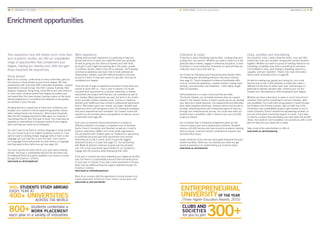
Your experience here will involve much more than
your academic studies; we offer an unparalleled
range of opportunities that complement your
degree, helping you develop your skills and gain
those important life experiences.
Study abroad
Most of our courses, unlike those at many universities, give you
the chance to study abroad as part of your degree. We have
partnerships with more than 400 universities worldwide – popular
destinations include Europe, the USA, Canada, Australia, New
Zealand, Singapore, Hong Kong, South Africa and Latin America.
In most cases, students extend their degree by another year
and spend their third year abroad. Gaining a place on the study
abroad programme is competitive and depends on the grades
you achieve in your first year.
Studying abroad is a great way to boost your confidence and
broaden your outlook on life by experiencing another culture,
while making friends and having fun. Returning to University
after this life-changing experience often gives our students a
new perspective for their final year of study. You could also be
awarded an international or European variant of your degree,
which will help you stand out to employers.
You don’t need to be fluent in another language to study abroad.
You can choose to go to an English-speaking country or, if you
want to build on existing foreign language skills or learn a new
language, you can start this in your first year. If you need it,
our Language Centre will provide you with advice on language
learning opportunities before you go (see page 14).
You won’t pay the full tuition fee for your year spent studying
abroad. You’ll pay a substantially reduced fee and there may
be additional financial support available if you study in Europe
through the Erasmus+ scheme.
www.leeds.ac.uk/studyabroad
Work experience
Getting practical work experience is a great way to help you
decide what kind of career you might like when you graduate.
As well as giving you the chance to develop your own skills,
you’ll gain a real insight into working life in the public, private
or voluntary sectors, either in the UK or overseas. You’ll develop
commercial awareness and learn how to build professional
relationships, network, deal with difficult situations and work
as part of a team. It may even result in a job offer once you’ve
completed your degree.
There are lots of ways to experience the world of work when you
choose to study with us – from a year in industry (12-month
industrial work placement) to a summer internship, or shorter
placements and project work that you can undertake as part of
your studies. Many placements are paid, but work in the charity
sector normally involves voluntary work. Courses in medicine,
dentistry and healthcare have clinical or professional placements
built in. Whichever option you choose, you’ll gain valuable work
experience and it will look great on your CV, proving to employers
that you’re experienced and motivated. Our Careers Centre will
support you and provide advice and guidance to help you secure
a placement (see page 26).
Each year our students secure placements in a variety of
different industries, including in companies such as Goldman
Sachs, French Connection and Vauxhall, as well as in small to
medium enterprises (SMEs) and not-for-profit organisations.
Our partnership with Unilever gives our students the opportunity
to undertake exclusive paid work placements and summer
internships at its site in Leeds, which houses the biggest
deodorant factory in Europe (see page 27). Our partnership
with Marks & Spencer continues to grow and has provided
over 120 unique placement opportunities for our students to
engage with the business while developing their skills.
A full year in industry will mean extending your degree by another
year, but there is a substantially reduced tuition fee while you’re
on your year in industry. If you take a work placement in Europe,
there may be additional financial support available through the
Erasmus+ scheme.
www.leeds.ac.uk/workexperience
Most of our courses offer the opportunity to study abroad or do
a work placement; to find out if your chosen course does, visit
www.leeds.ac.uk/coursefinder
Enterprise at Leeds
Enterprise is about identifying opportunities, creating ideas and
putting them into practice. Whether you want to stand out in the
graduate labour market, engage in enterprise education, or start
a business or social enterprise, Enterprise at Leeds will help you
make the most of your time with us.
Our Centre for Enterprise and Entrepreneurship Studies offers
14 interesting and stimulating enterprise discovery modules
(see page 5). They’re designed to enhance transferable skills
such as commercial awareness, creative problem solving, team
working, communication and leadership – skills highly sought
after by employers.
Self-employment is a career choice just like any other.
The Spark initiative, our innovative business start-up support
based in the Careers Centre, is there to guide you as you develop
your idea into a viable business. Our experienced and dedicated
team offers bespoke workshops, business advice and access to
funding, networking events and mentoring support to help you
through your entrepreneurial journey. You could even enter our
business plan competition, with a chance to win up to £2,000
to get you started.
Our innovative Year in Enterprise programme gives you the
chance to take a year out to develop your business. Students
receive a £5,000 bursary and have access to academic tutoring,
start-up advice, business mentors, professional networks and
serviced office space.
Leeds University Union also has some great enterprise-focused
student societies, where you can develop your skills and get
practical experience by implementing your business ideas.
www.leeds.ac.uk/enterprise
 
Clubs, societies and volunteering
Your students’ union, Leeds University Union, runs over 300
student-led clubs and societies, bringing like-minded students
together. Whether you want to pursue an existing interest or try
something completely new, there’s something for everyone –
from football to chess, wine tasting to skydiving, dance to a
cappella, and even Quidditch. There’s lots more information
about Leeds University Union on page 46.
As well as meeting new people and having fun, you could
become one of over 3,000 students at Leeds who make a
difference to the lives of others each year. Volunteering is a
great way to develop valuable skills, enhance your CV and
broaden your life experience while studying for your degree.
Whether you have a few hours to spare or much more time to
volunteer, there will be something to suit your interests, skills
and availability. You could tutor young people in Leeds through
the Students into Schools scheme, help out with one of the
University’s own sustainability projects, get involved in one of
Leeds University Union’s student-led volunteering societies, or
join one of the great community projects in Leeds. If you have
an idea for a project that will develop your own skills and benefit
others, the Leeds for Life Foundation can provide you with a cash
grant to help turn your ideas into a reality.
Take a look at the opportunities on offer at
www.leeds.ac.uk/volunteering
16 ■ UNIVERSITY OF LEEDS UNDERGRADUATE PROSPECTUS 2017 ■ YOUR LEEDS Enrichment opportunities	 www.leeds.ac.uk ■ 17
18 ■ UNIVERSITY OF LEEDS UNDERGRADUATE PROSPECTUS 2017 ■ YOUR LEEDS Enrichment opportunities	www.leeds.ac.uk ■ 19
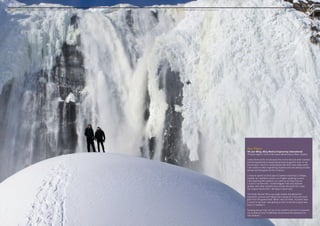
Alex Parker
4th year MEng, BEng Medical Engineering (International)
Pictured (right) in front of the frozen Montmorency River, Quebec
Leeds stood out for me because the course was just what I wanted
and the opportunity to study abroad was too good to miss. In my
second year I went to a study abroad talk which was really useful.
I also spoke to other engineering students who had already studied
abroad and they gave me lots of advice.
I chose to spend my third year at Carleton University in Ottawa,
Canada, as I wanted to study in an English-speaking country.
I love exploring the outdoors, so I went on as many trips as
I could in my free time. I visited Niagara Falls and explored
Quebec with other students from all over the world and made
lots of good friends who I still keep in touch with.
The Study Abroad Office was really helpful throughout the
application process and helped me to apply for a visa and travel
grant from the government. While I was out there, my tutors kept
in touch to see how I was getting on and I knew the support was
there if I needed it.
Studying abroad took me out of my comfort zone but it’s improved
my confidence and I’d definitely recommend the experience to
new students.
20 ■ UNIVERSITY OF LEEDS UNDERGRADUATE PROSPECTUS 2017 ■ YOUR LEEDS Enrichment opportunities	 www.leeds.ac.uk ■ 21
Robert Bruce-Konuah
2nd year BA Broadcast Journalism
Pictured in the Leeds Student Radio studio
I was part of the News Academy in 2014 which News UK set
up to help young journalists get into the profession. Whilst there
I offered to help out at their conferences where students get
the chance to ask top journalists difficult questions. It was
through these connections that I got a summer placement
at News UK headquarters.
Working there was really fast paced; I didn’t know what I would
be doing from one day to the next but I liked that – I went from
contacting people in the House of Lords to doing my own fashion
feature in The Times Results Day Supplement. My favourite part of
the placement was covering the Edinburgh Fringe Festival with just
a camera and microphone. I really enjoy feature writing because of
the freedom it gives you and you can get your personality across in
your writing style.
I’ve worked alongside some really good journalists and learnt
things that I can incorporate into my course. My work experience
has helped me develop the writing style and content I use on my
own website and also my broadcasting skills on the Leeds Student
Radio show I co-host. After the placement I knew I wanted to
go into broadcasting, so my advice would be to find what
you’re interested in and go for it!
22 ■ UNIVERSITY OF LEEDS UNDERGRADUATE PROSPECTUS 2017 ■ YOUR LEEDS Enrichment opportunities	 www.leeds.ac.uk ■ 23
Dominique Neilson
2nd year BSc Biotechnology with Enterprise
Pictured in the Garstang Teaching Lab B
I knew I wanted to continue studying science after school
but I also loved business studies, so when I saw Leeds did
Biotechnology with Enterprise, I knew it was the perfect mix.
I get to study biology and learn how to start up a new business
and the mix of both definitely helps me to stand out to employers.
Enterprise has taught me to use my brain in a completely different
and more creative way. I like the idea of bringing new ideas into
the business place and there are students from so many different
subjects on the course who all bring different perspectives.
The opportunities you get from doing an enterprise module or
course are unbelievable – we get to talk to enterprise ambassadors
who have created successful multimillion-pound businesses.
The academics are from all sorts of different backgrounds,
so there are some amazing networking events where you can
build on your contacts and your confidence to talk to people.
Even if you don’t study enterprise but you have a business
idea, you can get funding through the Centre for Enterprise and
Entrepreneurship Studies. You can use the funding to kick
start your business or for market research to see if your
business will work.
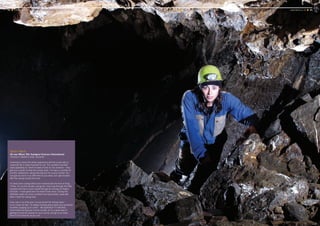
Sarah Harris
4th year MGeol, BSc Geological Sciences (International)
Pictured in Swildon’s Hole, Somerset
University is about the whole experience and the social side to
university life is really important to me. The societies sounded
really appealing so I went to loads of Give it a Go sessions – they
give you a taster of what the society does. I’ve been a member of
archery, taekwondo, swing dancing and my course society. You
can give as much or as little time as you want, but I get involved
with the caving society the most.
I’d never done caving before but it seemed like the kind of thing
I’d like. On my first society caving trip I had to go through this little
squeeze and had to push myself through by moving my fingers
and toes – it was great and I’ve loved it ever since. Caving has
definitely made me more confident and responsible, especially
when I lead the caving trips.
Even now in my final year I’ve just joined the hockey team –
so it’s never too late. I’m always hearing about weird and wonderful
societies popping up at Leeds – like Quidditch! I’d definitely
recommend joining your course society, as it’s a great way of
getting to know the people on your course, and go to as many
Give it a Go sessions as you can.
24 ■ UNIVERSITY OF LEEDS UNDERGRADUATE PROSPECTUS 2017 ■ YOUR LEEDS Enrichment opportunities	 www.leeds.ac.uk ■ 25
Preparing for your future
In an increasingly competitive job market,
our degrees and your wider experience at the
University of Leeds can help you stand out and
secure that all-important graduate job, or prepare
you for further study.
Leeds for Life
Leeds for Life is a University-wide initiative designed to help you
make the most of student life and prepare you for your career
from day one.
At the heart of Leeds for Life is personal tutoring. You’ll have
regular and structured meetings with your personal tutor, who will
guide your academic and personal development. They’ll help you
to talk clearly and confidently about your experiences and the
knowledge and skills you’ve developed.
Leeds for Life also brings together lots of opportunities for
academic and personal development – from work experience,
studying abroad, career planning and broadening your learning
through discovery modules to volunteering, applying for cash
grants to help fund your own projects and joining one of our
hundreds of Union societies. You’ll also have access to the
Leeds Network, giving you the chance to make contact with
our alumni who have been there, done that and are working
in the job that you want.
The Leeds for Life website enables you to explore these
opportunities and to record and reflect on all your experiences
and achievements, helping you to become a confident, articulate
and highly employable graduate.
www.leeds.ac.uk/leedsforlife
Career planning
We encourage you to start planning for your career as soon as
you get here; that’s one of the reasons our graduates are highly
sought after by employers. Our courses, combined with the
wealth of opportunities available outside your studies, will help
you broaden your experience and develop the skills employers
want – skills that will benefit their organisation.
Our award-winning Careers Centre offers a range of services
to help you plan your career and make well-informed decisions
along the way, even after you graduate. Our experienced,
qualified careers staff can help you find work experience,
improve your CV and offer advice on job applications,
preparing for interviews and what to do after graduation,
including further study.
As well as teaching accredited, career-related discovery modules
(see page 5) the Careers Centre provides a daily drop-in service,
one-to-one appointments and a dedicated job site advertising
hundreds of vacancies targeted at University of Leeds students.
Over 650 graduate recruiters target our students and visit
campus each year, including:
Abercrombie and Fitch The John Lewis Partnership
Accenture KPMG
Allen & Overy L’Oreal
BAE Systems Leeds City Council
Civil Service Fast Stream Pinsent Mason
Deloitte M&S
Emerald Group Publishing Network Rail
EY Procter & Gamble
European Civil Service PwC
GCHQ Rolls-Royce
Grant Thornton Sainsbury’s
Hallmark Cards Plc Teach First
HSBC Group Transport for London
IBM UK Ltd Unilever
www.leeds.ac.uk/careerscentre
26 ■ UNIVERSITY OF LEEDS UNDERGRADUATE PROSPECTUS 2017 ■ YOUR LEEDS Preparing for your future	www.leeds.ac.uk ■ 27
James Philip
4th year MEng, BEng Chemical Engineering (Industrial)
Pictured at a Unilever factory
I saw the Unilever internship advertised on the University’s Virtual
Learning Environment. I applied because it made the big brands
like Lynx, Dove and Vaseline that I’m interested in. It was also
very engineering based so really applicable to me. The University
helped with practice interviews and mock assessment centres,
using past Unilever questions and scenarios.
During the internship Unilever wanted to increase the production
in the factory, so one of my projects was to conduct a process
capability study where I had to make sure their equipment could
deal with the increase in volume. I found that the old batch mixers
wouldn’t be able to handle the new processes, so my other project
was to design a continuous process mixer.
The technical skills I picked up from the placement matched up
with the mathematics, engineering and science elements of my
degree. I have better appreciation for the theory and calculations
I study because I can put them into context on the real projects
I’ve worked on.
After my work placement I became an employability intern to
help others, especially with the application stage, and promote
how important placements are. Today’s environment can be
competitive so it helps to stand out and a placement is one
of the ways of doing that.
28 ■ UNIVERSITY OF LEEDS UNDERGRADUATE PROSPECTUS 2017 ■ YOUR LEEDS Preparing for your future	 www.leeds.ac.uk ■ 29
Courtenay Bray
2nd year BA Social Policy and Crime
Pictured at Armley Junk-tion Café
I first heard about The Real Junk Food Project through friends
who were already volunteers there and thought it was a really
brilliant project to be involved in. The charity is a network of
pay-as-you-feel cafés which originally started in Leeds but is now
global. It aims to prevent food waste, change food policy and raise
awareness of waste created by the food industry. I applied for
the job as one of three managers at Armley Junk-tion, the first
café created by the charity, and got the job. We serve food on a
pay-as-you-feel basis and source all the food from food retailers,
before it is disposed as waste.
My work with the charity ties in with my course too. In lectures
I can be learning about how to raise awareness of an issue and
how to influence policy, and then I can go to my job and be part
of a real example of something that is creating grassroots change.
Volunteering is a great way to spend your time productively and not
only does it help others and make you feel better about yourself,
it can also give you a career to work towards. Great things can
happen from people giving a bit of time.
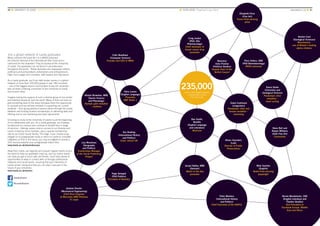
Join a global network of Leeds graduates
What connects the band Alt-J to a NASA astronaut,
the Director-General of the International Red Cross and a
cartoonist for the Guardian? They all studied at the University
of Leeds. Our graduates can be found in all professions
throughout the world – Nobel laureates and newspaper editors,
politicians and policymakers, entertainers and entrepreneurs,
High Court judges and scientists, faith leaders and Olympians.
As a Leeds graduate, you’ll join well-known names in a global
network of more than 235,000 people in over 180 countries
– one of the biggest alumni communities of any UK university –
who all share a lifelong connection to the University of Leeds
and to each other.
Imagine having the support of such a diverse group of successful
and talented people all over the world. Many of them are keen to
give something back to the place that gave them the opportunity
to succeed and are actively involved in supporting our current
students – from giving practical careers advice through the Leeds
Network and funding student scholarships, to delivering talks and
offering one-to-one mentoring and work placements.
Choosing to study at the University of Leeds is just the beginning
of our relationship with you. As a Leeds graduate, you’ll always
be welcome on campus and continue to benefit from a range
of services – lifelong careers advice, access to our libraries and
Leeds University Union facilities, plus a special membership
rate at our indoor sports facility, The Edge. If you choose to go
straight on to postgraduate study or return to Leeds to complete
a Masters or PhD in the future, you may be eligible to receive a
10% bursary towards your postgraduate tuition fees.
www.leeds.ac.uk/alumnibursary
Away from Leeds, we organise and support regular events across
the world to help our graduates meet up, and our online search
can help you get in touch with old friends. You’ll have plenty of
opportunities to keep in contact with us through professional
networks and social events, ensuring that your memories of
Leeds remain strong and that you can play a real part in the
future of your University.
www.leeds.ac.uk/alumni
/leedsalumni
@LeedsAlumni
30 ■ UNIVERSITY OF LEEDS UNDERGRADUATE PROSPECTUS 2017 ■ YOUR LEEDS Preparing for your future	 www.leeds.ac.uk ■ 31
Colin Needham
(Computer Science)
Founder and CEO of IMDb
Craig Jordan
(PhD, DSc
Pharmacology)
Chief developer of
breast cancer drug
tamoxifen
Baroness
Usha Prashar
(Political Studies)
Deputy Chair of the
British Council
Kenton Cool
(Geological Sciences)
Mountaineer,
one of Britain’s leading
alpine climbers
Ilse Howling
(International History
and Politics)
Chair, Unicef UK
Elizabeth Price
(Fine Art)
Turner Prize-winning
artist
Nicola Mendelsohn, CBE
(English Literature and
Theatre Studies)
Vice-President of
Facebook Europe, Middle
East and Africa
Piers Sellers, OBE
(PhD Biometeorology)
NASA astronaut
Alistair Brownlee, MBE
(Sports Science
and Physiology)
Olympic gold medallist
– triathlon
Dan Smith,
Bastille
(English Language
and Literature)
Musician
Claire Cashmore
(Linguistics)
Paralympic silver and
bronze medallist –
swimming
Karen Darke
(Chemistry and
Geological Science)
Paralympic silver
medallist –
hand cycling
Jacqui Oatley, MBE
(German)
Match of the Day
presenter
Alison Saunders
(Law)
Director of Public
Prosecutions
Wole Soyinka
(English)
Nobel Prize-winning
playwright
Steve Bell and
Kipper Williams
(both Fine Art)
Cartoonists
Andrew Shovlin
(Mechanical Engineering)
Chief Race Engineer
at Mercedes AMG Petronas
F1 team
Alice Levine
(English Language)
Presenter,
BBC Radio 1
Peter Wanless
(International History
and Politics)
Chief Executive of the NSPCC
235,000One of the biggest alumni
communities of any
UK university
Hage Geingob
(PhD Politics)
President of Namibia
Lisa Woodman
(Geography
and Politics)
Partnerships Manager
at the Social Publishing
Project
■ YOUR LEEDS Preparing for your future	 www.leeds.ac.uk ■ 3332 ■ UNIVERSITY OF LEEDS UNDERGRADUATE PROSPECTUS 2017
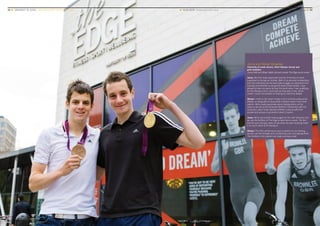
Jonny and Alistair Brownlee
University of Leeds alumni, 2012 Olympic bronze and
gold medalists
Jonny (left) and Alistair (right) pictured outside The Edge sports centre
Jonny: We both really appreciate how the University of Leeds
supported us during our studies. Both of us received scholarships
from the University and we were able to juggle our education and
training commitments so we got the best of both worlds. I was
allowed to take my exams all over the world when I was qualifying
for the Olympics and I could split my final year in two, which
meant I could concentrate on training as a full-time athlete.
Alistair: I think at 18 I wasn’t ready to be a full-time professional
athlete, so being able to study while I trained meant I had more
options. We’re really passionate about helping others do the
same so we set up the Brownlee Brothers’ Partnership with the
University, which helps talented athletes continue with their
studies and pursue a successful career in sports.
Jonny: We’ve just started training again for the next Olympics and
we use the facilities at The Edge at least twice a week. The fact
that the pool and gym were on site when we were studying made
it so much easier to fit training in.
Alistair: The 25m performance pool is perfect for our training;
we also use the strength and conditioning room and playing fields.
The facilities in the pipeline are really exciting as well.
Accommodation
Choosing a university is also about choosing a
home away from home. At the University of Leeds
we guarantee* single University accommodation
for your first year (and for all years for international
undergraduates) and we are dedicated to helping
you find the accommodation that best suits you.
We also provide a wide range of support services
to help you feel at home from day one.
Choosing your new home – things to consider
Apart from being a great introduction to student life and a
fantastic way to make new friends and feel part of our
University community, there are other benefits to living
in our accommodation.
Living with other students on different courses is a great way
to make friends and broaden your social circle. You’ll have
plenty of opportunities to get involved, as each residence has
a student-led residents’ committee that organises social events
and sporting activities during term time. Whether it’s a film night,
a trip to the great outdoors or an end-of-term ball, there’ll be
something for you.
You might want to find out who you’ll be living with before you
arrive – once your residence has been confirmed, you can check
out its Facebook group and say hello to your future neighbours.
www.leeds.ac.uk/accommodation
Around 70% of our students are allocated their first choice
of accommodation – like most other universities in the UK,
we can’t guarantee everyone their first choice.
Here are just some of the things we offer you:
• great locations – on campus, close to the city centre or in
the popular student suburbs of Headingley and Hyde Park
• a fantastic choice of accommodation – from modern,
purpose-built developments to more traditional buildings,
catered or self-catered
• a range of rents to suit different budgets
• a large number of en suites if you want private facilities,
or you can keep costs down by sharing a bathroom
• no hidden extras to pay – basic insurance cover, wi-fi,
all utility bills and off-peak gym and sports membership
are all included in your rent
• additional facilities at many sites, including common rooms,
TVs, pool tables, bars; some even have their own gym
• a safe environment, with our security service on call 24/7
• an efficient, responsive maintenance service
• advice and support from experienced wardens and resident
sub-wardens
• great customer service – we are a founding member of the
ANUK National Code of Standards, which is a quality guide
for student accommodation and fully approved by the
National Union of Students (NUS).
* Restrictions apply relating to deadlines, residence
and academic offer status. See our website for more
information about our guarantee.
■ YOUR LEEDS Accommodation Accommodation 	 www.leeds.ac.uk ■ 3534 ■ UNIVERSITY OF LEEDS UNDERGRADUATE PROSPECTUS 2017
COME AND
YOUR
F I N D
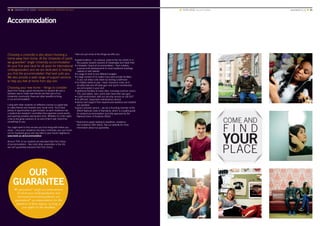
PLACE
We guarantee* single accommodation
for first-year undergraduates and
international undergraduates are
guaranteed* accommodation for the
duration of their degree, as long as
you apply by the deadline
OUR
GUARANTEE
Getting around Leeds
It’s easy to get to campus or the city centre from any of our
residences. Some are on campus, others within walking distance,
and those further away are on frequent bus routes.
Leeds has an excellent bus service, with buses running
throughout the day and into the early hours. There are cycle
routes along the main roads and bicycle storage facilities at all
residences and across campus. The University also boasts the
Velocampus scheme, which provides cycle support for students
– with low-cost bike hire, bike maintenance facilities and advice –
helping to make Leeds a cycle-friendly campus and city.
There is limited parking available at most of our residences
but there is no parking on campus due to space restrictions.
Instead, we encourage students to make use of the excellent
public transport system, which also helps to reduce our
carbon footprint.
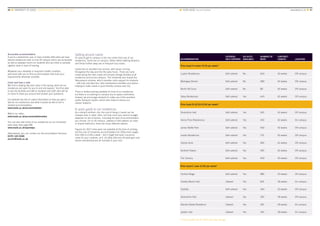
A quick guide to our residences
As a vibrant northern city, the cost of living in Leeds can be
cheaper than in other cities, but how much you need to budget
depends on lots of factors, including the type of accommodation
you choose. On or off campus, catered or self-catered, en suite
or shared bathroom, there are many different options.
Figures for 2017 entry were not available at the time of printing,
but the cost of University accommodation for 2016 entry ranges
from £83 to £194 a week – don’t forget that basic insurance
cover for your contents, wi-fi, all utility bills and off-peak gym and
sports membership are all included in your rent.
ACCOMMODATION
CATERED/
SELF-CATERED
EN SUITE
AVAILABLE
NUMBER OF
BEDS
CONTRACT
LENGTH LOCATION
Price band A (under £110 per week)*
Lupton Residences Self-catered No 640 42 weeks Off campus
Montague Burton Self-catered No 480 42 weeks Off campus
North Hill Court Self-catered No 80 42 weeks Off campus
Oxley Residences Self-catered Yes 440 42 weeks Off campus
Price band B (£110-£130 per week)*
Devonshire Hall Self-catered Yes 345 42 weeks Off campus
Henry Price Residences Self-catered Yes 355 42 weeks On campus
James Baillie Park Self-catered Yes 560 42 weeks Off campus
Leodis Residences Self-catered Yes 715 42 weeks Off campus
Liberty Dock Self-catered Yes 490 42 weeks Off campus
Sentinel Towers Self-catered Yes 240 42 weeks Off campus
The Tannery Self-catered Yes 440 43 weeks Off campus
Price band C (over £130 per week)*
Central Village Self-catered Yes 980 43 weeks Off campus
Charles Morris Hall Catered Yes 625 39 weeks On campus
CitySide Self-catered Yes 340 43 weeks Off campus
Devonshire Hall Catered Yes 250 39 weeks Off campus
Ellerslie Global Residence Catered Yes 100 39 weeks On campus
Lyddon Hall Catered Yes 150 39 weeks On campus
** Prices quoted are for 2014 and may change.
■ YOUR LEEDS Accommodation 	 www.leeds.ac.uk ■ 37
Accessible accommodation
If you’re a wheelchair user or have mobility difficulties we have
several residences both on and off campus which are accessible,
as well as adapted rooms for students who are blind or partially
sighted, deaf or hard of hearing.
Whatever your disability or long-term health condition,
we’ll work with you to find accommodation that suits your
requirements wherever possible.
Come and have a look
We hold a viewing day each year in the spring, when all our
residences are open for you to visit and explore. You’ll be able
to see the facilities and talk to students and staff, who will be
on hand to show you around and answer your questions.
Our website has lots of useful information to help you get a
feel for our residences and what it would be like to live in
student accommodation.
www.leeds.ac.uk/accommodation
Watch our video.
www.leeds.ac.uk/accommodationvideo
You can also visit some of our residences on our University
open days (see page 68).
www.leeds.ac.uk/opendays
Alternatively, you can contact our Accommodation Services.
0370 120 0189
accom@leeds.ac.uk
36 ■ UNIVERSITY OF LEEDS UNDERGRADUATE PROSPECTUS 2017
* Prices quoted are for 2016 and may change
■ YOUR LEEDS Accommodation	www.leeds.ac.uk ■ 3938 ■ UNIVERSITY OF LEEDS UNDERGRADUATE PROSPECTUS 2017
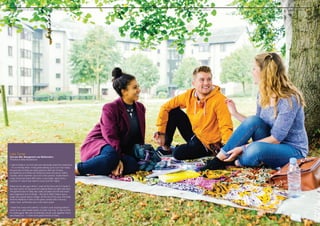
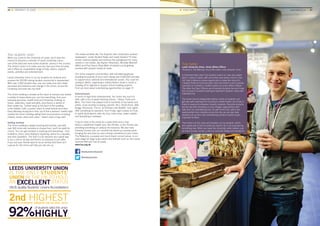
Luke Turner
2nd year BSc Management and Mathematics
Pictured at Oxley Residences
I lived at Oxley in my first year and absolutely loved the experience
– it’s so homely there. It was great waking up to such nice views;
the grounds at Oxley are really spacious with lots of trees
and greenery and there are barbecue areas and picnic tables
outside, which students use a lot in the summer. Inside there’s
a big communal space with sofas, a pool table, piano and a
massive TV, which was ideal for pizza and film nights.
Oxley has its own gym which I used all the time and it’s handy if
you play sports too because the playing fields are right next door.
The general vibe of Oxley was really sociable and the hall social
exec organised tons of things – the trip to Alton Towers was a
laugh and a good way to mingle. At the end of the year, the Oxley
Summer Blowout is held on the grass outside with a bouncy
castle, food, performers and a mini laser quest.
I loved that it was self-catered; I couldn’t cook anything before I
came to uni, well maybe beans on toast, but now, I’d like to think
I’m pretty good. Me and my flatmates would cook together which
was always fun – I made some great friends at Oxley.
YOUR CAMPUS Campus life
Our single-site campus, one of the largest in
the UK, is just a short walk from the centre
of Leeds. Our students love the fact that
everything is in one place and it’s really easy
to get around.
■ YOUR CAMPUS Campus life	www.leeds.ac.uk ■ 41
A creative and cultural campus
The University of Leeds is a creative community, with a vibrant
and distinctive cultural life. We aim to enrich your cultural
experience through our ambitious public art strategy. This sets
out how the University can engage with the arts through our
research, campus development and creative collaborations,
as well as through links with the wider community and
partnerships that reach far and wide.
There are many ways to immerse yourself in the arts, or to get
involved in performing, but if you’d rather just sit back and enjoy,
there’s no shortage of things on offer.
The Stanley  Audrey Burton Gallery
The Gallery, an Arts Council England-accredited museum,
displays innovative and contemporary art exhibitions, as well
as items from the University Art Collection. It hosts a regular
programme of temporary exhibitions and lively events, including
artist talks and art workshops. Admission is free.
FUAM Graduate Art Prize Exhibition
Hosted by the Stanley  Audrey Burton Gallery, the Friends of
University Art and Music (FUAM) Graduate Art Prize Exhibition
is one of the highlights of the region’s art calendar. It’s a great
opportunity to see the best new art of the year at a special
exhibition for recent graduates of the University’s undergraduate
fine art and design courses.
Treasures of the Brotherton Gallery
This new Gallery displays some of the most interesting,
precious and rare treasures from the Library’s Special Collections.
Visitors are encouraged to discover, explore and interact
with unique material, such as the oldest manuscripts and
printed books, maps and voyages of science, medicine and
industry, letters from the Brontës and Shakespeare’s first folio.
There are many opportunities to get involved with exhibitions
through conservation, research, curation, events and marketing.
Admission is free.
stage@leeds
Home to one of Leeds’ newest theatre venues, stage@leeds
is the University’s own theatre complex, which is open to the
public and right on campus. A contemporary performance space,
stage@leeds has excellent technical facilities and includes a
180-seat auditorium, a smaller experimental theatre and a dance
studio. stage@leeds regularly hosts a range of performances,
some by our own students and others by professional dance,
performance and theatre groups. Productions are diverse, from
Shakespeare’s Titus Andronicus to The Sun is Not for Us by Cao
Yu, which was taken to the Edinburgh Fringe and toured China.
The theatre also features NEWK (NEw and unfinished WorK),
a supportive platform for performers to test ideas at any stage
of development in front of an audience.
Theatre Group – one of the University’s longest-running
societies
The Theatre Group society gives students the chance to
write, direct, produce and star in high-quality productions –
contemporary, classical or physical work, as well as new
student writing. First-year students can shadow fellow student
directors and producers, and some go on to direct and produce
their own plays.
Recent work includes well-known pieces such as Macbeth, King
Lear and Blue Remembered Hills, as well as lesser known plays
and newly written student productions. Each year the Theatre
Group takes two productions to the Edinburgh Fringe, giving
aspiring producers, directors and actors a chance to showcase
their skills.
Leeds Poetry Centre
Our place in the history of British poetry is assured. Through our
literary collections and the work of remarkable poets who have
studied here – including Tony Harrison and Sir Geoffrey Hill –
our contribution to the field is unique.
Building on this heritage, the Leeds Poetry Centre is a
dynamic hub of research, teaching and public engagement,
offering scholarships to aspiring new poets and fostering the
enjoyment and love of poetry through outreach work in local
schools. Internationally acclaimed poets also visit the University
for regular readings and to deliver poetry masterclasses to
students and the wider community.
40 ■ UNIVERSITY OF LEEDS UNDERGRADUATE PROSPECTUS 2017
■ YOUR CAMPUS Campus life	 www.leeds.ac.uk ■ 4342 ■ UNIVERSITY OF LEEDS UNDERGRADUATE PROSPECTUS 2017
International Concert Series
Our extensive International Concert Series offers a varied
programme of performances and recitals covering a wide range
of musical genres including jazz, folk and traditional music,
classical, contemporary and avant-garde, as well as popular
music. All concerts are free for students to attend. The public
concerts take place in the Clothworkers Centenary Concert
Hall, a beautifully refurbished space. Others take place in the
University’s Great Hall – another truly impressive venue.
Sculptures and architecture
Our public art trail explores the campus and guides you around
the University’s impressive collection of public artworks, some of
which have been designed and created by our own students.
Our campus also features a variety of building styles and several
nationally listed buildings dating back four centuries – from the
landmark Parkinson Building to the Victorian Gothic Revival style
architecture of the Great Hall.
Marks  Spencer Company Archive
A company with a rich and varied past, Marks  Spencer, founded
in Leeds, has teamed up with the University to expose students to
the application of research in a commercial environment. Its living
archive is housed in the stunning purpose-built Michael Marks
building on campus. Open to the public, the archive offers
a fascinating insight into a national institution.
www.leeds.ac.uk/aroundcampus
Be part of our global community
If you choose the University of Leeds, you’ll be part of our
global community of students from over 140 countries.
We attract world-class academics with far-reaching influence who
are champions of international activity. We have links with over
400 institutions worldwide and over 6,000 international students
study with us each year. This means that you’ll graduate with a
truly global perspective – something highly valued by employers.
You’ll have the opportunity to meet new people and take part
in intercultural activities, introducing you to a world of new
ideas and experiences.
www.leeds.ac.uk/globalcommunity
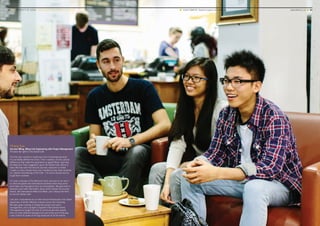
Akila Munir
2nd year BSc International Business and Finance
Pictured on an organised sightseeing trip
I’m from Mozambique and I knew that the University had a global
reputation and was part of the Russell Group, so that was perfect
for me. I completed the International Foundation Year (IFY) before
I started my degree, which was part of the reason why I wanted
to join the Intercultural Ambassadors programme. I was always
surrounded by students from around the world during my IFY and
I wanted to do something that continued to broaden my horizons.
Being an Ambassador has helped me to develop so many
transferable skills, which will help me in my academic and
professional career – skills like working as part of a team and
communicating with people from different backgrounds and
age groups.
The University was really helpful throughout the application
process and when I arrived in Leeds. They offer so many
services for international students – they’ll meet you when you
arrive in Leeds, help you arrange transport to your accommodation
and they organise lots of social events that you’ll get invited to.
The range of trips on offer are great for exploring other towns
and cities around the UK with new friends.
3 4
7 8
44 ■ UNIVERSITY OF LEEDS UNDERGRADUATE PROSPECTUS 2017 ■ YOUR CAMPUS Campus life	 www.leeds.ac.uk ■ 45
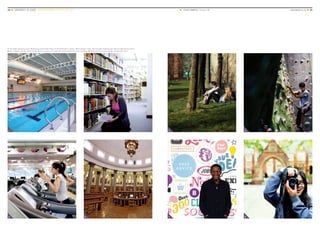
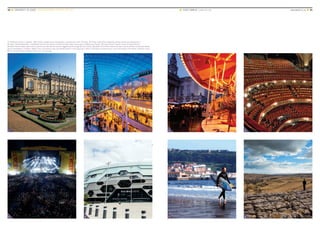
1 The Edge swimming pool / 2 Working in the lower floors of the Brotherton Library / 3 St George’s Field / 4 The Edge climbing wall / 5 The Edge fitness suite /
6 The majestic circular hall of the Brotherton Library / 7 Inside the Leeds University Union building / 8 Photography society outside Clothworkers Arch
1 2
5 6
Your students’ union
When you come to the University of Leeds, you’ll have the
chance to become a member of Leeds University Union,
one of the best and most active students’ unions in the country.
The Union’s vision is to make sure you love your time at Leeds,
and it offers an unparalleled range of help, advice, support,
events, activities and entertainment.
Leeds University Union is run by students for students and
ensures the 30,000-strong student community is represented.
With over 1,000 student reps, you can make sure your views
are heard and influence real change in the Union, across the
University and even the city itself.
The Union building is located at the heart of campus and boasts
a variety of shops where you can buy everything, from your
everyday groceries, health food and University clothing, to
books, stationery, cards and gifts, plus there’s a variety of
food outlets too. Tucked away at the back of the building
is the Hidden Café, a perfect place to meet friends and relax.
Every Monday during term time, you’ll find a farmers’ market right
outside the Union building selling fresh local produce including
cheese, bread, olives and cakes – there’s even a hog roast.
Getting involved
The Union building is always buzzing with activity, and with
over 300 clubs and societies to choose from, you’ll be spoilt for
choice. You can get involved in anything and everything – from
football to chess, wine tasting to skydiving, dance to a cappella,
and even Quidditch. The Give it a Go sessions are a great way
to try a club or society and there’s no pressure to join after.
If you and your friends want to do an activity that there isn’t
a group for, the Union will help you set one up.
The media societies like The Gryphon (the University’s student
newspaper), Leeds Student Radio and Leeds Student TV have
all won national awards and acted as the springboard for many
careers in the media. Jay Rayner (Observer), Nicholas Witchell
(BBC) and Paul Dacre (Daily Mail) all started out by getting
involved with student media at Leeds.
The Union supports communities, with volunteering groups
donating thousands of hours and raising over £300,000 annually
to support local, national and international causes. You could be
cycling to Berlin, organising a charity fashion show in Leeds or
heading off to Uganda to support school building projects.
Find out more about volunteering opportunities on page 17.
Entertainment
In terms of night-time entertainment, the Union has much to
offer, with a trio of award-winning venues – Stylus, Pulse and
Mine. The Union has played host to hundreds of top bands and
artists, more recently including Labrinth, Alt-J, Rizzle Kicks, Billy
Bragg, Disclosure, The xx, Ed Sheeran and Bastille. Club nights
offer something for everyone, from Friday night cheese at Fruity
to nights dedicated to retro hip hop, indie tunes, power ballads
and everything in between.
If you’re more in the mood for a quiet drink and a chat,
there’s a traditional English pub, the Old Bar, or the Terrace bar,
providing something on campus for everyone. We also have
Comedy Central Live, our monthly live stand-up comedy event,
bringing the very best up-and-coming comedians to your Union.
The Refectory, a popular and much-loved concert venue, is our
main stage for large-scale events and festivals such as The Leeds
Summer Ball and Live at Leeds.
www.luu.org.uk
/leedsuniversityunion
@leedsuniunion
46 ■ UNIVERSITY OF LEEDS UNDERGRADUATE PROSPECTUS 2017 ■ YOUR CAMPUS Campus life 	 www.leeds.ac.uk ■ 47
Toke Dahler
Leeds University Union, Union Affairs Officer
Pictured in The Balcony, one of the cafés in the students’ union
In Denmark there aren’t any student unions so I was very aware
when I came to Leeds, with one of the most active unions in the
UK, that it offered a unique opportunity to make the most of it.
I studied Political Communication here and there’s a lot of overlap
now that I’m involved in student politics as Union Affairs Officer.
The other five Exec Officers are all elected students too and it was
this concept of students working to represent students’ views that
interested me.
The Union has an independent advice centre so students can
get help with anything from housing to mental health; the Union is
there to respond to whatever impacts students. Recently students
led the way with donations to local refugee organisations with
help from our volunteering hub. As well as the hub, which has
opportunities from charities across the city, we can also help
students set up their own volunteering society to tackle issues
important to them.
Then there’s all the clubs and societies run by students, which
are a great way to find out what you want to do or be surprised by
something new. When you leave the University, what matters, just
as much as your course, is the co-curricular things and having fun.
■ YOUR CAMPUS Campus life	 www.leeds.ac.uk ■ 4948 ■ UNIVERSITY OF LEEDS UNDERGRADUATE PROSPECTUS 2017
Louisa Mamalis
4th year BSc Environmental Science (Industrial)
Pictured at Sports Park Weetwood during a training session
I’ve never been a particularly sporty person but when I got to uni,
I knew I really wanted to get more involved in sport. The Union
run loads of different sport societies, but because I’d played a bit
of rugby at school, Women’s Rugby Union stood out to me. I went
along to a couple of the training sessions and really enjoyed myself
and the girls were so friendly, so I became a member.
It’s just nice to have a break from your course, have a good run
around, let off a bit of steam and see some friends. We train
twice a week in the evenings so I can fit it around my course.
Every Wednesday we have a game and usually go out after.
I’ve made loads of really close friends through the society.
In the first weeks there are usually new members so we go over
catching, passing and tackling – you pick it up quite quickly.
There’s different positions you can slot yourself into as a player
– if you’re strong you can play forward, if you’re fast you can play
back. I think the women’s rugby society is really inclusive, anyone
can join, even if you’ve never played before.
Sport and fitness
Whatever your level of fitness, we provide excellent
opportunities to keep healthy and get active. So, whether you
want to participate for fun, at club level or at the highest national
or international standards, at Leeds you’ll be inspired to achieve
your personal best.
The Edge, our flagship £13.5m indoor facility, provides a variety
of fitness, sport and wellbeing opportunities including:
• 250-station state-of-the-art fitness suite – the largest in UK
higher education – complete with the latest Technogym
equipment and Sky TV
• 25m, eight-lane swimming pool with movable floor
• sauna and steam room
• squash courts
• strength and conditioning room
• three studios offering over 140 classes per week during term
time – covering everything from yoga and Pilates to circuits
and group cycle
• climbing wall.
Take the virtual tour at www.leeds.ac.uk/theedge
We also have excellent outdoor facilities at Sports Park Weetwood
including:
• a total of 51 hectares – equivalent to 50 international size
rugby pitches – making us joint top university in the UK for the
most playing field space (Higher Education Statistics Agency,
2013/14)
• floodlit five-a-side football courts
• floodlit tennis courts
• two floodlit hockey pitches (water-based and tiger-turf)
• 3G floodlit rubber crumb synthetic pitch
• 32 grass pitches (for rugby, football, lacrosse,
American football, ultimate frisbee)
• cricket squares.
If you’re looking for an adrenaline rush, we also have two
dedicated outdoor centres in the Lake District and the Yorkshire
Dales, perfectly located for hiking, caving, mountain biking
and climbing.
50 ■ UNIVERSITY OF LEEDS UNDERGRADUATE PROSPECTUS 2017
Sports programmes, leagues and clubs
If you don’t want a weekly commitment but you enjoy meeting
people and getting active, our Social Sport programme offers fun
and non-competitive sessions in a few different sports – you just
need to turn up.
Over 3,000 students participate every year in our Social Leagues,
one of the largest programmes of any UK university. Our Leagues
are a great way to play competitively with friends each week,
either on campus or at Sports Park Weetwood. Last year, we
had over 200 teams taking part and there are lots of sports to
choose from. Team champions may also have the opportunity to
represent the University in the annual Varsity event against Leeds
Beckett University.
There are over 40 sport, outdoor pursuit and martial arts clubs,
ranging from cycling, scuba diving and karate to basketball,
sailing and Thai boxing; some teams compete regularly at the
highest level in the British Universities and Colleges Sport
(BUCS) leagues. Athletes in these clubs benefit from support
services such as physiotherapy, strength and conditioning, sports
science testing, video analysis and outstanding coaching to help
them develop further. Take a look at the clubs you’re interested in
at www.leeds.ac.uk/gryphons
Leadership opportunities
Sport isn’t just about playing. We offer a range of top-quality
coaching, officiating and development courses right here
on campus, so you can deliver sport and physical activity
in the community. You could develop your team building,
communication and negotiating skills with our Emerging Leaders
programme, or you could gain nationally recognised qualifications
through our unique Sports Leadership Academy, where you’ll
gain experience of volunteering and working with children and
young people.
Sports Scholarship Programme
We support world-class athletes each year in their academic
and sporting lives through our prestigious Sports Scholarship
programme. Previous scholars on the programme include
Claire Cashmore, Paralympic silver medallist in breaststroke,
and Alistair Brownlee, MBE, Olympic gold triathalon medallist.
All elite athletes studying at the University are eligible to apply
for a sports scholarship.
www.leeds.ac.uk/gryphons
Student support and wellbeing
Exciting, exhilarating, nerve-racking, daunting
– coming to university can be many things.
But however you feel about the next chapter in
your life, it’s reassuring to know that when you
choose the University of Leeds there’s a network
of specialist services centred on you and your
wellbeing, which all work together to ensure that
any problems you have are carefully resolved.
Support services
The Student Education Service brings together support and
information services with lifestyle help and opportunities for
students. The For Students website directs you to those support
services, making it easier for you to find the right help when you
need it, as well as quick links to useful information including
money advice, health concerns, preparing for exams and
disability support.
Once you’ve started at Leeds, the Student Services Centre
counter service, located in the Marjorie and Arnold Ziff
Building, can help and advise you on a range of areas such
as accommodation, student administration, fees and funding,
registration, student ID cards and many other student enquiries.
http://students.leeds.ac.uk
Student mental health and wellbeing
We recognise that there may be times when you might
experience stress, emotional problems or upsetting life events
that make it hard to cope academically and/or personally. To help
you deal with those difficult times, we provide professional, free
and confidential counselling and mental health support. We also
promote emotional wellbeing through groups, workshops, drop-
in sessions and web-based self-help. Other activities are run
throughout the year to help you during potentially stressful times,
such as revision and exam periods.
If you have an existing moderate to severe and enduring mental
health diagnosis, we have professionals who will help you by
providing one-to-one support and developing appropriate support
plans. They’ll also act as an advocate between you and the
University and liaise with external referral agencies.
http://students.leeds.ac.uk/supportandwellbeing
Support for students with a disability, learning
difficulty or long-term medical condition
If you have a disability, learning difficulty or long-term
medical condition, we offer a comprehensive range of support
services. We’ll work with your school and other University
services to ensure that we meet your needs and put in place
any reasonable adjustments.
Support can include drop-in advice and guidance sessions,
modified examination arrangements, extended library loan
facilities and access to computers with assistive technology.
You may need to apply for additional funding for some support
(see page 65), including transcription services, sign language
interpretation and study assistance, so we have experienced staff
who can advise you on sources of funding and eligibility, and help
you fill in any forms.
You don’t need to wait until you start your course to contact us.
You can get in touch with us at any point, so we can discuss your
needs and arrange the right support for you before you get here.
http://students.leeds.ac.uk/supportandwellbeing
Student Advice Centre
Leeds University Union’s Student Advice Centre is a
professional, confidential service, providing help with
any problems you may face during your life as a student.
Although specialising in housing, money and academic
concerns, the Centre can support you with anything and
everything, and it’s important to remember that all their
help is free and completely independent of the University.
www.luu.org.uk/helpandadvice
Leeds Student Medical Practice
Leeds Student Medical Practice is an NHS practice specialising
in all aspects of student health. It’s located close to campus and
as well as the usual GP services, you can access a wide range of
specialist services including sports medicine, travel advice and
immunisation, contraception and sexual health services, and
asthma and diabetes management.
www.leedsstudentmedicalpractice.co.uk
Chaplaincy
You don’t need to have a particular faith in order to make use
of the University’s Chaplaincy; it is a place of welcome and
friendship for all and is there to support you during your time at
Leeds. You can drop into the Chaplaincy for a tea or coffee, relax
in the common room, use the dedicated spaces for meditation,
contemplation or worship, or talk in confidence to one of our
chaplains who come from a number of faith backgrounds.
www.leeds.ac.uk/chaplaincy
Childcare on campus
Bright Beginnings Childcare Centre offers a range of services
for students with children, including childcare for children
between the ages of three months and five years (pre-school)
and a playscheme during school holidays for children aged
between three and 11 years. The award-winning Centre, based
on campus, is registered with Ofsted and complies with the early
years foundation stage, so you can be sure your children will have
the very best of care while you’re studying for your degree.
www.brightbeginningschildcare.co.uk
■ YOUR CAMPUS Student support and wellbeing 	 www.leeds.ac.uk ■ 51
Keeping fit and staying healthy is an important part
of the University experience. At Leeds, you will have plenty of
opportunities to pursue all your sporting interests or perhaps
participate for the first time. We have excellent facilities and offer
a range of support, whether you want to participate for fun or at
club and elite levels.
Stewart Ross, Director of Commercial and Campus Support
Services
Support for mature and part-time students
Coming to university as a mature or part-time student can be
a very different experience to arriving directly from school or
college – a mature student is anyone aged 21 years or over on
1 September in the year they begin their studies. We know that
many mature and part-time students face unique challenges,
including balancing academic study with family and employment
commitments. For that reason, our Lifelong Learning Centre
provides specialised guidance, advice and support to mature
and part-time students, from pre-application right through to
graduation and beyond.
As a new student, you’ll be invited to a programme of welcome
events before starting your course, which will help you to find
your way around campus, to get to know the staff and other
students, and prepare you for the start of your studies.
The Centre also run social events and drop-in meetings
for mature and part-time students across the University
throughout the year, which you’ll be invited to attend.
www.leeds.ac.uk/lifelonglearningsupport
Support for international students
We are one of the most popular destinations in the UK for
international students. Each year more than 6,000 international
students from over 140 different countries choose to study
with us, making our University campus one of most diverse
and multicultural in the UK.
We have over a century of experience of welcoming international
students to our University. From the moment you accept our offer
and throughout the duration of your studies, we provide a range
of specialist services to help you with issues such as travelling
to Leeds and what to bring with you, settling in and adapting to
British culture, and extending your visa. You’ll also have many
opportunities to take part in social events, go on regular trips or
visit a host family for a weekend, ensuring you make the most of
your time in the UK.
Staff regularly travel overseas to meet with prospective students
and to give advice about life as an international student in Leeds.
You can find out whether we’ll be visiting your country in the near
future at www.leeds.ac.uk/visitstoyourcountry
For more information about all aspects of being an international
student at Leeds visit www.leeds.ac.uk/internationalstudents
Arriving in Leeds
We know that settling in at the beginning is really important for
the success of your time here, so we offer a comprehensive range
of international welcome and orientation services.
When you arrive in Leeds, our International Welcome team will
give you all the information you need to settle in during your
first few days. If you arrive in September when our free Meet
and Greet service is running, the team can meet you at Leeds
Bradford Airport or Leeds train station.
Before teaching starts in September, you’ll be invited to our
International Welcome Week, a free programme of useful
information sessions and social events. This includes an
orientation programme, welcome talks, tours, days out, café
events, film nights and a taste of what our clubs and societies
have to offer. They’re a great way to introduce you to British
culture and help you make new friends.
www.leeds.ac.uk/internationalarrival
International student societies
Students from all countries are represented in our international
student societies. It’s a great way to meet other international
students, learn about new cultures and meet new people.
www.luu.org.uk/groups
■ YOUR CAMPUS Student support and wellbeing 	 www.leeds.ac.uk ■ 5352 ■ UNIVERSITY OF LEEDS UNDERGRADUATE PROSPECTUS 2017
Chris Pritchard
4th year MEng, BEng Mechatronics and Robotics
Pictured in the National Facility for Innovative Robotic Systems
After leaving the Army as a radar engineer, I always knew I wanted
to continue with engineering. When I decided to do a degree,
I wanted a university that offered a wide range of interesting
courses and somewhere that would push me to my limits. Leeds
offered courses in Nanotechnology, and Mechatronics and
Robotics, and has made me reach further than I thought possible.
Being out of education for nearly 20 years, I decided a foundation
year would be the best place to start and I’ve never looked back.
I’ve got a great group of friends that I work closely with and we
help and support each other with assignments and workloads.
Despite my wife also doing a degree and having five children,
we’ve learned to manage our time effectively and I even manage
to get to the odd social event.
The support from the University has been amazing, especially
financially. I was awarded an engineering scholarship and obtained
a grant from the government to help with childcare costs.
Studying as a mature student was a culture shock at first but it’s
been a very positive experience, which I’ve thoroughly enjoyed.
Taking opportunities to talk to new students about my experience,
I’ve proved that it’s never too late to stretch yourself further.
■ YOUR CAMPUS Student support and wellbeing 	 www.leeds.ac.uk ■ 5554 ■ UNIVERSITY OF LEEDS UNDERGRADUATE PROSPECTUS 2017
Yihang Xue
3rd year MEng, BEng Civil Engineering with Project Management
Pictured (far right) in the Global Café
The first day I arrived in Leeds was kind of daunting because
it’s just totally different to China. Then I realised, it’s the cultural
differences that make the experience so great! When I got here
the Welcome Team suggested I go to the Global Café, which is
every Monday with free biscuits and tea; everyone is invited.
I made so many friends there and I wanted to help other students
so I started volunteering at the Café – I’d chat to people and try
to get them involved.
I’m now a member of the Welcome Team and part of my role is
to meet and greet new international students when they arrive
and make sure they get to their accommodation. We give them a
welcome pack with information about all the Global Community
events, like International Welcome Week, and I always tell them
to visit the Global Café.
Last year I volunteered as an Intercultural Ambassador and raised
awareness of all the different cultures across the University.
We were given training on things like project and event
management, and a budget to organise intercultural events.
The experience taught me how to communicate with people
from so many different backgrounds and at the end of the year
I was chosen to speak at the big showcase of all the events.
Leeds the city
Leeds is a vibrant, affordable and multicultural
city, renowned as a centre for arts, sports, leisure,
entertainment and nightlife. It has everything you
would expect from a major urban hub and is
surrounded by beautiful, accessible countryside.
With over 60,000 students living within the city
boundaries, there’s a real student focus, making it
an exciting place to live and learn.
Arts and culture
Leeds has been described as a ‘hotbed of creative cultural talent’
and enjoys a reputation for producing spectacular and innovative
shows. It’s the only UK city outside London to have its own opera
and ballet companies and boasts several theatres, including
Leeds Grand Theatre and Opera House, the Carriageworks and
West Yorkshire Playhouse, which all offer student discounts.
Places that are free to visit include Leeds City Museum and
Leeds Art Gallery. See page 41 for the many ways you can
explore art and culture on our campus.
Sport
Leeds has a great sporting tradition and was chosen as the host
city for Le Grand Départ, the start of the 2014 Tour de France.
Whatever your sport of choice, Leeds is home to some great
sporting teams, including Leeds United Football Club based at
Elland Road Stadium. Rugby fans will be spoilt for choice, with
both Leeds Rhinos rugby league and Leeds Carnegie rugby
union teams based at Headingley Carnegie Stadium, which is
also home to Yorkshire County Cricket Club and international Test
Match cricket.
If spectating isn’t enough and you want to get active, one of the
country’s biggest indoor real snow slopes is within easy reach, and
the city has plenty of gyms and health clubs, including our very
own fitness suite and swimming pool, The Edge (see page 50).
Shopping
Leeds is one of the UK’s top shopping destinations and
has an eclectic mix of high street favourites, independent
boutiques and vintage stores, all within easy walking distance.
From the beautiful architecture of the Victoria Quarter
and the Grand Arcade to the stunning domed roof of Leeds
Corn Exchange, Leeds is a true haven for anyone who wants
to shop somewhere different.
Trinity Leeds is a fantastic retail and leisure development in the
heart of the city centre, home to more than 120 national and
international brands, a cinema and a range of cafés, bars and
restaurants – including Trinity Kitchen, a unique mix of vibrant
restaurants and street food vans.
56 ■ UNIVERSITY OF LEEDS UNDERGRADUATE PROSPECTUS 2017 ■ YOUR CAMPUS Leeds the city	 www.leeds.ac.uk ■ 57
January
February
August
March
September
October
May
November
June
Black History Month The city takes part in celebrating
UK Black History Month, remembering the important
people and events throughout history that have shaped
our society today.
Light Night Leeds A spectacular celebration of Leeds’
creativity. Local artists and performers exhibit and perform
their work across the city centre; a chance for you to enjoy
some great entertainment.
Freshers’ Week Leeds University Union runs one of the
biggest Freshers’ Weeks in the country, jam-packed full of
events and fairs.
Bonfire night Leeds’ biggest bonfire and fireworks display is
held in Roundhay Park. There is also an event just around
the corner from the University at Woodhouse Moor. Both
are completely free; no tickets required.
Leeds International Film Festival The largest film festival
in England outside London, welcoming thousands of film
lovers to more than 300 screenings over 15 days at venues
across the city.
Thought Bubble The UK’s largest event of its kind – an
annual celebration of sequential art in all its forms, including
everything from superhero comics to independent and small
press artists and writers.
December
Leeds Christkindelmarkt As the city gets ready for
Christmas, Millennium Square hosts one of the largest and
most established traditional German Christmas markets in
England.
Ice Cube Leeds An open-air ice rink located right in the city
centre, along with a snowslide plus other rides and attractions.
Leeds Valentine’s Fair The UK’s biggest Valentine’s event
with thrilling fairground rides and amusements located
just outside the city centre.
Northern Art Prize Celebrates contemporary visual artists
based in the North of England. Shortlisted artists exhibit
their work at Leeds Art Gallery.
Live at Leeds A metropolitan music festival held annually
across a variety of venues in Leeds on the first bank holiday
weekend of May. Previous performers include Mumford 
Sons, Ed Sheeran, George Ezra and Rudimental.
Leeds Food and Drink Festival A two-week festival that
celebrates the Leeds independent food and drink scene.
Leeds Summer Ball A great way to round off your year
in style. Our campus is transformed as Leeds University
Union hosts a great line-up of live music acts, DJs,
performers and a range of fantastic attractions.
Leeds West Indian Carnival Western Europe’s oldest
West Indian carnival and the UK’s second largest after the
Notting Hill Carnival.
Leeds Festival Voted NME’s Best Live Event, the music
festival held in Bramham Park offers 80,000 fans a
chance to see some of the world’s biggest bands, as well
as up-and-coming artists and local bands.
Food and drink
You’re never far from a fantastic restaurant, café or pub, whether
you’re in the city centre or one of the popular student suburbs.
Many have special deals for students or early-bird menus ideal
for a student budget.
If you want to stay in and cook, Kirkgate Market in the city
centre – where Michael Marks opened his penny bazaar,
which later became Marks  Spencer – is one of the largest
undercover markets in Europe and a great place to buy cheap,
fresh groceries.
Nightlife and music
Leeds’ nightlife is legendary, with clubs and bars offering
music to suit all tastes. There are lots of live music venues in
the city, including the 13,500-capacity First Direct Arena, the
O2 Academy and Brudenell Social Club. See page 46 for more
information about Leeds University Union’s club nights, and the
many bands and artists that have graced the stages in the award-
winning Union venues and the University’s own Refectory.
Green space
Sitting in the heart of Yorkshire, Leeds is one of the greenest
cities in Britain and within easy reach of traditional towns and
cities such as York, Ilkley, Harrogate, Ripon and Bradford.
It also has many areas of natural beauty and historic interest,
including Roundhay Park, Temple Newsam, Harewood House
and Kirkstall Abbey.
The spectacular countryside – including the Lake District, the
Peak District, the Yorkshire Dales and the North York Moors –
provide the ideal environment for University groups and societies
taking part in everything from caving and kayaking to cycling and
walking. Discover more at www.yorkshire.com
Getting around
Located at the centre of the UK and enjoying excellent transport
links, Leeds is well connected to the rest of the UK by affordable,
frequent and extensive coach and rail services. You can reach
London in around two hours and Edinburgh is just three hours
away by train. Leeds Bradford Airport provides regular flights to
major international destinations.
Events
You’ll soon discover that there is always something to do in
Leeds, with the city playing host to numerous events throughout
the year such as the Leeds International Film Festival in
November, the Leeds Food and Drink Festival in May, and Leeds
Christkindelmarkt, one of the UK’s most established German
Christmas markets, during the festive period. Have a look at the
opposite page for a more detailed run down of what you can do
in Leeds throughout the year.
Visit the Leeds City Council website to find out more at
www.leeds.gov.uk/leisure
58 ■ UNIVERSITY OF LEEDS UNDERGRADUATE PROSPECTUS 2017 ■ YOUR CAMPUS Leeds the city	 www.leeds.ac.uk ■ 59
1 Harewood House, a majestic 18th-century stately home and gardens, situated just north of Leeds / 2 Trinity Leeds offers shopping, dining and leisure experiences /
3 Leeds Christkindelmarkt, a traditional German Christmas market that takes place every year in Millennium Square / 4 Leeds Grand Theatre, home of Opera North /
5 Leeds Festival takes place every summer and attracts the world’s biggest bands (Image © Giles Smith) / 6 Leeds’ First Direct Arena has seen acts as diverse as Michael Bublé,
Bruce Springsteen, Kasabian, Miley Cyrus, Ed Sheeran and Jack White perform since opening in 2013 / 7 Surfing in Scarborough, one of the jewels of the North Yorkshire coast /
8 The Yorkshire Dales National Park is on our doorstep
1 2
5 6
3 4
7 8
YOUR APPLICATION Costs to consider
Choosing the right university is an important
decision and an investment in your future.
There are two main costs to consider
at university: tuition fees and your own
living costs.
■ YOUR APPLICATION Costs to consider	 www.leeds.ac.uk ■ 61
Tuition fees for UK and EU students
The tuition fee for full-time UK and EU undergraduate students
coming to Leeds in September 2016 will be £9,000, reflecting
the high quality of a University of Leeds education. This may
increase in line with inflation in September 2017.
Our full-time extended degree courses, which include a
foundation year, are priced at the same rate, but you may qualify
for a scholarship in your first year – if you’re a UK student this will
depend on your annual household income. For more information
on our extended degree courses, see page 71.
If you intend to study part time, your tuition fee will be adjusted
based on the number of credits studied each year. For more
information about fees for part-time courses, contact the Lifelong
Learning Centre at www.leeds.ac.uk/lifelonglearning
Nursing, Midwifery and Radiography courses are only open to
UK applicants. Historically the NHS has paid the tuition fees for
these courses, but this may be subject to change for 2017 entry.
For more information visit www.nhsbsa.nhs.uk/students
You can apply for a tuition fee loan from the government to cover
the full cost of your course, or you can pay your tuition fees in full
or in instalments. For more information on student funding,
see page 64.
Tuition fees for international (non-EU) students
Tuition fees for full-time international (non-EU) undergraduate
students vary depending on the course you choose. The tuition
fees for 2017 will be confirmed in September 2016 and will be
available on our website at www.leeds.ac.uk/coursefinder
You may be able to apply for funding from your own government,
independent sponsors or from other award-paying bodies. See
page 65 for more information on the University scholarships you
may be eligible to apply for.
Living costs
Living costs include things like the cost of your accommodation,
food, transport and social activities. Leeds is a relatively low-cost
city compared to many areas of the UK, but you still need to
budget very carefully.
Leeds University Union offers lots of advice on money,
budgeting and the cost of living in Leeds at
www.luu.org.uk/helpandadvice/money
If you need to top up your income during your studies, there is a
service called Joblink, provided by Leeds University Union, where
you can find part-time work with a student-friendly and trusted
employer. Working not only puts money in your pocket, it also
helps you gain valuable experience.
If you’re an international (non-EU) student, you should check
whether your visa allows you to work part time. When you apply
for your visa, you’ll have to prove that you can support yourself
financially while in the UK. For more information visit
www.leeds.ac.uk/immigration
60 ■ UNIVERSITY OF LEEDS UNDERGRADUATE PROSPECTUS 2017
How much is a degree really worth?
Graduates, on average, earn around £200,000 more over a
lifetime than non-graduates, taking into account all the costs
involved in being a 21st-century student. The research compares
earnings and employment of individuals who have a first degree
with those who have two or more A-levels but no degree.
Department for Business, Innovation and Skills,
Research Paper 112, August 2013
■ YOUR APPLICATION Student funding	 www.leeds.ac.uk ■ 6362 ■ UNIVERSITY OF LEEDS UNDERGRADUATE PROSPECTUS 2017
Tammie Ash
3rd year MEng, BEng Civil and Structural Engineering
Pictured giving advice outside the Great Hall
I came to Leeds through Reach for Excellence, which is a scheme
that supports year 12 and 13 students who might not have
otherwise considered going to university. I attended a summer
school here as part of the programme which reinforced my
decision to come here.
When I was offered the place on my course I was also put forward
for a three-year scholarship. The extra money meant I could
afford my accommodation during the first year and also helped
me pay for field trips and equipment for my course. Last year the
scholarship enabled me to fund my work placement in London
where I knew it would be more expensive. I found it really useful
to make a spreadsheet of all my costs to see where my money was
going and where I needed to cut down.
I now work part-time for the University as a Student Ambassador
on open days and as a Student Host going into schools and talking
to young people about higher education. These were advertised
through Joblink, run by Leeds University Union. Both jobs really
help to bring in that extra bit of income and they’re really flexible
so I can fit them around my studies.
Student funding
Being able to finance your studies is an important
factor in your decision to go to university. There
are different kinds of financial support that you
may be entitled to from the UK government
and from the University of Leeds, although this
depends on your home country.
Funding from the government for UK and EU
students
Government funding is available for full- and part-time students
to help with tuition fees (UK and EU students) and living costs
(full-time UK students only).
Check our website for the most up-to-date information at
www.leeds.ac.uk/governmentsupport
Tuition fee loan
This has been designed to ensure that you don’t have to pay for
your degree up front. If you’re a UK or EU student studying for
your first degree, you can apply for a tuition fee loan from the
government to cover the full cost of your course, including any
fees for a year spent in industry or studying abroad.
Funding arrangements for those students studying for a
second degree were under review by the government at the
time of printing.
If you choose to study medicine or dentistry, you’re entitled to
the same tuition fee loan for the first four years. For UK students,
the funding arrangements for the fifth and subsequent years
were under review by the government for 2017 entry at the time
of printing. If you’re an EU student, you’ll be able to apply for a
tuition fee loan for your fifth and subsequent years.
Keep checking for updates at www.gov.uk/student-finance
Maintenance loan
You can get a maintenance loan to help with living costs;
the amount you’ll receive depends on your annual household
income and where you choose to live while you’re studying.
This loan is repayable, but you won’t have to start paying it
back until after you graduate.
Funding arrangements for students starting university in 2017
were under review by the government at the time of printing,
so keep checking for updates at www.gov.uk/student-finance
Applying for government funding
You can apply for government funding online from early 2017;
you don’t need a confirmed place at university to complete
the application.
If you’re from England, you’ll need to apply for government
funding through Student Finance England, which is responsible
for assessing the funding available to you.
www.gov.uk/student-finance
The government support package for students from elsewhere
in the UK may differ.
If you live in Scotland apply to
www.saas.gov.uk
If you live in Northern Ireland apply to
www.studentfinanceni.co.uk
If you live in Wales apply to
www.studentfinancewales.co.uk
Independent advice is available from the Money Saving Expert
website at www.moneysavingexpert.com
64 ■ UNIVERSITY OF LEEDS UNDERGRADUATE PROSPECTUS 2017 ■ YOUR APPLICATION Student funding	 www.leeds.ac.uk ■ 65
Paying it back
Repayments on your combined tuition fee and maintenance loans
are modest; you only become eligible to repay them in the April
after you graduate and only start to pay them back when you’re
earning above £21,000 a year. If your income doesn’t exceed
£21,000 a year, you’ll never have to repay the loan*.
Regardless of your course and living costs, you’ll only repay 9%
of your income over £21,000. So, for example, if you are earning
£22,000 a year, you would pay back 9% of £1,000, which works
out at about £90 per year or, put another way, less than £2
per week.
The repayment process for most people is simple as it’s
deducted automatically from your salary through the tax system.
If your salary falls below £21,000 or if you stop earning, for
example while bringing up a family, your repayments will be
automatically suspended during this time. If, after 30 years from
when you’re eligible, you haven’t managed to repay in full, any
outstanding loan will be written off, no matter how much you
still owe.
* This information is correct at time of going to print. You can
keep up to date on the latest information about repaying your
loans at www.gov.uk/repaying-your-student-loan
Funding for disabled students
Some disabled students from the UK are also eligible to apply for
a Disabled Students’ Allowance from Student Finance England
(or the equivalent organisation) to pay for academic-related
support and equipment – this doesn’t have to be paid back
and it’s not means-tested.
http://students.leeds.ac.uk/disabledstudentsfunding
Our team of Disability Coordinators can advise you on
sources of funding, eligibility and help you fill in any forms.
0113 343 3927
disability@leeds.ac.uk
Funding from us
If you have the talent, drive and potential to succeed, we want
to make sure you can study with us, whatever your financial
circumstances. We offer one of the most generous funding
packages in the country and, best of all, any funding you receive
from us does not need to be repaid.
Leeds Financial Support
We offer non-repayable financial support to UK and EU students
to help with the costs of being at University, which is linked to
annual household income. If your household income is above
the threshold, you may still be eligible for a scholarship from us
based on academic achievement.
Students with a household income of up to £42,600 can
receive financial help from us. At the time of printing,
our funding arrangements for 2017 had not been finalised.
Keep checking our website for the latest updates at
www.leeds.ac.uk/leedsfinancialsupport
Scholarships
We offer a range of prestigious scholarships which UK, EU
and international students may be eligible to apply for. Most
are based on academic achievement in certain subject areas
or on household income, but we also offer specialised sports
scholarships for elite athletes.
UK students who apply through the Access to Leeds scheme
will receive additional consideration for certain scholarships.
www.leeds.ac.uk/accesstoleeds
You can contact the admissions tutor for your course to find
out whether you are eligible to apply for a scholarship based
on academic achievement. Alternatively, a full list, including
information on eligibility criteria, deadlines and how to apply, is
available on our website. New scholarships are added throughout
the year, so keep checking for updates.
www.leeds.ac.uk/scholarships
Applying to study here
Our entry requirements
All our undergraduate courses have their own entry requirements
and unless stated, A-levels in general studies and critical thinking
are not accepted. For the most up-to-date information visit
www.leeds.ac.uk/coursefinder
If you’re an international student, more information is available at
www.leeds.ac.uk/internationalstudents
Entry requirements in this prospectus are expressed in terms of the
UK A-level system and the International Baccalaureate; however,
admissions tutors at Leeds welcome applications from students
with equivalent qualifications, which we’ve explained in the table.
Literacy and numeracy requirements
For all courses, applicants must have a minimum acceptable
level of literacy: GCSE grade C or above, or equivalent.
If you have a GCSE grade C in mathematics but the course you’re
applying for requires a higher grade, we’ll accept the Core Maths
qualification, although the grade required will depend on your
course. Some courses require a minimum GCSE mathematics
grade, or equivalent, which you can check at
www.leeds.ac.uk/coursefinder
English science A-levels
If you’re studying an English science A-level, from September
2017 you’ll need to achieve a pass in the practical assessment.
Extended Project
We recognise the value, effort and enthusiasm applicants make in the
Extended Project. Individual academic schools will decide whether
they’re going to use the Extended Project as part of their offer.
We encourage you to provide further information on your project
in your personal statement and, if invited, at interview. In some
cases, admissions tutors may make an alternative offer to an
applicant that includes successful completion of the Extended
Project – for example, AAA at A-level or AAB at A-level plus the
Extended Project. The relevant admissions team will be able to
provide further clarification on this.
Entry requirements for international applicants
If you are not able to gain the equivalent of A-level qualifications
in your own country, you should consider applying for one of our
International Foundation Year options (see page 71).
www.leeds.ac.uk/internationalfoundation
English language requirements
All candidates whose first language is not English must
gain an English language qualification. Many qualifications
are acceptable. Typical examples include GCSE or O-level
at minimum grade C, or IELTS 6 (with at least 5.5 in each
component of listening, reading, speaking and writing).
English language requirements are subject to change and vary
between courses, so you will need to check the level necessary
for your course. If you need to improve your English language
skills before you start your course, you may want to consider one
of the pre-sessional courses provided by our Language Centre.
Find out more at www.leeds.ac.uk/summerpresessionals
Visa and immigration requirements
If you are an international (non-EU) student, you will need to hold
an appropriate visa to study in the UK. Specialist immigration
advice is available on our website, which will guide you through
the visa application process at www.leeds.ac.uk/immigration
66 ■ UNIVERSITY OF LEEDS UNDERGRADUATE PROSPECTUS 2017 ■ YOUR APPLICATION Applying to study here	 www.leeds.ac.uk ■ 67
How to apply
Depending on the course you choose, there are different ways
to apply to the University of Leeds.
UCAS applications
For full-time courses starting in September 2017, with the
exception of International Foundation Year options, you apply
online through UCAS from 1 September 2016. The deadline for
applications is 15 January 2017, with the exception of Medicine
(A100) and Dental Surgery (A200) where the closing date is 15
October 2016. UCAS will acknowledge your application and let
you know the outcome. Late applications may be considered, but
you should check with the relevant admissions team before making
a late application.
International students also apply through UCAS. We have a
network of international representatives who can help you with
your application.
www.leeds.ac.uk/internationalstudents
You apply online at www.ucas.com/students/apply
Interviews and applicant visit days
If you apply through UCAS, you may be invited to an interview or
applicant visit day before you receive an offer – these are really
important as you’ll spend time in the academic department
talking to staff and students and experiencing what student life is
like at Leeds. Find out more about visiting campus on page 68.
Receiving an offer
Following the government’s reform of A-levels in England, we’ll
continue to make offers based on three A-levels or equivalent.
You won’t be disadvantaged when you apply to study at the
University of Leeds if you don’t have AS-level results.
We make offers based on the information you provide in your UCAS
application, including your personal statement and reference.
Deferred entry
We welcome applications from students who want to defer their
entry – this means applying for a course and then taking a year
out before going to university. If you would like to defer your entry,
you can state this on your UCAS application.
International Foundation Year options
You do not apply through UCAS for these courses as you apply
directly to the course provider. See page 71 for more information,
or for details on how to apply visit
www.leeds.ac.uk/internationalfoundation
Mature and part-time students
If you’re a mature student or want to study part time, the Lifelong
Learning Centre offers a free, confidential and impartial pre-entry
guidance service. Our experienced staff can also talk to you
about how you might meet the entry criteria and what support
may be available to you.
www.leeds.ac.uk/lifelonglearningadvice
Alternative admissions
Leeds has a socially diverse student community and we actively
welcome applications from students from all backgrounds. Our
admissions policy aims to provide fair and equal access to a
university education for everyone who has the potential to benefit
from it. The latest admissions policy can be downloaded at
www.leeds.ac.uk/admissionspolicy
As part of this commitment, we have developed a range of activities
to improve access and widen participation in higher education.
Access to Leeds scheme
Access to Leeds, the University’s widening access scheme,
guarantees special consideration if you have personal
circumstances that have affected your ability to demonstrate
talent and potential through grades alone. The scheme enables
our admissions tutors to consider the context surrounding your
educational achievements in order to fully understand your
potential to succeed here at Leeds.
Applicants who receive a standard offer will also receive an
Access to Leeds offer of two A-level grades (or equivalent)
below the standard offer.
To be eligible, you must be living permanently in the UK, have
the potential to study at the University of Leeds and meet two or
more of the following criteria:
• from a household with an annual income of £25,000 or less
• in the first generation of your immediate family to apply to
higher education
• your school achieved less than the national average of five A*
to C passes (including English and maths) at GCSE
• your only option is to attend a local university
• your studies have been disrupted by circumstances in your
personal, social or domestic life
• living in a geographical area with low levels of progression to
higher education
• living in or grew up in public care.
To find out more visit www.leeds.ac.uk/accesstoleeds
Alternative Entry Scheme
If you don’t have the formal qualifications for immediate entry
to a degree course, our Alternative Entry Scheme takes account
of your work and life experience. It usually involves an interview
and one or more pieces of work, set and marked by the relevant
admissions tutor. If you don’t have the required GCSEs, you may
also be asked to take tests in English and maths. The scheme
only applies to certain degrees, so contact the Lifelong Learning
Centre for more information at www.leeds.ac.uk/lifelonglearning
Extended degree courses with foundation year
See page 71 for more information about our extended degrees,
which are designed for students who don’t meet the typical entry
requirements for direct entry to one of our courses.
A-LEVEL IB
DIPLOMA
BTEC
EXTENDED
DIPLOMA†
CAMBRIDGE
PRE-U
SCOTTISH HIGHERS/
ADVANCED HIGHERS
IRISH
LEAVING
CERTIFICATE
ACCESS TO HIGHER
EDUCATION†
A*AA 36
(18-17 HL)
D*D*D* – D*DD D3 D3 D3 AA at AH and AAABB/
A at AH and AAAAB
For non-AH applicants:
AAAAAA
A1A1AAAA 60 credits overall, with
45 credits at level 3 at
distinction
AAA 35 points
(18-17 HL)
D*D*D* – DDD D3 D3 M1 AA at AH and AABBB/
A at AH and AAABB
For non-AH applicants:
AAAAAA
AAAAAA 60 credits overall, with 45
credits at level 3 with an
overall distinction and no
credits below merit
AAB 35 points
(16 HL)
DDD – DDM D3 M1 M1 AB at AH and AABBB/
A at AH and AABBB
For non-AH applicants:
AAAABB
AAAABB 60 credits overall, with 45
credits at level 3 with an
overall distinction and no
credits below merit
ABB 34 points
(16 HL)
DDM M1 M1 M1 BB at AH and AABBB/
B at AH and AAABB
For non-AH applicants:
AABBBB
AAABBB 60 credits overall, with 45
credits at level 3 with an
overall distinction and no
credits below merit
† Further subject-specific requirements may apply. For more information visit
www.leeds.ac.uk/coursefinder
Visit us and find out more
The best way to find out more about what Leeds
is like is to visit us. Every year we welcome
thousands of students at open days, on campus
tours and as part of applicant visit days. These
are a great way to explore our campus and
sample University life.
University open days
University open days are designed to help you decide where to
apply. Our open days give you a chance to find out more about
the course, attend subject presentations, speak to the academics
who would be teaching you, talk to Student Ambassadors, find
out more about where you would be living, and talk to our experts
about finance and how to apply.
You can also visit some of our student accommodation and take
tours of our students’ union building, indoor sports facility and
libraries. You’re welcome to bring others with you, including
parents and carers. As our campus is a short walk from the
city centre, you can visit Leeds too. Taking a stroll in the city
gives you a real taste of what it has to offer, from shopping and
entertainment to the many restaurants and bars.
Open days 2016
Saturday 18 June
Thursday 23 June
Friday 24 June
Saturday 10 September
Saturday 8 October
www.leeds.ac.uk/opendays
Accommodation viewing day
We hold a viewing day each year in the spring, when all our
residences are open for you to visit and explore. You’ll be able
to see the facilities and talk to students and staff, who will be on
hand to show you around and answer your questions.
www.leeds.ac.uk/accommodation
Campus tours
If you can’t attend an open day but would like to visit the
University, we offer organised campus tours throughout the
academic year. Guided by one of our current students, you’ll have
the opportunity to ask questions about life at Leeds. Depending
on when you visit, you may also be able to visit the academic
department, but you should contact the department in advance
to avoid disappointment.
Independent visits
If you’re unable to make a guided campus tour or you would
rather explore the campus on your own, you can make an
independent visit; we have a self-guided tour programme that
you can download from our website. You can visit at any time,
but remember that University buildings are not normally open
at weekends. If there is a particular academic department
you’d like to see, you should arrange this directly with the
relevant department.
Applicant visit days and interviews
If you apply to the University through UCAS you may be
invited to an interview or applicant visit day before you receive
an offer. These are really important and we encourage all
applicants to attend if they’re able to do so. It’s a more in-depth
experience than a University open day – you’ll spend more time
in the academic department talking to staff and students and
experiencing what student life is like at Leeds.
Find out more
We hope you have a chance to join us on campus. See page 74
for more information on where we are and how to find us or visit
www.leeds.ac.uk/campustours
Our website has much more information – on facilities, campus
life, student and staff profiles, and more about life in Leeds.
You will also find up-to-date fees and finance information.
www.leeds.ac.uk
For a full list of our single and joint honours courses visit
www.leeds.ac.uk/coursefinder
68 ■ UNIVERSITY OF LEEDS UNDERGRADUATE PROSPECTUS 2017 ■ YOUR APPLICATION Visit us and find out more	 www.leeds.ac.uk ■ 69
Open days 2016
Saturday 18 June
Thursday 23 June
Friday 24 June
Saturday 10 September
Saturday 8 October
www.leeds.ac.uk/opendays
YOUR STUDY
Choosing the right course is one of the most
important decisions you’ll make, so think
carefully about what you want from your
studies. Our courses are designed to offer
flexible study options and alternative routes
for those looking to return to study.
■ YOUR STUDY Our courses	 www.leeds.ac.uk ■ 71
Single honours courses
Our undergraduate single honours courses allow you to focus
in depth on one main subject, but most of these courses also
include the option to take discovery modules (see page 5).
Some of our degree courses are offered as Integrated Masters –
you undertake three years of undergraduate study with the fourth
year taught at postgraduate level, converting your undergraduate
degree to a postgraduate one. You may also be able to spend a
year in industry or studying abroad, which would mean extending
your degree by a further year. Check our website as you may
need higher qualifications to apply for these courses at
www.leeds.ac.uk/coursefinder
International Foundation Year options
There are two options for studying an International Foundation
Year that will prepare you for undergraduate study at Leeds.
The University’s International Foundation Year is a very popular
course with an exceptional pass rate. It’s an ideal solution if
you’re not able to gain the equivalent of A-level qualifications in
your own country. The course combines study skills with key
academic subjects.
On successful completion, you can progress automatically to one
of over 120 of our selected undergraduate degree courses, which
are currently available in arts, business, design, engineering,
science and joint honours.
Check our website to see if the University’s International
Foundation Year is available for your chosen course at
www.leeds.ac.uk/internationalfoundation
Alternatively, you might consider the Leeds International Study
Centre’s International Foundation Year. This will also help you
to develop the skills and knowledge you need to succeed at
university, but provides more flexible entry requirements and
an additional start date in January, as well as September.
You will be based at Leeds Beckett University campus for this
foundation year.
www.leeds.ac.uk/internationalfoundation
Part-time study
Part-time courses offer a more flexible way of achieving a degree
with less intensive study over a longer period – up to six years
for degrees that take three years full-time. Many courses are
designed so that contact time is clustered, making it possible for
study to be combined with work or family commitments.
To see if your chosen course is available to study part time, check
online or contact the Lifelong Learning Centre.
www.leeds.ac.uk/coursefinder
www.leeds.ac.uk/lifelonglearning
Joint honours courses
If you want to study more than one subject in depth, our joint
honours courses offer exciting combinations of two subjects in
one degree. We have expertise in a wide range of subjects, which
is why we can offer one of the most varied selections of joint
honours degrees in the country.
Studying a joint honours course doesn’t mean twice the work;
you’ll study the same number of credits as a single honours
student but will take fewer optional modules.
Joint honours courses vary in length, depending on which you
choose. All courses that include a modern foreign language are
either four or five years in duration, as you’ll spend time studying
abroad as part of your course. Other courses are normally three
years, unless you choose to spend an additional year studying
abroad or in industry (see page 16). You can find out how long
your chosen course is on the UCAS website or on our website at
www.leeds.ac.uk/coursefinder
There are a small number of subjects that can only be studied as
joint honours courses:
• Ancient History
• Classical Literature
• Comparative Literature
• European Studies
• Film Studies
• History and Philosophy of Science
• Russian Civilisation
For the most up-to-date information and to see what joint
honours combinations we offer go to
www.leeds.ac.uk/coursefinder or visit www.ucas.com
Extended degree courses with foundation year
If you don’t meet the typical entry requirements for direct entry
to one of our undergraduate courses, you could apply for one of
our extended degree courses, which will equip you with the skills
and knowledge you need to progress to a range of our standard
degree courses.
We offer a number of extended degree courses in a range of
subject areas – entry to these varies depending on whether
you are a UK or EU student. For more information about these
courses visit www.leeds.ac.uk/coursefinder
(and search for foundation year).
For information on how to apply to any of these courses,
see page 67.
70 ■ UNIVERSITY OF LEEDS UNDERGRADUATE PROSPECTUS 2017
Important Information
Information provided by the University such as in presentations, University brochures and the University website, is accurate at the
time of first disclosure. However, courses, University services and content of publications remain subject to change. Changes may
be necessary to comply with the requirements of accrediting bodies or to keep courses contemporary through updating practices
or areas of study. Circumstances may arise outside the reasonable control of the University, leading to required changes. Such
circumstances include, industrial action, unexpected student numbers, significant staff illness (where a course is reliant upon a
person’s expertise), unexpected lack of funding, severe weather, fire, civil disorder, political unrest, government restrictions and
serious concern with regard to the transmission of serious illness making a course unsafe to deliver. After a student has taken up a
place with the University, the University will look to give early notification of any changes and try to minimise their impact, offering
suitable alternative arrangements or forms of compensation where it believes there is a fair case to do so. Offers of a place to study
at the University will provide up to date information on courses. The latest key information on courses and entry requirements can
be found at www.leeds.ac.uk/coursefinder. Fees information can be found at www.leeds.ac.uk/yourfinances. Please check these
websites before making any decisions.
LEEDS
GENERAL
INFIRMARY
Key locations
Accommodation on campus Map no.
Charles Morris Hall
(Storm Jameson Court, Dobree and Whetton Houses)
86
Ellerslie Global Residence 22
Henry Price Residences 44
Lyddon Hall 30
Eating and drinking
Refectory 29
Leeds University Union (LUU) shops and bars 32
Libraries
Brotherton 59
Edward Boyle 83
Health Sciences, in the Worsley building 95
Laidlaw (opened 2015) 63
Main lecture theatres
Conference auditorium 100
Roger Stevens 89
Rupert Beckett (in the Michael Sadler building) 78
The University of Leeds is a single campus in the
heart of Leeds. Highlighted on the map are the
key buildings that our students use regularly.
www.leeds.ac.uk/aroundcampus
To Hyde Park and Headingley
Sport
The Edge – gym, pool, climbing wall and sports halls 101
Gryphon sports centre – sports hall and squash courts 17
Cromer Terrace – fitness centre and therapy rooms 27
Student administration
The Marjorie and Arnold Ziff building 77
Our campus
■ MAPS AND HOW TO FIND US Our campus 	 www.leeds.ac.uk ■ 7372 ■ UNIVERSITY OF LEEDS UNDERGRADUATE PROSPECTUS 2017
10-minute walk to the city
Leeds city centre map Leeds in the United Kingdom
The campus and the city
As you can see from the map below, our campus is a short,
10-minute walk from the city centre and all the attractions and
amenities it has to offer, including theatres, bars, restaurants, bus
and rail stations and more. www.leeds.ac.uk/citylife
Leeds city centre map
1km (10 to 15 minutes’ walk)
How to get here
For full details on how to get here by train, bus, car and air visit
www.leeds.ac.uk/howtofindus
City Distance Minimum travel time by train
York 24 miles 22mins
Manchester 42 miles 54mins
Newcastle 96 miles 1hr 27mins
• Leeds
• York
• Manchester
• Sheffield
• Birmingham
• Bristol
Liverpool •
Dublin •
Belfast •
Norwich •
Newcastle •
London •Cardiff •
• Southampton
• Edinburgh
• Nottingham
City Distance Minimum travel time by train
Birmingham 118 miles 1hr 55mins
London 195 miles 1hr 59mins (King’s Cross)
Edinburgh 206 miles 3hrs
NORTH
SOUTH
EASTWEST
■ MAPS AND HOW TO FIND US Leeds in the United Kingdom	 www.leeds.ac.uk ■ 7574 ■ UNIVERSITY OF LEEDS UNDERGRADUATE PROSPECTUS 2017
We’ve put this prospectus together for students looking to join
us in 2017, and it was printed in February 2016. That means,
to give you as much information as possible, the data in here
was collected and written in January 2016. It was checked
and correct at the time of printing, but for the most up-to-date
information please go to our website at www.leeds.ac.uk
where you will find the latest admissions criteria, fees and
finance information and more.
Produced by Communications, University of Leeds.
Case study photography by Mark Webster Photography except
page 12 by bigT images for the Royal Academy of Engineering,
page 27 by Simon and Simon Photography and page 43
by Victor De Jesus. The images on pages 18 and 24 were
supplied by the students featured.
Printed by Belmont Press.
Alternative formats
If you require any of the information contained
in this prospectus in an alternative format
eg Braille, large print or audio, please email
disability@leeds.ac.uk
www.leeds.ac.uk ■76 ■ UNIVERSITY OF LEEDS UNDERGRADUATE PROSPECTUS 2017
Admissions enquiries
University of Leeds
Leeds LS2 9JT
UK
+44 (0)113 343 2336
study@leeds.ac.uk
www.leeds.ac.uk/undergraduate
Open days 2016
Saturday 18 June
Thursday 23 June
Friday 24 June
Saturday 10 September
Saturday 8 October
www.leeds.ac.uk/opendays

UG Prospectus_2017_Web

  • 1.
    COME AND YOUR F IN D PLACEUndergraduate 2017
  • 2.
    Parkinson Tower The iconic landmark building ofthe University, visible from miles around First Direct Arena Leeds’ 13,500 capacity theatre-style music venue Hyde Park and Headingley Just a short walk or bus ride to the popular student suburbs in the north of the city Woodhouse Moor A large park right next to campus, perfect for chilling out or keeping fit The Edge Swimming pool, 250-station fitness suite and sports halls The Great Hall Venue for your graduation ceremony in a few years' time Leeds University Union Shops, music venues, bars, nightclubs, a supermarket and the home of our 300 clubs and societiesSt George's Field Beautiful green space to escape to, right at the heart of campus Brotherton Library Stunning historic library, one of four on campus Leeds city centre ...and all it has to offer, only a 10-minute walk from campus Leeds General Infirmary Located just south of campus and where much of the clinical teaching for medicine and healthcare students takes place www.leeds.ac.uk ■ 1 Kirkgate Market Western Campus Home to Leeds University Business School, the School of Law, Leeds Institute of Health Sciences, the Gryphon Sports Centre and the Marks & Spencer Archive The Laidlaw Library Our brand new undergraduate library, opened in spring 2015 CitySide SOUTH WEST EAST NORTH
  • 3.
    Contents Welcome to Leeds3 YOUR LEEDS 4 Be inspired 5 Outstanding learning and teaching 5 Research-based learning 5 Broadening your horizons 5 Research excellence 13 Academic facilities 14 Enrichment opportunities 16 Study abroad 16 Work experience 16 Enterprise at Leeds 17 Clubs, societies and volunteering 17 Preparing for your future 26 Leeds for Life 26 Career planning 26 Join a global network of Leeds graduates 30 Accommodation 34 Choosing your new home – things to consider 34 Getting around Leeds 36 A quick guide to our residences 37 YOUR CAMPUS 40 Campus life 41 A creative and cultural campus 41 Be part of our global community 42 Your students’ union 46 Sport and fitness 50 Student support and wellbeing 51 Leeds the city 56 YOUR APPLICATION 60 Costs to consider 61 Student funding 64 Applying to study here 66 Visit us and find out more 68 YOUR STUDY 70 Single honours courses 71 International Foundation Year options 71 Part-time study 71 Joint honours courses 71 Extended degree courses with foundation year 71 Subjects and courses Click here Maps and how to find us 72 2 ■ UNIVERSITY OF LEEDS UNDERGRADUATE PROSPECTUS 2017 Welcome to Leeds ■ Welcome to Leeds www.leeds.ac.uk ■ 3 This prospectus will give you an idea of what it’s like to be a University of Leeds student. It covers everything you need to know, including details of our courses, the opportunities available to you and the groundbreaking research happening right here on campus. You’ll also find information on things such as our facilities, student accommodation and what the city of Leeds is like, as well as how to apply. You’ll learn all about what our graduates have achieved and what our students say about studying here. For the most current information on our courses, entry requirements, fees and student funding, take a look at our website at www.leeds.ac.uk or give us a call on 0113 243 1751. It’s easy to find out more The best way to find out more is to come and visit us on one of our open days. It’s a great way to explore our campus and meet some of the staff who will be teaching you. You’ll also be able to chat to current students and find out what life is really like in our city and at our University. Important Information Information provided by the University such as in presentations, University brochures and the University website, is accurate at the time of first disclosure. However, courses, University services and content of publications remain subject to change. Changes may be necessary to comply with the requirements of accrediting bodies or to keep courses contemporary through updating practices or areas of study. Circumstances may arise outside the reasonable control of the University, leading to required changes. Such circumstances include, industrial action, unexpected student numbers, significant staff illness (where a course is reliant upon a person’s expertise), unexpected lack of funding, severe weather, fire, civil disorder, political unrest, government restrictions and serious concern with regard to the transmission of serious illness making a course unsafe to deliver. After a student has taken up a place with the University, the University will look to give early notification of any changes and try to minimise their impact, offering suitable alternative arrangements or forms of compensation where it believes there is a fair case to do so. Offers of a place to study at the University will provide up to date information on courses. The latest key information on courses and entry requirements can be found at www.leeds.ac.uk/coursefinder. Fees information can be found at www.leeds.ac.uk/yourfinances. Please check these websites before making any decisions. /universityofleeds @comingtoleeds
  • 4.
    YOUR LEEDS 4 ■UNIVERSITY OF LEEDS UNDERGRADUATE PROSPECTUS 2017 Be inspired When you enrol at Leeds, you’ll join a community of outstanding academics who share your passion for your subject and are committed to helping you learn and develop and, in time, become an expert in your own right. Our size and breadth enable us to offer you an exceptional student experience. The research-based Leeds Curriculum, combined with an unparalleled range of opportunities that complement your degree, means you can make your time with us a unique experience: one that is shaped around your individual goals, interests and career ambitions. ■ YOUR LEEDS Be inspired www.leeds.ac.uk ■ 5 We want to inspire you to be part of the next generation of highly skilled, critical thinkers – shaping the world around you in years to come. Outstanding learning and teaching We recognise that studying at university is very different to what you’ve been used to, but we’ll guide you through this transition and help you adjust to university life. We’ll work closely with you to ensure we meet your expectations, respond to your feedback and let you know what we expect in return. Our approach to learning and teaching is to develop your knowledge and skills, so you become an enquiring and critical thinker. You’ll learn how to define problems and how to go about finding answers – skills highly valued by graduate employers. You’ll be encouraged to engage with ethical issues in your subject area and understand its global and cultural influence. Our extensive research activity and the funding this brings means we can invest in the best facilities and attract staff actively engaged in pioneering research. From day one, you’ll be taught by internationally renowned and inspirational academics working at the forefront of their fields; some will have even written your textbooks and research articles. Our staff have been awarded more National Teaching Fellowships than any other university in the UK, reflecting the high quality of our teaching. You’ll be actively engaged in learning through a combination of lectures, seminars and tutorials, with additional time allocated to private study, project work, laboratory practicals or fieldwork. We have invested over £2m in a new state-of-the-art lecture capture and multimedia management system. This means you’ll be able to access video and audio recordings of many of your lectures and other learning activities through the University’s Virtual Learning Environment (VLE), so you can study at your own pace and revisit course content at any point in the year. Research-based learning Whichever subject you choose to study, research will be at the heart of your learning and you’ll be close to breakthroughs that are having a real impact in the world – sometimes even before they’ve been published. We’ll explore with you how research has influenced your subject area and the research methods that are essential to making advances. You’ll have the opportunity to use those skills and methods in your own final-year research project, giving you a chance to make your own contribution to the subject. There are lots of opportunities for you to work alongside our academics and get involved in the research happening on campus, so you’ll experience first-hand how knowledge is created. In some subjects, research placements are available right from the start of your course. Broadening your horizons Most of our courses give you the opportunity to broaden your learning by studying discovery modules. We have hundreds of discovery modules to choose from, which are grouped into 10 Discovery Themes that represent the breadth of our teaching. You could pursue your own personal interests, choose a module that is related to your course or try something completely new, while developing skills that will help prepare you for life after university. Or you could choose a discovery module learning a foreign language in your first year, to help you prepare for a year studying or working abroad (see page 16). You can explore our discovery modules at www.leeds.ac.uk/broadening
  • 5.
    6 ■ UNIVERSITYOF LEEDS UNDERGRADUATE PROSPECTUS 2017 ■ YOUR LEEDS Be inspired www.leeds.ac.uk ■ 7 Richard Cruttenden 4th year MBChB Medicine and Surgery and Intercalated Master of Research in Medicine Pictured in the Leeds Institute of Biomedical and Clinical Sciences at St James’s University Hospital The opportunities for research at Leeds are incredible and you can really push the boundaries of knowledge. This summer I did an eight-week internship at the Leeds Institute of Biomedical and Clinical Sciences looking at Photodynamic Therapy as a means of diagnosing colorectal cancer. In those eight weeks alone I learned laboratory skills, how to conduct research and how to write up and present my research findings. This year, as part of my degree, I am doing a Masters in Research. I’m conducting my research on the effects of hypoxia and high altitude on the human body. By looking at an enzyme called ACE (angiotensin-converting enzyme), we’re hoping to find ways to combat not just altitude sickness, but patients with hypoxia too. The majority of my data collection will take place on an Army medical research expedition to Dhaulagiri, Nepal. Both my supervisors are experts in their fields; they’re always on hand if I need a push in the right direction. Academics here are happy to supervise students who are interested in doing research. As part of my involvement with LEADERS, a student-run medical research society, we organise a Summer School for students who are interested in doing supervised research over the summer. Research can really help you stand out and focus on what you want to do in the future.
  • 6.
    8 ■ UNIVERSITYOF LEEDS UNDERGRADUATE PROSPECTUS 2017 ■ YOUR LEEDS Be inspired www.leeds.ac.uk ■ 9 Dr Luke Burns Teaching fellow and lecturer in Geographical Information Systems Pictured in a School of Geography seminar room My main research interests are in the application of geodemographics and Geographical Information Systems (GIS) to real-world problems. Both use information and data to make spatial decisions, often by analysing areas based on the people who live in them. When you see a new retail development, wind farm or marketing campaign, it has often been underpinned by GIS and geodemographics. For some of my research, I work with students who are on work placements as part of their course – it’s important that students see how the subject is applied in industry. We’ve worked with Huddersfield Town Football Club to map where their supporters live; the geodemographics helped them to identify other areas where they could target their marketing. I try to make my lectures interactive and use learning technology to encourage students to get involved. During my lectures students can tweet answers or ask questions, which appear live on the screen and they can vote from their mobile phones or by social media. Using social media is great as it creates a community where the conversation often continues once the lecture has finished. I’ve also designed interactive e-learning video tutorials ranging from quick ‘how to’ guides to full practical exercises – these have proved popular with students as they’re nice ‘go to’ resources that they can always refer to.
  • 7.
    10 ■ UNIVERSITYOF LEEDS UNDERGRADUATE PROSPECTUS 2017 ■ YOUR LEEDS Be inspired www.leeds.ac.uk ■ 11 Reece Parker and Joshua John 2nd year BA English Literature / BA International Development Reece (left) and Joshua (right) pictured in the newly redesigned Language Zone, part of the Language Centre Joshua: I couldn’t believe how many discovery modules there were to choose from. I knew I wanted to learn a new language and my course offers a semester abroad in Hong Kong so I chose beginners’ Mandarin to get a good grounding for that. On my course, you could continue with the discovery module throughout your studies and all the way to advanced level if you wanted to. Reece: For me, I’ve always been interested in teaching English as a foreign language and travelling the world, so I thought beginners’ Mandarin would give me a good start. I also chose computer coding and introduction to logic because I think it’s important to learn as many different skills as you can at university to help you choose a career path. Joshua: Reece was in the same seminars as me so we’d just chat to each other and became good friends. The course was challenging, but good in a way. I had to do a lot of speaking exercises with people I’d never met before, so it definitely improved my confidence in public speaking. Reece: It’s good to take a risk and use the discovery modules to find out what you like or to learn something new.
  • 8.
    Research excellence Our researchcommunity is in demand across the globe – from developing new technology and medical treatments to advising multi-million-pound organisations and influencing government policy. We have partners in industry worldwide and we work collaboratively to make the most of our vast knowledge and leading research, creating a rich, stimulating and exciting environment in which to learn. Here is a taste of some of our research, which is having far- reaching impact and informs our teaching: A cure for the common cold is one step closer Despite scientific advances, a cure for many common viruses, including the common cold, has evaded scientists – until now. A breakthrough, led by the University of Leeds in partnership with the University of York, has discovered what’s been dubbed the ‘Viral Enigma Machine’. Like the infamous German cypher machine used to encrypt wartime messages, researchers have discovered previously hidden signals within the strands of genetic material that enable viruses to assemble new particles and spread rapidly in their hosts. Not only can these codes now be read, they can be jammed – stopping a virus in its tracks. This research is still in its early stages, but it appears that many viruses, such as the common cold and polio, all use forms of the ‘Enigma Code’, potentially opening a new front in the war against viral disease. If you’re sitting down, don’t sit still New research carried out by Leeds and UCL suggests it’s best to avoid sitting still for long periods of time and that even fidgeting may offer enough of a break to make a positive difference to our health. The study, which examined data from Leeds’ own UK Women’s Cohort Study, reveals that a sedentary lifestyle could be bad for your health, even if you’re physically active. Breaks in sitting time have previously been shown to improve health but until now, no study has examined whether fidgeting may affect the link between time spent sitting down and the risk of mortality. If these simple movements are beneficial to our health, the findings also challenge perceptions that fidgeting is rude or related to poor concentration. The most carbon-dense ecosystem in Amazonia mapped for first time Areas with the highest concentration of carbon in Amazonia’s tropical forests store carbon below the ground as peat – not in trees – our researchers have found. By combining extensive satellite and field data, they estimate that more than three billion tonnes of carbon is stored in the largest area of peatland forest in Amazonia in a geological basin almost the size of England. While Amazonian forests are known to harbour large stores of carbon above the ground in trees, the findings reveal that 90% of carbon in this area is actually stored underfoot. By understanding where carbon is stored, policies can be developed to protect these ecosystems and help reduce carbon emissions caused by land use change. Listening to music using hearing aid technology Music is an important part of people’s lives and can have powerful physical, social and emotional effects. A collaborative project with Sheffield Teaching Hospitals NHS Foundation Trust is investigating how deafness, hearing impairments and the use of hearing aids affect music listening experiences. Although digital hearing aids have vastly improved, listening to music is still problematic because these aids are primarily designed to amplify speech signals. The project, Hearing Aids for Music, is looking at how people use hearing aids in different musical situations. The results will provide advice to hearing aid users, help audiologists talk about music listening issues with patients and inform the future development of hearing aids. Long-term risks of taking paracetamol underestimated Paracetamol is the most widely used painkiller worldwide. But its painkilling properties in managing acute lower back pain and chronic painful osteoarthritis have been questioned recently. Leeds led a team of UK researchers in a review of existing studies to assess links between frequent paracetamol use and adverse effects in adults. The findings suggest that doctors may have underestimated the side effects of long-term paracetamol use, particularly in relation to increased risk of heart, gastrointestinal and kidney problems. The study recommends a review to assess the effectiveness of paracetamol in common conditions, and states that future studies are needed to ensure that the side effects attributed to paracetamol don’t reflect the use of other over-the-counter painkillers. New glass technology that is impossible to counterfeit Dr Matthew Murray – winner of the prestigious 2015 Royal Academy of Engineering-ERA Foundation Entrepreneurs’ Award – is spearheading the commercialisation of a new method of counterfeit-proofing glass through his spin-out, Ultramatis. Laser technology is used to create patterns of new material in the structure of glass that are impossible to fake. These patterns can carry detailed information about where and when a product was made, so the technique could play a major role in tackling counterfeit goods in sectors such as pharmaceuticals, alcohol and perfumes that rely on glass containers. Fakes in these industries are responsible for massive financial losses and major health risks. 12 ■ UNIVERSITY OF LEEDS UNDERGRADUATE PROSPECTUS 2017 ■ YOUR LEEDS Be inspired www.leeds.ac.uk ■ 13 ■ (Left) Dr Matthew Murray, a research fellow in the University’s School of Chemical and Process Engineering, is developing a new way of counterfeit-proofing glass packaging
  • 9.
    Montana Wright 3rd yearBA Broadcast Journalism Pictured in the Laidlaw Library The Laidlaw Library is really modern and light inside, so it’s a great environment to study in. I really like the quirky individual study areas, especially the big comfy single chairs. It has all of the facilities you need and there are always spare plug sockets for your laptop and phone charger. The group study areas have extra-large PC screens, which makes it easier when you’re working on group projects. And if you need a break from studying, there’s always the café on the ground floor. I’ve never had any issues with getting any books or resources I need; there are plenty available in the libraries and there are thousands available online. The libraries on campus are open every day and most are open really late, which is great when you’ve got deadlines approaching. Finding a computer to work on is easy, as there’s clusters all over campus – some are open 24 hours, so you can use them whenever you need to. Even when I’m off campus, I use the Desktop Anywhere service to access my files and resources. The apps are really useful too; I can see my timetable, get any course announcements and book classes at The Edge wherever I am. Academic facilities We have all the facilities you’ll need to support and enhance your academic studies and we’re investing millions of pounds each year to ensure we maintain a first-class academic environment. From brand new laboratories and lecture theatres to one of the largest and most impressive libraries in the UK, you’ll find everything you need for your studies right here on campus. Visiting the campus is a great way to see the facilities on offer for yourself – see page 68 for our open day dates or go to www.leeds.ac.uk/campustours University Library Our Library is one of the major academic research libraries in the UK and attracts students and academics from around the world. Its rich and growing print and online collections, gathered over 100 years, include some of the UK’s most outstanding collections of rare books and manuscripts. As well as access to all the books you’ll need for your course, you’ll have a host of electronic resources, including 540,000 online books and more than 35,000 online journals at your fingertips, accessible from wherever you are. Four libraries on campus provide a variety of different working environments, including flexible group study areas and silent individual study spaces. They’re open seven days a week and have a variety of opening times to suit your needs. Library staff are always on hand to help, providing information and advice, as well as academic skills support, to help you develop important skills such as effective communication and time management. The new Laidlaw Library, which opened in spring 2015, has been designed specifically for undergraduate students. With 1,000 seats, dedicated IT zones and study facilities with the latest technology, including bookable rooms for group work and interactive presentation equipment, you can find a place to work that’s right for you. www.leeds.ac.uk/library Computers and IT We have some of the best computing resources in the country according to the Guardian University Guide, 2016. Our IT facilities are centred on you – a single login will give you access to all the University’s IT services, including our two mobile apps. You’ll find over 1,800 centrally provided, networked PCs available for you to use across campus; you can find them in computer clusters and in most of our cafés. These clusters have a range of opening hours, with some available 24/7, ensuring you can study when it suits you. If you would rather use your own laptop, most areas have free, high-speed wi-fi, and with our Desktop Anywhere service, you’ll always have secure access to your resources, files and a wide range of software from anywhere in the world. You’ll be provided with an email account on the Microsoft Office 365 service, offering secure access, wherever you are, to your email, calendar, contacts and tasks. As part of the Microsoft Office 365 suite of services, you can install up to five copies of Office Pro Plus completely free of charge. With our Blackboard Mobile Learn app you can access the University’s Virtual Learning Environment, where you can view announcements, get module information, participate in discussion boards and check your grades. The UniLeeds app brings together useful information, such as your personalised timetable and library record, the full library catalogue, campus maps, computer cluster availability, information from the students’ union, and much more. Our experienced IT Service Desk staff are available seven days a week to give you IT support by phone, email or in person. www.leeds.ac.uk/it The Language Centre Our Language Centre offers resources for independent language study and English language courses. If you’re an international student, our pre-sessional English language courses will help you prepare for study in the UK. English language development and academic study skills support is also available through part-time in-sessional classes and workshops, which you can do alongside your degree. Open to all students, facilities include the newly redesigned Language Zone. The Zone has learning materials in over 45 languages, including computer-assisted language learning, a dedicated space where you can study independently, an extensive collection of foreign language films and documentaries, and access to over 50 TV channels in 20 languages. If you want to practise your conversation skills, our Language Exchange Scheme can put you in touch with native speakers. www.leeds.ac.uk/languages 14 ■ UNIVERSITY OF LEEDS UNDERGRADUATE PROSPECTUS 2017 ■ YOUR LEEDS Be inspired www.leeds.ac.uk ■ 15
  • 10.
    Enrichment opportunities Your experiencehere will involve much more than your academic studies; we offer an unparalleled range of opportunities that complement your degree, helping you develop your skills and gain those important life experiences. Study abroad Most of our courses, unlike those at many universities, give you the chance to study abroad as part of your degree. We have partnerships with more than 400 universities worldwide – popular destinations include Europe, the USA, Canada, Australia, New Zealand, Singapore, Hong Kong, South Africa and Latin America. In most cases, students extend their degree by another year and spend their third year abroad. Gaining a place on the study abroad programme is competitive and depends on the grades you achieve in your first year. Studying abroad is a great way to boost your confidence and broaden your outlook on life by experiencing another culture, while making friends and having fun. Returning to University after this life-changing experience often gives our students a new perspective for their final year of study. You could also be awarded an international or European variant of your degree, which will help you stand out to employers. You don’t need to be fluent in another language to study abroad. You can choose to go to an English-speaking country or, if you want to build on existing foreign language skills or learn a new language, you can start this in your first year. If you need it, our Language Centre will provide you with advice on language learning opportunities before you go (see page 14). You won’t pay the full tuition fee for your year spent studying abroad. You’ll pay a substantially reduced fee and there may be additional financial support available if you study in Europe through the Erasmus+ scheme. www.leeds.ac.uk/studyabroad Work experience Getting practical work experience is a great way to help you decide what kind of career you might like when you graduate. As well as giving you the chance to develop your own skills, you’ll gain a real insight into working life in the public, private or voluntary sectors, either in the UK or overseas. You’ll develop commercial awareness and learn how to build professional relationships, network, deal with difficult situations and work as part of a team. It may even result in a job offer once you’ve completed your degree. There are lots of ways to experience the world of work when you choose to study with us – from a year in industry (12-month industrial work placement) to a summer internship, or shorter placements and project work that you can undertake as part of your studies. Many placements are paid, but work in the charity sector normally involves voluntary work. Courses in medicine, dentistry and healthcare have clinical or professional placements built in. Whichever option you choose, you’ll gain valuable work experience and it will look great on your CV, proving to employers that you’re experienced and motivated. Our Careers Centre will support you and provide advice and guidance to help you secure a placement (see page 26). Each year our students secure placements in a variety of different industries, including in companies such as Goldman Sachs, French Connection and Vauxhall, as well as in small to medium enterprises (SMEs) and not-for-profit organisations. Our partnership with Unilever gives our students the opportunity to undertake exclusive paid work placements and summer internships at its site in Leeds, which houses the biggest deodorant factory in Europe (see page 27). Our partnership with Marks & Spencer continues to grow and has provided over 120 unique placement opportunities for our students to engage with the business while developing their skills. A full year in industry will mean extending your degree by another year, but there is a substantially reduced tuition fee while you’re on your year in industry. If you take a work placement in Europe, there may be additional financial support available through the Erasmus+ scheme. www.leeds.ac.uk/workexperience Most of our courses offer the opportunity to study abroad or do a work placement; to find out if your chosen course does, visit www.leeds.ac.uk/coursefinder Enterprise at Leeds Enterprise is about identifying opportunities, creating ideas and putting them into practice. Whether you want to stand out in the graduate labour market, engage in enterprise education, or start a business or social enterprise, Enterprise at Leeds will help you make the most of your time with us. Our Centre for Enterprise and Entrepreneurship Studies offers 14 interesting and stimulating enterprise discovery modules (see page 5). They’re designed to enhance transferable skills such as commercial awareness, creative problem solving, team working, communication and leadership – skills highly sought after by employers. Self-employment is a career choice just like any other. The Spark initiative, our innovative business start-up support based in the Careers Centre, is there to guide you as you develop your idea into a viable business. Our experienced and dedicated team offers bespoke workshops, business advice and access to funding, networking events and mentoring support to help you through your entrepreneurial journey. You could even enter our business plan competition, with a chance to win up to £2,000 to get you started. Our innovative Year in Enterprise programme gives you the chance to take a year out to develop your business. Students receive a £5,000 bursary and have access to academic tutoring, start-up advice, business mentors, professional networks and serviced office space. Leeds University Union also has some great enterprise-focused student societies, where you can develop your skills and get practical experience by implementing your business ideas. www.leeds.ac.uk/enterprise   Clubs, societies and volunteering Your students’ union, Leeds University Union, runs over 300 student-led clubs and societies, bringing like-minded students together. Whether you want to pursue an existing interest or try something completely new, there’s something for everyone – from football to chess, wine tasting to skydiving, dance to a cappella, and even Quidditch. There’s lots more information about Leeds University Union on page 46. As well as meeting new people and having fun, you could become one of over 3,000 students at Leeds who make a difference to the lives of others each year. Volunteering is a great way to develop valuable skills, enhance your CV and broaden your life experience while studying for your degree. Whether you have a few hours to spare or much more time to volunteer, there will be something to suit your interests, skills and availability. You could tutor young people in Leeds through the Students into Schools scheme, help out with one of the University’s own sustainability projects, get involved in one of Leeds University Union’s student-led volunteering societies, or join one of the great community projects in Leeds. If you have an idea for a project that will develop your own skills and benefit others, the Leeds for Life Foundation can provide you with a cash grant to help turn your ideas into a reality. Take a look at the opportunities on offer at www.leeds.ac.uk/volunteering 16 ■ UNIVERSITY OF LEEDS UNDERGRADUATE PROSPECTUS 2017 ■ YOUR LEEDS Enrichment opportunities www.leeds.ac.uk ■ 17
  • 11.
    18 ■ UNIVERSITYOF LEEDS UNDERGRADUATE PROSPECTUS 2017 ■ YOUR LEEDS Enrichment opportunities www.leeds.ac.uk ■ 19 Alex Parker 4th year MEng, BEng Medical Engineering (International) Pictured (right) in front of the frozen Montmorency River, Quebec Leeds stood out for me because the course was just what I wanted and the opportunity to study abroad was too good to miss. In my second year I went to a study abroad talk which was really useful. I also spoke to other engineering students who had already studied abroad and they gave me lots of advice. I chose to spend my third year at Carleton University in Ottawa, Canada, as I wanted to study in an English-speaking country. I love exploring the outdoors, so I went on as many trips as I could in my free time. I visited Niagara Falls and explored Quebec with other students from all over the world and made lots of good friends who I still keep in touch with. The Study Abroad Office was really helpful throughout the application process and helped me to apply for a visa and travel grant from the government. While I was out there, my tutors kept in touch to see how I was getting on and I knew the support was there if I needed it. Studying abroad took me out of my comfort zone but it’s improved my confidence and I’d definitely recommend the experience to new students.
  • 12.
    20 ■ UNIVERSITYOF LEEDS UNDERGRADUATE PROSPECTUS 2017 ■ YOUR LEEDS Enrichment opportunities www.leeds.ac.uk ■ 21 Robert Bruce-Konuah 2nd year BA Broadcast Journalism Pictured in the Leeds Student Radio studio I was part of the News Academy in 2014 which News UK set up to help young journalists get into the profession. Whilst there I offered to help out at their conferences where students get the chance to ask top journalists difficult questions. It was through these connections that I got a summer placement at News UK headquarters. Working there was really fast paced; I didn’t know what I would be doing from one day to the next but I liked that – I went from contacting people in the House of Lords to doing my own fashion feature in The Times Results Day Supplement. My favourite part of the placement was covering the Edinburgh Fringe Festival with just a camera and microphone. I really enjoy feature writing because of the freedom it gives you and you can get your personality across in your writing style. I’ve worked alongside some really good journalists and learnt things that I can incorporate into my course. My work experience has helped me develop the writing style and content I use on my own website and also my broadcasting skills on the Leeds Student Radio show I co-host. After the placement I knew I wanted to go into broadcasting, so my advice would be to find what you’re interested in and go for it!
  • 13.
    22 ■ UNIVERSITYOF LEEDS UNDERGRADUATE PROSPECTUS 2017 ■ YOUR LEEDS Enrichment opportunities www.leeds.ac.uk ■ 23 Dominique Neilson 2nd year BSc Biotechnology with Enterprise Pictured in the Garstang Teaching Lab B I knew I wanted to continue studying science after school but I also loved business studies, so when I saw Leeds did Biotechnology with Enterprise, I knew it was the perfect mix. I get to study biology and learn how to start up a new business and the mix of both definitely helps me to stand out to employers. Enterprise has taught me to use my brain in a completely different and more creative way. I like the idea of bringing new ideas into the business place and there are students from so many different subjects on the course who all bring different perspectives. The opportunities you get from doing an enterprise module or course are unbelievable – we get to talk to enterprise ambassadors who have created successful multimillion-pound businesses. The academics are from all sorts of different backgrounds, so there are some amazing networking events where you can build on your contacts and your confidence to talk to people. Even if you don’t study enterprise but you have a business idea, you can get funding through the Centre for Enterprise and Entrepreneurship Studies. You can use the funding to kick start your business or for market research to see if your business will work.
  • 14.
    Sarah Harris 4th yearMGeol, BSc Geological Sciences (International) Pictured in Swildon’s Hole, Somerset University is about the whole experience and the social side to university life is really important to me. The societies sounded really appealing so I went to loads of Give it a Go sessions – they give you a taster of what the society does. I’ve been a member of archery, taekwondo, swing dancing and my course society. You can give as much or as little time as you want, but I get involved with the caving society the most. I’d never done caving before but it seemed like the kind of thing I’d like. On my first society caving trip I had to go through this little squeeze and had to push myself through by moving my fingers and toes – it was great and I’ve loved it ever since. Caving has definitely made me more confident and responsible, especially when I lead the caving trips. Even now in my final year I’ve just joined the hockey team – so it’s never too late. I’m always hearing about weird and wonderful societies popping up at Leeds – like Quidditch! I’d definitely recommend joining your course society, as it’s a great way of getting to know the people on your course, and go to as many Give it a Go sessions as you can. 24 ■ UNIVERSITY OF LEEDS UNDERGRADUATE PROSPECTUS 2017 ■ YOUR LEEDS Enrichment opportunities www.leeds.ac.uk ■ 25
  • 15.
    Preparing for yourfuture In an increasingly competitive job market, our degrees and your wider experience at the University of Leeds can help you stand out and secure that all-important graduate job, or prepare you for further study. Leeds for Life Leeds for Life is a University-wide initiative designed to help you make the most of student life and prepare you for your career from day one. At the heart of Leeds for Life is personal tutoring. You’ll have regular and structured meetings with your personal tutor, who will guide your academic and personal development. They’ll help you to talk clearly and confidently about your experiences and the knowledge and skills you’ve developed. Leeds for Life also brings together lots of opportunities for academic and personal development – from work experience, studying abroad, career planning and broadening your learning through discovery modules to volunteering, applying for cash grants to help fund your own projects and joining one of our hundreds of Union societies. You’ll also have access to the Leeds Network, giving you the chance to make contact with our alumni who have been there, done that and are working in the job that you want. The Leeds for Life website enables you to explore these opportunities and to record and reflect on all your experiences and achievements, helping you to become a confident, articulate and highly employable graduate. www.leeds.ac.uk/leedsforlife Career planning We encourage you to start planning for your career as soon as you get here; that’s one of the reasons our graduates are highly sought after by employers. Our courses, combined with the wealth of opportunities available outside your studies, will help you broaden your experience and develop the skills employers want – skills that will benefit their organisation. Our award-winning Careers Centre offers a range of services to help you plan your career and make well-informed decisions along the way, even after you graduate. Our experienced, qualified careers staff can help you find work experience, improve your CV and offer advice on job applications, preparing for interviews and what to do after graduation, including further study. As well as teaching accredited, career-related discovery modules (see page 5) the Careers Centre provides a daily drop-in service, one-to-one appointments and a dedicated job site advertising hundreds of vacancies targeted at University of Leeds students. Over 650 graduate recruiters target our students and visit campus each year, including: Abercrombie and Fitch The John Lewis Partnership Accenture KPMG Allen & Overy L’Oreal BAE Systems Leeds City Council Civil Service Fast Stream Pinsent Mason Deloitte M&S Emerald Group Publishing Network Rail EY Procter & Gamble European Civil Service PwC GCHQ Rolls-Royce Grant Thornton Sainsbury’s Hallmark Cards Plc Teach First HSBC Group Transport for London IBM UK Ltd Unilever www.leeds.ac.uk/careerscentre 26 ■ UNIVERSITY OF LEEDS UNDERGRADUATE PROSPECTUS 2017 ■ YOUR LEEDS Preparing for your future www.leeds.ac.uk ■ 27 James Philip 4th year MEng, BEng Chemical Engineering (Industrial) Pictured at a Unilever factory I saw the Unilever internship advertised on the University’s Virtual Learning Environment. I applied because it made the big brands like Lynx, Dove and Vaseline that I’m interested in. It was also very engineering based so really applicable to me. The University helped with practice interviews and mock assessment centres, using past Unilever questions and scenarios. During the internship Unilever wanted to increase the production in the factory, so one of my projects was to conduct a process capability study where I had to make sure their equipment could deal with the increase in volume. I found that the old batch mixers wouldn’t be able to handle the new processes, so my other project was to design a continuous process mixer. The technical skills I picked up from the placement matched up with the mathematics, engineering and science elements of my degree. I have better appreciation for the theory and calculations I study because I can put them into context on the real projects I’ve worked on. After my work placement I became an employability intern to help others, especially with the application stage, and promote how important placements are. Today’s environment can be competitive so it helps to stand out and a placement is one of the ways of doing that.
  • 16.
    28 ■ UNIVERSITYOF LEEDS UNDERGRADUATE PROSPECTUS 2017 ■ YOUR LEEDS Preparing for your future www.leeds.ac.uk ■ 29 Courtenay Bray 2nd year BA Social Policy and Crime Pictured at Armley Junk-tion Café I first heard about The Real Junk Food Project through friends who were already volunteers there and thought it was a really brilliant project to be involved in. The charity is a network of pay-as-you-feel cafés which originally started in Leeds but is now global. It aims to prevent food waste, change food policy and raise awareness of waste created by the food industry. I applied for the job as one of three managers at Armley Junk-tion, the first café created by the charity, and got the job. We serve food on a pay-as-you-feel basis and source all the food from food retailers, before it is disposed as waste. My work with the charity ties in with my course too. In lectures I can be learning about how to raise awareness of an issue and how to influence policy, and then I can go to my job and be part of a real example of something that is creating grassroots change. Volunteering is a great way to spend your time productively and not only does it help others and make you feel better about yourself, it can also give you a career to work towards. Great things can happen from people giving a bit of time.
  • 17.
    Join a globalnetwork of Leeds graduates What connects the band Alt-J to a NASA astronaut, the Director-General of the International Red Cross and a cartoonist for the Guardian? They all studied at the University of Leeds. Our graduates can be found in all professions throughout the world – Nobel laureates and newspaper editors, politicians and policymakers, entertainers and entrepreneurs, High Court judges and scientists, faith leaders and Olympians. As a Leeds graduate, you’ll join well-known names in a global network of more than 235,000 people in over 180 countries – one of the biggest alumni communities of any UK university – who all share a lifelong connection to the University of Leeds and to each other. Imagine having the support of such a diverse group of successful and talented people all over the world. Many of them are keen to give something back to the place that gave them the opportunity to succeed and are actively involved in supporting our current students – from giving practical careers advice through the Leeds Network and funding student scholarships, to delivering talks and offering one-to-one mentoring and work placements. Choosing to study at the University of Leeds is just the beginning of our relationship with you. As a Leeds graduate, you’ll always be welcome on campus and continue to benefit from a range of services – lifelong careers advice, access to our libraries and Leeds University Union facilities, plus a special membership rate at our indoor sports facility, The Edge. If you choose to go straight on to postgraduate study or return to Leeds to complete a Masters or PhD in the future, you may be eligible to receive a 10% bursary towards your postgraduate tuition fees. www.leeds.ac.uk/alumnibursary Away from Leeds, we organise and support regular events across the world to help our graduates meet up, and our online search can help you get in touch with old friends. You’ll have plenty of opportunities to keep in contact with us through professional networks and social events, ensuring that your memories of Leeds remain strong and that you can play a real part in the future of your University. www.leeds.ac.uk/alumni /leedsalumni @LeedsAlumni 30 ■ UNIVERSITY OF LEEDS UNDERGRADUATE PROSPECTUS 2017 ■ YOUR LEEDS Preparing for your future www.leeds.ac.uk ■ 31 Colin Needham (Computer Science) Founder and CEO of IMDb Craig Jordan (PhD, DSc Pharmacology) Chief developer of breast cancer drug tamoxifen Baroness Usha Prashar (Political Studies) Deputy Chair of the British Council Kenton Cool (Geological Sciences) Mountaineer, one of Britain’s leading alpine climbers Ilse Howling (International History and Politics) Chair, Unicef UK Elizabeth Price (Fine Art) Turner Prize-winning artist Nicola Mendelsohn, CBE (English Literature and Theatre Studies) Vice-President of Facebook Europe, Middle East and Africa Piers Sellers, OBE (PhD Biometeorology) NASA astronaut Alistair Brownlee, MBE (Sports Science and Physiology) Olympic gold medallist – triathlon Dan Smith, Bastille (English Language and Literature) Musician Claire Cashmore (Linguistics) Paralympic silver and bronze medallist – swimming Karen Darke (Chemistry and Geological Science) Paralympic silver medallist – hand cycling Jacqui Oatley, MBE (German) Match of the Day presenter Alison Saunders (Law) Director of Public Prosecutions Wole Soyinka (English) Nobel Prize-winning playwright Steve Bell and Kipper Williams (both Fine Art) Cartoonists Andrew Shovlin (Mechanical Engineering) Chief Race Engineer at Mercedes AMG Petronas F1 team Alice Levine (English Language) Presenter, BBC Radio 1 Peter Wanless (International History and Politics) Chief Executive of the NSPCC 235,000One of the biggest alumni communities of any UK university Hage Geingob (PhD Politics) President of Namibia Lisa Woodman (Geography and Politics) Partnerships Manager at the Social Publishing Project
  • 18.
    ■ YOUR LEEDSPreparing for your future www.leeds.ac.uk ■ 3332 ■ UNIVERSITY OF LEEDS UNDERGRADUATE PROSPECTUS 2017 Jonny and Alistair Brownlee University of Leeds alumni, 2012 Olympic bronze and gold medalists Jonny (left) and Alistair (right) pictured outside The Edge sports centre Jonny: We both really appreciate how the University of Leeds supported us during our studies. Both of us received scholarships from the University and we were able to juggle our education and training commitments so we got the best of both worlds. I was allowed to take my exams all over the world when I was qualifying for the Olympics and I could split my final year in two, which meant I could concentrate on training as a full-time athlete. Alistair: I think at 18 I wasn’t ready to be a full-time professional athlete, so being able to study while I trained meant I had more options. We’re really passionate about helping others do the same so we set up the Brownlee Brothers’ Partnership with the University, which helps talented athletes continue with their studies and pursue a successful career in sports. Jonny: We’ve just started training again for the next Olympics and we use the facilities at The Edge at least twice a week. The fact that the pool and gym were on site when we were studying made it so much easier to fit training in. Alistair: The 25m performance pool is perfect for our training; we also use the strength and conditioning room and playing fields. The facilities in the pipeline are really exciting as well.
  • 19.
    Accommodation Choosing a universityis also about choosing a home away from home. At the University of Leeds we guarantee* single University accommodation for your first year (and for all years for international undergraduates) and we are dedicated to helping you find the accommodation that best suits you. We also provide a wide range of support services to help you feel at home from day one. Choosing your new home – things to consider Apart from being a great introduction to student life and a fantastic way to make new friends and feel part of our University community, there are other benefits to living in our accommodation. Living with other students on different courses is a great way to make friends and broaden your social circle. You’ll have plenty of opportunities to get involved, as each residence has a student-led residents’ committee that organises social events and sporting activities during term time. Whether it’s a film night, a trip to the great outdoors or an end-of-term ball, there’ll be something for you. You might want to find out who you’ll be living with before you arrive – once your residence has been confirmed, you can check out its Facebook group and say hello to your future neighbours. www.leeds.ac.uk/accommodation Around 70% of our students are allocated their first choice of accommodation – like most other universities in the UK, we can’t guarantee everyone their first choice. Here are just some of the things we offer you: • great locations – on campus, close to the city centre or in the popular student suburbs of Headingley and Hyde Park • a fantastic choice of accommodation – from modern, purpose-built developments to more traditional buildings, catered or self-catered • a range of rents to suit different budgets • a large number of en suites if you want private facilities, or you can keep costs down by sharing a bathroom • no hidden extras to pay – basic insurance cover, wi-fi, all utility bills and off-peak gym and sports membership are all included in your rent • additional facilities at many sites, including common rooms, TVs, pool tables, bars; some even have their own gym • a safe environment, with our security service on call 24/7 • an efficient, responsive maintenance service • advice and support from experienced wardens and resident sub-wardens • great customer service – we are a founding member of the ANUK National Code of Standards, which is a quality guide for student accommodation and fully approved by the National Union of Students (NUS). * Restrictions apply relating to deadlines, residence and academic offer status. See our website for more information about our guarantee. ■ YOUR LEEDS Accommodation Accommodation www.leeds.ac.uk ■ 3534 ■ UNIVERSITY OF LEEDS UNDERGRADUATE PROSPECTUS 2017 COME AND YOUR F I N D PLACE We guarantee* single accommodation for first-year undergraduates and international undergraduates are guaranteed* accommodation for the duration of their degree, as long as you apply by the deadline OUR GUARANTEE
  • 20.
    Getting around Leeds It’seasy to get to campus or the city centre from any of our residences. Some are on campus, others within walking distance, and those further away are on frequent bus routes. Leeds has an excellent bus service, with buses running throughout the day and into the early hours. There are cycle routes along the main roads and bicycle storage facilities at all residences and across campus. The University also boasts the Velocampus scheme, which provides cycle support for students – with low-cost bike hire, bike maintenance facilities and advice – helping to make Leeds a cycle-friendly campus and city. There is limited parking available at most of our residences but there is no parking on campus due to space restrictions. Instead, we encourage students to make use of the excellent public transport system, which also helps to reduce our carbon footprint. A quick guide to our residences As a vibrant northern city, the cost of living in Leeds can be cheaper than in other cities, but how much you need to budget depends on lots of factors, including the type of accommodation you choose. On or off campus, catered or self-catered, en suite or shared bathroom, there are many different options. Figures for 2017 entry were not available at the time of printing, but the cost of University accommodation for 2016 entry ranges from £83 to £194 a week – don’t forget that basic insurance cover for your contents, wi-fi, all utility bills and off-peak gym and sports membership are all included in your rent. ACCOMMODATION CATERED/ SELF-CATERED EN SUITE AVAILABLE NUMBER OF BEDS CONTRACT LENGTH LOCATION Price band A (under £110 per week)* Lupton Residences Self-catered No 640 42 weeks Off campus Montague Burton Self-catered No 480 42 weeks Off campus North Hill Court Self-catered No 80 42 weeks Off campus Oxley Residences Self-catered Yes 440 42 weeks Off campus Price band B (£110-£130 per week)* Devonshire Hall Self-catered Yes 345 42 weeks Off campus Henry Price Residences Self-catered Yes 355 42 weeks On campus James Baillie Park Self-catered Yes 560 42 weeks Off campus Leodis Residences Self-catered Yes 715 42 weeks Off campus Liberty Dock Self-catered Yes 490 42 weeks Off campus Sentinel Towers Self-catered Yes 240 42 weeks Off campus The Tannery Self-catered Yes 440 43 weeks Off campus Price band C (over £130 per week)* Central Village Self-catered Yes 980 43 weeks Off campus Charles Morris Hall Catered Yes 625 39 weeks On campus CitySide Self-catered Yes 340 43 weeks Off campus Devonshire Hall Catered Yes 250 39 weeks Off campus Ellerslie Global Residence Catered Yes 100 39 weeks On campus Lyddon Hall Catered Yes 150 39 weeks On campus ** Prices quoted are for 2014 and may change. ■ YOUR LEEDS Accommodation www.leeds.ac.uk ■ 37 Accessible accommodation If you’re a wheelchair user or have mobility difficulties we have several residences both on and off campus which are accessible, as well as adapted rooms for students who are blind or partially sighted, deaf or hard of hearing. Whatever your disability or long-term health condition, we’ll work with you to find accommodation that suits your requirements wherever possible. Come and have a look We hold a viewing day each year in the spring, when all our residences are open for you to visit and explore. You’ll be able to see the facilities and talk to students and staff, who will be on hand to show you around and answer your questions. Our website has lots of useful information to help you get a feel for our residences and what it would be like to live in student accommodation. www.leeds.ac.uk/accommodation Watch our video. www.leeds.ac.uk/accommodationvideo You can also visit some of our residences on our University open days (see page 68). www.leeds.ac.uk/opendays Alternatively, you can contact our Accommodation Services. 0370 120 0189 accom@leeds.ac.uk 36 ■ UNIVERSITY OF LEEDS UNDERGRADUATE PROSPECTUS 2017 * Prices quoted are for 2016 and may change
  • 21.
    ■ YOUR LEEDSAccommodation www.leeds.ac.uk ■ 3938 ■ UNIVERSITY OF LEEDS UNDERGRADUATE PROSPECTUS 2017 Luke Turner 2nd year BSc Management and Mathematics Pictured at Oxley Residences I lived at Oxley in my first year and absolutely loved the experience – it’s so homely there. It was great waking up to such nice views; the grounds at Oxley are really spacious with lots of trees and greenery and there are barbecue areas and picnic tables outside, which students use a lot in the summer. Inside there’s a big communal space with sofas, a pool table, piano and a massive TV, which was ideal for pizza and film nights. Oxley has its own gym which I used all the time and it’s handy if you play sports too because the playing fields are right next door. The general vibe of Oxley was really sociable and the hall social exec organised tons of things – the trip to Alton Towers was a laugh and a good way to mingle. At the end of the year, the Oxley Summer Blowout is held on the grass outside with a bouncy castle, food, performers and a mini laser quest. I loved that it was self-catered; I couldn’t cook anything before I came to uni, well maybe beans on toast, but now, I’d like to think I’m pretty good. Me and my flatmates would cook together which was always fun – I made some great friends at Oxley.
  • 22.
    YOUR CAMPUS Campuslife Our single-site campus, one of the largest in the UK, is just a short walk from the centre of Leeds. Our students love the fact that everything is in one place and it’s really easy to get around. ■ YOUR CAMPUS Campus life www.leeds.ac.uk ■ 41 A creative and cultural campus The University of Leeds is a creative community, with a vibrant and distinctive cultural life. We aim to enrich your cultural experience through our ambitious public art strategy. This sets out how the University can engage with the arts through our research, campus development and creative collaborations, as well as through links with the wider community and partnerships that reach far and wide. There are many ways to immerse yourself in the arts, or to get involved in performing, but if you’d rather just sit back and enjoy, there’s no shortage of things on offer. The Stanley Audrey Burton Gallery The Gallery, an Arts Council England-accredited museum, displays innovative and contemporary art exhibitions, as well as items from the University Art Collection. It hosts a regular programme of temporary exhibitions and lively events, including artist talks and art workshops. Admission is free. FUAM Graduate Art Prize Exhibition Hosted by the Stanley Audrey Burton Gallery, the Friends of University Art and Music (FUAM) Graduate Art Prize Exhibition is one of the highlights of the region’s art calendar. It’s a great opportunity to see the best new art of the year at a special exhibition for recent graduates of the University’s undergraduate fine art and design courses. Treasures of the Brotherton Gallery This new Gallery displays some of the most interesting, precious and rare treasures from the Library’s Special Collections. Visitors are encouraged to discover, explore and interact with unique material, such as the oldest manuscripts and printed books, maps and voyages of science, medicine and industry, letters from the Brontës and Shakespeare’s first folio. There are many opportunities to get involved with exhibitions through conservation, research, curation, events and marketing. Admission is free. stage@leeds Home to one of Leeds’ newest theatre venues, stage@leeds is the University’s own theatre complex, which is open to the public and right on campus. A contemporary performance space, stage@leeds has excellent technical facilities and includes a 180-seat auditorium, a smaller experimental theatre and a dance studio. stage@leeds regularly hosts a range of performances, some by our own students and others by professional dance, performance and theatre groups. Productions are diverse, from Shakespeare’s Titus Andronicus to The Sun is Not for Us by Cao Yu, which was taken to the Edinburgh Fringe and toured China. The theatre also features NEWK (NEw and unfinished WorK), a supportive platform for performers to test ideas at any stage of development in front of an audience. Theatre Group – one of the University’s longest-running societies The Theatre Group society gives students the chance to write, direct, produce and star in high-quality productions – contemporary, classical or physical work, as well as new student writing. First-year students can shadow fellow student directors and producers, and some go on to direct and produce their own plays. Recent work includes well-known pieces such as Macbeth, King Lear and Blue Remembered Hills, as well as lesser known plays and newly written student productions. Each year the Theatre Group takes two productions to the Edinburgh Fringe, giving aspiring producers, directors and actors a chance to showcase their skills. Leeds Poetry Centre Our place in the history of British poetry is assured. Through our literary collections and the work of remarkable poets who have studied here – including Tony Harrison and Sir Geoffrey Hill – our contribution to the field is unique. Building on this heritage, the Leeds Poetry Centre is a dynamic hub of research, teaching and public engagement, offering scholarships to aspiring new poets and fostering the enjoyment and love of poetry through outreach work in local schools. Internationally acclaimed poets also visit the University for regular readings and to deliver poetry masterclasses to students and the wider community. 40 ■ UNIVERSITY OF LEEDS UNDERGRADUATE PROSPECTUS 2017
  • 23.
    ■ YOUR CAMPUSCampus life www.leeds.ac.uk ■ 4342 ■ UNIVERSITY OF LEEDS UNDERGRADUATE PROSPECTUS 2017 International Concert Series Our extensive International Concert Series offers a varied programme of performances and recitals covering a wide range of musical genres including jazz, folk and traditional music, classical, contemporary and avant-garde, as well as popular music. All concerts are free for students to attend. The public concerts take place in the Clothworkers Centenary Concert Hall, a beautifully refurbished space. Others take place in the University’s Great Hall – another truly impressive venue. Sculptures and architecture Our public art trail explores the campus and guides you around the University’s impressive collection of public artworks, some of which have been designed and created by our own students. Our campus also features a variety of building styles and several nationally listed buildings dating back four centuries – from the landmark Parkinson Building to the Victorian Gothic Revival style architecture of the Great Hall. Marks Spencer Company Archive A company with a rich and varied past, Marks Spencer, founded in Leeds, has teamed up with the University to expose students to the application of research in a commercial environment. Its living archive is housed in the stunning purpose-built Michael Marks building on campus. Open to the public, the archive offers a fascinating insight into a national institution. www.leeds.ac.uk/aroundcampus Be part of our global community If you choose the University of Leeds, you’ll be part of our global community of students from over 140 countries. We attract world-class academics with far-reaching influence who are champions of international activity. We have links with over 400 institutions worldwide and over 6,000 international students study with us each year. This means that you’ll graduate with a truly global perspective – something highly valued by employers. You’ll have the opportunity to meet new people and take part in intercultural activities, introducing you to a world of new ideas and experiences. www.leeds.ac.uk/globalcommunity Akila Munir 2nd year BSc International Business and Finance Pictured on an organised sightseeing trip I’m from Mozambique and I knew that the University had a global reputation and was part of the Russell Group, so that was perfect for me. I completed the International Foundation Year (IFY) before I started my degree, which was part of the reason why I wanted to join the Intercultural Ambassadors programme. I was always surrounded by students from around the world during my IFY and I wanted to do something that continued to broaden my horizons. Being an Ambassador has helped me to develop so many transferable skills, which will help me in my academic and professional career – skills like working as part of a team and communicating with people from different backgrounds and age groups. The University was really helpful throughout the application process and when I arrived in Leeds. They offer so many services for international students – they’ll meet you when you arrive in Leeds, help you arrange transport to your accommodation and they organise lots of social events that you’ll get invited to. The range of trips on offer are great for exploring other towns and cities around the UK with new friends.
  • 24.
    3 4 7 8 44■ UNIVERSITY OF LEEDS UNDERGRADUATE PROSPECTUS 2017 ■ YOUR CAMPUS Campus life www.leeds.ac.uk ■ 45 1 The Edge swimming pool / 2 Working in the lower floors of the Brotherton Library / 3 St George’s Field / 4 The Edge climbing wall / 5 The Edge fitness suite / 6 The majestic circular hall of the Brotherton Library / 7 Inside the Leeds University Union building / 8 Photography society outside Clothworkers Arch 1 2 5 6
  • 25.
    Your students’ union Whenyou come to the University of Leeds, you’ll have the chance to become a member of Leeds University Union, one of the best and most active students’ unions in the country. The Union’s vision is to make sure you love your time at Leeds, and it offers an unparalleled range of help, advice, support, events, activities and entertainment. Leeds University Union is run by students for students and ensures the 30,000-strong student community is represented. With over 1,000 student reps, you can make sure your views are heard and influence real change in the Union, across the University and even the city itself. The Union building is located at the heart of campus and boasts a variety of shops where you can buy everything, from your everyday groceries, health food and University clothing, to books, stationery, cards and gifts, plus there’s a variety of food outlets too. Tucked away at the back of the building is the Hidden Café, a perfect place to meet friends and relax. Every Monday during term time, you’ll find a farmers’ market right outside the Union building selling fresh local produce including cheese, bread, olives and cakes – there’s even a hog roast. Getting involved The Union building is always buzzing with activity, and with over 300 clubs and societies to choose from, you’ll be spoilt for choice. You can get involved in anything and everything – from football to chess, wine tasting to skydiving, dance to a cappella, and even Quidditch. The Give it a Go sessions are a great way to try a club or society and there’s no pressure to join after. If you and your friends want to do an activity that there isn’t a group for, the Union will help you set one up. The media societies like The Gryphon (the University’s student newspaper), Leeds Student Radio and Leeds Student TV have all won national awards and acted as the springboard for many careers in the media. Jay Rayner (Observer), Nicholas Witchell (BBC) and Paul Dacre (Daily Mail) all started out by getting involved with student media at Leeds. The Union supports communities, with volunteering groups donating thousands of hours and raising over £300,000 annually to support local, national and international causes. You could be cycling to Berlin, organising a charity fashion show in Leeds or heading off to Uganda to support school building projects. Find out more about volunteering opportunities on page 17. Entertainment In terms of night-time entertainment, the Union has much to offer, with a trio of award-winning venues – Stylus, Pulse and Mine. The Union has played host to hundreds of top bands and artists, more recently including Labrinth, Alt-J, Rizzle Kicks, Billy Bragg, Disclosure, The xx, Ed Sheeran and Bastille. Club nights offer something for everyone, from Friday night cheese at Fruity to nights dedicated to retro hip hop, indie tunes, power ballads and everything in between. If you’re more in the mood for a quiet drink and a chat, there’s a traditional English pub, the Old Bar, or the Terrace bar, providing something on campus for everyone. We also have Comedy Central Live, our monthly live stand-up comedy event, bringing the very best up-and-coming comedians to your Union. The Refectory, a popular and much-loved concert venue, is our main stage for large-scale events and festivals such as The Leeds Summer Ball and Live at Leeds. www.luu.org.uk /leedsuniversityunion @leedsuniunion 46 ■ UNIVERSITY OF LEEDS UNDERGRADUATE PROSPECTUS 2017 ■ YOUR CAMPUS Campus life www.leeds.ac.uk ■ 47 Toke Dahler Leeds University Union, Union Affairs Officer Pictured in The Balcony, one of the cafés in the students’ union In Denmark there aren’t any student unions so I was very aware when I came to Leeds, with one of the most active unions in the UK, that it offered a unique opportunity to make the most of it. I studied Political Communication here and there’s a lot of overlap now that I’m involved in student politics as Union Affairs Officer. The other five Exec Officers are all elected students too and it was this concept of students working to represent students’ views that interested me. The Union has an independent advice centre so students can get help with anything from housing to mental health; the Union is there to respond to whatever impacts students. Recently students led the way with donations to local refugee organisations with help from our volunteering hub. As well as the hub, which has opportunities from charities across the city, we can also help students set up their own volunteering society to tackle issues important to them. Then there’s all the clubs and societies run by students, which are a great way to find out what you want to do or be surprised by something new. When you leave the University, what matters, just as much as your course, is the co-curricular things and having fun.
  • 26.
    ■ YOUR CAMPUSCampus life www.leeds.ac.uk ■ 4948 ■ UNIVERSITY OF LEEDS UNDERGRADUATE PROSPECTUS 2017 Louisa Mamalis 4th year BSc Environmental Science (Industrial) Pictured at Sports Park Weetwood during a training session I’ve never been a particularly sporty person but when I got to uni, I knew I really wanted to get more involved in sport. The Union run loads of different sport societies, but because I’d played a bit of rugby at school, Women’s Rugby Union stood out to me. I went along to a couple of the training sessions and really enjoyed myself and the girls were so friendly, so I became a member. It’s just nice to have a break from your course, have a good run around, let off a bit of steam and see some friends. We train twice a week in the evenings so I can fit it around my course. Every Wednesday we have a game and usually go out after. I’ve made loads of really close friends through the society. In the first weeks there are usually new members so we go over catching, passing and tackling – you pick it up quite quickly. There’s different positions you can slot yourself into as a player – if you’re strong you can play forward, if you’re fast you can play back. I think the women’s rugby society is really inclusive, anyone can join, even if you’ve never played before.
  • 27.
    Sport and fitness Whateveryour level of fitness, we provide excellent opportunities to keep healthy and get active. So, whether you want to participate for fun, at club level or at the highest national or international standards, at Leeds you’ll be inspired to achieve your personal best. The Edge, our flagship £13.5m indoor facility, provides a variety of fitness, sport and wellbeing opportunities including: • 250-station state-of-the-art fitness suite – the largest in UK higher education – complete with the latest Technogym equipment and Sky TV • 25m, eight-lane swimming pool with movable floor • sauna and steam room • squash courts • strength and conditioning room • three studios offering over 140 classes per week during term time – covering everything from yoga and Pilates to circuits and group cycle • climbing wall. Take the virtual tour at www.leeds.ac.uk/theedge We also have excellent outdoor facilities at Sports Park Weetwood including: • a total of 51 hectares – equivalent to 50 international size rugby pitches – making us joint top university in the UK for the most playing field space (Higher Education Statistics Agency, 2013/14) • floodlit five-a-side football courts • floodlit tennis courts • two floodlit hockey pitches (water-based and tiger-turf) • 3G floodlit rubber crumb synthetic pitch • 32 grass pitches (for rugby, football, lacrosse, American football, ultimate frisbee) • cricket squares. If you’re looking for an adrenaline rush, we also have two dedicated outdoor centres in the Lake District and the Yorkshire Dales, perfectly located for hiking, caving, mountain biking and climbing. 50 ■ UNIVERSITY OF LEEDS UNDERGRADUATE PROSPECTUS 2017 Sports programmes, leagues and clubs If you don’t want a weekly commitment but you enjoy meeting people and getting active, our Social Sport programme offers fun and non-competitive sessions in a few different sports – you just need to turn up. Over 3,000 students participate every year in our Social Leagues, one of the largest programmes of any UK university. Our Leagues are a great way to play competitively with friends each week, either on campus or at Sports Park Weetwood. Last year, we had over 200 teams taking part and there are lots of sports to choose from. Team champions may also have the opportunity to represent the University in the annual Varsity event against Leeds Beckett University. There are over 40 sport, outdoor pursuit and martial arts clubs, ranging from cycling, scuba diving and karate to basketball, sailing and Thai boxing; some teams compete regularly at the highest level in the British Universities and Colleges Sport (BUCS) leagues. Athletes in these clubs benefit from support services such as physiotherapy, strength and conditioning, sports science testing, video analysis and outstanding coaching to help them develop further. Take a look at the clubs you’re interested in at www.leeds.ac.uk/gryphons Leadership opportunities Sport isn’t just about playing. We offer a range of top-quality coaching, officiating and development courses right here on campus, so you can deliver sport and physical activity in the community. You could develop your team building, communication and negotiating skills with our Emerging Leaders programme, or you could gain nationally recognised qualifications through our unique Sports Leadership Academy, where you’ll gain experience of volunteering and working with children and young people. Sports Scholarship Programme We support world-class athletes each year in their academic and sporting lives through our prestigious Sports Scholarship programme. Previous scholars on the programme include Claire Cashmore, Paralympic silver medallist in breaststroke, and Alistair Brownlee, MBE, Olympic gold triathalon medallist. All elite athletes studying at the University are eligible to apply for a sports scholarship. www.leeds.ac.uk/gryphons Student support and wellbeing Exciting, exhilarating, nerve-racking, daunting – coming to university can be many things. But however you feel about the next chapter in your life, it’s reassuring to know that when you choose the University of Leeds there’s a network of specialist services centred on you and your wellbeing, which all work together to ensure that any problems you have are carefully resolved. Support services The Student Education Service brings together support and information services with lifestyle help and opportunities for students. The For Students website directs you to those support services, making it easier for you to find the right help when you need it, as well as quick links to useful information including money advice, health concerns, preparing for exams and disability support. Once you’ve started at Leeds, the Student Services Centre counter service, located in the Marjorie and Arnold Ziff Building, can help and advise you on a range of areas such as accommodation, student administration, fees and funding, registration, student ID cards and many other student enquiries. http://students.leeds.ac.uk Student mental health and wellbeing We recognise that there may be times when you might experience stress, emotional problems or upsetting life events that make it hard to cope academically and/or personally. To help you deal with those difficult times, we provide professional, free and confidential counselling and mental health support. We also promote emotional wellbeing through groups, workshops, drop- in sessions and web-based self-help. Other activities are run throughout the year to help you during potentially stressful times, such as revision and exam periods. If you have an existing moderate to severe and enduring mental health diagnosis, we have professionals who will help you by providing one-to-one support and developing appropriate support plans. They’ll also act as an advocate between you and the University and liaise with external referral agencies. http://students.leeds.ac.uk/supportandwellbeing Support for students with a disability, learning difficulty or long-term medical condition If you have a disability, learning difficulty or long-term medical condition, we offer a comprehensive range of support services. We’ll work with your school and other University services to ensure that we meet your needs and put in place any reasonable adjustments. Support can include drop-in advice and guidance sessions, modified examination arrangements, extended library loan facilities and access to computers with assistive technology. You may need to apply for additional funding for some support (see page 65), including transcription services, sign language interpretation and study assistance, so we have experienced staff who can advise you on sources of funding and eligibility, and help you fill in any forms. You don’t need to wait until you start your course to contact us. You can get in touch with us at any point, so we can discuss your needs and arrange the right support for you before you get here. http://students.leeds.ac.uk/supportandwellbeing Student Advice Centre Leeds University Union’s Student Advice Centre is a professional, confidential service, providing help with any problems you may face during your life as a student. Although specialising in housing, money and academic concerns, the Centre can support you with anything and everything, and it’s important to remember that all their help is free and completely independent of the University. www.luu.org.uk/helpandadvice Leeds Student Medical Practice Leeds Student Medical Practice is an NHS practice specialising in all aspects of student health. It’s located close to campus and as well as the usual GP services, you can access a wide range of specialist services including sports medicine, travel advice and immunisation, contraception and sexual health services, and asthma and diabetes management. www.leedsstudentmedicalpractice.co.uk Chaplaincy You don’t need to have a particular faith in order to make use of the University’s Chaplaincy; it is a place of welcome and friendship for all and is there to support you during your time at Leeds. You can drop into the Chaplaincy for a tea or coffee, relax in the common room, use the dedicated spaces for meditation, contemplation or worship, or talk in confidence to one of our chaplains who come from a number of faith backgrounds. www.leeds.ac.uk/chaplaincy Childcare on campus Bright Beginnings Childcare Centre offers a range of services for students with children, including childcare for children between the ages of three months and five years (pre-school) and a playscheme during school holidays for children aged between three and 11 years. The award-winning Centre, based on campus, is registered with Ofsted and complies with the early years foundation stage, so you can be sure your children will have the very best of care while you’re studying for your degree. www.brightbeginningschildcare.co.uk ■ YOUR CAMPUS Student support and wellbeing www.leeds.ac.uk ■ 51 Keeping fit and staying healthy is an important part of the University experience. At Leeds, you will have plenty of opportunities to pursue all your sporting interests or perhaps participate for the first time. We have excellent facilities and offer a range of support, whether you want to participate for fun or at club and elite levels. Stewart Ross, Director of Commercial and Campus Support Services
  • 28.
    Support for matureand part-time students Coming to university as a mature or part-time student can be a very different experience to arriving directly from school or college – a mature student is anyone aged 21 years or over on 1 September in the year they begin their studies. We know that many mature and part-time students face unique challenges, including balancing academic study with family and employment commitments. For that reason, our Lifelong Learning Centre provides specialised guidance, advice and support to mature and part-time students, from pre-application right through to graduation and beyond. As a new student, you’ll be invited to a programme of welcome events before starting your course, which will help you to find your way around campus, to get to know the staff and other students, and prepare you for the start of your studies. The Centre also run social events and drop-in meetings for mature and part-time students across the University throughout the year, which you’ll be invited to attend. www.leeds.ac.uk/lifelonglearningsupport Support for international students We are one of the most popular destinations in the UK for international students. Each year more than 6,000 international students from over 140 different countries choose to study with us, making our University campus one of most diverse and multicultural in the UK. We have over a century of experience of welcoming international students to our University. From the moment you accept our offer and throughout the duration of your studies, we provide a range of specialist services to help you with issues such as travelling to Leeds and what to bring with you, settling in and adapting to British culture, and extending your visa. You’ll also have many opportunities to take part in social events, go on regular trips or visit a host family for a weekend, ensuring you make the most of your time in the UK. Staff regularly travel overseas to meet with prospective students and to give advice about life as an international student in Leeds. You can find out whether we’ll be visiting your country in the near future at www.leeds.ac.uk/visitstoyourcountry For more information about all aspects of being an international student at Leeds visit www.leeds.ac.uk/internationalstudents Arriving in Leeds We know that settling in at the beginning is really important for the success of your time here, so we offer a comprehensive range of international welcome and orientation services. When you arrive in Leeds, our International Welcome team will give you all the information you need to settle in during your first few days. If you arrive in September when our free Meet and Greet service is running, the team can meet you at Leeds Bradford Airport or Leeds train station. Before teaching starts in September, you’ll be invited to our International Welcome Week, a free programme of useful information sessions and social events. This includes an orientation programme, welcome talks, tours, days out, café events, film nights and a taste of what our clubs and societies have to offer. They’re a great way to introduce you to British culture and help you make new friends. www.leeds.ac.uk/internationalarrival International student societies Students from all countries are represented in our international student societies. It’s a great way to meet other international students, learn about new cultures and meet new people. www.luu.org.uk/groups ■ YOUR CAMPUS Student support and wellbeing www.leeds.ac.uk ■ 5352 ■ UNIVERSITY OF LEEDS UNDERGRADUATE PROSPECTUS 2017 Chris Pritchard 4th year MEng, BEng Mechatronics and Robotics Pictured in the National Facility for Innovative Robotic Systems After leaving the Army as a radar engineer, I always knew I wanted to continue with engineering. When I decided to do a degree, I wanted a university that offered a wide range of interesting courses and somewhere that would push me to my limits. Leeds offered courses in Nanotechnology, and Mechatronics and Robotics, and has made me reach further than I thought possible. Being out of education for nearly 20 years, I decided a foundation year would be the best place to start and I’ve never looked back. I’ve got a great group of friends that I work closely with and we help and support each other with assignments and workloads. Despite my wife also doing a degree and having five children, we’ve learned to manage our time effectively and I even manage to get to the odd social event. The support from the University has been amazing, especially financially. I was awarded an engineering scholarship and obtained a grant from the government to help with childcare costs. Studying as a mature student was a culture shock at first but it’s been a very positive experience, which I’ve thoroughly enjoyed. Taking opportunities to talk to new students about my experience, I’ve proved that it’s never too late to stretch yourself further.
  • 29.
    ■ YOUR CAMPUSStudent support and wellbeing www.leeds.ac.uk ■ 5554 ■ UNIVERSITY OF LEEDS UNDERGRADUATE PROSPECTUS 2017 Yihang Xue 3rd year MEng, BEng Civil Engineering with Project Management Pictured (far right) in the Global Café The first day I arrived in Leeds was kind of daunting because it’s just totally different to China. Then I realised, it’s the cultural differences that make the experience so great! When I got here the Welcome Team suggested I go to the Global Café, which is every Monday with free biscuits and tea; everyone is invited. I made so many friends there and I wanted to help other students so I started volunteering at the Café – I’d chat to people and try to get them involved. I’m now a member of the Welcome Team and part of my role is to meet and greet new international students when they arrive and make sure they get to their accommodation. We give them a welcome pack with information about all the Global Community events, like International Welcome Week, and I always tell them to visit the Global Café. Last year I volunteered as an Intercultural Ambassador and raised awareness of all the different cultures across the University. We were given training on things like project and event management, and a budget to organise intercultural events. The experience taught me how to communicate with people from so many different backgrounds and at the end of the year I was chosen to speak at the big showcase of all the events.
  • 30.
    Leeds the city Leedsis a vibrant, affordable and multicultural city, renowned as a centre for arts, sports, leisure, entertainment and nightlife. It has everything you would expect from a major urban hub and is surrounded by beautiful, accessible countryside. With over 60,000 students living within the city boundaries, there’s a real student focus, making it an exciting place to live and learn. Arts and culture Leeds has been described as a ‘hotbed of creative cultural talent’ and enjoys a reputation for producing spectacular and innovative shows. It’s the only UK city outside London to have its own opera and ballet companies and boasts several theatres, including Leeds Grand Theatre and Opera House, the Carriageworks and West Yorkshire Playhouse, which all offer student discounts. Places that are free to visit include Leeds City Museum and Leeds Art Gallery. See page 41 for the many ways you can explore art and culture on our campus. Sport Leeds has a great sporting tradition and was chosen as the host city for Le Grand Départ, the start of the 2014 Tour de France. Whatever your sport of choice, Leeds is home to some great sporting teams, including Leeds United Football Club based at Elland Road Stadium. Rugby fans will be spoilt for choice, with both Leeds Rhinos rugby league and Leeds Carnegie rugby union teams based at Headingley Carnegie Stadium, which is also home to Yorkshire County Cricket Club and international Test Match cricket. If spectating isn’t enough and you want to get active, one of the country’s biggest indoor real snow slopes is within easy reach, and the city has plenty of gyms and health clubs, including our very own fitness suite and swimming pool, The Edge (see page 50). Shopping Leeds is one of the UK’s top shopping destinations and has an eclectic mix of high street favourites, independent boutiques and vintage stores, all within easy walking distance. From the beautiful architecture of the Victoria Quarter and the Grand Arcade to the stunning domed roof of Leeds Corn Exchange, Leeds is a true haven for anyone who wants to shop somewhere different. Trinity Leeds is a fantastic retail and leisure development in the heart of the city centre, home to more than 120 national and international brands, a cinema and a range of cafés, bars and restaurants – including Trinity Kitchen, a unique mix of vibrant restaurants and street food vans. 56 ■ UNIVERSITY OF LEEDS UNDERGRADUATE PROSPECTUS 2017 ■ YOUR CAMPUS Leeds the city www.leeds.ac.uk ■ 57 January February August March September October May November June Black History Month The city takes part in celebrating UK Black History Month, remembering the important people and events throughout history that have shaped our society today. Light Night Leeds A spectacular celebration of Leeds’ creativity. Local artists and performers exhibit and perform their work across the city centre; a chance for you to enjoy some great entertainment. Freshers’ Week Leeds University Union runs one of the biggest Freshers’ Weeks in the country, jam-packed full of events and fairs. Bonfire night Leeds’ biggest bonfire and fireworks display is held in Roundhay Park. There is also an event just around the corner from the University at Woodhouse Moor. Both are completely free; no tickets required. Leeds International Film Festival The largest film festival in England outside London, welcoming thousands of film lovers to more than 300 screenings over 15 days at venues across the city. Thought Bubble The UK’s largest event of its kind – an annual celebration of sequential art in all its forms, including everything from superhero comics to independent and small press artists and writers. December Leeds Christkindelmarkt As the city gets ready for Christmas, Millennium Square hosts one of the largest and most established traditional German Christmas markets in England. Ice Cube Leeds An open-air ice rink located right in the city centre, along with a snowslide plus other rides and attractions. Leeds Valentine’s Fair The UK’s biggest Valentine’s event with thrilling fairground rides and amusements located just outside the city centre. Northern Art Prize Celebrates contemporary visual artists based in the North of England. Shortlisted artists exhibit their work at Leeds Art Gallery. Live at Leeds A metropolitan music festival held annually across a variety of venues in Leeds on the first bank holiday weekend of May. Previous performers include Mumford Sons, Ed Sheeran, George Ezra and Rudimental. Leeds Food and Drink Festival A two-week festival that celebrates the Leeds independent food and drink scene. Leeds Summer Ball A great way to round off your year in style. Our campus is transformed as Leeds University Union hosts a great line-up of live music acts, DJs, performers and a range of fantastic attractions. Leeds West Indian Carnival Western Europe’s oldest West Indian carnival and the UK’s second largest after the Notting Hill Carnival. Leeds Festival Voted NME’s Best Live Event, the music festival held in Bramham Park offers 80,000 fans a chance to see some of the world’s biggest bands, as well as up-and-coming artists and local bands. Food and drink You’re never far from a fantastic restaurant, café or pub, whether you’re in the city centre or one of the popular student suburbs. Many have special deals for students or early-bird menus ideal for a student budget. If you want to stay in and cook, Kirkgate Market in the city centre – where Michael Marks opened his penny bazaar, which later became Marks Spencer – is one of the largest undercover markets in Europe and a great place to buy cheap, fresh groceries. Nightlife and music Leeds’ nightlife is legendary, with clubs and bars offering music to suit all tastes. There are lots of live music venues in the city, including the 13,500-capacity First Direct Arena, the O2 Academy and Brudenell Social Club. See page 46 for more information about Leeds University Union’s club nights, and the many bands and artists that have graced the stages in the award- winning Union venues and the University’s own Refectory. Green space Sitting in the heart of Yorkshire, Leeds is one of the greenest cities in Britain and within easy reach of traditional towns and cities such as York, Ilkley, Harrogate, Ripon and Bradford. It also has many areas of natural beauty and historic interest, including Roundhay Park, Temple Newsam, Harewood House and Kirkstall Abbey. The spectacular countryside – including the Lake District, the Peak District, the Yorkshire Dales and the North York Moors – provide the ideal environment for University groups and societies taking part in everything from caving and kayaking to cycling and walking. Discover more at www.yorkshire.com Getting around Located at the centre of the UK and enjoying excellent transport links, Leeds is well connected to the rest of the UK by affordable, frequent and extensive coach and rail services. You can reach London in around two hours and Edinburgh is just three hours away by train. Leeds Bradford Airport provides regular flights to major international destinations. Events You’ll soon discover that there is always something to do in Leeds, with the city playing host to numerous events throughout the year such as the Leeds International Film Festival in November, the Leeds Food and Drink Festival in May, and Leeds Christkindelmarkt, one of the UK’s most established German Christmas markets, during the festive period. Have a look at the opposite page for a more detailed run down of what you can do in Leeds throughout the year. Visit the Leeds City Council website to find out more at www.leeds.gov.uk/leisure
  • 31.
    58 ■ UNIVERSITYOF LEEDS UNDERGRADUATE PROSPECTUS 2017 ■ YOUR CAMPUS Leeds the city www.leeds.ac.uk ■ 59 1 Harewood House, a majestic 18th-century stately home and gardens, situated just north of Leeds / 2 Trinity Leeds offers shopping, dining and leisure experiences / 3 Leeds Christkindelmarkt, a traditional German Christmas market that takes place every year in Millennium Square / 4 Leeds Grand Theatre, home of Opera North / 5 Leeds Festival takes place every summer and attracts the world’s biggest bands (Image © Giles Smith) / 6 Leeds’ First Direct Arena has seen acts as diverse as Michael Bublé, Bruce Springsteen, Kasabian, Miley Cyrus, Ed Sheeran and Jack White perform since opening in 2013 / 7 Surfing in Scarborough, one of the jewels of the North Yorkshire coast / 8 The Yorkshire Dales National Park is on our doorstep 1 2 5 6 3 4 7 8
  • 32.
    YOUR APPLICATION Coststo consider Choosing the right university is an important decision and an investment in your future. There are two main costs to consider at university: tuition fees and your own living costs. ■ YOUR APPLICATION Costs to consider www.leeds.ac.uk ■ 61 Tuition fees for UK and EU students The tuition fee for full-time UK and EU undergraduate students coming to Leeds in September 2016 will be £9,000, reflecting the high quality of a University of Leeds education. This may increase in line with inflation in September 2017. Our full-time extended degree courses, which include a foundation year, are priced at the same rate, but you may qualify for a scholarship in your first year – if you’re a UK student this will depend on your annual household income. For more information on our extended degree courses, see page 71. If you intend to study part time, your tuition fee will be adjusted based on the number of credits studied each year. For more information about fees for part-time courses, contact the Lifelong Learning Centre at www.leeds.ac.uk/lifelonglearning Nursing, Midwifery and Radiography courses are only open to UK applicants. Historically the NHS has paid the tuition fees for these courses, but this may be subject to change for 2017 entry. For more information visit www.nhsbsa.nhs.uk/students You can apply for a tuition fee loan from the government to cover the full cost of your course, or you can pay your tuition fees in full or in instalments. For more information on student funding, see page 64. Tuition fees for international (non-EU) students Tuition fees for full-time international (non-EU) undergraduate students vary depending on the course you choose. The tuition fees for 2017 will be confirmed in September 2016 and will be available on our website at www.leeds.ac.uk/coursefinder You may be able to apply for funding from your own government, independent sponsors or from other award-paying bodies. See page 65 for more information on the University scholarships you may be eligible to apply for. Living costs Living costs include things like the cost of your accommodation, food, transport and social activities. Leeds is a relatively low-cost city compared to many areas of the UK, but you still need to budget very carefully. Leeds University Union offers lots of advice on money, budgeting and the cost of living in Leeds at www.luu.org.uk/helpandadvice/money If you need to top up your income during your studies, there is a service called Joblink, provided by Leeds University Union, where you can find part-time work with a student-friendly and trusted employer. Working not only puts money in your pocket, it also helps you gain valuable experience. If you’re an international (non-EU) student, you should check whether your visa allows you to work part time. When you apply for your visa, you’ll have to prove that you can support yourself financially while in the UK. For more information visit www.leeds.ac.uk/immigration 60 ■ UNIVERSITY OF LEEDS UNDERGRADUATE PROSPECTUS 2017 How much is a degree really worth? Graduates, on average, earn around £200,000 more over a lifetime than non-graduates, taking into account all the costs involved in being a 21st-century student. The research compares earnings and employment of individuals who have a first degree with those who have two or more A-levels but no degree. Department for Business, Innovation and Skills, Research Paper 112, August 2013
  • 33.
    ■ YOUR APPLICATIONStudent funding www.leeds.ac.uk ■ 6362 ■ UNIVERSITY OF LEEDS UNDERGRADUATE PROSPECTUS 2017 Tammie Ash 3rd year MEng, BEng Civil and Structural Engineering Pictured giving advice outside the Great Hall I came to Leeds through Reach for Excellence, which is a scheme that supports year 12 and 13 students who might not have otherwise considered going to university. I attended a summer school here as part of the programme which reinforced my decision to come here. When I was offered the place on my course I was also put forward for a three-year scholarship. The extra money meant I could afford my accommodation during the first year and also helped me pay for field trips and equipment for my course. Last year the scholarship enabled me to fund my work placement in London where I knew it would be more expensive. I found it really useful to make a spreadsheet of all my costs to see where my money was going and where I needed to cut down. I now work part-time for the University as a Student Ambassador on open days and as a Student Host going into schools and talking to young people about higher education. These were advertised through Joblink, run by Leeds University Union. Both jobs really help to bring in that extra bit of income and they’re really flexible so I can fit them around my studies.
  • 34.
    Student funding Being ableto finance your studies is an important factor in your decision to go to university. There are different kinds of financial support that you may be entitled to from the UK government and from the University of Leeds, although this depends on your home country. Funding from the government for UK and EU students Government funding is available for full- and part-time students to help with tuition fees (UK and EU students) and living costs (full-time UK students only). Check our website for the most up-to-date information at www.leeds.ac.uk/governmentsupport Tuition fee loan This has been designed to ensure that you don’t have to pay for your degree up front. If you’re a UK or EU student studying for your first degree, you can apply for a tuition fee loan from the government to cover the full cost of your course, including any fees for a year spent in industry or studying abroad. Funding arrangements for those students studying for a second degree were under review by the government at the time of printing. If you choose to study medicine or dentistry, you’re entitled to the same tuition fee loan for the first four years. For UK students, the funding arrangements for the fifth and subsequent years were under review by the government for 2017 entry at the time of printing. If you’re an EU student, you’ll be able to apply for a tuition fee loan for your fifth and subsequent years. Keep checking for updates at www.gov.uk/student-finance Maintenance loan You can get a maintenance loan to help with living costs; the amount you’ll receive depends on your annual household income and where you choose to live while you’re studying. This loan is repayable, but you won’t have to start paying it back until after you graduate. Funding arrangements for students starting university in 2017 were under review by the government at the time of printing, so keep checking for updates at www.gov.uk/student-finance Applying for government funding You can apply for government funding online from early 2017; you don’t need a confirmed place at university to complete the application. If you’re from England, you’ll need to apply for government funding through Student Finance England, which is responsible for assessing the funding available to you. www.gov.uk/student-finance The government support package for students from elsewhere in the UK may differ. If you live in Scotland apply to www.saas.gov.uk If you live in Northern Ireland apply to www.studentfinanceni.co.uk If you live in Wales apply to www.studentfinancewales.co.uk Independent advice is available from the Money Saving Expert website at www.moneysavingexpert.com 64 ■ UNIVERSITY OF LEEDS UNDERGRADUATE PROSPECTUS 2017 ■ YOUR APPLICATION Student funding www.leeds.ac.uk ■ 65 Paying it back Repayments on your combined tuition fee and maintenance loans are modest; you only become eligible to repay them in the April after you graduate and only start to pay them back when you’re earning above £21,000 a year. If your income doesn’t exceed £21,000 a year, you’ll never have to repay the loan*. Regardless of your course and living costs, you’ll only repay 9% of your income over £21,000. So, for example, if you are earning £22,000 a year, you would pay back 9% of £1,000, which works out at about £90 per year or, put another way, less than £2 per week. The repayment process for most people is simple as it’s deducted automatically from your salary through the tax system. If your salary falls below £21,000 or if you stop earning, for example while bringing up a family, your repayments will be automatically suspended during this time. If, after 30 years from when you’re eligible, you haven’t managed to repay in full, any outstanding loan will be written off, no matter how much you still owe. * This information is correct at time of going to print. You can keep up to date on the latest information about repaying your loans at www.gov.uk/repaying-your-student-loan Funding for disabled students Some disabled students from the UK are also eligible to apply for a Disabled Students’ Allowance from Student Finance England (or the equivalent organisation) to pay for academic-related support and equipment – this doesn’t have to be paid back and it’s not means-tested. http://students.leeds.ac.uk/disabledstudentsfunding Our team of Disability Coordinators can advise you on sources of funding, eligibility and help you fill in any forms. 0113 343 3927 disability@leeds.ac.uk Funding from us If you have the talent, drive and potential to succeed, we want to make sure you can study with us, whatever your financial circumstances. We offer one of the most generous funding packages in the country and, best of all, any funding you receive from us does not need to be repaid. Leeds Financial Support We offer non-repayable financial support to UK and EU students to help with the costs of being at University, which is linked to annual household income. If your household income is above the threshold, you may still be eligible for a scholarship from us based on academic achievement. Students with a household income of up to £42,600 can receive financial help from us. At the time of printing, our funding arrangements for 2017 had not been finalised. Keep checking our website for the latest updates at www.leeds.ac.uk/leedsfinancialsupport Scholarships We offer a range of prestigious scholarships which UK, EU and international students may be eligible to apply for. Most are based on academic achievement in certain subject areas or on household income, but we also offer specialised sports scholarships for elite athletes. UK students who apply through the Access to Leeds scheme will receive additional consideration for certain scholarships. www.leeds.ac.uk/accesstoleeds You can contact the admissions tutor for your course to find out whether you are eligible to apply for a scholarship based on academic achievement. Alternatively, a full list, including information on eligibility criteria, deadlines and how to apply, is available on our website. New scholarships are added throughout the year, so keep checking for updates. www.leeds.ac.uk/scholarships
  • 35.
    Applying to studyhere Our entry requirements All our undergraduate courses have their own entry requirements and unless stated, A-levels in general studies and critical thinking are not accepted. For the most up-to-date information visit www.leeds.ac.uk/coursefinder If you’re an international student, more information is available at www.leeds.ac.uk/internationalstudents Entry requirements in this prospectus are expressed in terms of the UK A-level system and the International Baccalaureate; however, admissions tutors at Leeds welcome applications from students with equivalent qualifications, which we’ve explained in the table. Literacy and numeracy requirements For all courses, applicants must have a minimum acceptable level of literacy: GCSE grade C or above, or equivalent. If you have a GCSE grade C in mathematics but the course you’re applying for requires a higher grade, we’ll accept the Core Maths qualification, although the grade required will depend on your course. Some courses require a minimum GCSE mathematics grade, or equivalent, which you can check at www.leeds.ac.uk/coursefinder English science A-levels If you’re studying an English science A-level, from September 2017 you’ll need to achieve a pass in the practical assessment. Extended Project We recognise the value, effort and enthusiasm applicants make in the Extended Project. Individual academic schools will decide whether they’re going to use the Extended Project as part of their offer. We encourage you to provide further information on your project in your personal statement and, if invited, at interview. In some cases, admissions tutors may make an alternative offer to an applicant that includes successful completion of the Extended Project – for example, AAA at A-level or AAB at A-level plus the Extended Project. The relevant admissions team will be able to provide further clarification on this. Entry requirements for international applicants If you are not able to gain the equivalent of A-level qualifications in your own country, you should consider applying for one of our International Foundation Year options (see page 71). www.leeds.ac.uk/internationalfoundation English language requirements All candidates whose first language is not English must gain an English language qualification. Many qualifications are acceptable. Typical examples include GCSE or O-level at minimum grade C, or IELTS 6 (with at least 5.5 in each component of listening, reading, speaking and writing). English language requirements are subject to change and vary between courses, so you will need to check the level necessary for your course. If you need to improve your English language skills before you start your course, you may want to consider one of the pre-sessional courses provided by our Language Centre. Find out more at www.leeds.ac.uk/summerpresessionals Visa and immigration requirements If you are an international (non-EU) student, you will need to hold an appropriate visa to study in the UK. Specialist immigration advice is available on our website, which will guide you through the visa application process at www.leeds.ac.uk/immigration 66 ■ UNIVERSITY OF LEEDS UNDERGRADUATE PROSPECTUS 2017 ■ YOUR APPLICATION Applying to study here www.leeds.ac.uk ■ 67 How to apply Depending on the course you choose, there are different ways to apply to the University of Leeds. UCAS applications For full-time courses starting in September 2017, with the exception of International Foundation Year options, you apply online through UCAS from 1 September 2016. The deadline for applications is 15 January 2017, with the exception of Medicine (A100) and Dental Surgery (A200) where the closing date is 15 October 2016. UCAS will acknowledge your application and let you know the outcome. Late applications may be considered, but you should check with the relevant admissions team before making a late application. International students also apply through UCAS. We have a network of international representatives who can help you with your application. www.leeds.ac.uk/internationalstudents You apply online at www.ucas.com/students/apply Interviews and applicant visit days If you apply through UCAS, you may be invited to an interview or applicant visit day before you receive an offer – these are really important as you’ll spend time in the academic department talking to staff and students and experiencing what student life is like at Leeds. Find out more about visiting campus on page 68. Receiving an offer Following the government’s reform of A-levels in England, we’ll continue to make offers based on three A-levels or equivalent. You won’t be disadvantaged when you apply to study at the University of Leeds if you don’t have AS-level results. We make offers based on the information you provide in your UCAS application, including your personal statement and reference. Deferred entry We welcome applications from students who want to defer their entry – this means applying for a course and then taking a year out before going to university. If you would like to defer your entry, you can state this on your UCAS application. International Foundation Year options You do not apply through UCAS for these courses as you apply directly to the course provider. See page 71 for more information, or for details on how to apply visit www.leeds.ac.uk/internationalfoundation Mature and part-time students If you’re a mature student or want to study part time, the Lifelong Learning Centre offers a free, confidential and impartial pre-entry guidance service. Our experienced staff can also talk to you about how you might meet the entry criteria and what support may be available to you. www.leeds.ac.uk/lifelonglearningadvice Alternative admissions Leeds has a socially diverse student community and we actively welcome applications from students from all backgrounds. Our admissions policy aims to provide fair and equal access to a university education for everyone who has the potential to benefit from it. The latest admissions policy can be downloaded at www.leeds.ac.uk/admissionspolicy As part of this commitment, we have developed a range of activities to improve access and widen participation in higher education. Access to Leeds scheme Access to Leeds, the University’s widening access scheme, guarantees special consideration if you have personal circumstances that have affected your ability to demonstrate talent and potential through grades alone. The scheme enables our admissions tutors to consider the context surrounding your educational achievements in order to fully understand your potential to succeed here at Leeds. Applicants who receive a standard offer will also receive an Access to Leeds offer of two A-level grades (or equivalent) below the standard offer. To be eligible, you must be living permanently in the UK, have the potential to study at the University of Leeds and meet two or more of the following criteria: • from a household with an annual income of £25,000 or less • in the first generation of your immediate family to apply to higher education • your school achieved less than the national average of five A* to C passes (including English and maths) at GCSE • your only option is to attend a local university • your studies have been disrupted by circumstances in your personal, social or domestic life • living in a geographical area with low levels of progression to higher education • living in or grew up in public care. To find out more visit www.leeds.ac.uk/accesstoleeds Alternative Entry Scheme If you don’t have the formal qualifications for immediate entry to a degree course, our Alternative Entry Scheme takes account of your work and life experience. It usually involves an interview and one or more pieces of work, set and marked by the relevant admissions tutor. If you don’t have the required GCSEs, you may also be asked to take tests in English and maths. The scheme only applies to certain degrees, so contact the Lifelong Learning Centre for more information at www.leeds.ac.uk/lifelonglearning Extended degree courses with foundation year See page 71 for more information about our extended degrees, which are designed for students who don’t meet the typical entry requirements for direct entry to one of our courses. A-LEVEL IB DIPLOMA BTEC EXTENDED DIPLOMA† CAMBRIDGE PRE-U SCOTTISH HIGHERS/ ADVANCED HIGHERS IRISH LEAVING CERTIFICATE ACCESS TO HIGHER EDUCATION† A*AA 36 (18-17 HL) D*D*D* – D*DD D3 D3 D3 AA at AH and AAABB/ A at AH and AAAAB For non-AH applicants: AAAAAA A1A1AAAA 60 credits overall, with 45 credits at level 3 at distinction AAA 35 points (18-17 HL) D*D*D* – DDD D3 D3 M1 AA at AH and AABBB/ A at AH and AAABB For non-AH applicants: AAAAAA AAAAAA 60 credits overall, with 45 credits at level 3 with an overall distinction and no credits below merit AAB 35 points (16 HL) DDD – DDM D3 M1 M1 AB at AH and AABBB/ A at AH and AABBB For non-AH applicants: AAAABB AAAABB 60 credits overall, with 45 credits at level 3 with an overall distinction and no credits below merit ABB 34 points (16 HL) DDM M1 M1 M1 BB at AH and AABBB/ B at AH and AAABB For non-AH applicants: AABBBB AAABBB 60 credits overall, with 45 credits at level 3 with an overall distinction and no credits below merit † Further subject-specific requirements may apply. For more information visit www.leeds.ac.uk/coursefinder
  • 36.
    Visit us andfind out more The best way to find out more about what Leeds is like is to visit us. Every year we welcome thousands of students at open days, on campus tours and as part of applicant visit days. These are a great way to explore our campus and sample University life. University open days University open days are designed to help you decide where to apply. Our open days give you a chance to find out more about the course, attend subject presentations, speak to the academics who would be teaching you, talk to Student Ambassadors, find out more about where you would be living, and talk to our experts about finance and how to apply. You can also visit some of our student accommodation and take tours of our students’ union building, indoor sports facility and libraries. You’re welcome to bring others with you, including parents and carers. As our campus is a short walk from the city centre, you can visit Leeds too. Taking a stroll in the city gives you a real taste of what it has to offer, from shopping and entertainment to the many restaurants and bars. Open days 2016 Saturday 18 June Thursday 23 June Friday 24 June Saturday 10 September Saturday 8 October www.leeds.ac.uk/opendays Accommodation viewing day We hold a viewing day each year in the spring, when all our residences are open for you to visit and explore. You’ll be able to see the facilities and talk to students and staff, who will be on hand to show you around and answer your questions. www.leeds.ac.uk/accommodation Campus tours If you can’t attend an open day but would like to visit the University, we offer organised campus tours throughout the academic year. Guided by one of our current students, you’ll have the opportunity to ask questions about life at Leeds. Depending on when you visit, you may also be able to visit the academic department, but you should contact the department in advance to avoid disappointment. Independent visits If you’re unable to make a guided campus tour or you would rather explore the campus on your own, you can make an independent visit; we have a self-guided tour programme that you can download from our website. You can visit at any time, but remember that University buildings are not normally open at weekends. If there is a particular academic department you’d like to see, you should arrange this directly with the relevant department. Applicant visit days and interviews If you apply to the University through UCAS you may be invited to an interview or applicant visit day before you receive an offer. These are really important and we encourage all applicants to attend if they’re able to do so. It’s a more in-depth experience than a University open day – you’ll spend more time in the academic department talking to staff and students and experiencing what student life is like at Leeds. Find out more We hope you have a chance to join us on campus. See page 74 for more information on where we are and how to find us or visit www.leeds.ac.uk/campustours Our website has much more information – on facilities, campus life, student and staff profiles, and more about life in Leeds. You will also find up-to-date fees and finance information. www.leeds.ac.uk For a full list of our single and joint honours courses visit www.leeds.ac.uk/coursefinder 68 ■ UNIVERSITY OF LEEDS UNDERGRADUATE PROSPECTUS 2017 ■ YOUR APPLICATION Visit us and find out more www.leeds.ac.uk ■ 69 Open days 2016 Saturday 18 June Thursday 23 June Friday 24 June Saturday 10 September Saturday 8 October www.leeds.ac.uk/opendays
  • 37.
    YOUR STUDY Choosing theright course is one of the most important decisions you’ll make, so think carefully about what you want from your studies. Our courses are designed to offer flexible study options and alternative routes for those looking to return to study. ■ YOUR STUDY Our courses www.leeds.ac.uk ■ 71 Single honours courses Our undergraduate single honours courses allow you to focus in depth on one main subject, but most of these courses also include the option to take discovery modules (see page 5). Some of our degree courses are offered as Integrated Masters – you undertake three years of undergraduate study with the fourth year taught at postgraduate level, converting your undergraduate degree to a postgraduate one. You may also be able to spend a year in industry or studying abroad, which would mean extending your degree by a further year. Check our website as you may need higher qualifications to apply for these courses at www.leeds.ac.uk/coursefinder International Foundation Year options There are two options for studying an International Foundation Year that will prepare you for undergraduate study at Leeds. The University’s International Foundation Year is a very popular course with an exceptional pass rate. It’s an ideal solution if you’re not able to gain the equivalent of A-level qualifications in your own country. The course combines study skills with key academic subjects. On successful completion, you can progress automatically to one of over 120 of our selected undergraduate degree courses, which are currently available in arts, business, design, engineering, science and joint honours. Check our website to see if the University’s International Foundation Year is available for your chosen course at www.leeds.ac.uk/internationalfoundation Alternatively, you might consider the Leeds International Study Centre’s International Foundation Year. This will also help you to develop the skills and knowledge you need to succeed at university, but provides more flexible entry requirements and an additional start date in January, as well as September. You will be based at Leeds Beckett University campus for this foundation year. www.leeds.ac.uk/internationalfoundation Part-time study Part-time courses offer a more flexible way of achieving a degree with less intensive study over a longer period – up to six years for degrees that take three years full-time. Many courses are designed so that contact time is clustered, making it possible for study to be combined with work or family commitments. To see if your chosen course is available to study part time, check online or contact the Lifelong Learning Centre. www.leeds.ac.uk/coursefinder www.leeds.ac.uk/lifelonglearning Joint honours courses If you want to study more than one subject in depth, our joint honours courses offer exciting combinations of two subjects in one degree. We have expertise in a wide range of subjects, which is why we can offer one of the most varied selections of joint honours degrees in the country. Studying a joint honours course doesn’t mean twice the work; you’ll study the same number of credits as a single honours student but will take fewer optional modules. Joint honours courses vary in length, depending on which you choose. All courses that include a modern foreign language are either four or five years in duration, as you’ll spend time studying abroad as part of your course. Other courses are normally three years, unless you choose to spend an additional year studying abroad or in industry (see page 16). You can find out how long your chosen course is on the UCAS website or on our website at www.leeds.ac.uk/coursefinder There are a small number of subjects that can only be studied as joint honours courses: • Ancient History • Classical Literature • Comparative Literature • European Studies • Film Studies • History and Philosophy of Science • Russian Civilisation For the most up-to-date information and to see what joint honours combinations we offer go to www.leeds.ac.uk/coursefinder or visit www.ucas.com Extended degree courses with foundation year If you don’t meet the typical entry requirements for direct entry to one of our undergraduate courses, you could apply for one of our extended degree courses, which will equip you with the skills and knowledge you need to progress to a range of our standard degree courses. We offer a number of extended degree courses in a range of subject areas – entry to these varies depending on whether you are a UK or EU student. For more information about these courses visit www.leeds.ac.uk/coursefinder (and search for foundation year). For information on how to apply to any of these courses, see page 67. 70 ■ UNIVERSITY OF LEEDS UNDERGRADUATE PROSPECTUS 2017 Important Information Information provided by the University such as in presentations, University brochures and the University website, is accurate at the time of first disclosure. However, courses, University services and content of publications remain subject to change. Changes may be necessary to comply with the requirements of accrediting bodies or to keep courses contemporary through updating practices or areas of study. Circumstances may arise outside the reasonable control of the University, leading to required changes. Such circumstances include, industrial action, unexpected student numbers, significant staff illness (where a course is reliant upon a person’s expertise), unexpected lack of funding, severe weather, fire, civil disorder, political unrest, government restrictions and serious concern with regard to the transmission of serious illness making a course unsafe to deliver. After a student has taken up a place with the University, the University will look to give early notification of any changes and try to minimise their impact, offering suitable alternative arrangements or forms of compensation where it believes there is a fair case to do so. Offers of a place to study at the University will provide up to date information on courses. The latest key information on courses and entry requirements can be found at www.leeds.ac.uk/coursefinder. Fees information can be found at www.leeds.ac.uk/yourfinances. Please check these websites before making any decisions.
  • 38.
    LEEDS GENERAL INFIRMARY Key locations Accommodation oncampus Map no. Charles Morris Hall (Storm Jameson Court, Dobree and Whetton Houses) 86 Ellerslie Global Residence 22 Henry Price Residences 44 Lyddon Hall 30 Eating and drinking Refectory 29 Leeds University Union (LUU) shops and bars 32 Libraries Brotherton 59 Edward Boyle 83 Health Sciences, in the Worsley building 95 Laidlaw (opened 2015) 63 Main lecture theatres Conference auditorium 100 Roger Stevens 89 Rupert Beckett (in the Michael Sadler building) 78 The University of Leeds is a single campus in the heart of Leeds. Highlighted on the map are the key buildings that our students use regularly. www.leeds.ac.uk/aroundcampus To Hyde Park and Headingley Sport The Edge – gym, pool, climbing wall and sports halls 101 Gryphon sports centre – sports hall and squash courts 17 Cromer Terrace – fitness centre and therapy rooms 27 Student administration The Marjorie and Arnold Ziff building 77 Our campus ■ MAPS AND HOW TO FIND US Our campus www.leeds.ac.uk ■ 7372 ■ UNIVERSITY OF LEEDS UNDERGRADUATE PROSPECTUS 2017 10-minute walk to the city
  • 39.
    Leeds city centremap Leeds in the United Kingdom The campus and the city As you can see from the map below, our campus is a short, 10-minute walk from the city centre and all the attractions and amenities it has to offer, including theatres, bars, restaurants, bus and rail stations and more. www.leeds.ac.uk/citylife Leeds city centre map 1km (10 to 15 minutes’ walk) How to get here For full details on how to get here by train, bus, car and air visit www.leeds.ac.uk/howtofindus City Distance Minimum travel time by train York 24 miles 22mins Manchester 42 miles 54mins Newcastle 96 miles 1hr 27mins • Leeds • York • Manchester • Sheffield • Birmingham • Bristol Liverpool • Dublin • Belfast • Norwich • Newcastle • London •Cardiff • • Southampton • Edinburgh • Nottingham City Distance Minimum travel time by train Birmingham 118 miles 1hr 55mins London 195 miles 1hr 59mins (King’s Cross) Edinburgh 206 miles 3hrs NORTH SOUTH EASTWEST ■ MAPS AND HOW TO FIND US Leeds in the United Kingdom www.leeds.ac.uk ■ 7574 ■ UNIVERSITY OF LEEDS UNDERGRADUATE PROSPECTUS 2017
  • 40.
    We’ve put thisprospectus together for students looking to join us in 2017, and it was printed in February 2016. That means, to give you as much information as possible, the data in here was collected and written in January 2016. It was checked and correct at the time of printing, but for the most up-to-date information please go to our website at www.leeds.ac.uk where you will find the latest admissions criteria, fees and finance information and more. Produced by Communications, University of Leeds. Case study photography by Mark Webster Photography except page 12 by bigT images for the Royal Academy of Engineering, page 27 by Simon and Simon Photography and page 43 by Victor De Jesus. The images on pages 18 and 24 were supplied by the students featured. Printed by Belmont Press. Alternative formats If you require any of the information contained in this prospectus in an alternative format eg Braille, large print or audio, please email disability@leeds.ac.uk www.leeds.ac.uk ■76 ■ UNIVERSITY OF LEEDS UNDERGRADUATE PROSPECTUS 2017
  • 41.
    Admissions enquiries University ofLeeds Leeds LS2 9JT UK +44 (0)113 343 2336 study@leeds.ac.uk www.leeds.ac.uk/undergraduate Open days 2016 Saturday 18 June Thursday 23 June Friday 24 June Saturday 10 September Saturday 8 October www.leeds.ac.uk/opendays