Successfully Navigating 
the United States Market 
Presented by: 
Stephanie Selesnick, President 
International Trade Information, Inc. 
stephanie@intltradeinfo.com 
Twitter: @StephSelesnick 
www.internationaltradeinformation.com
Introduction 
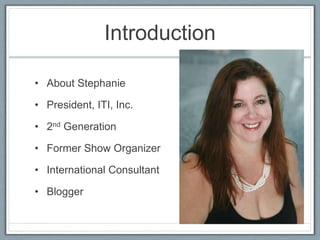
• About Stephanie 
• President, ITI, Inc. 
• 2nd Generation 
• Former Show Organizer 
• International Consultant 
• Blogger
What we are covering today 
• Key Geographical, Economic Facts 
• Cultural Differences 
• The US Exhibition Market 
• Launching an Exhibition in the US 
• Developing a US Pavilion in Your Fair 
• Recruiting US Companies to Your Fair 
• Questions & Answers
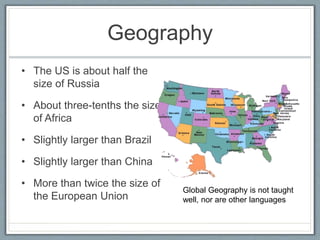
Geography 
• The US is about half the 
size of Russia 
• About three-tenths the size 
of Africa 
• Slightly larger than Brazil 
• Slightly larger than China 
• More than twice the size of 
the European Union 
Global Geography is not taught 
well, nor are other languages
Geography & Demographics 
There are 4 time zones within the continental US, not including Alaska or Hawaii. 
• East Coast 
• Midwest 
• Mountain 
• Pacific 
• 3rd largest population in the world: 316,668,567 people (July 2013) 
• 4th if you count the EU as one country 
• 82% of the population lives in urban areas 
• Throughout most of its history, the United States has had influxes of 
immigration. The ethnic mix is: 
• 83% white (generally of European descent, but also from the Middle 
East and Latin America) 
• 12% African-American 
• 3% Asian 
• About 1% Native American. 
• Today the biggest immigrant groups are from Latin countries.
Economics 
• The US has the largest and most technologically 
powerful economy in the world, with a per capita 
GDP ranging from $49,800 - $53,000. 
• Taxes – vary by City, State and there is Federal 
tax as well. There is no VAT. 
• Excellent Infrastructure 
• People regularly fly to other cities to attend 
exhibitions, but drive within 200 miles as well.
Cultural Differences 
• Much more informal, casual – everyone is on a first name basis 
• It is not important to develop a personal relationship in order to 
establish a long and successful business relationship. 
• Expect answers in 5 seconds - the “now” generation 
• Don’t understand time differences (you may be sleeping) 
• Relationships are not as formal 
• Americans do business where they get the best deal and the best 
service.
Cultural Differences 
• It is always proper to ask questions if 
you do not understand something. 
• US organizers ask questions -- lots 
of them. They are not ashamed to 
admit what they do know. 
• US organizers will assume you 
understand something if you do not 
tell them otherwise!
Cultural Differences - 
Meetings 
• Keep appointments once made. You may 
not get a second chance if you do not. 
• When doing business in the United States, 
you must be on time. 
• Americans view someone being late as rude, 
showing a lack of respect and having sloppy, 
undisciplined personal habits. 
• Being "on time" in business situations 
generally means being about five minutes 
early. 
• Five minutes late is acceptable with a brief 
apology. 
• Ten to fifteen minutes late requires a phone 
call to warn of the delay and to apologize.
Cultural Differences - 
Meetings 
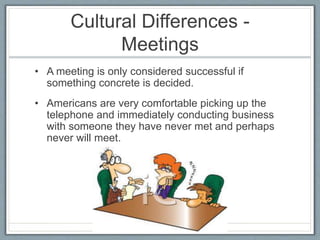
• A meeting is only considered successful if 
something concrete is decided. 
• Americans are very comfortable picking up the 
telephone and immediately conducting business 
with someone they have never met and perhaps 
never will meet.
Cultural Differences - 
Deadlines 
• It is very important to meet 
deadlines. 
• If you tell someone that you will have 
a report to them by a certain date, or 
that you will email something to them 
immediately, they will take you at 
your word. 
• People who miss deadlines are 
viewed as irresponsible & 
undependable.
Cultural Differences - 
Negotiating 
• The goal of most negotiations in the United States is to 
arrive at a signed contract. 
• Long-term relationships and benefits may not be the main 
objective. 
• The immediate deal may be the only important issue. 
• Negotiations will seem rushed to most other cultures. 
• Remember that "time is money" to Americans and that 
they may not think that building a relationship with 
potential business partners is necessary
Cultural Differences - 
Negotiating 
• Americans prefer directness in communication. 
When Americans say "yes" or "no," they mean 
precisely that. "Maybe" really does mean "it might 
happen"; it does not mean "no." 
• Get everything in writing! 
• Legal – everyone is “sue” happy 
• Do not enter into any contract without hiring a 
lawyer. No American businesspeople would 
dream of signing a contract before consulting a 
lawyer.
Cultural Differences – Misc. 
• Work ethic – 2 weeks paid vacation a year and many 
don’t even take that 
• Major Holidays – New Year’s, Easter, 4th of July, 
Thanksgiving and Christmas are the big ones. 
• Meal Times – one-hour lunches are the norm 
• Food varies by region 
• When going to breakfast, lunch, or dinner, the person 
who invites pays, whether it is a man or a woman.
Exhibition Business 
Characteristics: 
• Large professional tradeshow facilities 
• Most venues are owned by the cities they are located in, 
but they don’t own the exhibitions 
• Unlike the German Messe model 
• Most fairs are held annually. Less are on 2-3 year cycles. 
• Some move cities each year (rotation) 
• 100 years for a show is ANCIENT 
• Shorter move in/move out times 
• Most trade fairs are 2.5 days
Exhibition Facts 
• Over 11,000 exhibitions held annually (CEIR, 2011 statistics) 
• Most are under 200 stands. 
• 37% are held in exhibition and convention centers 
• 44% are held in hotels 
• 20% are held in conference centers and misc. places 
• 60% are still Association owned, 40% for-profit companies 
• Differences between associations and for-profits 
• CES International® is the largest annual exhibition in the US.
Location, Location, Location 
• Metropolitan hub 
1st Tier 
Cities 
• Major airport with large airlift and 
easy national and international 
access 
• Strong travel infrastructure (rail, 
public transportation, taxis) 
• Convention center with a minimum 
of 500,000 gross sq. ft. (46,000 m2) 
exhibit space 
• Minimum committable 10,000 
sleeping rooms 
• Hotel inventory that includes a large 
number of chain convention hotels, 
luxury properties and a spectrum of 
rates 
• Abundant dining, entertainment, 
attraction options 
• Reputation for world-class services 
and amenities 
• Connotes an element of glamour, 
cachet, desirability 
Source: Destination Marketing Association International (DMAI)
Location, Location, Location 
2nd Tier Cities: 
• Smaller population and convention facilities 
• Less direct airlift (flights) 
• Opportunity for better value 
• Tier II destinations can be a great choice for planners that prefer having their 
convention be “the big fish.” 
• It can be a special experience for the attendees when they own the city 
instead of being one of multiple conventions taking place in a Tier I city. 
• Similarly, adding second tier destinations to the schedule can provide a fresh 
and exciting change to the often-visited, sometimes overexposed, first tier 
cities.
Location, Location, Location 
3rd Tier cities (also known as leisure market) 
• In fact, some of the country’s most luxurious resorts are 
located in destinations labeled third tier simply because of 
overall destination size. 
• More limited airlift, usually requiring connections 
• No convention center, a smaller conference center, or 
meeting and exhibit space contained within a hotel rather 
than a dedicated facility 
• Distinctive leisure travel appeal 
• Regional drive market
US Venues 
• Most are smaller 
• Not the Fair model, usually just one building 
• Taxpayer funded Venues – going to more 
European model but not the same. 
• They receive hotel (bed) taxes 
• Who’s starting to joint venture? 
• Houston 
• Boston 
• New Orleans (began their own show division)
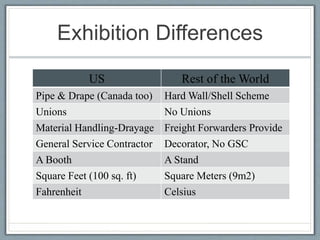
Exhibition Differences 
US Rest of the World 
Pipe & Drape (Canada too) Hard Wall/Shell Scheme 
Unions No Unions 
Material Handling-Drayage Freight Forwarders Provide 
General Service Contractor Decorator, No GSC 
A Booth A Stand 
Square Feet (100 sq. ft) Square Meters (9m2) 
Fahrenheit Celsius
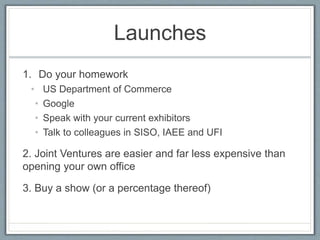
Launches 
1. Do your homework 
• US Department of Commerce 
• Google 
• Speak with your current exhibitors 
• Talk to colleagues in SISO, IAEE and UFI 
2. Joint Ventures are easier and far less expensive than 
opening your own office 
3. Buy a show (or a percentage thereof)
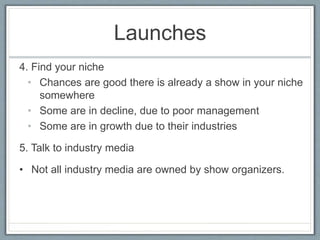
Launches 
4. Find your niche 
• Chances are good there is already a show in your niche 
somewhere 
• Some are in decline, due to poor management 
• Some are in growth due to their industries 
5. Talk to industry media 
• Not all industry media are owned by show organizers.
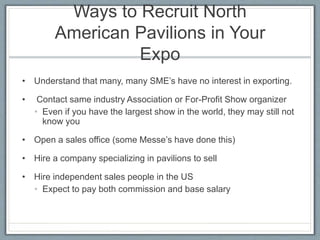
Ways to Recruit North 
American Pavilions in Your 
Expo 
• Understand that many, many SME’s have no interest in exporting. 
• Contact same industry Association or For-Profit Show organizer 
• Even if you have the largest show in the world, they may still not 
know you 
• Open a sales office (some Messe’s have done this) 
• Hire a company specializing in pavilions to sell 
• Hire independent sales people in the US 
• Expect to pay both commission and base salary
Pavilion Recruitment 
• Work and regularly communicate with US 
counterparts for a successful pavilion 
• No government subsidies (few exceptions) 
• Utilize the US Department of Commerce 
International Trade Administration’s posts in your 
country! 
• Utilize your government contacts too!
Pavilion Recruitment 
Successful Marketing Tips: 
• Features vs. Benefits – Features Tell, Benefits Sell! 
• Your collateral materials should include statistics, but have them 
couched in “What’s in it for me?” terms. 
• Offer sales and marketing assistance once the exhibitors commit 
• What works best in your country? 
• Can you legally provide leads for exhibitors? 
• How is distribution done? Or is it direct sales? Any tricky laws? 
• Arrange to have key distributors and buyers visit the pavilions.
Pavilion Recruitment 
• More Marketing Advice 
• Email 
• Direct mail is still the 
best way to attract 
qualified attendees 
• Mailing Lists/Email lists 
– for sale 
• Most companies don’t 
rely on faxes 
• The word “invite” does 
NOT mean attend for 
free
Recruiting Exhibitors 
1. Make exhibiting easy. 
Offer package space. Explain how set up and tear down 
works. 
Educate your US exhibitors on booth salesmanship for your 
country. Recommend reasonably priced interpreters. 
2. Enlist the US Department of Commerce International 
Trade Administration’s posts in your country. 
• They know who is exporting – and who is looking to 
export. 
• It is their job to help sell US products and services 
abroad. 
3. Statistics, statistics, statistics!
Summary 
• The US is massive. 
• Personal relationships are not necessary to do 
business. 
• Do what you say you are going to do when you say 
you are going to do it! 
• Partnerships are the least costly, most effective 
way to enter the market – or bring a US Pavilion 
into your show 
• There are other options if there’s no interest in a 
partnership!
Successfully Navigating 
the United States Market 
Questions and Answers! 
Stephanie Selesnick 
stephanie@intltradeinfo.com 
www.internationaltradeinformation.com

Successfully Navigating the United States Market, an UFI Webinar

  • 1.
    Successfully Navigating theUnited States Market Presented by: Stephanie Selesnick, President International Trade Information, Inc. stephanie@intltradeinfo.com Twitter: @StephSelesnick www.internationaltradeinformation.com
  • 2.
    Introduction • AboutStephanie • President, ITI, Inc. • 2nd Generation • Former Show Organizer • International Consultant • Blogger
  • 3.
    What we arecovering today • Key Geographical, Economic Facts • Cultural Differences • The US Exhibition Market • Launching an Exhibition in the US • Developing a US Pavilion in Your Fair • Recruiting US Companies to Your Fair • Questions & Answers
  • 4.
    Geography • TheUS is about half the size of Russia • About three-tenths the size of Africa • Slightly larger than Brazil • Slightly larger than China • More than twice the size of the European Union Global Geography is not taught well, nor are other languages
  • 5.
    Geography & Demographics There are 4 time zones within the continental US, not including Alaska or Hawaii. • East Coast • Midwest • Mountain • Pacific • 3rd largest population in the world: 316,668,567 people (July 2013) • 4th if you count the EU as one country • 82% of the population lives in urban areas • Throughout most of its history, the United States has had influxes of immigration. The ethnic mix is: • 83% white (generally of European descent, but also from the Middle East and Latin America) • 12% African-American • 3% Asian • About 1% Native American. • Today the biggest immigrant groups are from Latin countries.
  • 6.
    Economics • TheUS has the largest and most technologically powerful economy in the world, with a per capita GDP ranging from $49,800 - $53,000. • Taxes – vary by City, State and there is Federal tax as well. There is no VAT. • Excellent Infrastructure • People regularly fly to other cities to attend exhibitions, but drive within 200 miles as well.
  • 7.
    Cultural Differences •Much more informal, casual – everyone is on a first name basis • It is not important to develop a personal relationship in order to establish a long and successful business relationship. • Expect answers in 5 seconds - the “now” generation • Don’t understand time differences (you may be sleeping) • Relationships are not as formal • Americans do business where they get the best deal and the best service.
  • 8.
    Cultural Differences •It is always proper to ask questions if you do not understand something. • US organizers ask questions -- lots of them. They are not ashamed to admit what they do know. • US organizers will assume you understand something if you do not tell them otherwise!
  • 9.
    Cultural Differences - Meetings • Keep appointments once made. You may not get a second chance if you do not. • When doing business in the United States, you must be on time. • Americans view someone being late as rude, showing a lack of respect and having sloppy, undisciplined personal habits. • Being "on time" in business situations generally means being about five minutes early. • Five minutes late is acceptable with a brief apology. • Ten to fifteen minutes late requires a phone call to warn of the delay and to apologize.
  • 10.
    Cultural Differences - Meetings • A meeting is only considered successful if something concrete is decided. • Americans are very comfortable picking up the telephone and immediately conducting business with someone they have never met and perhaps never will meet.
  • 11.
    Cultural Differences - Deadlines • It is very important to meet deadlines. • If you tell someone that you will have a report to them by a certain date, or that you will email something to them immediately, they will take you at your word. • People who miss deadlines are viewed as irresponsible & undependable.
  • 12.
    Cultural Differences - Negotiating • The goal of most negotiations in the United States is to arrive at a signed contract. • Long-term relationships and benefits may not be the main objective. • The immediate deal may be the only important issue. • Negotiations will seem rushed to most other cultures. • Remember that "time is money" to Americans and that they may not think that building a relationship with potential business partners is necessary
  • 13.
    Cultural Differences - Negotiating • Americans prefer directness in communication. When Americans say "yes" or "no," they mean precisely that. "Maybe" really does mean "it might happen"; it does not mean "no." • Get everything in writing! • Legal – everyone is “sue” happy • Do not enter into any contract without hiring a lawyer. No American businesspeople would dream of signing a contract before consulting a lawyer.
  • 14.
    Cultural Differences –Misc. • Work ethic – 2 weeks paid vacation a year and many don’t even take that • Major Holidays – New Year’s, Easter, 4th of July, Thanksgiving and Christmas are the big ones. • Meal Times – one-hour lunches are the norm • Food varies by region • When going to breakfast, lunch, or dinner, the person who invites pays, whether it is a man or a woman.
  • 15.
    Exhibition Business Characteristics: • Large professional tradeshow facilities • Most venues are owned by the cities they are located in, but they don’t own the exhibitions • Unlike the German Messe model • Most fairs are held annually. Less are on 2-3 year cycles. • Some move cities each year (rotation) • 100 years for a show is ANCIENT • Shorter move in/move out times • Most trade fairs are 2.5 days
  • 16.
    Exhibition Facts •Over 11,000 exhibitions held annually (CEIR, 2011 statistics) • Most are under 200 stands. • 37% are held in exhibition and convention centers • 44% are held in hotels • 20% are held in conference centers and misc. places • 60% are still Association owned, 40% for-profit companies • Differences between associations and for-profits • CES International® is the largest annual exhibition in the US.
  • 17.
    Location, Location, Location • Metropolitan hub 1st Tier Cities • Major airport with large airlift and easy national and international access • Strong travel infrastructure (rail, public transportation, taxis) • Convention center with a minimum of 500,000 gross sq. ft. (46,000 m2) exhibit space • Minimum committable 10,000 sleeping rooms • Hotel inventory that includes a large number of chain convention hotels, luxury properties and a spectrum of rates • Abundant dining, entertainment, attraction options • Reputation for world-class services and amenities • Connotes an element of glamour, cachet, desirability Source: Destination Marketing Association International (DMAI)
  • 18.
    Location, Location, Location 2nd Tier Cities: • Smaller population and convention facilities • Less direct airlift (flights) • Opportunity for better value • Tier II destinations can be a great choice for planners that prefer having their convention be “the big fish.” • It can be a special experience for the attendees when they own the city instead of being one of multiple conventions taking place in a Tier I city. • Similarly, adding second tier destinations to the schedule can provide a fresh and exciting change to the often-visited, sometimes overexposed, first tier cities.
  • 19.
    Location, Location, Location 3rd Tier cities (also known as leisure market) • In fact, some of the country’s most luxurious resorts are located in destinations labeled third tier simply because of overall destination size. • More limited airlift, usually requiring connections • No convention center, a smaller conference center, or meeting and exhibit space contained within a hotel rather than a dedicated facility • Distinctive leisure travel appeal • Regional drive market
  • 20.
    US Venues •Most are smaller • Not the Fair model, usually just one building • Taxpayer funded Venues – going to more European model but not the same. • They receive hotel (bed) taxes • Who’s starting to joint venture? • Houston • Boston • New Orleans (began their own show division)
  • 22.
    Exhibition Differences USRest of the World Pipe & Drape (Canada too) Hard Wall/Shell Scheme Unions No Unions Material Handling-Drayage Freight Forwarders Provide General Service Contractor Decorator, No GSC A Booth A Stand Square Feet (100 sq. ft) Square Meters (9m2) Fahrenheit Celsius
  • 23.
    Launches 1. Doyour homework • US Department of Commerce • Google • Speak with your current exhibitors • Talk to colleagues in SISO, IAEE and UFI 2. Joint Ventures are easier and far less expensive than opening your own office 3. Buy a show (or a percentage thereof)
  • 24.
    Launches 4. Findyour niche • Chances are good there is already a show in your niche somewhere • Some are in decline, due to poor management • Some are in growth due to their industries 5. Talk to industry media • Not all industry media are owned by show organizers.
  • 25.
    Ways to RecruitNorth American Pavilions in Your Expo • Understand that many, many SME’s have no interest in exporting. • Contact same industry Association or For-Profit Show organizer • Even if you have the largest show in the world, they may still not know you • Open a sales office (some Messe’s have done this) • Hire a company specializing in pavilions to sell • Hire independent sales people in the US • Expect to pay both commission and base salary
  • 26.
    Pavilion Recruitment •Work and regularly communicate with US counterparts for a successful pavilion • No government subsidies (few exceptions) • Utilize the US Department of Commerce International Trade Administration’s posts in your country! • Utilize your government contacts too!
  • 27.
    Pavilion Recruitment SuccessfulMarketing Tips: • Features vs. Benefits – Features Tell, Benefits Sell! • Your collateral materials should include statistics, but have them couched in “What’s in it for me?” terms. • Offer sales and marketing assistance once the exhibitors commit • What works best in your country? • Can you legally provide leads for exhibitors? • How is distribution done? Or is it direct sales? Any tricky laws? • Arrange to have key distributors and buyers visit the pavilions.
  • 28.
    Pavilion Recruitment •More Marketing Advice • Email • Direct mail is still the best way to attract qualified attendees • Mailing Lists/Email lists – for sale • Most companies don’t rely on faxes • The word “invite” does NOT mean attend for free
  • 29.
    Recruiting Exhibitors 1.Make exhibiting easy. Offer package space. Explain how set up and tear down works. Educate your US exhibitors on booth salesmanship for your country. Recommend reasonably priced interpreters. 2. Enlist the US Department of Commerce International Trade Administration’s posts in your country. • They know who is exporting – and who is looking to export. • It is their job to help sell US products and services abroad. 3. Statistics, statistics, statistics!
  • 30.
    Summary • TheUS is massive. • Personal relationships are not necessary to do business. • Do what you say you are going to do when you say you are going to do it! • Partnerships are the least costly, most effective way to enter the market – or bring a US Pavilion into your show • There are other options if there’s no interest in a partnership!
  • 31.
    Successfully Navigating theUnited States Market Questions and Answers! Stephanie Selesnick stephanie@intltradeinfo.com www.internationaltradeinformation.com