Welcome to
Advance Learning
School of Reading and
Technology
1st-5th Grade
7:30am-3:30pm
School Information
School of Reading and Technology
Main office: 713-933-9000
Reading Institution: 713-933-9100
Technology Department: 713-933-9200
Technology Help Desk: 713-933-9300
Email: www.advancelearning.edu
Principle: K. Russell
Assistant Principle: T. Newman
Reading Specialist: R. Lyles
Technology Specialist: M. Flynn
The Staff
 The school is composed of 25 classrooms and 20
teachers for a 10:1 student teacher ratio. There are four
teachers per grade level, two technology teachers, two
reading specialists, and one physical education teacher.
 There are 13 members of the staff including: front office,
custodial, cafeteria, speech therapist, and support staff.
Structure of School
The structures are put in place to help maximize teacher and student flexibility,
boost in depth teaching and learning, and implement a vast variety of
resources.
Each student will receive an iPad for
instructional learning. This can be used
for at home webinars or classroom
instructional time.
3 times for a week for 45 minutes, each
student will go to the computer lab. One
day will consist of learning computer
applications and the other two days will
consist of completing assignments.
Once a week it is MANDATORY that
student participate in physical education
WITHOUT technology.
Each student will have one teacher. The
teacher is determined by the tier group.
When a child is moved out of the tier,
depending on their level, they will move to
the teacher that’s in the next tier group.
Support staff will be available to all
students for in class or pull out support.
Students will have the opportunity to work
with other grade level teachers and learn
new strategies once a month during a
classroom switch.
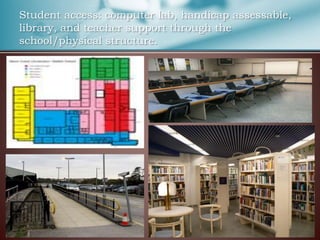
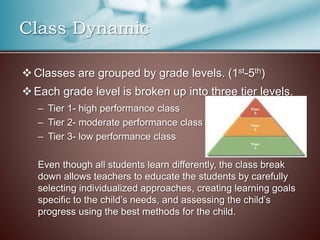
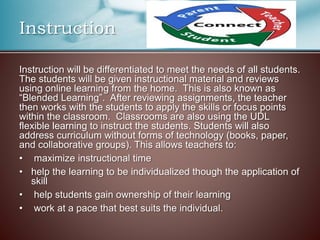
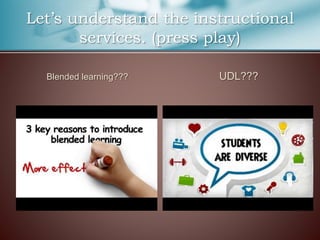
Student access: computer lab, handicap assessable,
library, and teacher support through the
school/physical structure.
Class Dynamic
Classes are grouped by grade levels. (1st-5th)
Each grade level is broken up into three tier levels.
– Tier 1- high performance class
– Tier 2- moderate performance class
– Tier 3- low performance class
Even though all students learn differently, the class break
down allows teachers to educate the students by carefully
selecting individualized approaches, creating learning goals
specific to the child’s needs, and assessing the child’s
progress using the best methods for the child.
Instruction
Instruction will be differentiated to meet the needs of all students.
The students will be given instructional material and reviews
using online learning from the home. This is also known as
“Blended Learning”. After reviewing assignments, the teacher
then works with the students to apply the skills or focus points
within the classroom. Classrooms are also using the UDL
flexible learning to instruct the students. Students will also
address curriculum without forms of technology (books, paper,
and collaborative groups). This allows teachers to:
• maximize instructional time
• help the learning to be individualized though the application of
skill
• help students gain ownership of their learning
• work at a pace that best suits the individual.
Blended learning??? UDL???
Let’s understand the instructional
services. (press play)
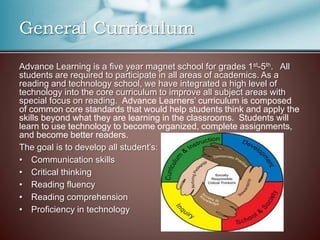
Advance Learning is a five year magnet school for grades 1st-5th. All
students are required to participate in all areas of academics. As a
reading and technology school, we have integrated a high level of
technology into the core curriculum to improve all subject areas with
special focus on reading. Advance Learners’ curriculum is composed
of common core standards that would help students think and apply the
skills beyond what they are learning in the classrooms. Students will
learn to use technology to become organized, complete assignments,
and become better readers.
The goal is to develop all student’s:
• Communication skills
• Critical thinking
• Reading fluency
• Reading comprehension
• Proficiency in technology
General Curriculum
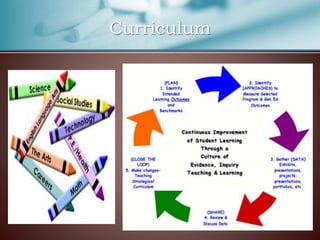
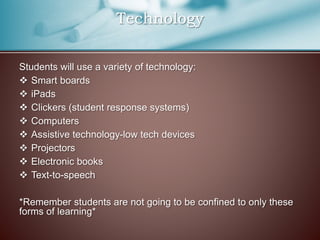
Curriculum
Students will use a variety of technology:
 Smart boards
 iPads
 Clickers (student response systems)
 Computers
 Assistive technology-low tech devices
 Projectors
 Electronic books
 Text-to-speech
*Remember students are not going to be confined to only these
forms of learning*
Technology
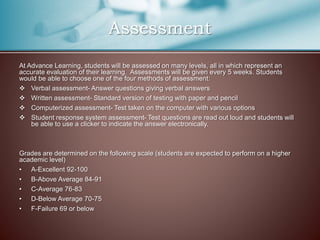
At Advance Learning, students will be assessed on many levels, all in which represent an
accurate evaluation of their learning. Assessments will be given every 5 weeks. Students
would be able to choose one of the four methods of assessment:
 Verbal assessment- Answer questions giving verbal answers
 Written assessment- Standard version of testing with paper and pencil
 Computerized assessment- Test taken on the computer with various options
 Student response system assessment- Test questions are read out loud and students will
be able to use a clicker to indicate the answer electronically.
Grades are determined on the following scale (students are expected to perform on a higher
academic level)
• A-Excellent 92-100
• B-Above Average 84-91
• C-Average 76-83
• D-Below Average 70-75
• F-Failure 69 or below
Assessment
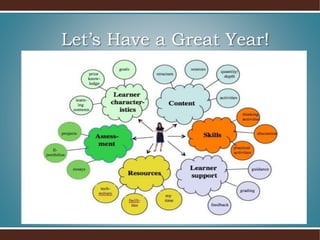
Let’s Have a Great Year!
Rose, D.H., & Meyer, A. (2002) Teaching every student in the digital age. Universal
Design for Learning. Association for Supervision and Curriculum Development,
Alexandria, Virginia.
http://www.blendedlearningnow.com/ (This is Blended Learning, n.d.)
https://www.youtube.com/watch?v=uOUrWn8GSvw
https://www.youtube.com/watch?v=xTShQyw3m80
References:

Udl assignment

  • 1.
    Welcome to Advance Learning Schoolof Reading and Technology 1st-5th Grade 7:30am-3:30pm
  • 2.
    School Information School ofReading and Technology Main office: 713-933-9000 Reading Institution: 713-933-9100 Technology Department: 713-933-9200 Technology Help Desk: 713-933-9300 Email: www.advancelearning.edu Principle: K. Russell Assistant Principle: T. Newman Reading Specialist: R. Lyles Technology Specialist: M. Flynn
  • 3.
    The Staff  Theschool is composed of 25 classrooms and 20 teachers for a 10:1 student teacher ratio. There are four teachers per grade level, two technology teachers, two reading specialists, and one physical education teacher.  There are 13 members of the staff including: front office, custodial, cafeteria, speech therapist, and support staff.
  • 4.
    Structure of School Thestructures are put in place to help maximize teacher and student flexibility, boost in depth teaching and learning, and implement a vast variety of resources. Each student will receive an iPad for instructional learning. This can be used for at home webinars or classroom instructional time. 3 times for a week for 45 minutes, each student will go to the computer lab. One day will consist of learning computer applications and the other two days will consist of completing assignments. Once a week it is MANDATORY that student participate in physical education WITHOUT technology. Each student will have one teacher. The teacher is determined by the tier group. When a child is moved out of the tier, depending on their level, they will move to the teacher that’s in the next tier group. Support staff will be available to all students for in class or pull out support. Students will have the opportunity to work with other grade level teachers and learn new strategies once a month during a classroom switch.
  • 5.
    Student access: computerlab, handicap assessable, library, and teacher support through the school/physical structure.
  • 6.
    Class Dynamic Classes aregrouped by grade levels. (1st-5th) Each grade level is broken up into three tier levels. – Tier 1- high performance class – Tier 2- moderate performance class – Tier 3- low performance class Even though all students learn differently, the class break down allows teachers to educate the students by carefully selecting individualized approaches, creating learning goals specific to the child’s needs, and assessing the child’s progress using the best methods for the child.
  • 7.
    Instruction Instruction will bedifferentiated to meet the needs of all students. The students will be given instructional material and reviews using online learning from the home. This is also known as “Blended Learning”. After reviewing assignments, the teacher then works with the students to apply the skills or focus points within the classroom. Classrooms are also using the UDL flexible learning to instruct the students. Students will also address curriculum without forms of technology (books, paper, and collaborative groups). This allows teachers to: • maximize instructional time • help the learning to be individualized though the application of skill • help students gain ownership of their learning • work at a pace that best suits the individual.
  • 8.
    Blended learning??? UDL??? Let’sunderstand the instructional services. (press play)
  • 9.
    Advance Learning isa five year magnet school for grades 1st-5th. All students are required to participate in all areas of academics. As a reading and technology school, we have integrated a high level of technology into the core curriculum to improve all subject areas with special focus on reading. Advance Learners’ curriculum is composed of common core standards that would help students think and apply the skills beyond what they are learning in the classrooms. Students will learn to use technology to become organized, complete assignments, and become better readers. The goal is to develop all student’s: • Communication skills • Critical thinking • Reading fluency • Reading comprehension • Proficiency in technology General Curriculum
  • 10.
  • 11.
    Students will usea variety of technology:  Smart boards  iPads  Clickers (student response systems)  Computers  Assistive technology-low tech devices  Projectors  Electronic books  Text-to-speech *Remember students are not going to be confined to only these forms of learning* Technology
  • 12.
    At Advance Learning,students will be assessed on many levels, all in which represent an accurate evaluation of their learning. Assessments will be given every 5 weeks. Students would be able to choose one of the four methods of assessment:  Verbal assessment- Answer questions giving verbal answers  Written assessment- Standard version of testing with paper and pencil  Computerized assessment- Test taken on the computer with various options  Student response system assessment- Test questions are read out loud and students will be able to use a clicker to indicate the answer electronically. Grades are determined on the following scale (students are expected to perform on a higher academic level) • A-Excellent 92-100 • B-Above Average 84-91 • C-Average 76-83 • D-Below Average 70-75 • F-Failure 69 or below Assessment
  • 13.
    Let’s Have aGreat Year!
  • 14.
    Rose, D.H., &Meyer, A. (2002) Teaching every student in the digital age. Universal Design for Learning. Association for Supervision and Curriculum Development, Alexandria, Virginia. http://www.blendedlearningnow.com/ (This is Blended Learning, n.d.) https://www.youtube.com/watch?v=uOUrWn8GSvw https://www.youtube.com/watch?v=xTShQyw3m80 References: