Nine months, 3 terms:
Computer vision
and deep learning
(5 projects)
Sensor fusion,
localization, and
control
(5 projects)
Path planning,
concentrations,
and systems
(4 projects)
Udacity's Self-Driving Car Engineer Nanodegree
Identify lane lines on
the road, first in an
image, then in a video
stream utilizing image
analysis techniques:
color channels,
thresholding, region
masking, Canny edge
detection, and Hough
transform.
View project on github
Lane line detection
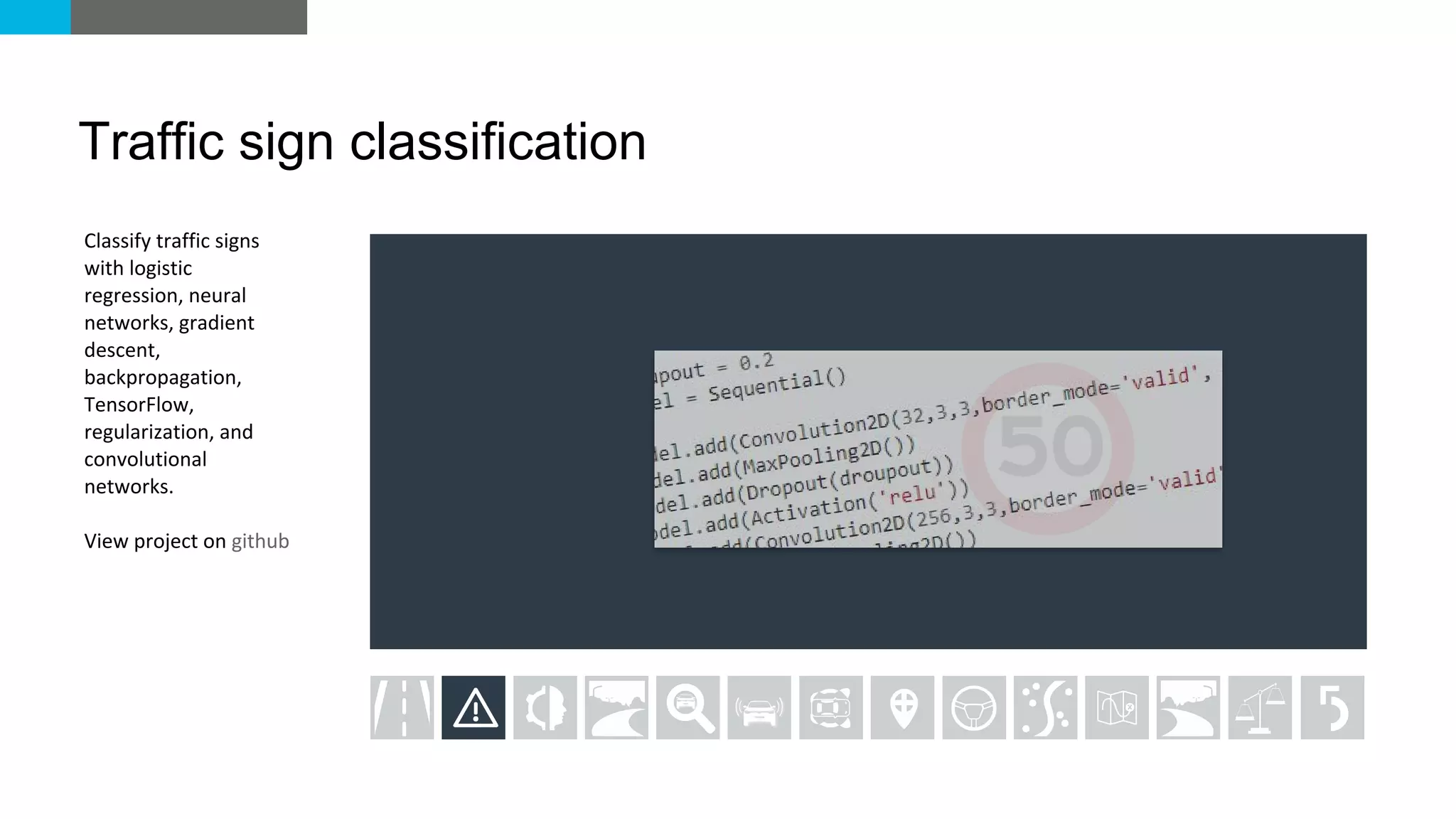
Traffic sign classification
Classify traffic signs
with logistic
regression, neural
networks, gradient
descent,
backpropagation,
TensorFlow,
regularization, and
convolutional
networks.
View project on github
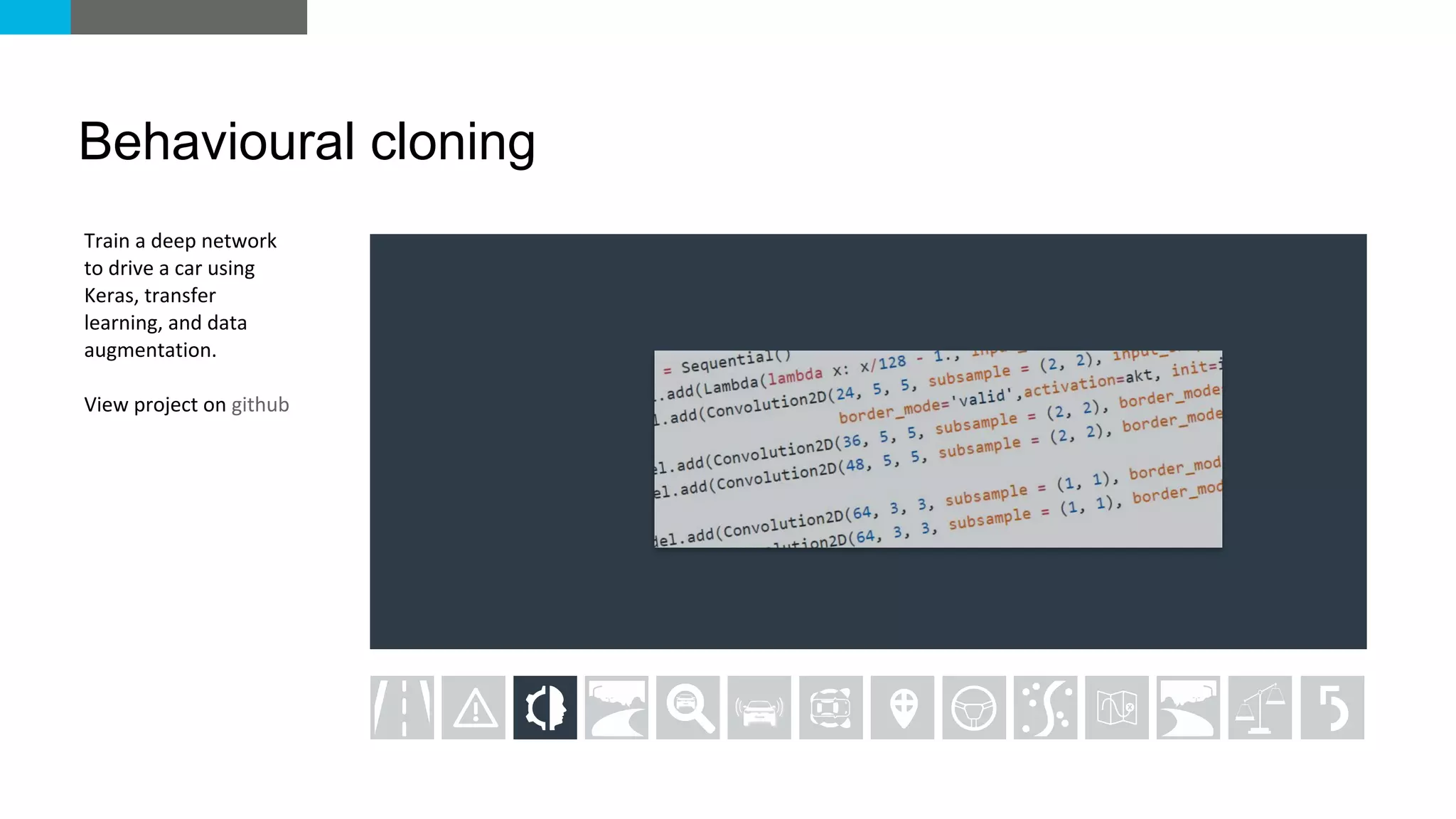
Behavioural cloning
Train a deep network
to drive a car using
Keras, transfer
learning, and data
augmentation.
View project on github
Identify the lane
boundaries and
curvature in a video
from a front-facing
camera on a car.
Calibration and
distortion correction,
image rectification,
color transforms, and
gradient thresholding.
View project on github
Advanced lane detection
Identify vehicles in
a video from a
front-facing camera.
Histogram of
gradients, support
vector machine,
heat map,
data normalization,
shuffling.
View project on github
Vehicle detection and tracking
Implement an
Extended Kalman Filter
in C++ capable of
real-time tracking of
linear motion.
Lidar and radar
data fusion.
View project on github
Sensor fusion: extended Kalman filter
Code an Unscented
Kalman Filter capable
of tracking non-linear
motion. Constant turn
rate and velocity
magnitude model,
sigma point prediction,
code optimization.
View project on github
Sensor fusion: unscented Kalman filter
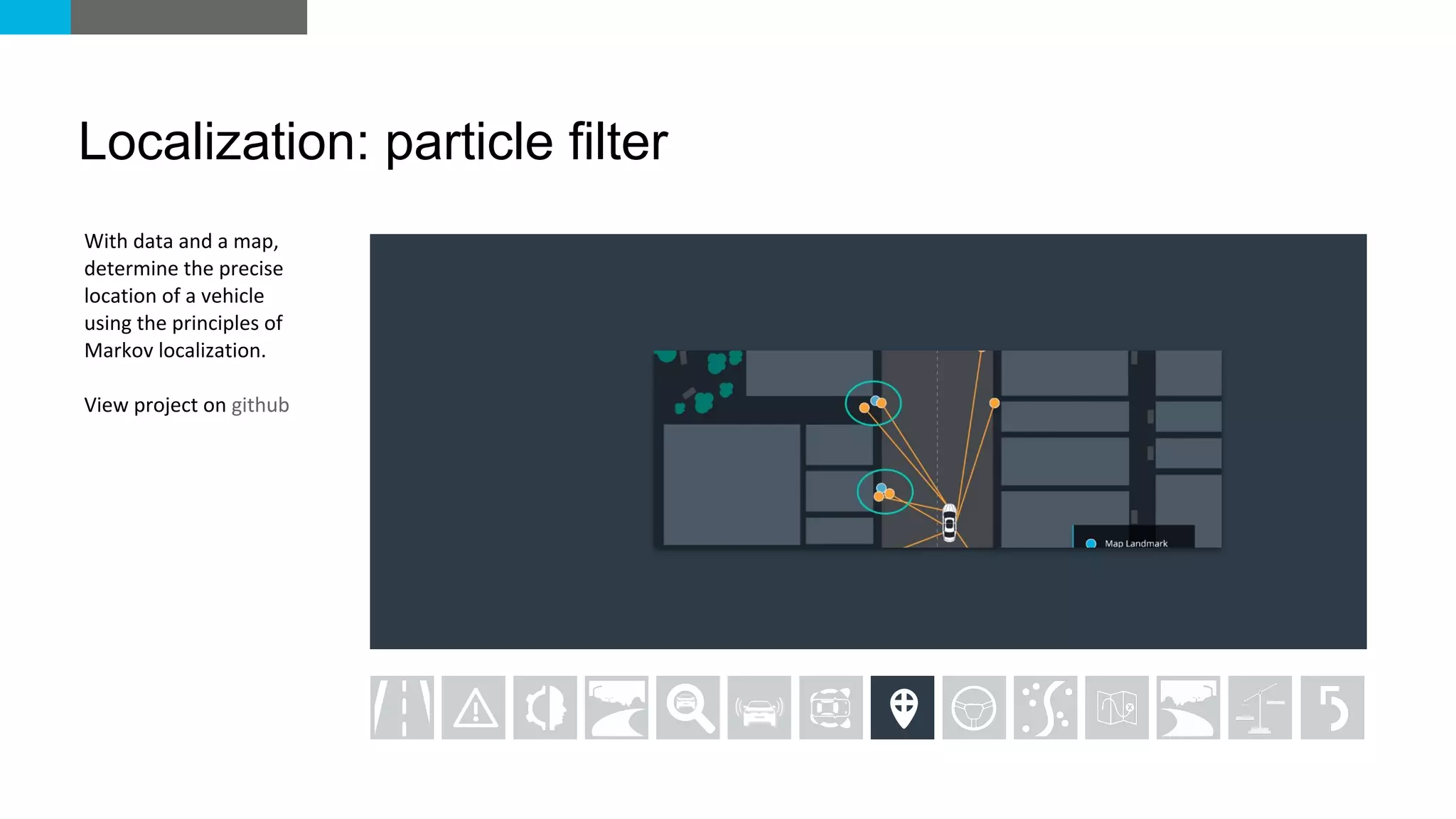
With data and a map,
determine the precise
location of a vehicle
using the principles of
Markov localization.
View project on github
Localization: particle filter
Implement a PID
(proportional-integral-
derivative) controller
in C++ to maneuver a
vehicle around the
track.
View project on github
PID controller
Implement a model
predictive controller
using Ipopt and CppAD
to drive a vehicle
around the track even
with additional latency
between commands.
View project on github
Model predictive controller
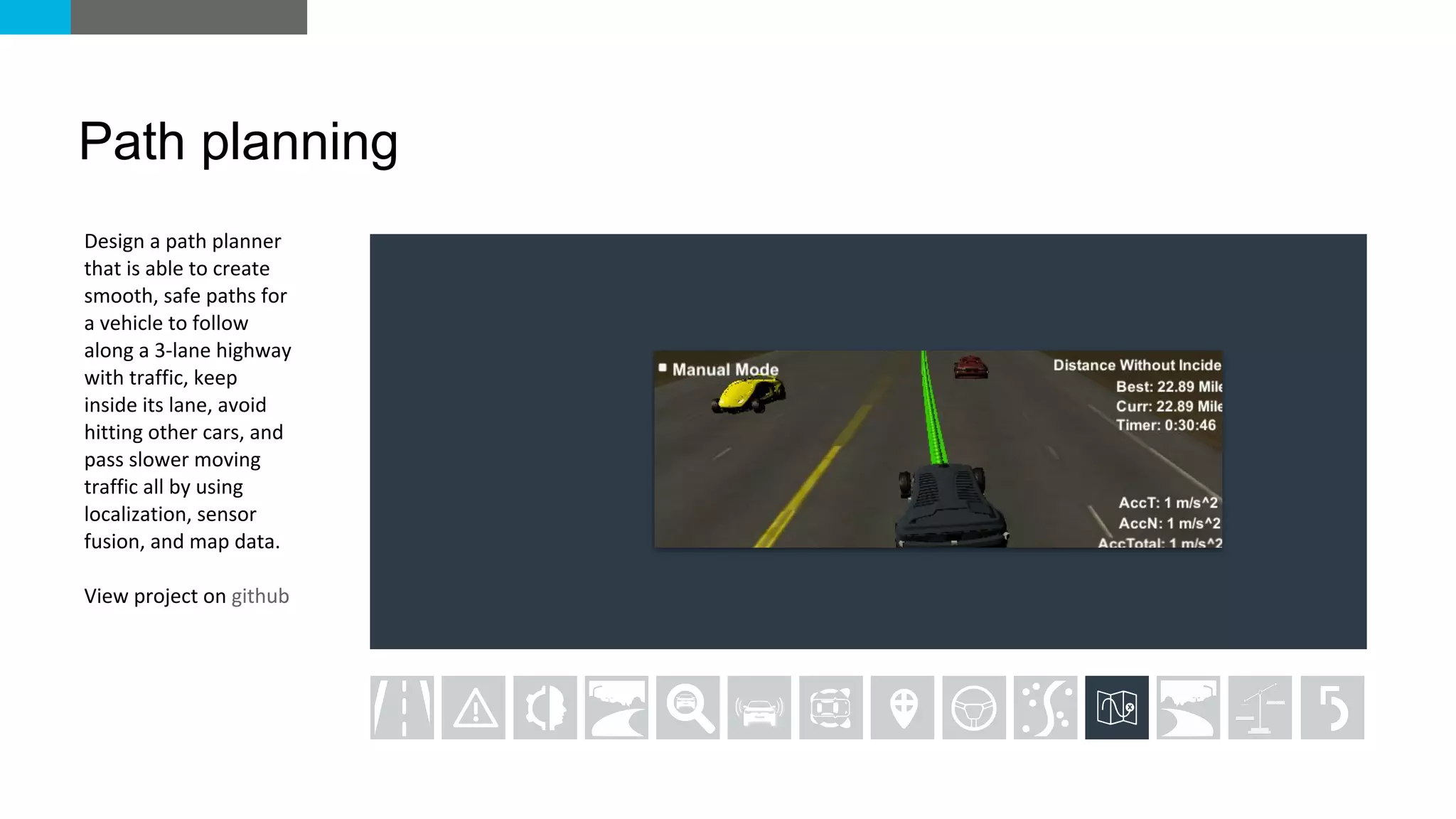
Design a path planner
that is able to create
smooth, safe paths for
a vehicle to follow
along a 3-lane highway
with traffic, keep
inside its lane, avoid
hitting other cars, and
pass slower moving
traffic all by using
localization, sensor
fusion, and map data.
View project on github
Path planning
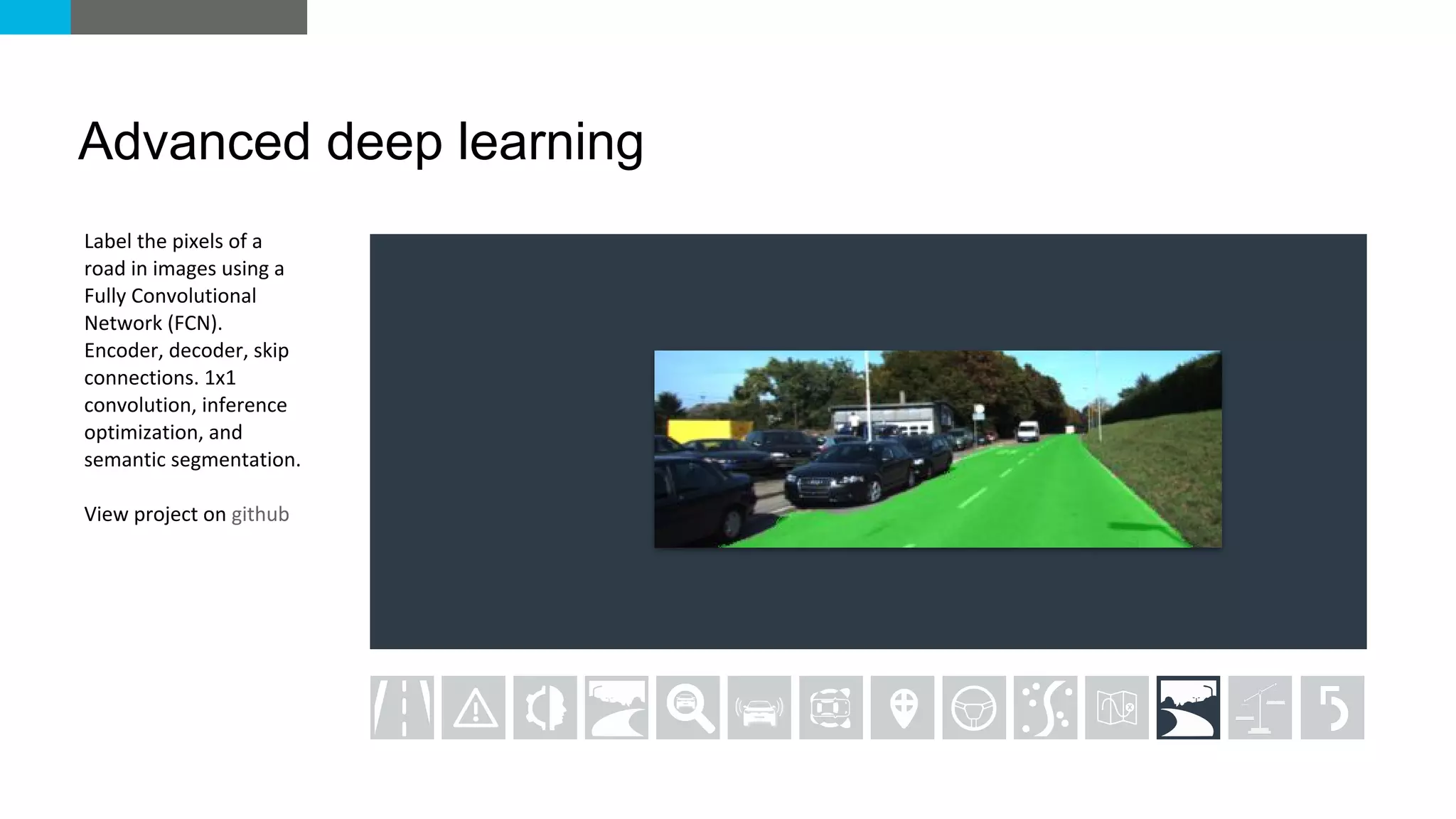
Label the pixels of a
road in images using a
Fully Convolutional
Network (FCN).
Encoder, decoder, skip
connections. 1x1
convolution, inference
optimization, and
semantic segmentation.
View project on github
Advanced deep learning
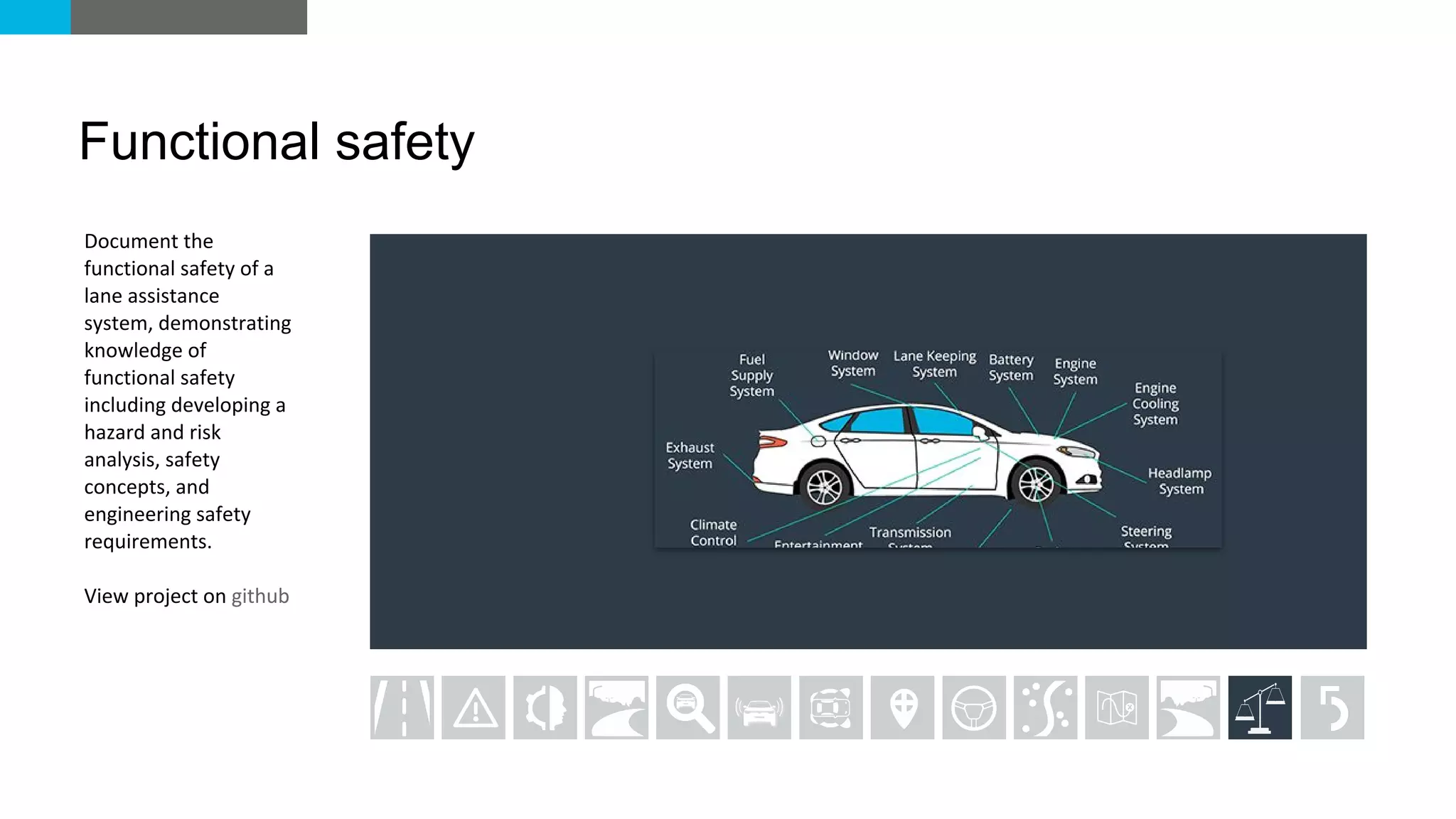
Document the
functional safety of a
lane assistance
system, demonstrating
knowledge of
functional safety
including developing a
hazard and risk
analysis, safety
concepts, and
engineering safety
requirements.
View project on github
Functional safety
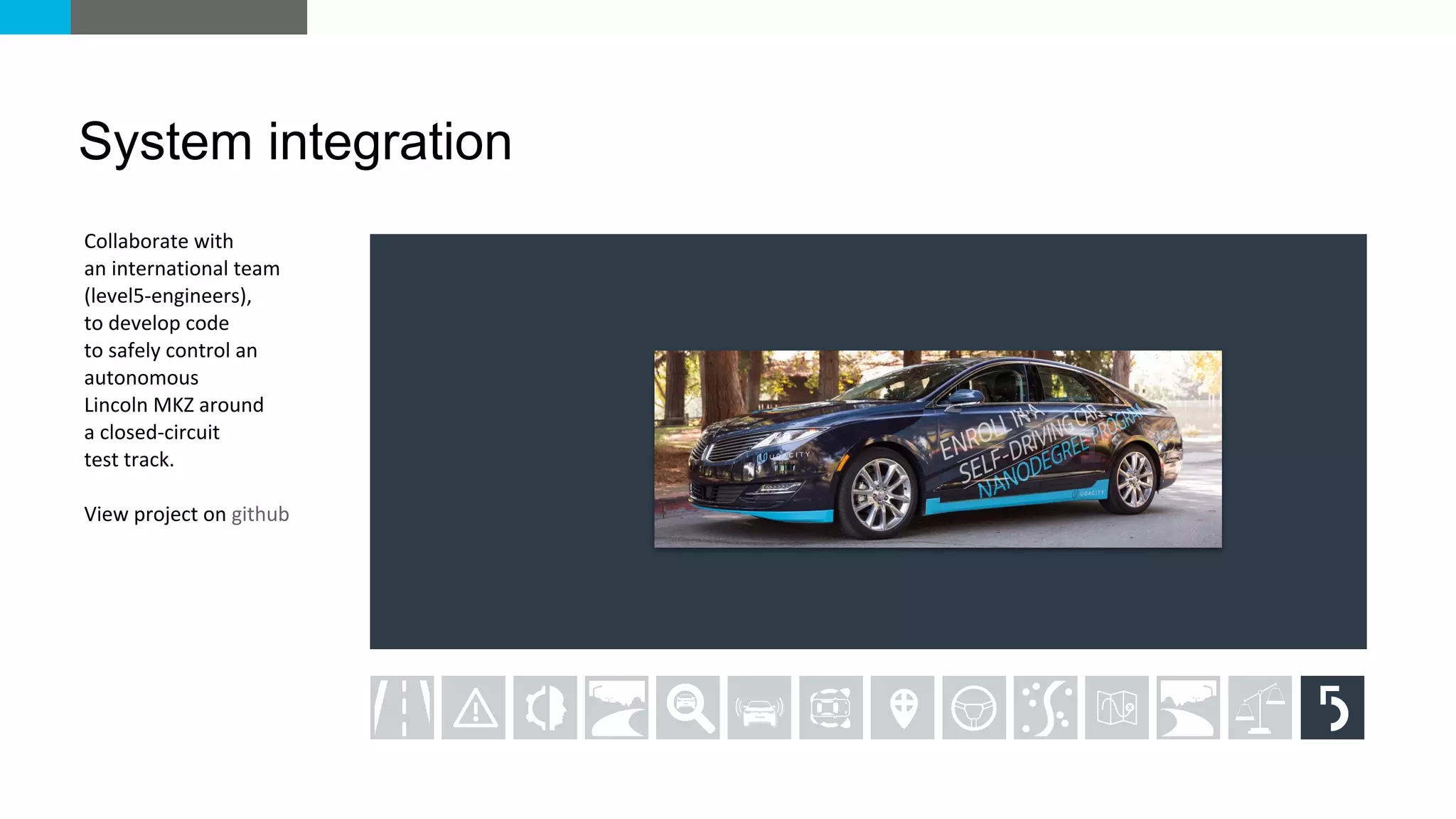
Collaborate with
an international team
(level5-engineers),
to develop code
to safely control an
autonomous
Lincoln MKZ around
a closed-circuit
test track.
View project on github
System integration
The SDC Nanodegree
program has been
assessed as equivalent
to a 60 credit package
of learning at the
master’s degree level
on the New Zealand
Qualifications
Framework.
Image credits
Slide 02: creativeshot
Slide 06: ricgu8086
Slide 07: Sheng Xu
Slide 08: Udacity
Slide 11: Wikipedia
Slide 15: Udacity
Slide 16: Udacity

Udacity Self-Driving Car Engineer Nanodegree Graduate

  • 2.
    Nine months, 3terms: Computer vision and deep learning (5 projects) Sensor fusion, localization, and control (5 projects) Path planning, concentrations, and systems (4 projects) Udacity's Self-Driving Car Engineer Nanodegree
  • 3.
    Identify lane lineson the road, first in an image, then in a video stream utilizing image analysis techniques: color channels, thresholding, region masking, Canny edge detection, and Hough transform. View project on github Lane line detection
  • 4.
    Traffic sign classification Classifytraffic signs with logistic regression, neural networks, gradient descent, backpropagation, TensorFlow, regularization, and convolutional networks. View project on github
  • 5.
    Behavioural cloning Train adeep network to drive a car using Keras, transfer learning, and data augmentation. View project on github
  • 6.
    Identify the lane boundariesand curvature in a video from a front-facing camera on a car. Calibration and distortion correction, image rectification, color transforms, and gradient thresholding. View project on github Advanced lane detection
  • 7.
    Identify vehicles in avideo from a front-facing camera. Histogram of gradients, support vector machine, heat map, data normalization, shuffling. View project on github Vehicle detection and tracking
  • 8.
    Implement an Extended KalmanFilter in C++ capable of real-time tracking of linear motion. Lidar and radar data fusion. View project on github Sensor fusion: extended Kalman filter
  • 9.
    Code an Unscented KalmanFilter capable of tracking non-linear motion. Constant turn rate and velocity magnitude model, sigma point prediction, code optimization. View project on github Sensor fusion: unscented Kalman filter
  • 10.
    With data anda map, determine the precise location of a vehicle using the principles of Markov localization. View project on github Localization: particle filter
  • 11.
    Implement a PID (proportional-integral- derivative)controller in C++ to maneuver a vehicle around the track. View project on github PID controller
  • 12.
    Implement a model predictivecontroller using Ipopt and CppAD to drive a vehicle around the track even with additional latency between commands. View project on github Model predictive controller
  • 13.
    Design a pathplanner that is able to create smooth, safe paths for a vehicle to follow along a 3-lane highway with traffic, keep inside its lane, avoid hitting other cars, and pass slower moving traffic all by using localization, sensor fusion, and map data. View project on github Path planning
  • 14.
    Label the pixelsof a road in images using a Fully Convolutional Network (FCN). Encoder, decoder, skip connections. 1x1 convolution, inference optimization, and semantic segmentation. View project on github Advanced deep learning
  • 15.
    Document the functional safetyof a lane assistance system, demonstrating knowledge of functional safety including developing a hazard and risk analysis, safety concepts, and engineering safety requirements. View project on github Functional safety
  • 16.
    Collaborate with an internationalteam (level5-engineers), to develop code to safely control an autonomous Lincoln MKZ around a closed-circuit test track. View project on github System integration
  • 17.
    The SDC Nanodegree programhas been assessed as equivalent to a 60 credit package of learning at the master’s degree level on the New Zealand Qualifications Framework. Image credits Slide 02: creativeshot Slide 06: ricgu8086 Slide 07: Sheng Xu Slide 08: Udacity Slide 11: Wikipedia Slide 15: Udacity Slide 16: Udacity