Universal Design and Visitability:
From Accessibility to Zoning Conference: 13-14 July 2006
The Ohio State University, USA


          Antika Sawadsri
          School of Architecture, Planning and Landscape
          University of Newcastle upon Tyne, UK
Content

          - Personal Background
          - Research Inspiration


          - Objective of Research
          - Research Question
          - Research Framework


          - Research Method and Findings
          - Conclusion
          - Bibliography
          - Discussion
Background: Personal                                            Background
        Educational Background; B.F.A. and M.A. majored in Interior Design

                                  Working as a practitioner


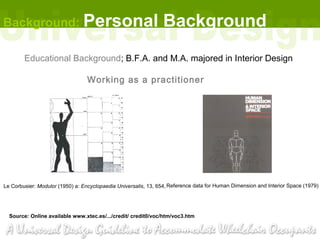
Le Corbusier: Modulor (1950) a: Encyclopaedia Universalis, 13, 654, Reference data for Human Dimension and Interior Space (1979)


  Source: Online available www.xtec.es/.../credit/ credit0/voc/htm/voc3.htm
Background: Research                                                    Inspiration

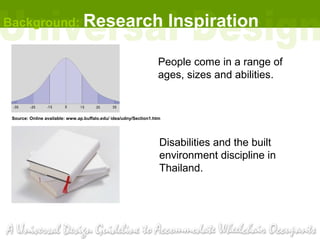
                                                                   People come in a range of
                                                                   ages, sizes and abilities.


 Source: Online available: www.ap.buffalo.edu/ idea/udny/Section1.htm


                                                                    Disabilities and the built
                                                                    environment discipline in
                                                                    Thailand.
Objective of Research

1. To advance the state of knowledge concerning
   environment-behavior studies in accordance with
   user participation paradigm

2. To explore living behavior, spatial configuration
   and need of physical environment in domestic
   space of wheelchair users
Objective of Research

3. To explore the novelty of research methodology
   by means of emerging subjective and objective
   field research

4. To purpose the optimal and practical Universal
   Design guideline for people with disabilities in
   accordance with the Thai context
Research Questions
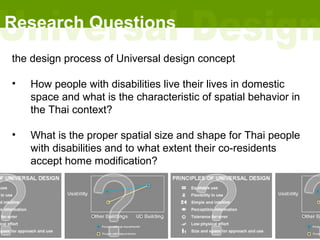
the design process of Universal design concept

•   How people with disabilities live their lives in domestic
    space and what is the characteristic of spatial behavior in
    the Thai context?

•   What is the proper spatial size and shape for Thai people
    with disabilities and to what extent their co-residents
    accept home modification?
Term of Definition

 -   People with disabilities: In this study referred to people
     who has mobility difficulty and use wheelchair to circulate
     in living areas

 -   Thai context: referred to the distinction of physical and
     societal dimension such as socio-economic, socio-
     cultural aspect, human proportion and attitude toward
     disablement of Thai people
Term of Definition

 -   Accommodation, Domestic space, Living area:
     referred to built environments within living areas where
     people with disabilities and their co-residents live
     together

 -   Environment-Behavior in living space: referred to daily
     living activities of people with disabilities by using
     wheelchair, such activities comprised; circulate from
     place to place, transfer from wheelchair to furniture and
     do activities on wheelchair
Theoretical Framework

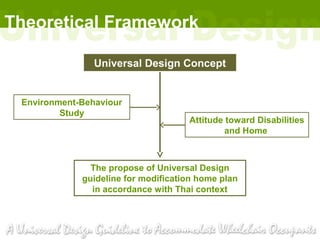
                Universal Design Concept


 Environment-Behaviour
         Study
                                     Attitude toward Disabilities
                                              and Home


               The propose of Universal Design
             guideline for modification home plan
               in accordance with Thai context
Research Framework
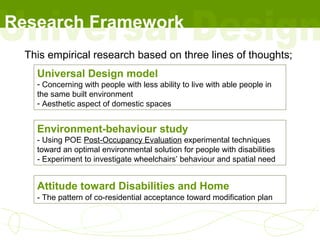
  This empirical research based on three lines of thoughts;
    Universal Design model
    - Concerning with people with less ability to live with able people in
    the same built environment
    - Aesthetic aspect of domestic spaces


    Environment-behaviour study
    - Using POE Post-Occupancy Evaluation experimental techniques
    toward an optimal environmental solution for people with disabilities
    - Experiment to investigate wheelchairs’ behaviour and spatial need


    Attitude toward Disabilities and Home
    - The pattern of co-residential acceptance toward modification plan
Variables

  Two types of variables were used in the framework;

  -   Size and Spatial characteristics of each area
      understudied vis-à-vis the pattern activities

  -   Attitudes of the people with disabilities and their
      co-residents toward the acceptance of the needed
      home modification
Research Method & Findings
Question 1:    How people with disabilities live their lives in domestic spaces
               and what is the characteristic of spatial behavior in the Thai context?


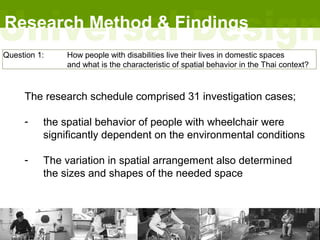
     The research schedule comprised 31 investigation cases;

     -    the spatial behavior of people with wheelchair were
          significantly dependent on the environmental conditions

     -    The variation in spatial arrangement also determined
          the sizes and shapes of the needed space
Research Findings
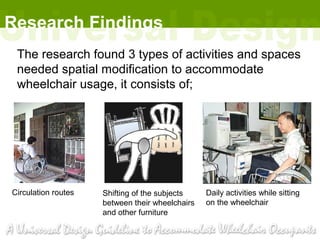
 The research found 3 types of activities and spaces
 needed spatial modification to accommodate
 wheelchair usage, it consists of;


Circulation routes   Shifting of the subjects    Daily activities while sitting
                     between their wheelchairs   on the wheelchair
                     and other furniture
Research Method & Findings
Question 2:    What is the proper spatial size and shape for Thai people with
               disabilities ?

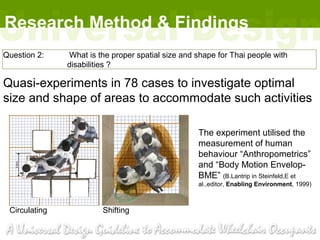
Quasi-experiments in 78 cases to investigate optimal
size and shape of areas to accommodate such activities

                                                   The experiment utilised the
                                                   measurement of human
                                                   behaviour “Anthropometrics”
                                                   and “Body Motion Envelop-
                                                   BME” (B.Lantrip in Steinfeld,E et
                                                   al.,editor, Enabling Environment, 1999)


 Circulating             Shifting
Research Method & Findings
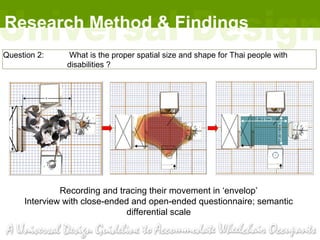
Question 2:    What is the proper spatial size and shape for Thai people with
               disabilities ?


              Recording and tracing their movement in ‘envelop’
     Interview with close-ended and open-ended questionnaire; semantic
                              differential scale
Research Method & Findings


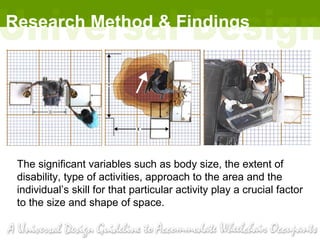
 The significant variables such as body size, the extent of
 disability, type of activities, approach to the area and the
 individual’s skill for that particular activity play a crucial factor
 to the size and shape of space.
Research Method & Findings
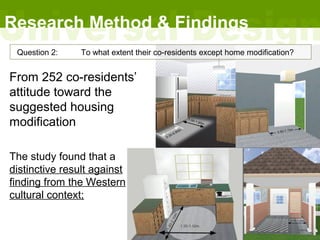
 Question 2:    To what extent their co-residents except home modification?


From 252 co-residents’
attitude toward the
suggested housing
modification

The study found that a
distinctive result against
finding from the Western
cultural context;
Research Findings

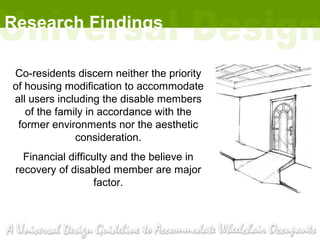
Co-residents discern neither the priority
of housing modification to accommodate
all users including the disable members
   of the family in accordance with the
 former environments nor the aesthetic
              consideration.
   Financial difficulty and the believe in
 recovery of disabled member are major
                    factor.
Conclusion


 The distinctive nature of people with disabilities
 and co-residents; in term of socio-psychology,
 the sense of belonging to their house, cultural
 background the extent of disability and the
 specific needs required by each of individual
 residents.
Bibliography
Adaptive Environments Center, Inc., 2001. Principles of Universal Design. [Online] Available: http:
//www.adaptenv.org/universal.
Bednar,M.J.,1977. Barrier-Free Environments. Pennsylvania. U.S.A. Dowden,Hutchinson & Ross,Inc.
Dobkin, I. L. and Peterson, M. J., 1999. Gracious Space: Universal Interiors by
            Design. U.S.A.The McGraw-Hill Companies.
Fair Housing Accessibility, 2000. The Seventh Technical Requirements for Builders and Developers.
            [Online] Available: http: //www.wheelweb.com
Mace R.L. ,1990. Definition of Accessible, Adaptable and Universal Design. [Online] Available:
http://www.design.ncsu.edu.
Mace R.L. ,1999. Universal Design in Housing. [Online] Available: http: //www.adaptenv.org/universal.
Orstein W.S., 1997. Environment and Behavior. Brazil: Sage Publication,Inc.
Peterson, M. J., 1996. Universal Bathroom Planning Design That Adapts to People. New York: The
National Kitchen & Bath Associate”
Steinfeld,E., 1994. The concept of Universal Design. New York. Center for Inclusive Design &
Environmental Access State University of New York at Buffalo.
Steinfeld,E et al.,editor,1999. Enabling Environment. New York. Kluwer Academic / Plenum Publisher.
Steven Winter Associates, 1997. Accessible Housing by Design. Oregon.U.S.A. McGraw-Hill
Companies.
The center for Universal Design, 2000. Universal Design Principle. [Online] Available: http:
//www.design.ncsu.edu: 8120/cud/built env/overview hous.html
United Nation and United Nations Centre for Human Settlements (Habitat). 1981. Designing with Care.
            Sweden. Swedish International Development Authority (SIDA).
Discussion


      Please ……..
                    Questions & Comments
Further info.


  thank you very much

          antika.sawadsri@ncl.ac.uk

UD in Thai context (M.Arch.)

  • 1.
    Universal Design andVisitability: From Accessibility to Zoning Conference: 13-14 July 2006 The Ohio State University, USA Antika Sawadsri School of Architecture, Planning and Landscape University of Newcastle upon Tyne, UK
  • 2.
    Content - Personal Background - Research Inspiration - Objective of Research - Research Question - Research Framework - Research Method and Findings - Conclusion - Bibliography - Discussion
  • 3.
    Background: Personal Background Educational Background; B.F.A. and M.A. majored in Interior Design Working as a practitioner Le Corbusier: Modulor (1950) a: Encyclopaedia Universalis, 13, 654, Reference data for Human Dimension and Interior Space (1979) Source: Online available www.xtec.es/.../credit/ credit0/voc/htm/voc3.htm
  • 4.
    Background: Research Inspiration People come in a range of ages, sizes and abilities. Source: Online available: www.ap.buffalo.edu/ idea/udny/Section1.htm Disabilities and the built environment discipline in Thailand.
  • 5.
    Objective of Research 1.To advance the state of knowledge concerning environment-behavior studies in accordance with user participation paradigm 2. To explore living behavior, spatial configuration and need of physical environment in domestic space of wheelchair users
  • 6.
    Objective of Research 3.To explore the novelty of research methodology by means of emerging subjective and objective field research 4. To purpose the optimal and practical Universal Design guideline for people with disabilities in accordance with the Thai context
  • 7.
    Research Questions the designprocess of Universal design concept • How people with disabilities live their lives in domestic space and what is the characteristic of spatial behavior in the Thai context? • What is the proper spatial size and shape for Thai people with disabilities and to what extent their co-residents accept home modification?
  • 8.
    Term of Definition - People with disabilities: In this study referred to people who has mobility difficulty and use wheelchair to circulate in living areas - Thai context: referred to the distinction of physical and societal dimension such as socio-economic, socio- cultural aspect, human proportion and attitude toward disablement of Thai people
  • 9.
    Term of Definition - Accommodation, Domestic space, Living area: referred to built environments within living areas where people with disabilities and their co-residents live together - Environment-Behavior in living space: referred to daily living activities of people with disabilities by using wheelchair, such activities comprised; circulate from place to place, transfer from wheelchair to furniture and do activities on wheelchair
  • 10.
    Theoretical Framework Universal Design Concept Environment-Behaviour Study Attitude toward Disabilities and Home The propose of Universal Design guideline for modification home plan in accordance with Thai context
  • 11.
    Research Framework This empirical research based on three lines of thoughts; Universal Design model - Concerning with people with less ability to live with able people in the same built environment - Aesthetic aspect of domestic spaces Environment-behaviour study - Using POE Post-Occupancy Evaluation experimental techniques toward an optimal environmental solution for people with disabilities - Experiment to investigate wheelchairs’ behaviour and spatial need Attitude toward Disabilities and Home - The pattern of co-residential acceptance toward modification plan
  • 12.
    Variables Twotypes of variables were used in the framework; - Size and Spatial characteristics of each area understudied vis-à-vis the pattern activities - Attitudes of the people with disabilities and their co-residents toward the acceptance of the needed home modification
  • 13.
    Research Method &Findings Question 1: How people with disabilities live their lives in domestic spaces and what is the characteristic of spatial behavior in the Thai context? The research schedule comprised 31 investigation cases; - the spatial behavior of people with wheelchair were significantly dependent on the environmental conditions - The variation in spatial arrangement also determined the sizes and shapes of the needed space
  • 14.
    Research Findings Theresearch found 3 types of activities and spaces needed spatial modification to accommodate wheelchair usage, it consists of; Circulation routes Shifting of the subjects Daily activities while sitting between their wheelchairs on the wheelchair and other furniture
  • 15.
    Research Method &Findings Question 2: What is the proper spatial size and shape for Thai people with disabilities ? Quasi-experiments in 78 cases to investigate optimal size and shape of areas to accommodate such activities The experiment utilised the measurement of human behaviour “Anthropometrics” and “Body Motion Envelop- BME” (B.Lantrip in Steinfeld,E et al.,editor, Enabling Environment, 1999) Circulating Shifting
  • 16.
    Research Method &Findings Question 2: What is the proper spatial size and shape for Thai people with disabilities ? Recording and tracing their movement in ‘envelop’ Interview with close-ended and open-ended questionnaire; semantic differential scale
  • 17.
    Research Method &Findings The significant variables such as body size, the extent of disability, type of activities, approach to the area and the individual’s skill for that particular activity play a crucial factor to the size and shape of space.
  • 18.
    Research Method &Findings Question 2: To what extent their co-residents except home modification? From 252 co-residents’ attitude toward the suggested housing modification The study found that a distinctive result against finding from the Western cultural context;
  • 19.
    Research Findings Co-residents discernneither the priority of housing modification to accommodate all users including the disable members of the family in accordance with the former environments nor the aesthetic consideration. Financial difficulty and the believe in recovery of disabled member are major factor.
  • 20.
    Conclusion The distinctivenature of people with disabilities and co-residents; in term of socio-psychology, the sense of belonging to their house, cultural background the extent of disability and the specific needs required by each of individual residents.
  • 21.
    Bibliography Adaptive Environments Center,Inc., 2001. Principles of Universal Design. [Online] Available: http: //www.adaptenv.org/universal. Bednar,M.J.,1977. Barrier-Free Environments. Pennsylvania. U.S.A. Dowden,Hutchinson & Ross,Inc. Dobkin, I. L. and Peterson, M. J., 1999. Gracious Space: Universal Interiors by Design. U.S.A.The McGraw-Hill Companies. Fair Housing Accessibility, 2000. The Seventh Technical Requirements for Builders and Developers. [Online] Available: http: //www.wheelweb.com Mace R.L. ,1990. Definition of Accessible, Adaptable and Universal Design. [Online] Available: http://www.design.ncsu.edu. Mace R.L. ,1999. Universal Design in Housing. [Online] Available: http: //www.adaptenv.org/universal. Orstein W.S., 1997. Environment and Behavior. Brazil: Sage Publication,Inc. Peterson, M. J., 1996. Universal Bathroom Planning Design That Adapts to People. New York: The National Kitchen & Bath Associate” Steinfeld,E., 1994. The concept of Universal Design. New York. Center for Inclusive Design & Environmental Access State University of New York at Buffalo. Steinfeld,E et al.,editor,1999. Enabling Environment. New York. Kluwer Academic / Plenum Publisher. Steven Winter Associates, 1997. Accessible Housing by Design. Oregon.U.S.A. McGraw-Hill Companies. The center for Universal Design, 2000. Universal Design Principle. [Online] Available: http: //www.design.ncsu.edu: 8120/cud/built env/overview hous.html United Nation and United Nations Centre for Human Settlements (Habitat). 1981. Designing with Care. Sweden. Swedish International Development Authority (SIDA).
  • 22.
    Discussion Please …….. Questions & Comments
  • 23.
    Further info. thank you very much antika.sawadsri@ncl.ac.uk