i
SHS
Understanding Culture Society
and Politics
Quarter 1: Week 1 - Module 1
www.shsph.blogspot.com
ii
UNDERSTANDING CULTURE SOCIETY AND POLITICS
Grade 11/12 Quarter 1: Week 1 - Module 1
First Edition, 2020
Copyright © 2020
La Union Schools Division
Region I
All rights reserved. No part of this module may be reproduced in any form without
written permission from the copyright owners.
Development Team of the Module
Author: Robert D. Torcedo, T-III
Editor: SDO La Union, Learning Resource Quality Assurance Team
Illustrator: Ernesto F. Ramos Jr., P II
Management Team:
Atty. Donato D. Balderas, Jr.
Schools Division Superintendent
Vivian Luz S. Pagatpatan, Ph.D.
Assistant Schools Division Superintendent
German E. Flora, Ph.D., CID Chief
Virgilio C. Boado, Ph.D., EPS in Charge of LRMS
Mario B. Paneda, Ed.D., EPS in Charge of Araling Panlipunan
Michael Jason D. Morales, PDO II
Claire P. Toluyen, Librarian II
www.shsph.blogspot.com
iii
Understanding Culture
Society and Politics
Quarter 1: Week 1 - Module 1
www.shsph.blogspot.com
1
This module will help you understand the Nature and Goals of Anthropology,
Sociology and Political Science. Sociology is the study of human social relationships
and institutions. Sociology’s subject matter is diverse, ranging from crime to
religion, from the family to the state. While anthropology is a branch of sociology, it
always describes human, human behavior and human societies around the world.
Political science, by nature, is a social science that deals with humans and their
interactions
After going through this module, you are expected to:
Discuss the nature, goals and perspectives in/of anthropology, sociology and
political science
Specific Learning Objecticve
1. identify the nature, goals and perspectives of Anthropology, Sociology and
Political Science;
2. explain the different perspectives of anthropology, sociology and
political science
Target
www.shsph.blogspot.com
2
This activity will enable you to assess your prior
knowledge from the topic that will be discussed in
this lesson. Have fun and good luck!
Pre-Test
Directions: Choose the letter of the best answer and write your answer on a
separate sheet of paper.
1. It defines how people relate to nature and their physical environment.
A. Politics C. Culture
B. Anthropology D. Sociology
2. It always describes human, human behaviour and human societies around the
world.
A. Sociology C. Political Science
B. Anthropology D. Culture
3. It is a social science that deals with humans and their interactions.
A. Sociology C. Political Science
B. Anthropology D. Culture
4. It is the study of human social relationships and institutions.
A. Politics C.Culture
B. Anthropology D. Sociology
5. It is a state or habit of mind in which trust or confidence is placed in some
person or thing.
A. Beliefs C. Traditions
B. Customs D. Norms
6. This term means scientific study of man or human beings.
A. Politics C. Culture
B. Anthropology D. Sociology
7. It refers to a theoretical foundation of contemporary anthropology.
A. Nature of politics C. Nature of culture
B. Nature of anthropology D. Nature of sociology
8. It attempts to explain how the social world operates.
A. Political theory C. Anthropological theory
B. Sociological theory D. Cultural theory
9. It is used to analyse and explain objects of social study, and facilitate organizing
sociological knowledge.
A. Theoretical perspective C. Cultural perspective
B. Conflict perspective D. Functionalist perspective
Jumpstart
www.shsph.blogspot.com
3
10. It sees social life as a competition, and focuses on the distribution of
resources,power, and inequality.
A. Theoretical perspective C. Cultural perspective
B. Conflict perspective D. Functionalist perspective
The nature, goals and perspectives of anthropology, sociology and
political science
1. Anthropology
relates to sociology, it always describes human, human behaviour and
human societies around the world. It is a comparative science that
examines all societies. The term anthropology means scientific study of
man or human beings.
Cultural anthropology studies, human societies and elements of
cultural life. An example of cultural anthropology is the Linguistic
anthropology which focuses on language in a certain society. The goal of
studying anthropology is to understand the origin human evolution and the
diverse forms of its existence throughout time
The study of Man and its various aspects is known as Anthropology. It
may be a subject of science and arts. It is a branch of sociology. It describes
human, human behaviour and human societies and it examines all
societies around the world. It also describes the ancestors through time
and space in relation to its environmental, social relations, and culture
2. Sociology
is the study of human social relationships and institutions.
Sociology’s subject matter is diverse, ranging from crime to religion, from
the family to the state, from the divisions of race and social class to the
shared beliefs of a common culture, and from social stability to radical
change in whole societies. The purpose of sociology is to understand how
human action and consciousness both shape and are shaped by
surrounding cultural and social structures.
Sociology is a social science; it belongs to the family of social sciences.
As a social science, focuses its aspects on man, his social manners, social
activities and social life. The goal of sociology is to help you understand
how human action and consciousness both shape and are shaped by the
surrounding cultural and social structures
3. Political Science
is a social science that deals with humans and their interactions. It is
a branch of sociology; it essentially deals with the large-scale actions of
humans, and group mentality
it is a discipline that deals with several aspects such as the study of
Discover
www.shsph.blogspot.com
4
state and government. It deals with the nature and formation of the state
and attempts to understand its forms and functions. The goal of Political
Science is to constantly deepen the knowledge, discover progress and
protect the quality of life within a group, community, country, and the
world. Thus, it is the study of power relationships and competing interests
among states around the world.
4. Anthropological perspectives
are culture, cultural relativism, fieldwork, human diversity, holism,
bio-cultural focus. The four main perspectives of Anthropology are the
cross-cultural or comparative emphasis, its evolutionary/historical
emphasis, its ecological emphasis, and its holistic emphasis . An example
for this is the analysis and solutions of the different aspects of the society
such as the environment issues of pollution, the issues on health and
medicine and other issues related to the human activities.
5. Sociological perspective
introduces the discipline of sociology, including something about its
history, questions, theory, and scientific methods, and what distinguishes
it from other social science disciplines. Central features include social
interaction and relationships, social contexts, social structure, social
change, the significance of diversity and human variation, and the critical,
questioning character of sociology. It also explores what sociologists do.
Sociology includes three major theoretical perspectives:
1. the functionalist perspective;
2. the conflict perspective; and
3. the symbolic interaction perspective.
6. Theoretical perspective
is used to analyse and explain objects of social study, and facilitat
organizing sociological knowledge. In functionalist perspective, societies are
thought to function like organisms, with various social institutions working
together like organs to maintain and reproduce societies. The conflict
perspective sees social life as a competition, and focuses on the distribution
of resources, power, and inequality.
7. Political science perspective
studies the tendencies and actions of people which cannot be easily
quantified or examined. Political science is more focused than most social
sciences. It sticks to the political arena and to the realm of politics, either
dealing with situations with two competing sides or the lateral decisions
that affect the group as a whole. An example is the study of democracy as a
form of government and why is democracy considered as the best form of
government.
www.shsph.blogspot.com
5
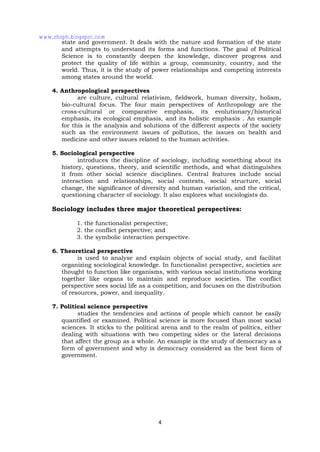
Activity 1. Power Organizer
Directions: Using the power organizer, write the most important details about the
nature and goals of Anthropology, Sociology and Political Science in your activity
notebook.
Questions:
1. How do you find the activity?
2. What are the important details you find out about the topic?
3. Do you find it helpful to know about the details of the topic?
Activity 2. Jumbled Letters
Directions:
There are five words that you can find below; however, the letters are
jumbled. A short description is provided to help you identify the words. Kindly write
the correct word/phrase on the blanks provided. Write your answer in your
notebook.
1. GYOLOPORTHAN -Scientific study of man or human beings.
__ __ __ __ __ __ __ __ __ __ __ __
2. GYOLOICOS -Study of human social relationships and institutions.
__ __ __ __ __ __ __ __ __
3. CALITILOP ECNEICS - A social science that deals with humans and their
interactions.
__ __ __ __ __ __ __ __ __ __ __ __ __ __ __ __
important
details about
the nature
and goals of
Anthropolog
y, Sociology
and Political
Science
1. ____
2. ____
1. ____
2. ____
1. ____
2. ____
1. ____
2. ____
1. ____
2. ____
1. ____
2. ____
www.shsph.blogspot.com
6
4. ERUTLUC - Consists of beliefs, behaviours, objects, and other
characteristics common to the members of a particular group or society.
__ __ __ __ __ __ __
5. SFEILEB - A state or habit of mind in which trust or confidence is placed
in some person or thing.
__ __ __ __ __ __ __
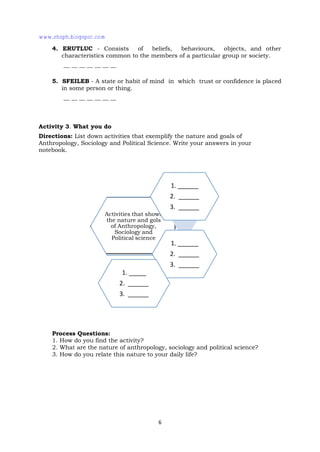
Activity 3. What you do
Directions: List down activities that exemplify the nature and goals of
Anthropology, Sociology and Political Science. Write your answers in your
notebook.
Process Questions:
1. How do you find the activity?
2. What are the nature of anthropology, sociology and political science?
3. How do you relate this nature to your daily life?
Activities that shows
the nature and gols
of Anthropology,
Sociology and
Political science
1. ______
2. ______
3. ______
1. ______
2. ______
3. ______
1. _____
2. ______
3. ______
www.shsph.blogspot.com
7
Activity 4. Give me the details
Directions: Enumerate the perspectives of anthropology, sociology and political
science. Then, give examples of how they are being used in society. Write your
answers in your activity notebook.
A. Anthropology
Perspectives Examples
1.
2.
3.
B. Sociology
Perspectives Examples
1.
2.
3.
C. Political Science
Perspectives Examples
1.
2.
3.
www.shsph.blogspot.com
8
Here are some enrichment activities for you to work on to master and
strengthen the basic concepts you have learned from this lesson.

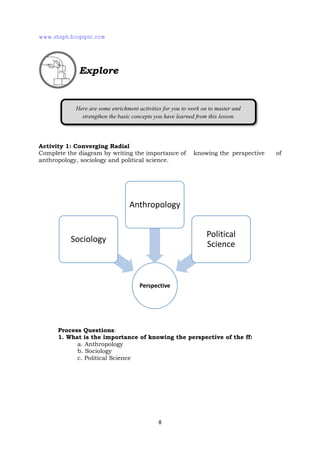
Activity 1: Converging Radial
Complete the diagram by writing the importance of knowing the perspective of
anthropology, sociology and political science.
Process Questions:
1. What is the importance of knowing the perspective of the ff:
a. Anthropology
b. Sociology
c. Political Science
Perspective
Sociology
Anthropology
Political
Science
Explore
www.shsph.blogspot.com
9
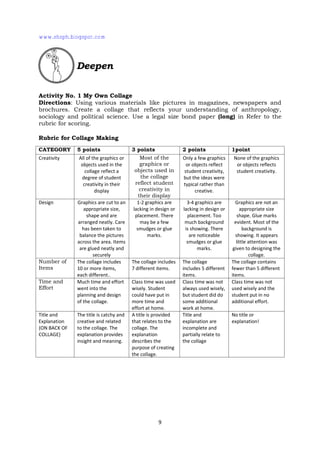
Activity No. 1 My Own Collage
Directions: Using various materials like pictures in magazines, newspapers and
brochures. Create a collage that reflects your understanding of anthropology,
sociology and political science. Use a legal size bond paper (long) in Refer to the
rubric for scoring.
Rubric for Collage Making
CATEGORY 5 points 3 points 2 points 1point
Creativity All of the graphics or
objects used in the
collage reflect a
degree of student
creativity in their
display
Most of the
graphics or
objects used in
the collage
reflect student
creativity in
their display
Only a few graphics
or objects reflect
student creativity,
but the ideas were
typical rather than
creative.
None of the graphics
or objects reflects
student creativity.
Design Graphics are cut to an
appropriate size,
shape and are
arranged neatly. Care
has been taken to
balance the pictures
across the area. Items
are glued neatly and
securely
1-2 graphics are
lacking in design or
placement. There
may be a few
smudges or glue
marks.
3-4 graphics are
lacking in design or
placement. Too
much background
is showing. There
are noticeable
smudges or glue
marks.
Graphics are not an
appropriate size
shape. Glue marks
evident. Most of the
background is
showing. It appears
little attention was
given to designing the
collage.
Number of
Items
The collage includes
10 or more items,
each different..
The collage includes
7 different items.
The collage
includes 5 different
items.
The collage contains
fewer than 5 different
items.
Time and
Effort
Much time and effort
went into the
planning and design
of the collage.
Class time was used
wisely. Student
could have put in
more time and
effort at home.
Class time was not
always used wisely,
but student did do
some additional
work at home.
Class time was not
used wisely and the
student put in no
additional effort.
Title and
Explanation
{ON BACK OF
COLLAGE}
The title is catchy and
creative and related
to the collage. The
explanation provides
insight and meaning.
A title is provided
that relates to the
collage. The
explanation
describes the
purpose of creating
the collage.
Title and
explanation are
incomplete and
partially relate to
the collage
No title or
explanation!
Deepen
www.shsph.blogspot.com
10
Activity 1. Summative Assessment
Directions: True or False. Analyze each statement. Write T If the statement is true
and write F if the statement is false. Write your answer in your activity notebook.
________1. Culture is defined as how people relate to nature and their physical
environment.
_______ 2. The term “Politics” means scientific study of man or human beings.
________3. Theoretical perspective is used to analyse and explain objects of social
study, and facilitate organizing sociological knowledge.
________4. Anthropology always describes human, human behaviour and human
societies around the world.
________5. Beliefs refer to the state or habit of mind in which trust or confidence
is placed in some person or thing.
________6. Cultural perspective sees social life as a competition, and focuses on
the distribution of resources, power, and inequality.
________7. Sociology is the study of human social relationships and institutions.
________8. Sociological theory attempts to explain how the social world operates
________9. Political Science, social science that deals with humans and their
interactions.
________10. Nature of politics refers to a theoretical foundation of contemporary
anthropology.
Great job! You are done with this
module.
Gauge
www.shsph.blogspot.com
11
Pre
Test
1.
C
2.
B
3.
C
4.
D
5.
A
6.
B
7.
C
8.
B
9.
A
10.
B
Post
Test
1.
T
2.
F
3.
T
4.
T
5.
T
6.
F
7.
T
8.
T
9.
T
10.
F
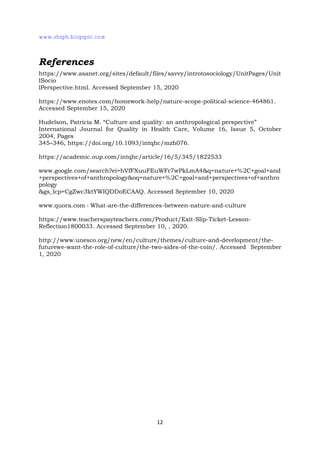
Discover
Activity
1
Power
Organized
(Answer
may
vary)
Activity
2
Jumbled
Letter
1.
Anthropology
2.
Sociology
3.
Political
Science
4.
Culture
5.
Beliefs
Activity
3
What
you
do
(Answer
may
vary)
Activity
4
Give
me
details
(Answer
may
vary)
Explore
Activity
1
Converging
Radial
(Answer
may
vary)
Answer Key
www.shsph.blogspot.com
12
References
https://www.asanet.org/sites/default/files/savvy/introtosociology/UnitPages/Unit
ISocio
lPerspective.html. Accessed September 15, 2020
https://www.enotes.com/homework-help/nature-scope-political-science-464861.
Accessed September 15, 2020
Hudelson, Patricia M. “Culture and quality: an anthropological perspective”
International Journal for Quality in Health Care, Volume 16, Issue 5, October
2004, Pages
345–346, https://doi.org/10.1093/intqhc/mzh076.
https://academic.oup.com/intqhc/article/16/5/345/1822533
www.google.com/search?ei=hVfFXuuFEuWFr7wPkLmA4&q=nature+%2C+goal+and
+perspectives+of+anthropology&oq=nature+%2C+goal+and+perspectives+of+anthro
pology
&gs_lcp=CgZwc3ktYWIQDDoECAAQ. Accessed September 10, 2020
www.quora.com › What-are-the-differences-between-nature-and-culture
https://www.teacherspayteachers.com/Product/Exit-Slip-Ticket-Lesson-
Reflection1800033. Accessed September 10, , 2020.
http://www.unesco.org/new/en/culture/themes/culture-and-development/the-
futurewe-want-the-role-of-culture/the-two-sides-of-the-coin/. Accessed September
1, 2020
www.shsph.blogspot.com

UCSP Module 1

  • 1.
    i SHS Understanding Culture Society andPolitics Quarter 1: Week 1 - Module 1 www.shsph.blogspot.com
  • 2.
    ii UNDERSTANDING CULTURE SOCIETYAND POLITICS Grade 11/12 Quarter 1: Week 1 - Module 1 First Edition, 2020 Copyright © 2020 La Union Schools Division Region I All rights reserved. No part of this module may be reproduced in any form without written permission from the copyright owners. Development Team of the Module Author: Robert D. Torcedo, T-III Editor: SDO La Union, Learning Resource Quality Assurance Team Illustrator: Ernesto F. Ramos Jr., P II Management Team: Atty. Donato D. Balderas, Jr. Schools Division Superintendent Vivian Luz S. Pagatpatan, Ph.D. Assistant Schools Division Superintendent German E. Flora, Ph.D., CID Chief Virgilio C. Boado, Ph.D., EPS in Charge of LRMS Mario B. Paneda, Ed.D., EPS in Charge of Araling Panlipunan Michael Jason D. Morales, PDO II Claire P. Toluyen, Librarian II www.shsph.blogspot.com
  • 3.
    iii Understanding Culture Society andPolitics Quarter 1: Week 1 - Module 1 www.shsph.blogspot.com
  • 4.
    1 This module willhelp you understand the Nature and Goals of Anthropology, Sociology and Political Science. Sociology is the study of human social relationships and institutions. Sociology’s subject matter is diverse, ranging from crime to religion, from the family to the state. While anthropology is a branch of sociology, it always describes human, human behavior and human societies around the world. Political science, by nature, is a social science that deals with humans and their interactions After going through this module, you are expected to: Discuss the nature, goals and perspectives in/of anthropology, sociology and political science Specific Learning Objecticve 1. identify the nature, goals and perspectives of Anthropology, Sociology and Political Science; 2. explain the different perspectives of anthropology, sociology and political science Target www.shsph.blogspot.com
  • 5.
    2 This activity willenable you to assess your prior knowledge from the topic that will be discussed in this lesson. Have fun and good luck! Pre-Test Directions: Choose the letter of the best answer and write your answer on a separate sheet of paper. 1. It defines how people relate to nature and their physical environment. A. Politics C. Culture B. Anthropology D. Sociology 2. It always describes human, human behaviour and human societies around the world. A. Sociology C. Political Science B. Anthropology D. Culture 3. It is a social science that deals with humans and their interactions. A. Sociology C. Political Science B. Anthropology D. Culture 4. It is the study of human social relationships and institutions. A. Politics C.Culture B. Anthropology D. Sociology 5. It is a state or habit of mind in which trust or confidence is placed in some person or thing. A. Beliefs C. Traditions B. Customs D. Norms 6. This term means scientific study of man or human beings. A. Politics C. Culture B. Anthropology D. Sociology 7. It refers to a theoretical foundation of contemporary anthropology. A. Nature of politics C. Nature of culture B. Nature of anthropology D. Nature of sociology 8. It attempts to explain how the social world operates. A. Political theory C. Anthropological theory B. Sociological theory D. Cultural theory 9. It is used to analyse and explain objects of social study, and facilitate organizing sociological knowledge. A. Theoretical perspective C. Cultural perspective B. Conflict perspective D. Functionalist perspective Jumpstart www.shsph.blogspot.com
  • 6.
    3 10. It seessocial life as a competition, and focuses on the distribution of resources,power, and inequality. A. Theoretical perspective C. Cultural perspective B. Conflict perspective D. Functionalist perspective The nature, goals and perspectives of anthropology, sociology and political science 1. Anthropology relates to sociology, it always describes human, human behaviour and human societies around the world. It is a comparative science that examines all societies. The term anthropology means scientific study of man or human beings. Cultural anthropology studies, human societies and elements of cultural life. An example of cultural anthropology is the Linguistic anthropology which focuses on language in a certain society. The goal of studying anthropology is to understand the origin human evolution and the diverse forms of its existence throughout time The study of Man and its various aspects is known as Anthropology. It may be a subject of science and arts. It is a branch of sociology. It describes human, human behaviour and human societies and it examines all societies around the world. It also describes the ancestors through time and space in relation to its environmental, social relations, and culture 2. Sociology is the study of human social relationships and institutions. Sociology’s subject matter is diverse, ranging from crime to religion, from the family to the state, from the divisions of race and social class to the shared beliefs of a common culture, and from social stability to radical change in whole societies. The purpose of sociology is to understand how human action and consciousness both shape and are shaped by surrounding cultural and social structures. Sociology is a social science; it belongs to the family of social sciences. As a social science, focuses its aspects on man, his social manners, social activities and social life. The goal of sociology is to help you understand how human action and consciousness both shape and are shaped by the surrounding cultural and social structures 3. Political Science is a social science that deals with humans and their interactions. It is a branch of sociology; it essentially deals with the large-scale actions of humans, and group mentality it is a discipline that deals with several aspects such as the study of Discover www.shsph.blogspot.com
  • 7.
    4 state and government.It deals with the nature and formation of the state and attempts to understand its forms and functions. The goal of Political Science is to constantly deepen the knowledge, discover progress and protect the quality of life within a group, community, country, and the world. Thus, it is the study of power relationships and competing interests among states around the world. 4. Anthropological perspectives are culture, cultural relativism, fieldwork, human diversity, holism, bio-cultural focus. The four main perspectives of Anthropology are the cross-cultural or comparative emphasis, its evolutionary/historical emphasis, its ecological emphasis, and its holistic emphasis . An example for this is the analysis and solutions of the different aspects of the society such as the environment issues of pollution, the issues on health and medicine and other issues related to the human activities. 5. Sociological perspective introduces the discipline of sociology, including something about its history, questions, theory, and scientific methods, and what distinguishes it from other social science disciplines. Central features include social interaction and relationships, social contexts, social structure, social change, the significance of diversity and human variation, and the critical, questioning character of sociology. It also explores what sociologists do. Sociology includes three major theoretical perspectives: 1. the functionalist perspective; 2. the conflict perspective; and 3. the symbolic interaction perspective. 6. Theoretical perspective is used to analyse and explain objects of social study, and facilitat organizing sociological knowledge. In functionalist perspective, societies are thought to function like organisms, with various social institutions working together like organs to maintain and reproduce societies. The conflict perspective sees social life as a competition, and focuses on the distribution of resources, power, and inequality. 7. Political science perspective studies the tendencies and actions of people which cannot be easily quantified or examined. Political science is more focused than most social sciences. It sticks to the political arena and to the realm of politics, either dealing with situations with two competing sides or the lateral decisions that affect the group as a whole. An example is the study of democracy as a form of government and why is democracy considered as the best form of government. www.shsph.blogspot.com
  • 8.
    5 Activity 1. PowerOrganizer Directions: Using the power organizer, write the most important details about the nature and goals of Anthropology, Sociology and Political Science in your activity notebook. Questions: 1. How do you find the activity? 2. What are the important details you find out about the topic? 3. Do you find it helpful to know about the details of the topic? Activity 2. Jumbled Letters Directions: There are five words that you can find below; however, the letters are jumbled. A short description is provided to help you identify the words. Kindly write the correct word/phrase on the blanks provided. Write your answer in your notebook. 1. GYOLOPORTHAN -Scientific study of man or human beings. __ __ __ __ __ __ __ __ __ __ __ __ 2. GYOLOICOS -Study of human social relationships and institutions. __ __ __ __ __ __ __ __ __ 3. CALITILOP ECNEICS - A social science that deals with humans and their interactions. __ __ __ __ __ __ __ __ __ __ __ __ __ __ __ __ important details about the nature and goals of Anthropolog y, Sociology and Political Science 1. ____ 2. ____ 1. ____ 2. ____ 1. ____ 2. ____ 1. ____ 2. ____ 1. ____ 2. ____ 1. ____ 2. ____ www.shsph.blogspot.com
  • 9.
    6 4. ERUTLUC -Consists of beliefs, behaviours, objects, and other characteristics common to the members of a particular group or society. __ __ __ __ __ __ __ 5. SFEILEB - A state or habit of mind in which trust or confidence is placed in some person or thing. __ __ __ __ __ __ __ Activity 3. What you do Directions: List down activities that exemplify the nature and goals of Anthropology, Sociology and Political Science. Write your answers in your notebook. Process Questions: 1. How do you find the activity? 2. What are the nature of anthropology, sociology and political science? 3. How do you relate this nature to your daily life? Activities that shows the nature and gols of Anthropology, Sociology and Political science 1. ______ 2. ______ 3. ______ 1. ______ 2. ______ 3. ______ 1. _____ 2. ______ 3. ______ www.shsph.blogspot.com
  • 10.
    7 Activity 4. Giveme the details Directions: Enumerate the perspectives of anthropology, sociology and political science. Then, give examples of how they are being used in society. Write your answers in your activity notebook. A. Anthropology Perspectives Examples 1. 2. 3. B. Sociology Perspectives Examples 1. 2. 3. C. Political Science Perspectives Examples 1. 2. 3. www.shsph.blogspot.com
  • 11.
    8 Here are someenrichment activities for you to work on to master and strengthen the basic concepts you have learned from this lesson.  Activity 1: Converging Radial Complete the diagram by writing the importance of knowing the perspective of anthropology, sociology and political science. Process Questions: 1. What is the importance of knowing the perspective of the ff: a. Anthropology b. Sociology c. Political Science Perspective Sociology Anthropology Political Science Explore www.shsph.blogspot.com
  • 12.
    9 Activity No. 1My Own Collage Directions: Using various materials like pictures in magazines, newspapers and brochures. Create a collage that reflects your understanding of anthropology, sociology and political science. Use a legal size bond paper (long) in Refer to the rubric for scoring. Rubric for Collage Making CATEGORY 5 points 3 points 2 points 1point Creativity All of the graphics or objects used in the collage reflect a degree of student creativity in their display Most of the graphics or objects used in the collage reflect student creativity in their display Only a few graphics or objects reflect student creativity, but the ideas were typical rather than creative. None of the graphics or objects reflects student creativity. Design Graphics are cut to an appropriate size, shape and are arranged neatly. Care has been taken to balance the pictures across the area. Items are glued neatly and securely 1-2 graphics are lacking in design or placement. There may be a few smudges or glue marks. 3-4 graphics are lacking in design or placement. Too much background is showing. There are noticeable smudges or glue marks. Graphics are not an appropriate size shape. Glue marks evident. Most of the background is showing. It appears little attention was given to designing the collage. Number of Items The collage includes 10 or more items, each different.. The collage includes 7 different items. The collage includes 5 different items. The collage contains fewer than 5 different items. Time and Effort Much time and effort went into the planning and design of the collage. Class time was used wisely. Student could have put in more time and effort at home. Class time was not always used wisely, but student did do some additional work at home. Class time was not used wisely and the student put in no additional effort. Title and Explanation {ON BACK OF COLLAGE} The title is catchy and creative and related to the collage. The explanation provides insight and meaning. A title is provided that relates to the collage. The explanation describes the purpose of creating the collage. Title and explanation are incomplete and partially relate to the collage No title or explanation! Deepen www.shsph.blogspot.com
  • 13.
    10 Activity 1. SummativeAssessment Directions: True or False. Analyze each statement. Write T If the statement is true and write F if the statement is false. Write your answer in your activity notebook. ________1. Culture is defined as how people relate to nature and their physical environment. _______ 2. The term “Politics” means scientific study of man or human beings. ________3. Theoretical perspective is used to analyse and explain objects of social study, and facilitate organizing sociological knowledge. ________4. Anthropology always describes human, human behaviour and human societies around the world. ________5. Beliefs refer to the state or habit of mind in which trust or confidence is placed in some person or thing. ________6. Cultural perspective sees social life as a competition, and focuses on the distribution of resources, power, and inequality. ________7. Sociology is the study of human social relationships and institutions. ________8. Sociological theory attempts to explain how the social world operates ________9. Political Science, social science that deals with humans and their interactions. ________10. Nature of politics refers to a theoretical foundation of contemporary anthropology. Great job! You are done with this module. Gauge www.shsph.blogspot.com
  • 14.
  • 15.
    12 References https://www.asanet.org/sites/default/files/savvy/introtosociology/UnitPages/Unit ISocio lPerspective.html. Accessed September15, 2020 https://www.enotes.com/homework-help/nature-scope-political-science-464861. Accessed September 15, 2020 Hudelson, Patricia M. “Culture and quality: an anthropological perspective” International Journal for Quality in Health Care, Volume 16, Issue 5, October 2004, Pages 345–346, https://doi.org/10.1093/intqhc/mzh076. https://academic.oup.com/intqhc/article/16/5/345/1822533 www.google.com/search?ei=hVfFXuuFEuWFr7wPkLmA4&q=nature+%2C+goal+and +perspectives+of+anthropology&oq=nature+%2C+goal+and+perspectives+of+anthro pology &gs_lcp=CgZwc3ktYWIQDDoECAAQ. Accessed September 10, 2020 www.quora.com › What-are-the-differences-between-nature-and-culture https://www.teacherspayteachers.com/Product/Exit-Slip-Ticket-Lesson- Reflection1800033. Accessed September 10, , 2020. http://www.unesco.org/new/en/culture/themes/culture-and-development/the- futurewe-want-the-role-of-culture/the-two-sides-of-the-coin/. Accessed September 1, 2020 www.shsph.blogspot.com