
Gibberellin and plant growth
What is GAs
• Gibberellins (GAs) are plant hormones that regulate growth and
influence various developmental processes, including stem
elongation, germination, dormancy, flowering, sex expression,
enzyme induction, and leaf and fruit senescence.
History
• Gibberellin was first recognized in 1926 by a Japanese scientist, Eiichi
Kurosawa and studying bakanae, the "foolish seedling" disease in rice.
• It was first isolated in 1935 by Teijiro Yabuta and Sumuki, from
fungal strain (Gibberella fujikuroi) provided by Kurosawa.
• Yabuta named the isolate as gibberellin.
• In the United States, the first research was undertaken by a unit at
Camp Detrick in Maryland, via studying seedlings of the bean Vicia
faba.
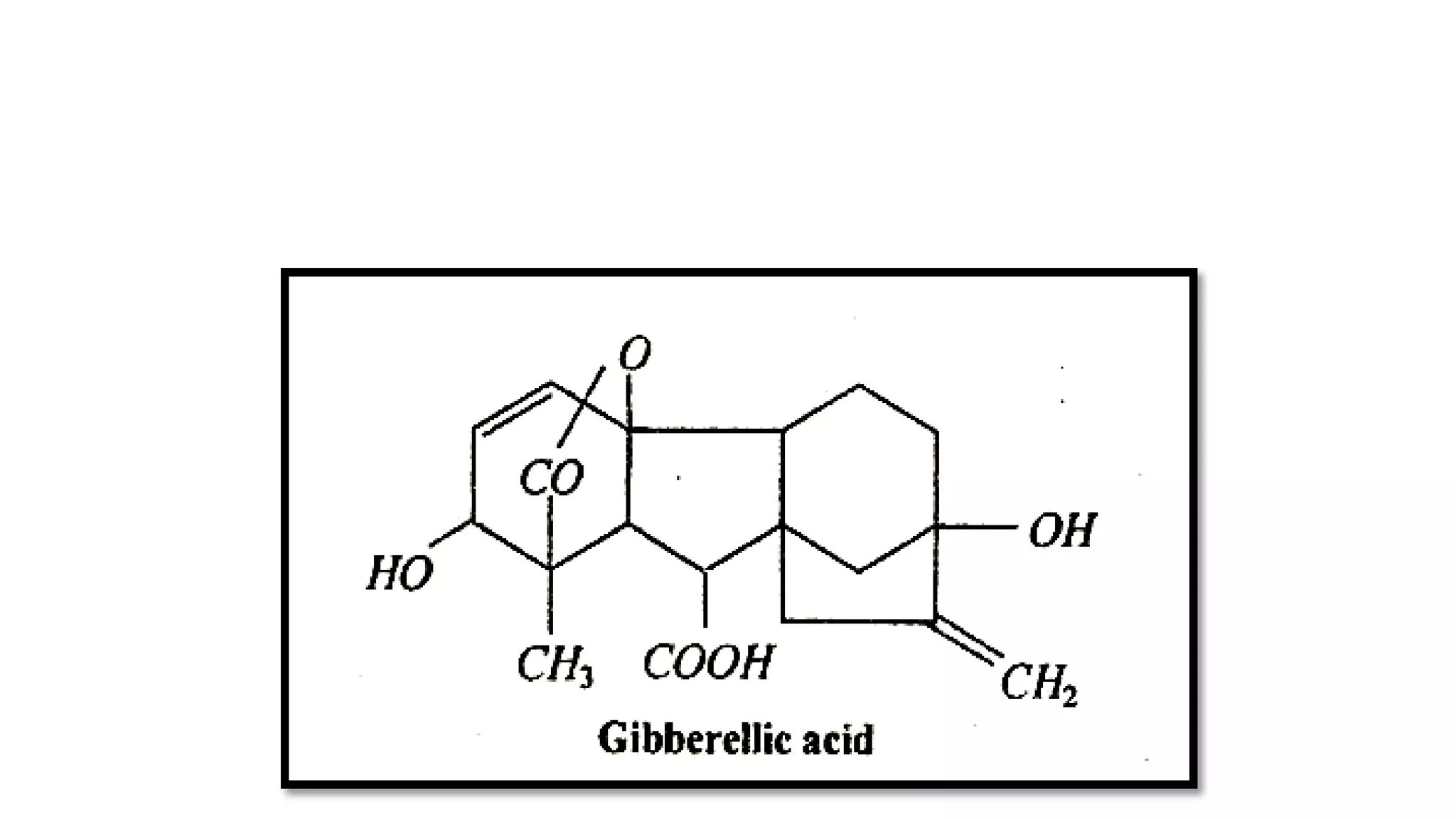
Bioactive gibberellic acid
• The gibberellins are metabolic products of the fungus Gibberella
fujikuroi.
• Three gibberellins are known:
• gibberellic acid (C19H22O6)
• gibberellin A1 (C19H24O6)
• gibberellin A2 (C19H26O6)
• A structure for gibberellic acid has been proposed. Gibberellin A1 is a
dihydro derivative of gibberellic acid. The structure of gibberellin A2
has not yet been established
Effects of GAs on plant growth
• The most characteristic effects of GA on shoot growth.
• GAs are increased inter-node extension, increased leaf-growth and
enhanced apical dominance.
• High concentrations of GA are only slightly inhibitory.
• Many forms of dormancy are broken by GA.
• These include seed dormancy, dormancy of potato tubers and
dormancy of shoot internodes and buds.
Conti…..
• GA will induce flowering of long-short-day plants kept permanently in
short-day photoperiods and induce stem growth.
• It inhibits flowering of short-day plants in inductive short-day
photoperiods.
• In its effects on vegetative cell extension GA has certain similarities to
the auxins but there are also differences.
Important differences b/w auxin and GAs
• The most important differences are:
• (a) auxins greatly increase cell-extension in excised tissue sections,
whereas GA has little effect
• GA induces marked cell extension in shoots of some intact plants,
whereas exogenous auxins have little effect
• (c) auxins inhibit root growth strongly, but GA does not.
• There are more than 70 gibberellins isolated. They are GA1, GA2,
GA3 and so on. The GA3 Gibberellic acid is the most widely
studied plant growth regulators.
Physiological effects
• Seed Germination
• Some seeds that are sensitive to light such as tobacco and lettuce
exhibit poor germination in the absence of sunlight.
• Germination begins rapidly if the seeds are exposed to the sunlight.
• Dormancy of Buds
• The buds that are formed in autumn stay dormant until next spring.
• This dormancy can be overcome by treating them with gibberellin.
• Root Growth
• GAs have no effect on root growth.
• Elongation of the Internodes
• Internodes elongation is the Gibberellins have almost no effect on the
growth of roots.
• most pronounced effects of gibberellins on the plant growth.
• For example, the dwarf pea plants have expanded leaves and short
internodes.
• But the internodes expand and look like tall plants when treated with
gibberellin.
Biosynthesis
• GAs are usually synthesized from the methylerythritol
phosphate(MEP) pathway in higher plants.
• GA is produced from trans-geranylgeranyl diphosphate(GGDP).
• In the MEP pathway,three classes of enzymes are used to yield GA
from GGDP:
• 1) cytochrome P450 monooxygenases (P450s).
• 3) 2-oxoglutarate-dependent dioxygenases (2ODDs).
• There are 8 steps in the MEP pathway: -
• 1) GGDP is converted to ent-copalyl diphosphate (ent-CPD).
• 2) etn-CDP is converted to ent-kaurene by ent-kaurene synthase
• 3) ent-kaurene is converted to ent-kaurenol by ent-kaurene oxidase
(KO) .
• 4) ent-kaurenol is converted to ent-kaurenal by KO
• 5) ent-kaurenal is converted to ent-kaurenoic acid.
• 6) ent-kaurenoic acid is converted to ent-7a-hydroxykaurenoic acid
• 7) ent-7a-hydroxykaurenoic acid is converted to GA12-aldehyde.
• 8) GA12-aldehyde is converted to GA12.
ubaidafzal018@gmail.com

ubaidafzal018@gmail.com

  • 1.
  • 2.
    What is GAs •Gibberellins (GAs) are plant hormones that regulate growth and influence various developmental processes, including stem elongation, germination, dormancy, flowering, sex expression, enzyme induction, and leaf and fruit senescence.
  • 4.
    History • Gibberellin wasfirst recognized in 1926 by a Japanese scientist, Eiichi Kurosawa and studying bakanae, the "foolish seedling" disease in rice. • It was first isolated in 1935 by Teijiro Yabuta and Sumuki, from fungal strain (Gibberella fujikuroi) provided by Kurosawa. • Yabuta named the isolate as gibberellin. • In the United States, the first research was undertaken by a unit at Camp Detrick in Maryland, via studying seedlings of the bean Vicia faba.
  • 5.
    Bioactive gibberellic acid •The gibberellins are metabolic products of the fungus Gibberella fujikuroi. • Three gibberellins are known: • gibberellic acid (C19H22O6) • gibberellin A1 (C19H24O6) • gibberellin A2 (C19H26O6) • A structure for gibberellic acid has been proposed. Gibberellin A1 is a dihydro derivative of gibberellic acid. The structure of gibberellin A2 has not yet been established
  • 6.
    Effects of GAson plant growth • The most characteristic effects of GA on shoot growth. • GAs are increased inter-node extension, increased leaf-growth and enhanced apical dominance. • High concentrations of GA are only slightly inhibitory. • Many forms of dormancy are broken by GA. • These include seed dormancy, dormancy of potato tubers and dormancy of shoot internodes and buds.
  • 7.
    Conti….. • GA willinduce flowering of long-short-day plants kept permanently in short-day photoperiods and induce stem growth. • It inhibits flowering of short-day plants in inductive short-day photoperiods. • In its effects on vegetative cell extension GA has certain similarities to the auxins but there are also differences.
  • 8.
    Important differences b/wauxin and GAs • The most important differences are: • (a) auxins greatly increase cell-extension in excised tissue sections, whereas GA has little effect • GA induces marked cell extension in shoots of some intact plants, whereas exogenous auxins have little effect • (c) auxins inhibit root growth strongly, but GA does not. • There are more than 70 gibberellins isolated. They are GA1, GA2, GA3 and so on. The GA3 Gibberellic acid is the most widely studied plant growth regulators.
  • 9.
    Physiological effects • SeedGermination • Some seeds that are sensitive to light such as tobacco and lettuce exhibit poor germination in the absence of sunlight. • Germination begins rapidly if the seeds are exposed to the sunlight. • Dormancy of Buds • The buds that are formed in autumn stay dormant until next spring. • This dormancy can be overcome by treating them with gibberellin.
  • 10.
    • Root Growth •GAs have no effect on root growth. • Elongation of the Internodes • Internodes elongation is the Gibberellins have almost no effect on the growth of roots. • most pronounced effects of gibberellins on the plant growth. • For example, the dwarf pea plants have expanded leaves and short internodes. • But the internodes expand and look like tall plants when treated with gibberellin.
  • 11.
    Biosynthesis • GAs areusually synthesized from the methylerythritol phosphate(MEP) pathway in higher plants. • GA is produced from trans-geranylgeranyl diphosphate(GGDP). • In the MEP pathway,three classes of enzymes are used to yield GA from GGDP: • 1) cytochrome P450 monooxygenases (P450s). • 3) 2-oxoglutarate-dependent dioxygenases (2ODDs).
  • 12.
    • There are8 steps in the MEP pathway: - • 1) GGDP is converted to ent-copalyl diphosphate (ent-CPD). • 2) etn-CDP is converted to ent-kaurene by ent-kaurene synthase • 3) ent-kaurene is converted to ent-kaurenol by ent-kaurene oxidase (KO) . • 4) ent-kaurenol is converted to ent-kaurenal by KO • 5) ent-kaurenal is converted to ent-kaurenoic acid.
  • 13.
    • 6) ent-kaurenoicacid is converted to ent-7a-hydroxykaurenoic acid • 7) ent-7a-hydroxykaurenoic acid is converted to GA12-aldehyde. • 8) GA12-aldehyde is converted to GA12.