United Arab EmiratesKrishneshNayakVinay Raj
IntroductionThe United Arab Emirates is a federation of 7 Arab monarchies –Abu Dhabi		AjmanDubai			FujairahRas Al-KhaimahSharjahUmm al-Qaiwain.Currency: DirhamLanguage: Arabic, English and others.Population – 4.5 Million
GDP(PPP)$115.7 Billion8.5% growth in 2007$ 25,514 per capitaUnemployment – 2.4%
Inflation (CPI) – 7.8%
FDI (Net Inflow) - $ 5.3 Billion
External Debt - $ 39.1 Billion
Exports - $117.2 billion	Primarily crude oil 	Natural gas, Re-exports, 	Dried fish, DatesImports - $74.5 billion	Primarily machinery 	& Transport equipment	Chemicals and FoodAbu Dhabi accounts for about 90 percent of UAE oil production and has taken a leading role in political and economic decision-making, but many economic policy decisions are made by the rulers of the individual emirates.
HistoryPrior to independence, the UAE was Trucial Oman.1892 – UK assumed responsibility for the defense and external relations.1952 – The Trucial Council, comprising the rulers of the seven sheikhdoms, was established.1958 – Petroleum was first discovered.1960 – Onshore Petroleum was found.1962 – Commercial exploitation of petroleum began.1968 – UK Announced its intention of withdrawing British military forces.1971 – UAE became independent.1981 - UAE was a founder member of the GCC of the Gulf (generally known as the Gulf Co-operation Council).1987 - Full diplomatic relations were restored with Egypt for Commercial Links between them.
CultureArabs are an event-orientated people as opposed to time-orientated.
Never refuse refreshments offered, as this will be taken as an insult to your host.
No set business hours in UAE.
Work "straight" which is between 08hrs and 17hrs.
Work "shift" which is anytime between 08hrs and 13hrs, and then again between 16hrs and 21hrs or even 22hrs.Political OutlookUAE maintains an extensive 'cradle to grave' welfare system for its nationals.
Provides many subsidized services, which also are extended to foreigners who form 80 percent of the total population.

Uae

  • 1.
  • 2.
    IntroductionThe United ArabEmirates is a federation of 7 Arab monarchies –Abu Dhabi AjmanDubai FujairahRas Al-KhaimahSharjahUmm al-Qaiwain.Currency: DirhamLanguage: Arabic, English and others.Population – 4.5 Million
  • 3.
    GDP(PPP)$115.7 Billion8.5% growthin 2007$ 25,514 per capitaUnemployment – 2.4%
  • 4.
  • 5.
    FDI (Net Inflow)- $ 5.3 Billion
  • 6.
    External Debt -$ 39.1 Billion
  • 7.
    Exports - $117.2billion Primarily crude oil Natural gas, Re-exports, Dried fish, DatesImports - $74.5 billion Primarily machinery & Transport equipment Chemicals and FoodAbu Dhabi accounts for about 90 percent of UAE oil production and has taken a leading role in political and economic decision-making, but many economic policy decisions are made by the rulers of the individual emirates.
  • 8.
    HistoryPrior to independence,the UAE was Trucial Oman.1892 – UK assumed responsibility for the defense and external relations.1952 – The Trucial Council, comprising the rulers of the seven sheikhdoms, was established.1958 – Petroleum was first discovered.1960 – Onshore Petroleum was found.1962 – Commercial exploitation of petroleum began.1968 – UK Announced its intention of withdrawing British military forces.1971 – UAE became independent.1981 - UAE was a founder member of the GCC of the Gulf (generally known as the Gulf Co-operation Council).1987 - Full diplomatic relations were restored with Egypt for Commercial Links between them.
  • 9.
    CultureArabs are anevent-orientated people as opposed to time-orientated.
  • 10.
    Never refuse refreshmentsoffered, as this will be taken as an insult to your host.
  • 11.
    No set businesshours in UAE.
  • 12.
    Work "straight" whichis between 08hrs and 17hrs.
  • 13.
    Work "shift" whichis anytime between 08hrs and 13hrs, and then again between 16hrs and 21hrs or even 22hrs.Political OutlookUAE maintains an extensive 'cradle to grave' welfare system for its nationals.
  • 14.
    Provides many subsidizedservices, which also are extended to foreigners who form 80 percent of the total population.

Editor's Notes

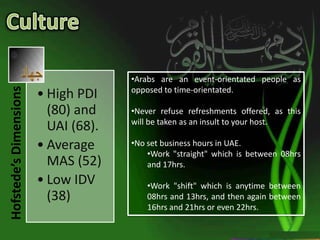
  • #6 arge Power Distance (PDI) (80) and Uncertainty Avoidance (UAI) (68) are predominant Hofstede Dimension characteristics for the countries in this region. These societies are more likely to follow a caste system that does not allow significant upward mobility of its citizens. They are also highly rule-oriented with laws, rules, regulations, and controls in order to reduce the amount of uncertainty, while inequalities of power and wealth have been allowed to grow within the society. When these two Dimensions are combined, it creates a situation where leaders have virtually ultimate power and authority, and the rules, laws and regulations developed by those in power reinforce their own leadership and control. It is not unusual for new leadership to arise from armed insurrection – the ultimate power, rather than from diplomatic or democratic change. The high Power Distance (PDI) ranking is indicative of a high level of inequality of power and wealth within the society. These populations have an expectation and acceptance that leaders will separate themselves from the group and this condition is not necessarily subverted upon the population, but rather accepted by the society as their cultural heritage. The high Uncertainty Avoidance Index (UAI) ranking of 68, indicates the society’s low level of tolerance for uncertainty. In an effort to minimize or reduce this level of uncertainty, strict rules, laws, policies, and regulations are adopted and implemented. The ultimate goal of these populations is to control everything in order to eliminate or avoid the unexpected. As a result of this high Uncertainty Avoidance characteristic, the society does not readily accept change and is very risk adverse.The Masculinity index (MAS), the third highest Hofstede Dimension is 52, only slightly higher than the 50.2 average for all the countries included in the Hofstede MAS Dimension. This would indicate that while women in the Arab World are limited in their rights, it may be due more to Muslim religion rather than a cultural paradigm. The lowest Hofstede Dimension for the Arab World is the Individualism (IDV) ranking at 38, compared to a world average ranking of 64. This translates into a Collectivist society as compared to Individualist culture and is manifested in a close long-term commitment to the member 'group', that being a family, extended family, or extended relationships. Loyalty in a collectivist culture is paramount, and over-rides most other societal rules.