


Unit 4 Revision
Area of Study 2
Mental Health
Thursday, 10 October 2013
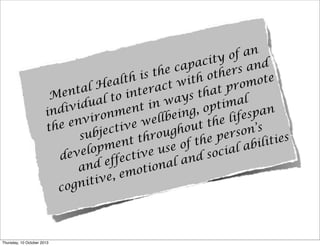
Mental Health is the capacity of an
individual to interact with others and
the environment in ways that promote
subjective wellbeing, optimal
development throughout the lifespan
and effective use of the person’s
cognitive, emotional and social abilities
Thursday, 10 October 2013
Key Concepts
Thursday, 10 October 2013
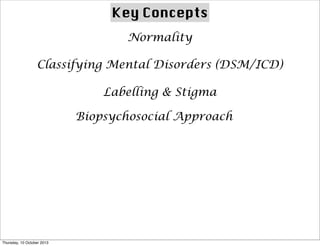
Key Concepts
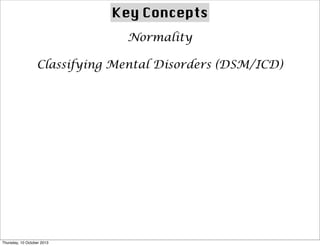
Normality
Thursday, 10 October 2013
Key Concepts
Normality
Classifying Mental Disorders (DSM/ICD)
Thursday, 10 October 2013
Key Concepts
Normality
Classifying Mental Disorders (DSM/ICD)
Labelling & Stigma
Thursday, 10 October 2013
Key Concepts
Normality
Classifying Mental Disorders (DSM/ICD)
Labelling & Stigma
Biopsychosocial Approach
Thursday, 10 October 2013
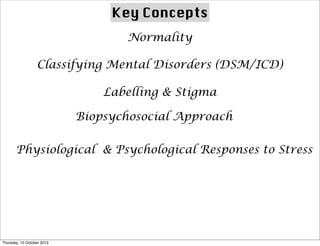
Key Concepts
Normality
Classifying Mental Disorders (DSM/ICD)
Labelling & Stigma
Biopsychosocial Approach
Physiological & Psychological Responses to Stress
Thursday, 10 October 2013
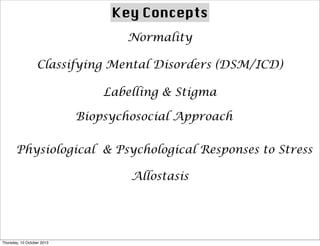
Key Concepts
Normality
Classifying Mental Disorders (DSM/ICD)
Labelling & Stigma
Biopsychosocial Approach
Physiological & Psychological Responses to Stress
Allostasis
Thursday, 10 October 2013
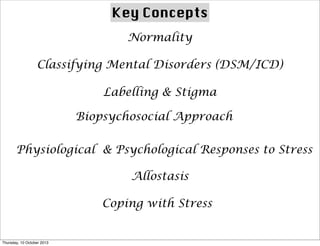
Key Concepts
Normality
Classifying Mental Disorders (DSM/ICD)
Labelling & Stigma
Biopsychosocial Approach
Physiological & Psychological Responses to Stress
Allostasis
Coping with Stress
Thursday, 10 October 2013
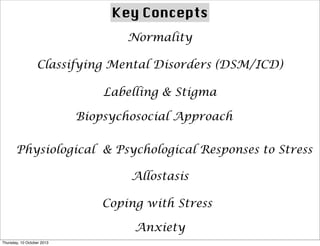
Key Concepts
Normality
Classifying Mental Disorders (DSM/ICD)
Labelling & Stigma
Biopsychosocial Approach
Physiological & Psychological Responses to Stress
Allostasis
Coping with Stress
Anxiety
Thursday, 10 October 2013
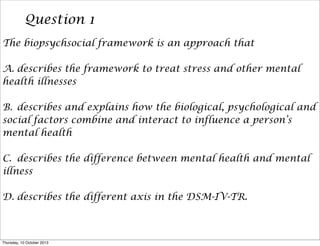
Question 1
The biopsychsocial framework is an approach that
A. describes the framework to treat stress and other mental
health illnesses
B. describes and explains how the biological, psychological and
social factors combine and interact to influence a person’s
mental health
C. describes the difference between mental health and mental
illness
D. describes the different axis in the DSM-IV-TR.
Thursday, 10 October 2013
Suggested Solution
The biopsychsocial framework is an approach that
A. describes the framework to treat stress and other mental
health illnesses
B. describes and explains how the biological, psychological and
social factors combine and interact to influence a person’s
mental health
C. describes the difference between mental health and mental
illness
D. describes the different axis in the DSM-IV-TR.
Thursday, 10 October 2013
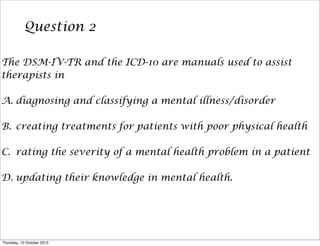
Question 2
The DSM-IV-TR and the ICD-10 are manuals used to assist
therapists in
A. diagnosing and classifying a mental illness/disorder
B. creating treatments for patients with poor physical health
C. rating the severity of a mental health problem in a patient
D. updating their knowledge in mental health.
Thursday, 10 October 2013
Suggested Solution
The DSM-IV-TR and the ICD-10 are manuals used to assist
therapists in
A. diagnosing and classifying a mental illness/disorder
B. creating treatments for patients with poor physical health
C. rating the severity of a mental health problem in a patient
D. updating their knowledge in mental health.
Thursday, 10 October 2013
Question 3
Vicki has had an amazing day. This morning she rang a radio
station and recited the last five songs they
played. As a result she won $1000.
It is likely that Vicki may be experiencing
A. fight-flight response
B. distress
C. homeostasis
D. eustress.
Thursday, 10 October 2013
Suggested Solution
Vicki has had an amazing day. This morning she rang a radio
station and recited the last five songs they
played. As a result she won $1000.
It is likely that Vicki may be experiencing
A. fight-flight response
B. distress
C. homeostasis
D. eustress.
Thursday, 10 October 2013
Question 4
Steve has an intense fear of moths. He has decided to seek help
and visits a psychologist. The psychologist has taught him some
relaxation techniques. Once he has learned the relaxation
techniques the psychologist will begin to gradually expose Steve
to the feared object.
This is an example of
A. systematic desensitisation
B. aversion therapy
C. flooding
D. stimulus discrimination.
Thursday, 10 October 2013
Suggested Solution
Steve has an intense fear of moths. He has decided to seek help
and visits a psychologist. The psychologist has taught him some
relaxation techniques. Once he has learned the relaxation
techniques the psychologist will begin to gradually expose Steve
to the feared object.
This is an example of
A. systematic desensitisation
B. aversion therapy
C. flooding
D. stimulus discrimination.
Thursday, 10 October 2013
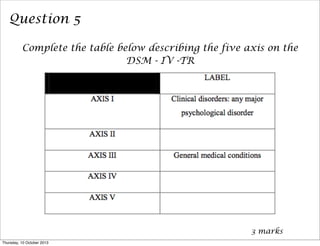
Question 5
Complete the table below describing the five axis on the
DSM - IV -TR
3 marks
Thursday, 10 October 2013
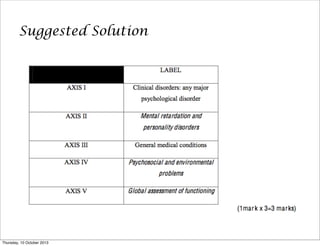
Suggested Solution
Thursday, 10 October 2013
Question 6
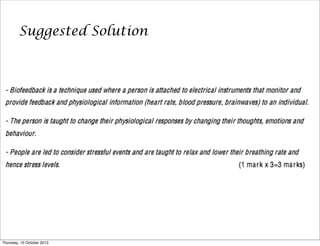
Biofeedback is one strategy for coping with stress.
What is biofeedback?
3 marks
Thursday, 10 October 2013
Suggested Solution
Thursday, 10 October 2013
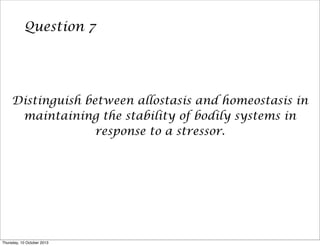
Question 7
Distinguish between allostasis and homeostasis in
maintaining the stability of bodily systems in
response to a stressor.
Thursday, 10 October 2013
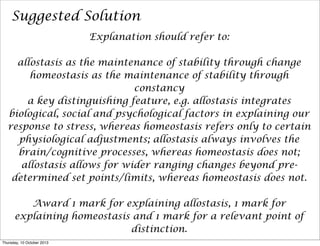
Suggested Solution
Explanation should refer to:
allostasis as the maintenance of stability through change
homeostasis as the maintenance of stability through
constancy
a key distinguishing feature, e.g. allostasis integrates
biological, social and psychological factors in explaining our
response to stress, whereas homeostasis refers only to certain
physiological adjustments; allostasis always involves the
brain/cognitive processes, whereas homeostasis does not;
allostasis allows for wider ranging changes beyond pre-
determined set points/limits, whereas homeostasis does not.
Award 1 mark for explaining allostasis, 1 mark for
explaining homeostasis and 1 mark for a relevant point of
distinction.
Thursday, 10 October 2013
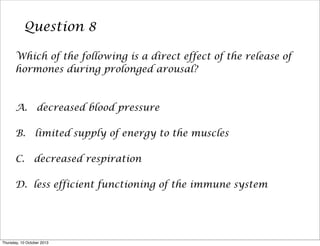
Question 8
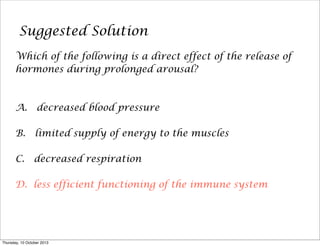
Which of the following is a direct effect of the release of
hormones during prolonged arousal?
A. decreased blood pressure
B. limited supply of energy to the muscles
C. decreased respiration
D. less efficient functioning of the immune system
Thursday, 10 October 2013
Suggested Solution
Which of the following is a direct effect of the release of
hormones during prolonged arousal?
A. decreased blood pressure
B. limited supply of energy to the muscles
C. decreased respiration
D. less efficient functioning of the immune system
Thursday, 10 October 2013
Question 9
Briefly explain what the HPA axis is in
relation to stress and what the HPA axis
involves.
2 mark
Thursday, 10 October 2013
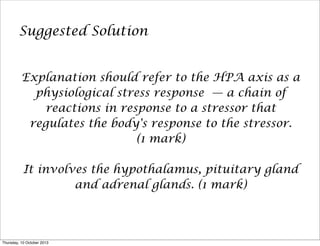
Suggested Solution
Explanation should refer to the HPA axis as a
physiological stress response — a chain of
reactions in response to a stressor that
regulates the body's response to the stressor.
(1 mark)
It involves the hypothalamus, pituitary gland
and adrenal glands. (1 mark)
Thursday, 10 October 2013
Question 10
Describe one limitation of the transactional
model of stress and coping.
1 mark
Thursday, 10 October 2013
Suggested Solution
Limitations may reflect to difficulty in testing
the model through empirical research because of
the subjective nature of the stress response;
stress response is possible without appraisal and;
the overlapping nature of primary and
secondary appraisals.
Award 1 mark for a relevant limitation.
Thursday, 10 October 2013

Mental healthrevision2013

  • 1.
    Unit 4 Revision Areaof Study 2 Mental Health Thursday, 10 October 2013
  • 2.
  • 3.
    Mental Health isthe capacity of an individual to interact with others and the environment in ways that promote subjective wellbeing, optimal development throughout the lifespan and effective use of the person’s cognitive, emotional and social abilities Thursday, 10 October 2013
  • 4.
  • 5.
  • 6.
    Key Concepts Normality Classifying MentalDisorders (DSM/ICD) Thursday, 10 October 2013
  • 7.
    Key Concepts Normality Classifying MentalDisorders (DSM/ICD) Labelling & Stigma Thursday, 10 October 2013
  • 8.
    Key Concepts Normality Classifying MentalDisorders (DSM/ICD) Labelling & Stigma Biopsychosocial Approach Thursday, 10 October 2013
  • 9.
    Key Concepts Normality Classifying MentalDisorders (DSM/ICD) Labelling & Stigma Biopsychosocial Approach Physiological & Psychological Responses to Stress Thursday, 10 October 2013
  • 10.
    Key Concepts Normality Classifying MentalDisorders (DSM/ICD) Labelling & Stigma Biopsychosocial Approach Physiological & Psychological Responses to Stress Allostasis Thursday, 10 October 2013
  • 11.
    Key Concepts Normality Classifying MentalDisorders (DSM/ICD) Labelling & Stigma Biopsychosocial Approach Physiological & Psychological Responses to Stress Allostasis Coping with Stress Thursday, 10 October 2013
  • 12.
    Key Concepts Normality Classifying MentalDisorders (DSM/ICD) Labelling & Stigma Biopsychosocial Approach Physiological & Psychological Responses to Stress Allostasis Coping with Stress Anxiety Thursday, 10 October 2013
  • 13.
    Question 1 The biopsychsocialframework is an approach that A. describes the framework to treat stress and other mental health illnesses B. describes and explains how the biological, psychological and social factors combine and interact to influence a person’s mental health C. describes the difference between mental health and mental illness D. describes the different axis in the DSM-IV-TR. Thursday, 10 October 2013
  • 14.
    Suggested Solution The biopsychsocialframework is an approach that A. describes the framework to treat stress and other mental health illnesses B. describes and explains how the biological, psychological and social factors combine and interact to influence a person’s mental health C. describes the difference between mental health and mental illness D. describes the different axis in the DSM-IV-TR. Thursday, 10 October 2013
  • 15.
    Question 2 The DSM-IV-TRand the ICD-10 are manuals used to assist therapists in A. diagnosing and classifying a mental illness/disorder B. creating treatments for patients with poor physical health C. rating the severity of a mental health problem in a patient D. updating their knowledge in mental health. Thursday, 10 October 2013
  • 16.
    Suggested Solution The DSM-IV-TRand the ICD-10 are manuals used to assist therapists in A. diagnosing and classifying a mental illness/disorder B. creating treatments for patients with poor physical health C. rating the severity of a mental health problem in a patient D. updating their knowledge in mental health. Thursday, 10 October 2013
  • 17.
    Question 3 Vicki hashad an amazing day. This morning she rang a radio station and recited the last five songs they played. As a result she won $1000. It is likely that Vicki may be experiencing A. fight-flight response B. distress C. homeostasis D. eustress. Thursday, 10 October 2013
  • 18.
    Suggested Solution Vicki hashad an amazing day. This morning she rang a radio station and recited the last five songs they played. As a result she won $1000. It is likely that Vicki may be experiencing A. fight-flight response B. distress C. homeostasis D. eustress. Thursday, 10 October 2013
  • 19.
    Question 4 Steve hasan intense fear of moths. He has decided to seek help and visits a psychologist. The psychologist has taught him some relaxation techniques. Once he has learned the relaxation techniques the psychologist will begin to gradually expose Steve to the feared object. This is an example of A. systematic desensitisation B. aversion therapy C. flooding D. stimulus discrimination. Thursday, 10 October 2013
  • 20.
    Suggested Solution Steve hasan intense fear of moths. He has decided to seek help and visits a psychologist. The psychologist has taught him some relaxation techniques. Once he has learned the relaxation techniques the psychologist will begin to gradually expose Steve to the feared object. This is an example of A. systematic desensitisation B. aversion therapy C. flooding D. stimulus discrimination. Thursday, 10 October 2013
  • 21.
    Question 5 Complete thetable below describing the five axis on the DSM - IV -TR 3 marks Thursday, 10 October 2013
  • 22.
  • 23.
    Question 6 Biofeedback isone strategy for coping with stress. What is biofeedback? 3 marks Thursday, 10 October 2013
  • 24.
  • 25.
    Question 7 Distinguish betweenallostasis and homeostasis in maintaining the stability of bodily systems in response to a stressor. Thursday, 10 October 2013
  • 26.
    Suggested Solution Explanation shouldrefer to: allostasis as the maintenance of stability through change homeostasis as the maintenance of stability through constancy a key distinguishing feature, e.g. allostasis integrates biological, social and psychological factors in explaining our response to stress, whereas homeostasis refers only to certain physiological adjustments; allostasis always involves the brain/cognitive processes, whereas homeostasis does not; allostasis allows for wider ranging changes beyond pre- determined set points/limits, whereas homeostasis does not. Award 1 mark for explaining allostasis, 1 mark for explaining homeostasis and 1 mark for a relevant point of distinction. Thursday, 10 October 2013
  • 27.
    Question 8 Which ofthe following is a direct effect of the release of hormones during prolonged arousal? A. decreased blood pressure B. limited supply of energy to the muscles C. decreased respiration D. less efficient functioning of the immune system Thursday, 10 October 2013
  • 28.
    Suggested Solution Which ofthe following is a direct effect of the release of hormones during prolonged arousal? A. decreased blood pressure B. limited supply of energy to the muscles C. decreased respiration D. less efficient functioning of the immune system Thursday, 10 October 2013
  • 29.
    Question 9 Briefly explainwhat the HPA axis is in relation to stress and what the HPA axis involves. 2 mark Thursday, 10 October 2013
  • 30.
    Suggested Solution Explanation shouldrefer to the HPA axis as a physiological stress response — a chain of reactions in response to a stressor that regulates the body's response to the stressor. (1 mark) It involves the hypothalamus, pituitary gland and adrenal glands. (1 mark) Thursday, 10 October 2013
  • 31.
    Question 10 Describe onelimitation of the transactional model of stress and coping. 1 mark Thursday, 10 October 2013
  • 32.
    Suggested Solution Limitations mayreflect to difficulty in testing the model through empirical research because of the subjective nature of the stress response; stress response is possible without appraisal and; the overlapping nature of primary and secondary appraisals. Award 1 mark for a relevant limitation. Thursday, 10 October 2013