Ancient Scripts, Alphabets and Letters
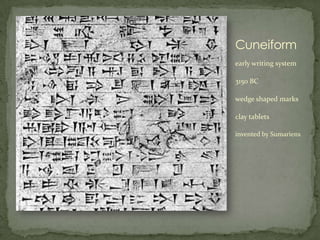
Cuneiform
early writing system

3150 BC

wedge shaped marks

clay tablets

invented by Sumariens
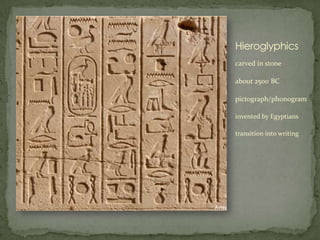
Hieroglyphics
carved in stone

about 2500 BC

pictograph/phonogram

invented by Egyptians

transition into writing
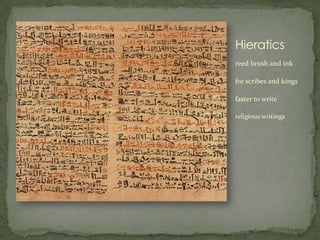
Hieratics
reed brush and ink

for scribes and kings

faster to write

religious writings
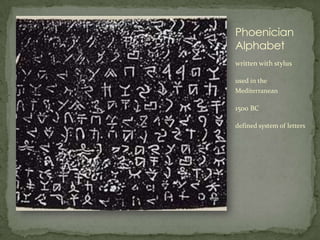
Phoenician
Alphabet
written with stylus

used in the
Mediterranean

1500 BC

defined system of letters
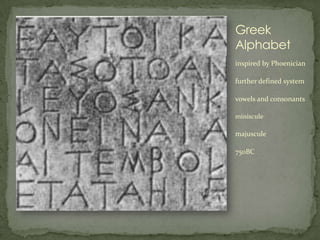
Greek
Alphabet
inspired by Phoenician

further defined system

vowels and consonants

miniscule

majuscule

750BC
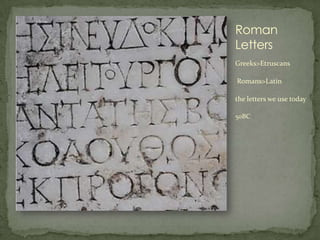
Roman
Letters
Greeks>Etruscans

Romans>Latin

the letters we use today

50BC
Roman
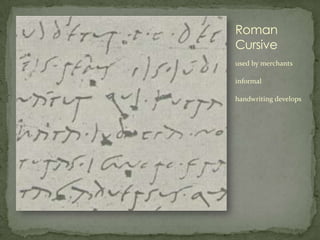
Cursive
used by merchants

informal

handwriting develops
Uncial
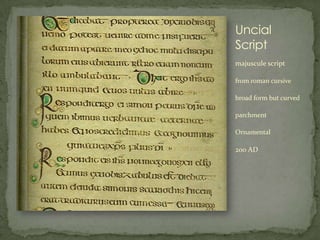
Script
majuscule script

from roman cursive

broad form but curved

parchment

Ornamental

200 AD

Typographic Historical Survey 1

Editor's Notes

  • #3 Kyoo[Q] ni form is one of the earliest writing forms used for different languages. It consists of wedges shaped marks impressed into clay tables. It is written that this script was created by the Sumerians (one of our early societal groupings in the middle east.)
  • #4 Hieroglyphics are similar to the earlier writing forms as it is definitely derived from the Cuneiform but it is typically carved into stone These are seen as early as 2500 BC. With this script as we all know uses images to tell the story of the written language these could be considered pictographs or phonograms. The Egyptians would however transition their script to being written, scribed by stylus as we’re all used to today.
  • #5 Hieratics was a script that was developed alongside hieroglyphics. It was written with a brush and ink and reserved for pharaohs and scribes. It much was faster to write and more efficient to produce religious texts.
  • #6 This alphabet created by the Phoenicians was written with a stylus although it is very angular. This was spread mostly through commerce in the Mediterranean so this alphabet was pretty widely used. The systematic approach to writing language was Phoenicians greatest contribution to civilization.
  • #7 The very popular Greek alphabet is directly derived from the Phoenician alphabet. The system became more complex through development with consonants, vowels and numbers as well. It was also the first to elaborate miniscule (lowercase) as well as majuscule (uppercase) letters
  • #8 This alphabet was derived from Greek by the early Romans (Etruscans) then the Roman Empire to the Latin derivatives that we know of, Celtic, Slavic, Germanic to the letters that we use today all the way from 50 years before Christ.
  • #9 The roman cursive version was used by the working romans. Merchants, school children in a fast and informal format. This is when handwriting becomes a style of its own an less of a shorthand version of normal letters.
  • #10 The Uncial is a majuscule script that was derived from the old roman cursive handwriting. The letterform is broader and utilizes rounded shape made easy by developments of parchment paper made from animal skins. The exaggeration of the letterform lent to more ornamental swooshes of the form.