TYPES OF TEST
BY
IRSHAD NAREJO
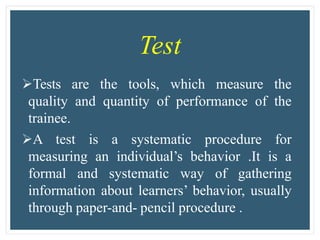
Test
Tests are the tools, which measure the
quality and quantity of performance of the
trainee.
A test is a systematic procedure for
measuring an individual’s behavior .It is a
formal and systematic way of gathering
information about learners’ behavior, usually
through paper-and- pencil procedure .
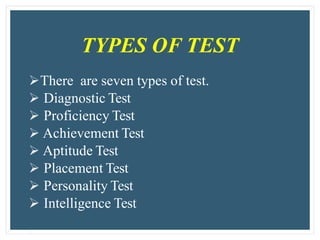
TYPES OF TEST
There are seven types of test.
 Diagnostic Test
 Proficiency Test
 Achievement Test
 Aptitude Test
 Placement Test
 Personality Test
 Intelligence Test

Diagnostic Test
Diagnostic test measures the knowledge and
skills of student. It is used to identify
students’ strengths and weaknesses in past and
present learning.
Proficiency Test
Proficiency tests are designed to measure
people’s ability in a language whether they
have any training in that language or not.
Achievement Test
Achievement tests are designed to measure a
student's performance in specific academic areas
such as reading, comprehension, written or oral
expression, and mathematical computations.
Aptitude Test
Aptitude tests are mainly made to assess
intelligence and knowledge. Aptitude tests most
commonly consist of numerical reasoning, verbal
reasoning, speed, accuracy abilities, and more.
Placement Test
Placement tests are planned to provide
information which will help to place
students at the stage of the teaching program
most appropriate to their abilities.
Personality Test
This test is designed for assessing some
aspects of an individual’s personality.
Intelligence Test
Intelligence test measures the mental ability of
an individual.
The ability to judge, comprehend, and reason
The ability to understand and deal with people,
objects, and symbols.
The ability to act purposefully, think rationally,
and deal effectively with the environment
•Objective Test
In this test the ability of student is judged through
filling the blanks or selecting the correct answer
among the multiple options.
Subjective Test
Subjective tests are also called essay type tests.An
essay test is one, which contains one or more
questions or other tasks that require lengthy written
responses from students.
Oral Test
It is a test where in the test taker gives his answer
orally.
Criterion-referenced Test
It is a test that measures a student’s performance
against the predefined level of performance.
Norm-referenced Test
It is a test that evaluates a student’s performance
by comparing it to the performance of a group
students on the same test
Formative Test
Formative tests are conducting without
informing the learner and it identifies the
trainee’s needs, his learning states and
difficulties during the instructions.
Summative Test
It is a test given at the end of instruction to
determine students’learning and assign
grades.
• Direct & Indirect Testing
Direct testing is easier to carry out when it is
intended to measure the productive skills of
speaking and writing. The direct test requires the
candidate to perform exactly the skill which we
wish to measure.
Indirect testing attempts to measure the abilities
underlie the skills in which we are interested.
Individual Test
It is a test administered to one student
at a time.
Group Test
It is one administered to a group of
students simultaneously.
typesoftest-150411090652-conversion-gate01.pptx

typesoftest-150411090652-conversion-gate01.pptx

  • 1.
  • 2.
    Test Tests are thetools, which measure the quality and quantity of performance of the trainee. A test is a systematic procedure for measuring an individual’s behavior .It is a formal and systematic way of gathering information about learners’ behavior, usually through paper-and- pencil procedure .
  • 3.
    TYPES OF TEST Thereare seven types of test.  Diagnostic Test  Proficiency Test  Achievement Test  Aptitude Test  Placement Test  Personality Test  Intelligence Test 
  • 4.
    Diagnostic Test Diagnostic testmeasures the knowledge and skills of student. It is used to identify students’ strengths and weaknesses in past and present learning. Proficiency Test Proficiency tests are designed to measure people’s ability in a language whether they have any training in that language or not.
  • 5.
    Achievement Test Achievement testsare designed to measure a student's performance in specific academic areas such as reading, comprehension, written or oral expression, and mathematical computations. Aptitude Test Aptitude tests are mainly made to assess intelligence and knowledge. Aptitude tests most commonly consist of numerical reasoning, verbal reasoning, speed, accuracy abilities, and more.
  • 6.
    Placement Test Placement testsare planned to provide information which will help to place students at the stage of the teaching program most appropriate to their abilities. Personality Test This test is designed for assessing some aspects of an individual’s personality.
  • 7.
    Intelligence Test Intelligence testmeasures the mental ability of an individual. The ability to judge, comprehend, and reason The ability to understand and deal with people, objects, and symbols. The ability to act purposefully, think rationally, and deal effectively with the environment
  • 8.
    •Objective Test In thistest the ability of student is judged through filling the blanks or selecting the correct answer among the multiple options. Subjective Test Subjective tests are also called essay type tests.An essay test is one, which contains one or more questions or other tasks that require lengthy written responses from students.
  • 9.
    Oral Test It isa test where in the test taker gives his answer orally. Criterion-referenced Test It is a test that measures a student’s performance against the predefined level of performance. Norm-referenced Test It is a test that evaluates a student’s performance by comparing it to the performance of a group students on the same test
  • 10.
    Formative Test Formative testsare conducting without informing the learner and it identifies the trainee’s needs, his learning states and difficulties during the instructions. Summative Test It is a test given at the end of instruction to determine students’learning and assign grades.
  • 11.
    • Direct &Indirect Testing Direct testing is easier to carry out when it is intended to measure the productive skills of speaking and writing. The direct test requires the candidate to perform exactly the skill which we wish to measure. Indirect testing attempts to measure the abilities underlie the skills in which we are interested.
  • 12.
    Individual Test It isa test administered to one student at a time. Group Test It is one administered to a group of students simultaneously.