www.suretybondauthority.com
TYPES OF
SURETY BOND
COLLATERAL
WHAT IS A COLLATERAL?
A collateral refers to a security deposit the Principal (bond applicant) provides to the Surety (Bond Company) to
be approved and issued a bond that is rather difficult to achieve. The collateral aims to reduce the surety’s risk and
exposure and makes supporting the bond more favorable.
WHAT IS A COLLATERAL?
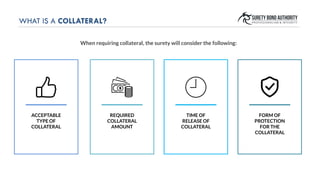
When requiring collateral, the surety will consider the following:
ACCEPTABLE
TYPE OF
COLLATERAL
REQUIRED
COLLATERAL
AMOUNT
TIME OF
RELEASE OF
COLLATERAL
FORM OF
PROTECTION
FOR THE
COLLATERAL
WHAT ARE THE TYPES OF COLLATERAL?
There are several types of collateral that sureties may accept.
Here are the most common forms:
1
IRREVOCABLE LETTERS OF CREDIT (ILOC)
Considered to be the safest form of collateral, these letters
are often issued by a commercial bank. ILOC, also called as
Standby Letter of Credit, are awarded based on the financial
standing of the bond applicant. These letters serve as a
private contract between the bank and the surety, with the
surety acting as the beneficiary.
Most types of collateral accepted by the surety (except
ILOC) are subject to the rules of the bankruptcy courts.
Under Section 547 of the Bankruptcy Code, most transfers
or payments are made “on or within 90 days before the date
of the filing of the petition” and may be recalled for the
benefit of the bankruptcy creditors.
WHAT ARE THE TYPES OF COLLATERAL?
There are several types of collateral that sureties may accept.
Here are the most common forms:
2
CERTIFICATES OF DEPOSIT (CD)
A Certificate of Deposit is used as a short- or long-term
investment. Local banks may provide Federal Deposit
Insurance Corporation (FDIC)-insured CDs with higher
return rates than other investment options. With this
collateral, the bank retains money for a specific length of
time with the guarantee to repay the surety and interest to
the depositor at the end of the investment term.
The CD account’s aggregate limit must not exceed the
coverage provided by FDIC to ensure that the failure of the
bank does not reduce the collateral below the required limit.
WHAT ARE THE TYPES OF COLLATERAL?
There are several types of collateral that sureties may accept.
Here are the most common forms:
3
FIXED ASSETS
Fixed assets, such as real property, can be a form of
collateral if they undergo professional appraisal, has
adequate insurance, and free of encumbrances.
DOCUMENTS FOR COLLATERAL
Are there any other
documents required
for the collateral?
Sureties may require collateral receipts that hold the principal’s name if, and when, collateral will be returned. Sureties also may call for a pledge agreement,
in addition to a general indemnity agreement, to secure repayment of a debt or obligation.
A general indemnity agreement indicates that the surety is provided with acceptable evidence that it has been released from all liability under its bonds and
that the surety will have sole decision-making discretion.
General indemnity agreements, collateral receipts, and pledge agreements contain specific conditions for the release of collateral.
RELEASE OF COLLATERAL
Sureties will not release the collateral until they are cleared of all bond
obligations. This is often a subject of disagreement between the
principal and the surety as to when it is the right time to release the
collateral.
When is the release of collateral?
In construction or fiduciary/probate duties, sureties will not partially
release half of the collateral even if half of the job is finished. The job and
obligation should be completed at all costs and must meet the
conditions specified in the bond contract. To avoid risks and for security
purposes, sureties will hold the entire collateral until the end.
“The End” is not at the end of every project or court-appointed
obligation as the principal may assume. For example, in construction,
there is a maintenance bond where the surety may require that
collateral be held until the maintenance period has concluded. The
surety is equally obligated for the duration of the lien period, which
can run for 90 days after work completion.
RELEASE OF COLLATERAL
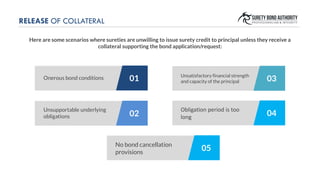
Here are some scenarios where sureties are unwilling to issue surety credit to principal unless they receive a
collateral supporting the bond application/request:
01Onerous bond conditions
02
Unsupportable underlying
obligations
03Unsatisfactory financial strength
and capacity of the principal
04
Obligation period is too
long
05No bond cancellation
provisions
WHAT HAPPENS IF YOU CHANGE SURETIES?
Concluding a collateral relationship can prove difficult, particularly if a series of bonds (like bid, performance or payment bonds) have already
been issued. It is easier to use collateral funds with the old surety than move to a new non-collateral surety.
Even if the principal starts receiving bonds from a new bond provider, the collateral will remain in place until bond obligations are exonerated.
Though more beneficial conditions are available, this can be a deterrent and may impact your surety relationship in the long run.
IMPORTANCE OF COLLATERAL
For riskier bonds, the sureties will often require collateral.
Collateral is regarded as a “last resort” payment or credit, and
you may want to avoid it. But if it’s not a burden, then it may
be necessary to secure collateral in some cases. For instance,
you may have a weak business financial statement, but you
have other financial resources.
Surety underwriters may look into the case if the collateral
requirement makes it impossible or problematic for the
principal to work on a project or perform contractual or
court-appointed obligations.

Types of Surety Bond Collateral

  • 1.
  • 2.
    WHAT IS ACOLLATERAL? A collateral refers to a security deposit the Principal (bond applicant) provides to the Surety (Bond Company) to be approved and issued a bond that is rather difficult to achieve. The collateral aims to reduce the surety’s risk and exposure and makes supporting the bond more favorable.
  • 3.
    WHAT IS ACOLLATERAL? When requiring collateral, the surety will consider the following: ACCEPTABLE TYPE OF COLLATERAL REQUIRED COLLATERAL AMOUNT TIME OF RELEASE OF COLLATERAL FORM OF PROTECTION FOR THE COLLATERAL
  • 4.
    WHAT ARE THETYPES OF COLLATERAL? There are several types of collateral that sureties may accept. Here are the most common forms: 1 IRREVOCABLE LETTERS OF CREDIT (ILOC) Considered to be the safest form of collateral, these letters are often issued by a commercial bank. ILOC, also called as Standby Letter of Credit, are awarded based on the financial standing of the bond applicant. These letters serve as a private contract between the bank and the surety, with the surety acting as the beneficiary. Most types of collateral accepted by the surety (except ILOC) are subject to the rules of the bankruptcy courts. Under Section 547 of the Bankruptcy Code, most transfers or payments are made “on or within 90 days before the date of the filing of the petition” and may be recalled for the benefit of the bankruptcy creditors.
  • 5.
    WHAT ARE THETYPES OF COLLATERAL? There are several types of collateral that sureties may accept. Here are the most common forms: 2 CERTIFICATES OF DEPOSIT (CD) A Certificate of Deposit is used as a short- or long-term investment. Local banks may provide Federal Deposit Insurance Corporation (FDIC)-insured CDs with higher return rates than other investment options. With this collateral, the bank retains money for a specific length of time with the guarantee to repay the surety and interest to the depositor at the end of the investment term. The CD account’s aggregate limit must not exceed the coverage provided by FDIC to ensure that the failure of the bank does not reduce the collateral below the required limit.
  • 6.
    WHAT ARE THETYPES OF COLLATERAL? There are several types of collateral that sureties may accept. Here are the most common forms: 3 FIXED ASSETS Fixed assets, such as real property, can be a form of collateral if they undergo professional appraisal, has adequate insurance, and free of encumbrances.
  • 7.
    DOCUMENTS FOR COLLATERAL Arethere any other documents required for the collateral? Sureties may require collateral receipts that hold the principal’s name if, and when, collateral will be returned. Sureties also may call for a pledge agreement, in addition to a general indemnity agreement, to secure repayment of a debt or obligation. A general indemnity agreement indicates that the surety is provided with acceptable evidence that it has been released from all liability under its bonds and that the surety will have sole decision-making discretion. General indemnity agreements, collateral receipts, and pledge agreements contain specific conditions for the release of collateral.
  • 8.
    RELEASE OF COLLATERAL Suretieswill not release the collateral until they are cleared of all bond obligations. This is often a subject of disagreement between the principal and the surety as to when it is the right time to release the collateral. When is the release of collateral? In construction or fiduciary/probate duties, sureties will not partially release half of the collateral even if half of the job is finished. The job and obligation should be completed at all costs and must meet the conditions specified in the bond contract. To avoid risks and for security purposes, sureties will hold the entire collateral until the end. “The End” is not at the end of every project or court-appointed obligation as the principal may assume. For example, in construction, there is a maintenance bond where the surety may require that collateral be held until the maintenance period has concluded. The surety is equally obligated for the duration of the lien period, which can run for 90 days after work completion.
  • 9.
    RELEASE OF COLLATERAL Hereare some scenarios where sureties are unwilling to issue surety credit to principal unless they receive a collateral supporting the bond application/request: 01Onerous bond conditions 02 Unsupportable underlying obligations 03Unsatisfactory financial strength and capacity of the principal 04 Obligation period is too long 05No bond cancellation provisions
  • 10.
    WHAT HAPPENS IFYOU CHANGE SURETIES? Concluding a collateral relationship can prove difficult, particularly if a series of bonds (like bid, performance or payment bonds) have already been issued. It is easier to use collateral funds with the old surety than move to a new non-collateral surety. Even if the principal starts receiving bonds from a new bond provider, the collateral will remain in place until bond obligations are exonerated. Though more beneficial conditions are available, this can be a deterrent and may impact your surety relationship in the long run.
  • 11.
    IMPORTANCE OF COLLATERAL Forriskier bonds, the sureties will often require collateral. Collateral is regarded as a “last resort” payment or credit, and you may want to avoid it. But if it’s not a burden, then it may be necessary to secure collateral in some cases. For instance, you may have a weak business financial statement, but you have other financial resources. Surety underwriters may look into the case if the collateral requirement makes it impossible or problematic for the principal to work on a project or perform contractual or court-appointed obligations.