Types of Sorting in
Database Structure
and Algorithms
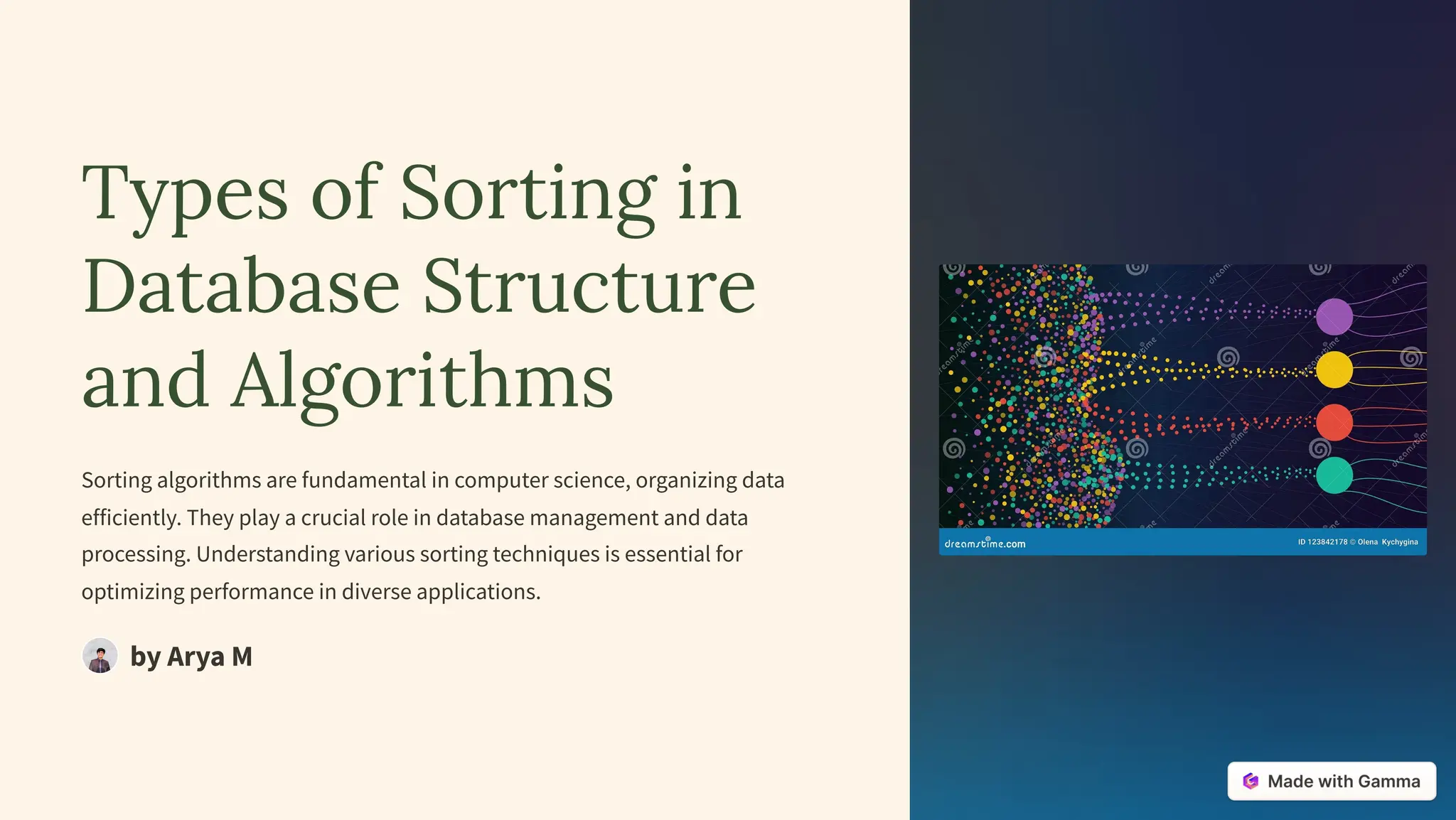
Sorting algorithms are fundamental in computer science, organizing data
efficiently. They play a crucial role in database management and data
processing. Understanding various sorting techniques is essential for
optimizing performance in diverse applications.
by Arya M
Introduction to Sorting
Algorithms
1 Definition
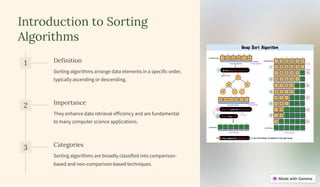
Sorting algorithms arrange data elements in a specific order,
typically ascending or descending.
2 Importance
They enhance data retrieval efficiency and are fundamental
to many computer science applications.
3 Categories
Sorting algorithms are broadly classified into comparison-
based and non-comparison-based techniques.
Comparison-Based Sorting
Algorithms
1 Key Concept
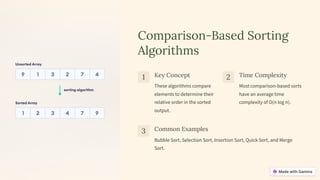
These algorithms compare
elements to determine their
relative order in the sorted
output.
2 Time Complexity
Most comparison-based sorts
have an average time
complexity of O(n log n).
3 Common Examples
Bubble Sort, Selection Sort, Insertion Sort, Quick Sort, and Merge
Sort.
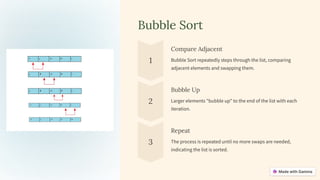
Bubble Sort
1
Compare Adjacent
Bubble Sort repeatedly steps through the list, comparing
adjacent elements and swapping them.
2
Bubble Up
Larger elements "bubble up" to the end of the list with each
iteration.
3
Repeat
The process is repeated until no more swaps are needed,
indicating the list is sorted.
Selection Sort
1 Find Minimum
Selection Sort finds the minimum element in the unsorted
portion of the array.
2 Swap
It swaps this minimum element with the first unsorted
element.
3 Repeat
The process continues until the entire array is sorted in
ascending order.
Insertion Sort
Start
Insertion Sort begins with the
second element, considering the
first as sorted.
Compare
It compares the current element
with previous elements, shifting
them if necessary.
Insert
The current element is then
inserted into its correct position
in the sorted portion.
Repeat
This process continues until all
elements are in their proper
sorted positions.
Quick Sort
Divide
Quick Sort selects a pivot element and
partitions the array around it.
Conquer
It recursively sorts the sub-arrays on
either side of the pivot.
Combine
The sorted sub-arrays are combined to
produce the final sorted array.
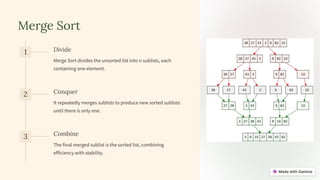
Merge Sort
1 Divide
Merge Sort divides the unsorted list into n sublists, each
containing one element.
2 Conquer
It repeatedly merges sublists to produce new sorted sublists
until there is only one.
3 Combine
The final merged sublist is the sorted list, combining
efficiency with stability.
Non-Comparison-Based
Sorting Algorithms
1 Key Concept
These algorithms don't
compare elements directly,
often using numerical
properties for sorting.
2 Time Complexity
They can achieve linear time
complexity, outperforming
comparison-based sorts in
specific scenarios.
3 Examples
Counting Sort, Bucket Sort, and Radix Sort are common non-
comparison-based algorithms.
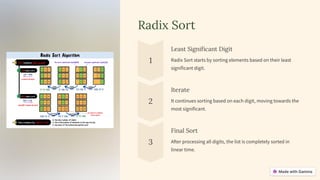
Radix Sort
1
Least Significant Digit
Radix Sort starts by sorting elements based on their least
significant digit.
2
Iterate
It continues sorting based on each digit, moving towards the
most significant.
3
Final Sort
After processing all digits, the list is completely sorted in
linear time.

Types-of-Sorting-in-Database-Structure-and-Algorithms.pdf

  • 1.
    Types of Sortingin Database Structure and Algorithms Sorting algorithms are fundamental in computer science, organizing data efficiently. They play a crucial role in database management and data processing. Understanding various sorting techniques is essential for optimizing performance in diverse applications. by Arya M
  • 2.
    Introduction to Sorting Algorithms 1Definition Sorting algorithms arrange data elements in a specific order, typically ascending or descending. 2 Importance They enhance data retrieval efficiency and are fundamental to many computer science applications. 3 Categories Sorting algorithms are broadly classified into comparison- based and non-comparison-based techniques.
  • 3.
    Comparison-Based Sorting Algorithms 1 KeyConcept These algorithms compare elements to determine their relative order in the sorted output. 2 Time Complexity Most comparison-based sorts have an average time complexity of O(n log n). 3 Common Examples Bubble Sort, Selection Sort, Insertion Sort, Quick Sort, and Merge Sort.
  • 4.
    Bubble Sort 1 Compare Adjacent BubbleSort repeatedly steps through the list, comparing adjacent elements and swapping them. 2 Bubble Up Larger elements "bubble up" to the end of the list with each iteration. 3 Repeat The process is repeated until no more swaps are needed, indicating the list is sorted.
  • 5.
    Selection Sort 1 FindMinimum Selection Sort finds the minimum element in the unsorted portion of the array. 2 Swap It swaps this minimum element with the first unsorted element. 3 Repeat The process continues until the entire array is sorted in ascending order.
  • 6.
    Insertion Sort Start Insertion Sortbegins with the second element, considering the first as sorted. Compare It compares the current element with previous elements, shifting them if necessary. Insert The current element is then inserted into its correct position in the sorted portion. Repeat This process continues until all elements are in their proper sorted positions.
  • 7.
    Quick Sort Divide Quick Sortselects a pivot element and partitions the array around it. Conquer It recursively sorts the sub-arrays on either side of the pivot. Combine The sorted sub-arrays are combined to produce the final sorted array.
  • 8.
    Merge Sort 1 Divide MergeSort divides the unsorted list into n sublists, each containing one element. 2 Conquer It repeatedly merges sublists to produce new sorted sublists until there is only one. 3 Combine The final merged sublist is the sorted list, combining efficiency with stability.
  • 9.
    Non-Comparison-Based Sorting Algorithms 1 KeyConcept These algorithms don't compare elements directly, often using numerical properties for sorting. 2 Time Complexity They can achieve linear time complexity, outperforming comparison-based sorts in specific scenarios. 3 Examples Counting Sort, Bucket Sort, and Radix Sort are common non- comparison-based algorithms.
  • 10.
    Radix Sort 1 Least SignificantDigit Radix Sort starts by sorting elements based on their least significant digit. 2 Iterate It continues sorting based on each digit, moving towards the most significant. 3 Final Sort After processing all digits, the list is completely sorted in linear time.