Types of Operating System
ABHINAND P K
ROLLNO:1
What Is Operating System
 Operating System is a type of software that works as an interface between the
system program and the hardware. There are several types of Operating Systems
many of which are mentioned below. Let’s have a look at them.
 Batch Operating System
 Multi-Programming System
 Multi-Processing System
 Time-Sharing Operating System
 Distributed Operating System
 Real-Time Operating System
Batch Operating System
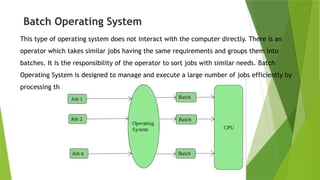
This type of operating system does not interact with the computer directly. There is an
operator which takes similar jobs having the same requirements and groups them into
batches. It is the responsibility of the operator to sort jobs with similar needs. Batch
Operating System is designed to manage and execute a large number of jobs efficiently by
processing them in groups
Advantages of Batch Operating System
• Multiple users can share the batch systems.
• The idle time for the batch system is very less.
• It is easy to manage large work repeatedly in batch systems.
Disadvantages of Batch Operating System
• Batch systems are hard to debug.
• It is sometimes costly.
• The other jobs will have to wait for an unknown time if any job fails.
• In batch operating system the processing time for jobs is commonly difficult to accurately predict
while they are in the queue.
Multi-Programming Operating System
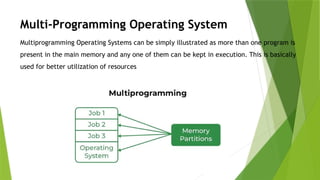
Multiprogramming Operating Systems can be simply illustrated as more than one program is
present in the main memory and any one of them can be kept in execution. This is basically
used for better utilization of resources
Advantages
• Multi Programming increases the Throughput of the System.
• It helps in reducing the response time
Disadvantages
• There is not any facility for user interaction of system resources with the
system
Multi-Processing Operating System
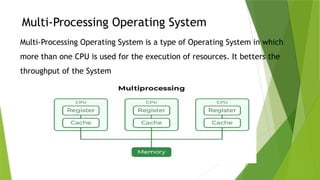
Multi-Processing Operating System is a type of Operating System in which
more than one CPU is used for the execution of resources. It betters the
throughput of the System
Advantages
• It increases the throughput of the system.
• As it has several processors, so, if one processor fails, we can proceed with
another processor
Disadvantages
• Due to the multiple CPU, it can be more complex and somehow difficult to
understand
Time-Sharing Operating Systems
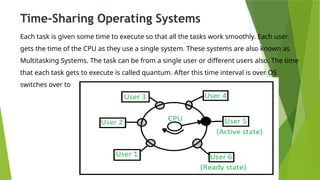
Each task is given some time to execute so that all the tasks work smoothly. Each user
gets the time of the CPU as they use a single system. These systems are also known as
Multitasking Systems. The task can be from a single user or different users also. The time
that each task gets to execute is called quantum. After this time interval is over OS
switches over to the next task
Real-Time Operating System
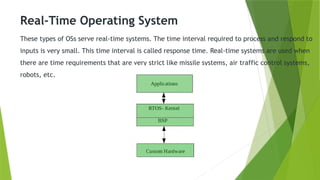
These types of OSs serve real-time systems. The time interval required to process and respond to
inputs is very small. This time interval is called response time. Real-time systems are used when
there are time requirements that are very strict like missile systems, air traffic control systems,
robots, etc.
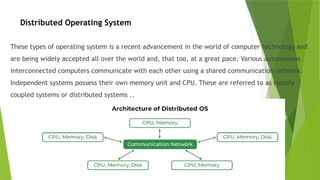
These types of operating system is a recent advancement in the world of computer technology and
are being widely accepted all over the world and, that too, at a great pace. Various autonomous
interconnected computers communicate with each other using a shared communication network.
Independent systems possess their own memory unit and CPU. These are referred to as loosely
coupled systems or distributed systems ..
Distributed Operating System
THANK YOU

Types of Operating Systemdddddddddd.pptx

  • 1.
    Types of OperatingSystem ABHINAND P K ROLLNO:1
  • 2.
    What Is OperatingSystem  Operating System is a type of software that works as an interface between the system program and the hardware. There are several types of Operating Systems many of which are mentioned below. Let’s have a look at them.  Batch Operating System  Multi-Programming System  Multi-Processing System  Time-Sharing Operating System  Distributed Operating System  Real-Time Operating System
  • 3.
    Batch Operating System Thistype of operating system does not interact with the computer directly. There is an operator which takes similar jobs having the same requirements and groups them into batches. It is the responsibility of the operator to sort jobs with similar needs. Batch Operating System is designed to manage and execute a large number of jobs efficiently by processing them in groups
  • 4.
    Advantages of BatchOperating System • Multiple users can share the batch systems. • The idle time for the batch system is very less. • It is easy to manage large work repeatedly in batch systems. Disadvantages of Batch Operating System • Batch systems are hard to debug. • It is sometimes costly. • The other jobs will have to wait for an unknown time if any job fails. • In batch operating system the processing time for jobs is commonly difficult to accurately predict while they are in the queue.
  • 5.
    Multi-Programming Operating System MultiprogrammingOperating Systems can be simply illustrated as more than one program is present in the main memory and any one of them can be kept in execution. This is basically used for better utilization of resources
  • 6.
    Advantages • Multi Programmingincreases the Throughput of the System. • It helps in reducing the response time Disadvantages • There is not any facility for user interaction of system resources with the system
  • 7.
    Multi-Processing Operating System Multi-ProcessingOperating System is a type of Operating System in which more than one CPU is used for the execution of resources. It betters the throughput of the System
  • 8.
    Advantages • It increasesthe throughput of the system. • As it has several processors, so, if one processor fails, we can proceed with another processor Disadvantages • Due to the multiple CPU, it can be more complex and somehow difficult to understand
  • 9.
    Time-Sharing Operating Systems Eachtask is given some time to execute so that all the tasks work smoothly. Each user gets the time of the CPU as they use a single system. These systems are also known as Multitasking Systems. The task can be from a single user or different users also. The time that each task gets to execute is called quantum. After this time interval is over OS switches over to the next task
  • 10.
    Real-Time Operating System Thesetypes of OSs serve real-time systems. The time interval required to process and respond to inputs is very small. This time interval is called response time. Real-time systems are used when there are time requirements that are very strict like missile systems, air traffic control systems, robots, etc.
  • 11.
    These types ofoperating system is a recent advancement in the world of computer technology and are being widely accepted all over the world and, that too, at a great pace. Various autonomous interconnected computers communicate with each other using a shared communication network. Independent systems possess their own memory unit and CPU. These are referred to as loosely coupled systems or distributed systems .. Distributed Operating System
  • 12.