Multi-Processing and multi tasking Operating System
1.
Multi-Processing Operating System
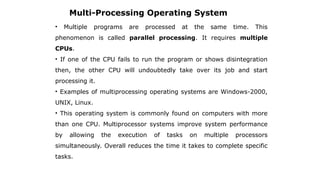
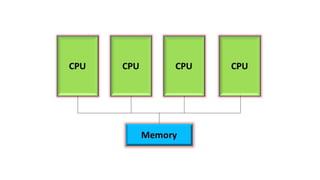
•Multiple programs are processed at the same time. This
phenomenon is called parallel processing. It requires multiple
CPUs.
• If one of the CPU fails to run the program or shows disintegration
then, the other CPU will undoubtedly take over its job and start
processing it.
• Examples of multiprocessing operating systems are Windows-2000,
UNIX, Linux.
• This operating system is commonly found on computers with more
than one CPU. Multiprocessor systems improve system performance
by allowing the execution of tasks on multiple processors
simultaneously. Overall reduces the time it takes to complete specific
tasks.
3.
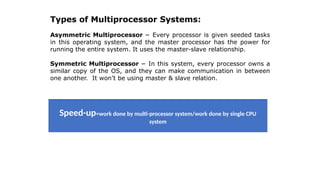
Types of MultiprocessorSystems:
Asymmetric Multiprocessor − Every processor is given seeded tasks
in this operating system, and the master processor has the power for
running the entire system. It uses the master-slave relationship.
Symmetric Multiprocessor − In this system, every processor owns a
similar copy of the OS, and they can make communication in between
one another. It won’t be using master & slave relation.
Speed-up=work done by multi-processor system/work done by single CPU
system
4.
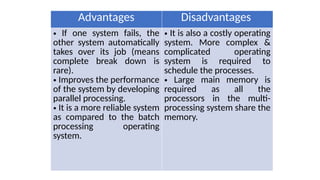
Advantages Disadvantages
• Ifone system fails, the
other system automatically
takes over its job (means
complete break down is
rare).
• Improves the performance
of the system by developing
parallel processing.
• It is a more reliable system
as compared to the batch
processing operating
system.
• It is also a costly operating
system. More complex &
complicated operating
system is required to
schedule the processes.
• Large main memory is
required as all the
processors in the multi-
processing system share the
memory.
5.
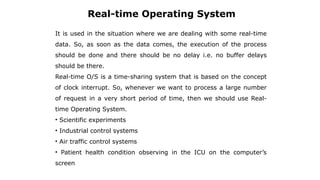
Real-time Operating System
Itis used in the situation where we are dealing with some real-time
data. So, as soon as the data comes, the execution of the process
should be done and there should be no delay i.e. no buffer delays
should be there.
Real-time O/S is a time-sharing system that is based on the concept
of clock interrupt. So, whenever we want to process a large number
of request in a very short period of time, then we should use Real-
time Operating System.
• Scientific experiments
• Industrial control systems
• Air traffic control systems
• Patient health condition observing in the ICU on the computer’s
screen
6.
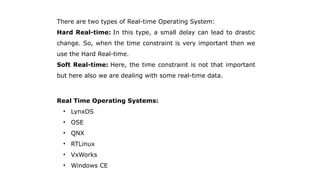
There are twotypes of Real-time Operating System:
Hard Real-time: In this type, a small delay can lead to drastic
change. So, when the time constraint is very important then we
use the Hard Real-time.
Soft Real-time: Here, the time constraint is not that important
but here also we are dealing with some real-time data.
Real Time Operating Systems:
• LynxOS
• OSE
• QNX
• RTLinux
• VxWorks
• Windows CE
7.
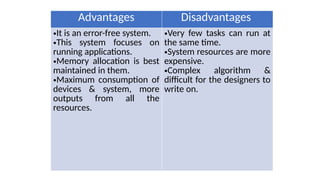
Advantages Disadvantages
•It isan error-free system.
•This system focuses on
running applications.
•Memory allocation is best
maintained in them.
•Maximum consumption of
devices & system, more
outputs from all the
resources.
•Very few tasks can run at
the same time.
•System resources are more
expensive.
•Complex algorithm &
difficult for the designers to
write on.
8.
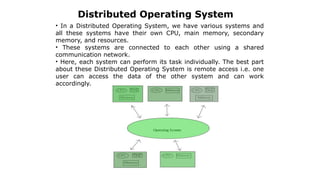
Distributed Operating System
•In a Distributed Operating System, we have various systems and
all these systems have their own CPU, main memory, secondary
memory, and resources.
• These systems are connected to each other using a shared
communication network.
• Here, each system can perform its task individually. The best part
about these Distributed Operating System is remote access i.e. one
user can access the data of the other system and can work
accordingly.
9.
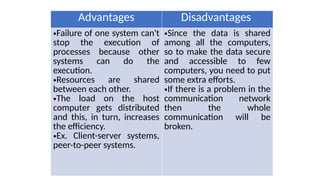
Advantages Disadvantages
•Failure ofone system can't
stop the execution of
processes because other
systems can do the
execution.
•Resources are shared
between each other.
•The load on the host
computer gets distributed
and this, in turn, increases
the efficiency.
•Ex. Client-server systems,
peer-to-peer systems.
•Since the data is shared
among all the computers,
so to make the data secure
and accessible to few
computers, you need to put
some extra efforts.
•If there is a problem in the
communication network
then the whole
communication will be
broken.