Lecture and other forms
of organizing teaching at
University
Performed by: Maripova Diana
Bektanova Diana
Plan
Function and classification of lectures
Structure of lecture its pecularies
Advantages and disadvantages
Activities
The role of a teacher
The Teacher as a Planner and Manager of
Time
The Teacher as an Academic Guide to Students
The Teacher as an Adviser and Counsellor
The Teacher as a Researcher
The Teacher as a Consultant
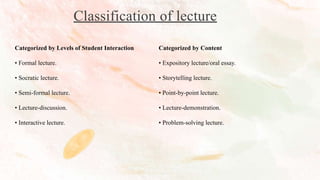
Classification of lecture
Categorized by Levels of Student Interaction
• Formal lecture.​
• Socratic lecture.​
• Semi-formal lecture.​
• Lecture-discussion.​
• Interactive lecture.​
Categorized by Content
• Expository lecture/oral essay.​
• Storytelling lecture.​
• Point-by-point lecture.​
• Lecture-demonstration.​
• Problem-solving lecture​.
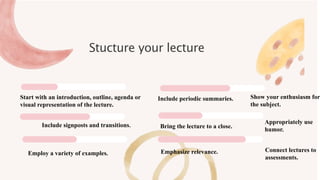
Stucture your lecture
Start with an introduction, outline, agenda or
visual representation of the lecture.
Include signposts and transitions.
Employ a variety of examples.
Include periodic summaries. Show your enthusiasm for
the subject.
Bring the lecture to a close.
Appropriately use
humor.
Emphasize relevance. Connect lectures to
assessments.
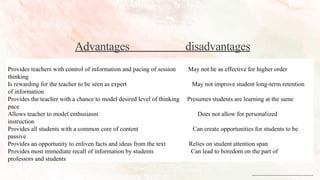
Advantages disadvantages
Provides teachers with control of information and pacing of session May not be as effective for higher order
thinking
Is rewarding for the teacher to be seen as expert May not improve student long-term retention
of information
Provides the teacher with a chance to model desired level of thinking Presumes students are learning at the same
pace
Allows teacher to model enthusiasm Does not allow for personalized
instruction
Provides all students with a common core of content Can create opportunities for students to be
passive
Provides an opportunity to enliven facts and ideas from the text Relies on student attention span
Provides most immediate recall of information by students Can lead to boredom on the part of
professors and students
Activity
https://docs.google.com/forms/d/e/1FAI
pQLSeyx-
JDmYwJFAMCc_3ZjtD_LKPcrKMC-
4IMzv_G9OD35y-
NGQ/viewform?vc=0&c=0&w=1&flr=
0&usp=mail_form_link
Сливочное мороженое с пеканом
Пробежка или быстрая прогулка ночью
Приготовление лапши с нуля
Прослушивание джазовой музыки
Декорирование дома
https://oaa.osu.edu/sites/default/files/uploads/nfo/2
019/Types-of-Lectures.pdf
https://www.cmu.edu/teaching/designteach/design/i
nstructionalstrategies/lectures.html
http://www.nzdl.org/cgi-bin/library.cgi?e=d-00000-00---off-0cdl--00-0--
--0-10-0---0---0direct-10---4-------0-0l--11-en-50---20-about---00-0-1-
00-0-0-11-1-0utfZz-8-
00&cl=CL4.43&d=HASH01bacd4b975a0db4bc878ddf.4.4&gt=1
https://www.thoughtco.com/lecture-pros-and-cons-
8037
https://en.wikipedia.org/wiki/Lecture
References
1
2
3
4
5

Types of lectures.pptx

  • 1.
    Lecture and otherforms of organizing teaching at University Performed by: Maripova Diana Bektanova Diana
  • 2.
    Plan Function and classificationof lectures Structure of lecture its pecularies Advantages and disadvantages Activities
  • 3.
    The role ofa teacher The Teacher as a Planner and Manager of Time The Teacher as an Academic Guide to Students The Teacher as an Adviser and Counsellor The Teacher as a Researcher The Teacher as a Consultant
  • 4.
    Classification of lecture Categorizedby Levels of Student Interaction • Formal lecture.​ • Socratic lecture.​ • Semi-formal lecture.​ • Lecture-discussion.​ • Interactive lecture.​ Categorized by Content • Expository lecture/oral essay.​ • Storytelling lecture.​ • Point-by-point lecture.​ • Lecture-demonstration.​ • Problem-solving lecture​.
  • 5.
    Stucture your lecture Startwith an introduction, outline, agenda or visual representation of the lecture. Include signposts and transitions. Employ a variety of examples. Include periodic summaries. Show your enthusiasm for the subject. Bring the lecture to a close. Appropriately use humor. Emphasize relevance. Connect lectures to assessments.
  • 6.
    Advantages disadvantages Provides teacherswith control of information and pacing of session May not be as effective for higher order thinking Is rewarding for the teacher to be seen as expert May not improve student long-term retention of information Provides the teacher with a chance to model desired level of thinking Presumes students are learning at the same pace Allows teacher to model enthusiasm Does not allow for personalized instruction Provides all students with a common core of content Can create opportunities for students to be passive Provides an opportunity to enliven facts and ideas from the text Relies on student attention span Provides most immediate recall of information by students Can lead to boredom on the part of professors and students
  • 7.
  • 8.
    Сливочное мороженое спеканом Пробежка или быстрая прогулка ночью Приготовление лапши с нуля Прослушивание джазовой музыки Декорирование дома https://oaa.osu.edu/sites/default/files/uploads/nfo/2 019/Types-of-Lectures.pdf https://www.cmu.edu/teaching/designteach/design/i nstructionalstrategies/lectures.html http://www.nzdl.org/cgi-bin/library.cgi?e=d-00000-00---off-0cdl--00-0-- --0-10-0---0---0direct-10---4-------0-0l--11-en-50---20-about---00-0-1- 00-0-0-11-1-0utfZz-8- 00&cl=CL4.43&d=HASH01bacd4b975a0db4bc878ddf.4.4&gt=1 https://www.thoughtco.com/lecture-pros-and-cons- 8037 https://en.wikipedia.org/wiki/Lecture References 1 2 3 4 5