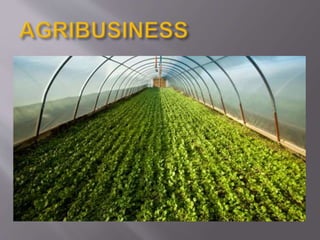
Agribusiness refers to agriculture-
related activities that put farmers,
processors, distributors and
consumers within a system that
produces, processes, transports,
markets and distributes agricultural
products.
The transformation of agricultural
farming into a thriving agribusiness-
driven sector entails:
 acquiring farming technologies
 training in more sophisticated
farming techniques
 creating stable supply chains
 establishing transport and
agricultural infrastructure
 investing and research and
development
 securing a reliable property rights
regime.
These activities can contribute not
only in diversifying and increasing
the value of agribusiness outputs,
but also contribute to the inclusive
growth and rural development
agenda of the Philippine
government.
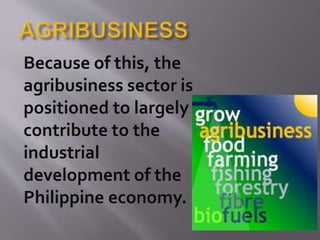
Because of this, the
agribusiness sector is
positioned to largely
contribute to the
industrial
development of the
Philippine economy.
 This industry engage in the
transformation of goods, materials
or substances into new products.
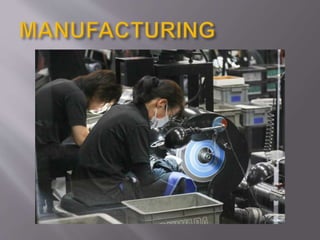
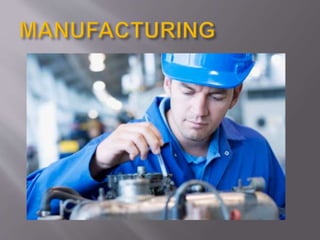
 The transformational process can be
physical, chemical or mechanical.
 Manufacturers often have plants,
mills or factories that produce goods
for public consumption
 Economies thrive when they have
strong manufacturing industries.
Also when manufacturing is a thing,
innovation soars.
 Manufacturing is a huge propeller of
innovation and forward thinking.
MANUFACTURING INDUSTRY is the
sector of the economy that produces
finished products.
This can be compared to primary
industries that produce raw materials
and service industries that produce
intangible products.
EXAMPLES OF MANUFACTURING
INDUSTRIES INCLUDE:
 Transportation – from automobiles
to aerospace and shipbuilding
 Fast moving consumer goods such
as food, beverages, toiletries
 Chemical industry – production of
chemicals such as plastics
 Pharmaceutical – medications,
devices and healthcare supplies
 Paper, printing and publishing –
making of pulp, paper, cardboard
 Furnitures and fixtures
 Fashion industry
 Sporting goods
RETAIL – is the process of selling
consumer goods or services to
customers through multiple
channels of distribution to earn a
profit.
SERVICES – are intangible products
provided to customers such as tours,
housekeeping, nursing, and
teaching.
 By contrast, those employed in the
manufacturing sectors produce
tangible goods such as cars,
clothes, or equipment.
RETAILING includes all the activities
involved in selling goods or services
directly to final customers for their
personal, non business use.
 SPECIALTY STORES
 SUPERMARKETS
 CONVENIENCE STORES
 FACTORY OUTLETS
 INDEPENDENT OFF-PRICE RETAILER
 WAREHOUSE CLUBS
 DEPARTMENT STORES
 DISCOUNT STORES
 Retailing shapes the lifestyle of people
 Retailing contributes to the economy
 Retailing dominates the supply chain
 Retailing is interdisciplinary
 Retailing offers itself as an academic
course
 Retailers have scope for expanding
internationally
Service industry companies are also
involved in retail, transport,
distribution, food services as well as
other service-dominated businesses.
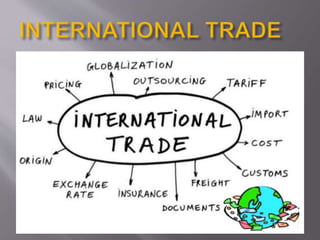
 Concerned with the exchange of goods
and services with foreign countries.
 Purchase, sale or exchange of goods
and services across national borders.
 Almost every kind of product can be
found on the international market
nowadays, including basic needs such
as food, clothes, oil, currencies, etc.
ABSOLUTE ADVANTAGE – occurs when
one producer can do a task using fewer
inputs than the other producer
COMPARATIVE ADVANTAGE – occurs
when a person or a country can produce
a good or service at a lower opportunity
cost than others.
 Because of specialization, both
nations can be better off, even
if one nation has an absolute
advantage in both goods over
the other.
 They can import resources they lack
 They can import goods for which they
are a relatively inefficient producer
 Specialization sometimes permits
economies of large-scale production
 Enables countries to specialize and
increase world output
 Helps widen the range of choice of
goods or products
 Increases the need to be more efficient
and effective in production
 Stimulates research and development
policies and more rapid adoption of
new technology to reduce cost of
production
 One may need to wait for long term
gains
 Hiring professional staffs to launch
international trade is timely and costly
 Modifying product or packaging
 Develop new promotional material
 Dealing with licenses and regulations
 Apply for additional financing
Based on the videos you watched, what
can you say about the agribusiness and
manufacturing industry and how big do
you think their impact is on the country's

economy? Provide examples on how
these types of industries are crucial to
the success of a country's economy.
2-3 paragraphs (30points)
 thank you! 

Types of Industry

  • 4.
    Agribusiness refers toagriculture- related activities that put farmers, processors, distributors and consumers within a system that produces, processes, transports, markets and distributes agricultural products.
  • 5.
    The transformation ofagricultural farming into a thriving agribusiness- driven sector entails:  acquiring farming technologies  training in more sophisticated farming techniques  creating stable supply chains
  • 6.
     establishing transportand agricultural infrastructure  investing and research and development  securing a reliable property rights regime.
  • 9.
    These activities cancontribute not only in diversifying and increasing the value of agribusiness outputs, but also contribute to the inclusive growth and rural development agenda of the Philippine government.
  • 10.
    Because of this,the agribusiness sector is positioned to largely contribute to the industrial development of the Philippine economy.
  • 12.
     This industryengage in the transformation of goods, materials or substances into new products.  The transformational process can be physical, chemical or mechanical.  Manufacturers often have plants, mills or factories that produce goods for public consumption
  • 13.
     Economies thrivewhen they have strong manufacturing industries. Also when manufacturing is a thing, innovation soars.  Manufacturing is a huge propeller of innovation and forward thinking.
  • 16.
    MANUFACTURING INDUSTRY isthe sector of the economy that produces finished products. This can be compared to primary industries that produce raw materials and service industries that produce intangible products.
  • 17.
    EXAMPLES OF MANUFACTURING INDUSTRIESINCLUDE:  Transportation – from automobiles to aerospace and shipbuilding  Fast moving consumer goods such as food, beverages, toiletries  Chemical industry – production of chemicals such as plastics
  • 18.
     Pharmaceutical –medications, devices and healthcare supplies  Paper, printing and publishing – making of pulp, paper, cardboard  Furnitures and fixtures  Fashion industry  Sporting goods
  • 20.
    RETAIL – isthe process of selling consumer goods or services to customers through multiple channels of distribution to earn a profit.
  • 21.
    SERVICES – areintangible products provided to customers such as tours, housekeeping, nursing, and teaching.  By contrast, those employed in the manufacturing sectors produce tangible goods such as cars, clothes, or equipment.
  • 22.
    RETAILING includes allthe activities involved in selling goods or services directly to final customers for their personal, non business use.
  • 23.
     SPECIALTY STORES SUPERMARKETS  CONVENIENCE STORES  FACTORY OUTLETS  INDEPENDENT OFF-PRICE RETAILER  WAREHOUSE CLUBS  DEPARTMENT STORES  DISCOUNT STORES
  • 24.
     Retailing shapesthe lifestyle of people  Retailing contributes to the economy  Retailing dominates the supply chain  Retailing is interdisciplinary  Retailing offers itself as an academic course  Retailers have scope for expanding internationally
  • 25.
    Service industry companiesare also involved in retail, transport, distribution, food services as well as other service-dominated businesses.
  • 28.
     Concerned withthe exchange of goods and services with foreign countries.  Purchase, sale or exchange of goods and services across national borders.  Almost every kind of product can be found on the international market nowadays, including basic needs such as food, clothes, oil, currencies, etc.
  • 29.
    ABSOLUTE ADVANTAGE –occurs when one producer can do a task using fewer inputs than the other producer COMPARATIVE ADVANTAGE – occurs when a person or a country can produce a good or service at a lower opportunity cost than others.
  • 30.
     Because ofspecialization, both nations can be better off, even if one nation has an absolute advantage in both goods over the other.
  • 31.
     They canimport resources they lack  They can import goods for which they are a relatively inefficient producer  Specialization sometimes permits economies of large-scale production  Enables countries to specialize and increase world output
  • 32.
     Helps widenthe range of choice of goods or products  Increases the need to be more efficient and effective in production  Stimulates research and development policies and more rapid adoption of new technology to reduce cost of production
  • 33.
     One mayneed to wait for long term gains  Hiring professional staffs to launch international trade is timely and costly  Modifying product or packaging  Develop new promotional material  Dealing with licenses and regulations  Apply for additional financing
  • 34.
    Based on thevideos you watched, what can you say about the agribusiness and manufacturing industry and how big do you think their impact is on the country's economy? Provide examples on how these types of industries are crucial to the success of a country's economy. 2-3 paragraphs (30points)
  • 35.