Exhausted list on types of
entrepreneurship
“
‘’Entrepreneur”
French verb
‘entrepredre’
INTRODUCTION
Am I an Entrepreneur?
• If you have your own business you could be
deemed an entrepreneur, but with setting up
businesses being so simple nowadays this term is
being coined all too easily.
The definition of an entrepreneur is this…
‘‘a person that starts a business, taking on financial
risks in the hope of profit.”
The definition of an entrepreneurship is this….
‘‘It is a philosophy or process through which an
entrepreneur seeks innovation and employment.’’
Entrepreneur Person/ an
individual
Entrepreneur-
ship
Process or
philosophy
Enterprise
Object/business
entity
1-What is an Online
Entrepreneurship?
An online entrepreneur is
someone who makes their
living online.
2-What is a
Wantrepreneurship?
A person who aspires to be an
entrepreneur, but never takes any
action towards this goal.
An entrepreneur is driven by his
passion for his
business.Wantrepreneurs follow the
trend, simply because it has proven
successful already.
Additionally, they introduce the low-cost non-reusable syringes for clinics that lack
money globally. Since its foundation, this firm has delivered more than 4 billion
safe injections in more than 50 nations around the globe
It is controlled by Marc Koska and involved in the world of
redesigning medical tools.
One of the Premier Examples about Social Entrepreneurship is
SafePoint Trust.
If your goal is about changing the world for the better, then
you’re probably a socialpreneur.
They recognize a need in their community or in society as a whole
and then seek out ways to feed this need while still being able to
turn a profit.
Socialpreneurs are folks who pay attention to the
world around them.
3-What is Socialpreneurship?
Webpreneurship is not for the weak-willed
A webpreneur is a blend word made from the world wide web and entrepreneur.
6. Webpreneurship?
At the highest level of entrepreneurship sits the angel investor. This is the silicon valley type of entrepreneur
who made their money starting businesses and now is looking to help the next generation.
5. Investor Entrepreneurship?
The influencer entrepreneur shares their knowledge for free but then charges advertisers to sell to their
audience
An influencer is someone that built an audience around a topic and then sells exposure to that audience.
4. Influencer Entrepreneurship?
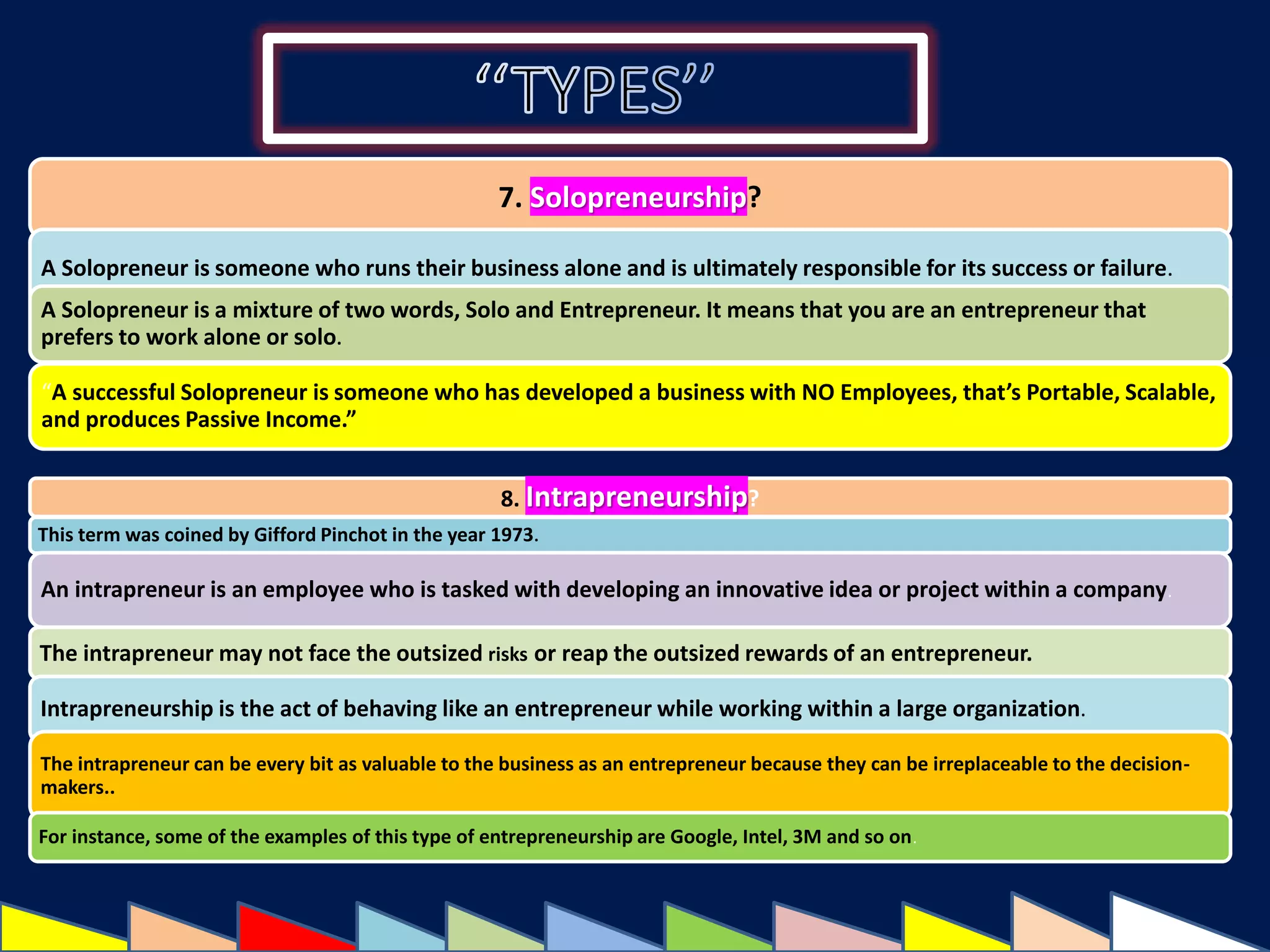
7. Solopreneurship?
A Solopreneur is someone who runs their business alone and is ultimately responsible for its success or failure.
A Solopreneur is a mixture of two words, Solo and Entrepreneur. It means that you are an entrepreneur that
prefers to work alone or solo.
“A successful Solopreneur is someone who has developed a business with NO Employees, that’s Portable, Scalable,
and produces Passive Income.”
8. Intrapreneurship?
This term was coined by Gifford Pinchot in the year 1973.
An intrapreneur is an employee who is tasked with developing an innovative idea or project within a company.
The intrapreneur may not face the outsized risks or reap the outsized rewards of an entrepreneur.
Intrapreneurship is the act of behaving like an entrepreneur while working within a large organization.
The intrapreneur can be every bit as valuable to the business as an entrepreneur because they can be irreplaceable to the decision-
makers..
For instance, some of the examples of this type of entrepreneurship are Google, Intel, 3M and so on.
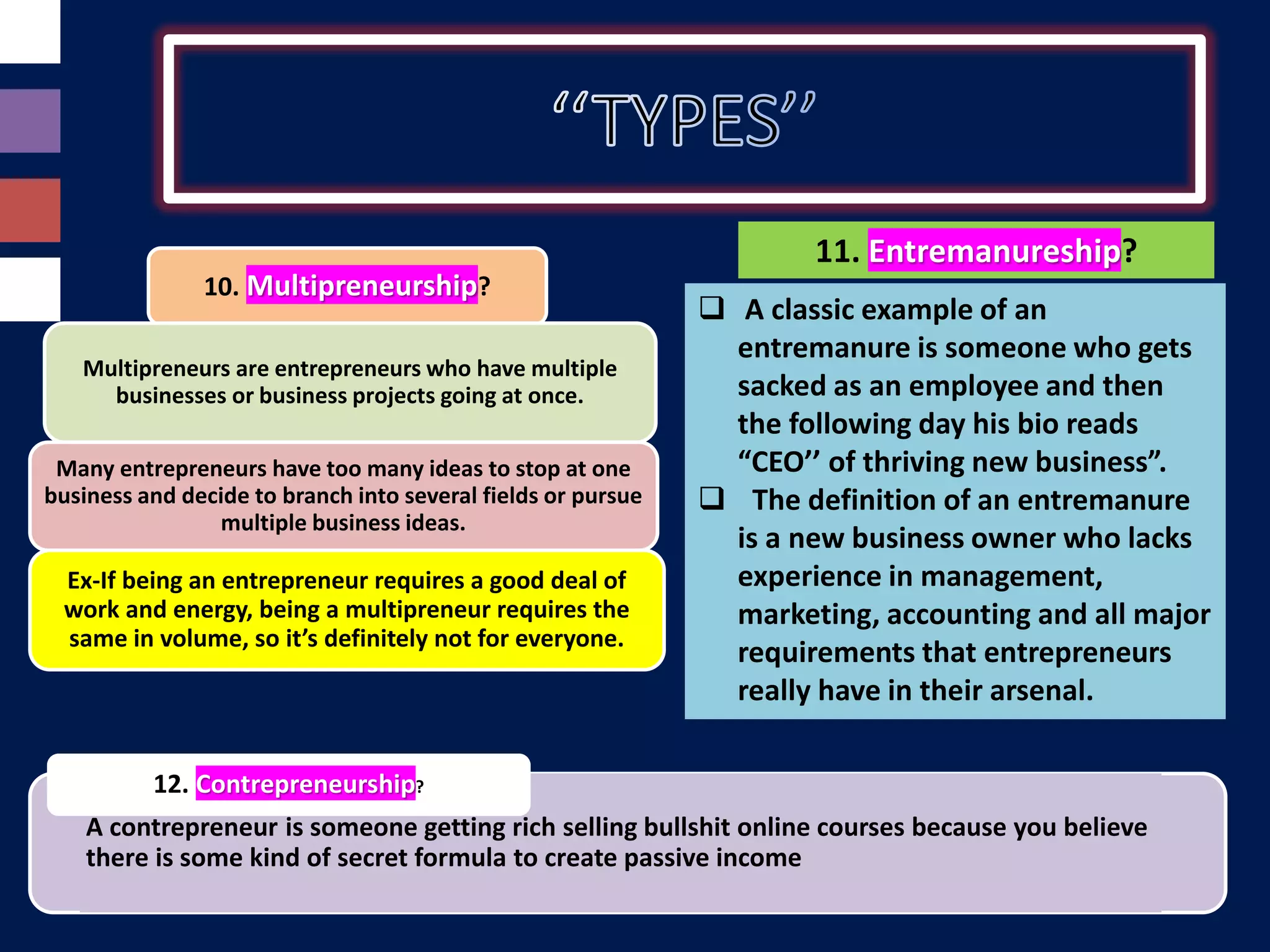
10. Multipreneurship?
Multipreneurs are entrepreneurs who have multiple
businesses or business projects going at once.
Many entrepreneurs have too many ideas to stop at one
business and decide to branch into several fields or pursue
multiple business ideas.
Ex-If being an entrepreneur requires a good deal of
work and energy, being a multipreneur requires the
same in volume, so it’s definitely not for everyone.
11. Entremanureship?
 A classic example of an
entremanure is someone who gets
sacked as an employee and then
the following day his bio reads
“CEO’’ of thriving new business”.
 The definition of an entremanure
is a new business owner who lacks
experience in management,
marketing, accounting and all major
requirements that entrepreneurs
really have in their arsenal.
..
A contrepreneur is someone getting rich selling bullshit online courses because you believe
there is some kind of secret formula to create passive income
12. Contrepreneurship?
14. Dadpreneurship?
 A dadpreneur refers to male
business owners who actively
balance the role of dad and the
role of entrepreneur.
 Dadpreneur is a slang term
describing men who start or run
their own businesses while also
acting as a full-time parent, where
dadpreneur is a combination of the
words “dad” and “entrepreneur”.
 Dadpreneurship is a growing term
used online because many are
having to balance family with the
workload of trying to build a
successful business
 A mompreneur refers to female
business owners who actively
balance the role of mom and the role
of entrepreneur.
 Mompreneur is a slang term
describing women who start or run
their own businesses while also
acting as a full-time parent, where
Mompreneur is a combination of the
words “mom” and “entrepreneur”.
 Mompreneurship is a relatively new
trend in entrepreneurship, and have
come to increase prominence
especially in the internet age.
13. Mompreneurship?
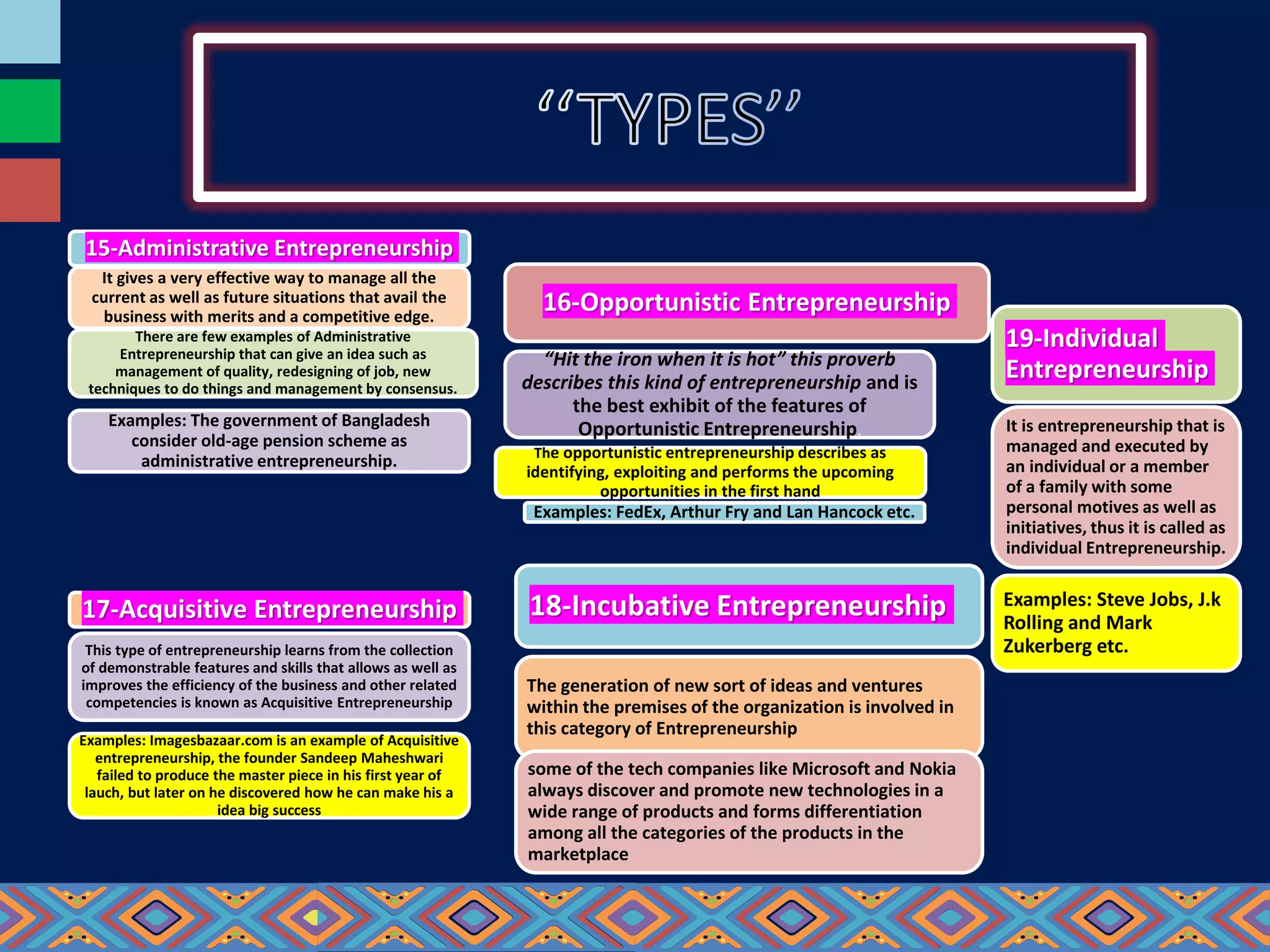
15-Administrative Entrepreneurship
It gives a very effective way to manage all the
current as well as future situations that avail the
business with merits and a competitive edge.
There are few examples of Administrative
Entrepreneurship that can give an idea such as
management of quality, redesigning of job, new
techniques to do things and management by consensus.
Examples: The government of Bangladesh
consider old-age pension scheme as
administrative entrepreneurship.
16-Opportunistic Entrepreneurship
“Hit the iron when it is hot” this proverb
describes this kind of entrepreneurship and is
the best exhibit of the features of
Opportunistic Entrepreneurship.
The opportunistic entrepreneurship describes as
identifying, exploiting and performs the upcoming
opportunities in the first hand
Examples: FedEx, Arthur Fry and Lan Hancock etc.
17-Acquisitive Entrepreneurship
This type of entrepreneurship learns from the collection
of demonstrable features and skills that allows as well as
improves the efficiency of the business and other related
competencies is known as Acquisitive Entrepreneurship
Examples: Imagesbazaar.com is an example of Acquisitive
entrepreneurship, the founder Sandeep Maheshwari
failed to produce the master piece in his first year of
lauch, but later on he discovered how he can make his a
idea big success
The generation of new sort of ideas and ventures
within the premises of the organization is involved in
this category of Entrepreneurship
18-Incubative Entrepreneurship
some of the tech companies like Microsoft and Nokia
always discover and promote new technologies in a
wide range of products and forms differentiation
among all the categories of the products in the
marketplace
19-Individual
Entrepreneurship
It is entrepreneurship that is
managed and executed by
an individual or a member
of a family with some
personal motives as well as
initiatives, thus it is called as
individual Entrepreneurship.
Examples: Steve Jobs, J.k
Rolling and Mark
Zukerberg etc.
20-Individual Entrepreneurship
• It is managed and executed by an individual or a member of a family with some personal motives as
well as initiatives, thus it is called as individual Entrepreneurship.
• Examples: Steve Jobs, J.k Rolling and Mark Zukerberg etc.
21-Mass Entrepreneurship
• The emergence of this category of entrepreneurship occurs when there is a presence of a lot of
favourable climate of encouragement as well as a motivation among the common masses and this
describes the Mass Entrepreneurship.
• Examples: Food caterers, beauty salon and local shops
22-Cultural Entrepreneurship
• These entrepreneurs’ changes culturally who organize cultural, financial, social as well as human
capital to make a profit out of it. They produce products that are culturally good and generating a lot
of opportunities for economy, society and culture.
• Such entrepreneurship works in cultural professions such as artists, writers, musicians, dancers,
advertisers, bloggers, architects and so on.
• Examples: Singers, Musicians, Artists and Writers.
23-International Entrepreneurship
• It is the whole process of entrepreneurship conducts ad, performs the activities of the business
across the boundaries of the nation.
• The highlighted purpose of this entrepreneurship is to fulfill and satisfy the needs and wants of the
target audiences.
• Examples: Google, Apple and Mcdonalds etc.
24-Ecopreneurship
• It is also named as “Green entrepreneurship”. It involves the perspectives that signify corporation
with the environment by working on their goals as well as profitability. This term gained popularity in
the year 1990s and termed as “Environmental entrepreneurship”
• Examples: Body Shop and Ben and Jerry’s, Patagoina, Clif Bars and Grow Green Happiness etc.
25-Transpreneurship
• When the people from various groups of gender such as transgender and Hijda, comes up with some
small scale businesses to fulfil their day to day needs, then it is widely known as Transpreneruship.
• It is associated with the third class of gender where people are not only beggars or sex workers, but they
get their bread and butter from doing any small scale business.
• For example: A fair was organized by “Anam Prem” in Mumbai where thirty-five stalls were there and
most of the shopkeepers belong to transgender started their stalls of different products such as food,
artificial jewellery, artificial flowers and so on.
26-E- Entrepreneurship/Cyberpreneurship
• In this world of full of technology, the sea of opportunities is there where individual, organizations as
well as social and nations can use their mobile phone and computer again and again to access the online
services.
• Examples: Amazon, Ebay and Etsy etc.
27-Domestic Entrepreneurship
• When a business owner produces goods and provides services within the boundaries of a nation, then it
is known as Domestic Entrepreneurship. They follow all the rules and regulations related to the business
established by the government of the country to grow their business domestically.
For Examples: House Cleaning, Dog Walking and Freelance writing etc.
28-State Entrepreneurship
• When a business firm is managed and operated wholly by the state or the government of the state, then
it is defined as “State Entrepreneurship”.
• Examples: Any Business that is based on state like Invest punjab in India.
‘’Clarence Danhof Classification’’
•Are conservative or orthodox in
outlook (alz comfortable in old
fashion)
•Are laggards who follow the
traditional way of doing business
•Reluctant to any change even if
they face losses
•Donot utilize the oppurtunities
they come across
•Go for change only for the fear of
failure and loss (crucial behavior)
•Exhibit resistance to venture or risk
•Adopt and follow conventional
approaches
•Firm in their rigid and fundamental
approaches
•Flexible to adopt their ideas
•They start the enterprise by
imitating others people’s idea
and set up their enterprise in the
same manner
•They bring about the change and
are very crucial for the
underdeveloped economics
socities.
•(agent of economic dev.)
• Introduce new
products/services/new markets/
improve upon them
• Very aggressive and intelligent to
put their ideas into practice
• Very much helpful for their
• country
• because they bring about
• a transformation in life style
Innovative Imitative
DroneFabian
Based on
Arthur H. Cole Classification:
1.Empirical:
• He is an
entrepreneur
hardly
introduces
anything
revolutionary
and follows
the
• principle of
rule of thumb.
2. Rational
• The rational
entrepreneur
is well
informed
about the
general
economic
conditions and
introduces
changes which
look more
revolutionary.
3. Cognitive:
• Cognitive
entrepreneur
is well
informed,
draws upon
the advice and
services of
experts and
introduces
changes that
reflect
complete
break from the
existing
scheme of
• enterprise.
Classification Based on the Scale
of Enterprise:
•popular in the
underdeveloped countries.
•Small entrepreneurs do not
possess the necessary talents
and resources to initiate large
scale production.
•Examples: Mint.com, core
power, ozone coffee and
Birchbox.
1. Small
scale:
•Popular in the developed
countries most entrepreneurs
deal with large scale
enterprises.
•Are able to sustain and
develop a high level of
technical progress.
•Some Examples of Large
Company Entrepreneurship
are LG, Tata, Microsoft, etc.
2. Large
scale:
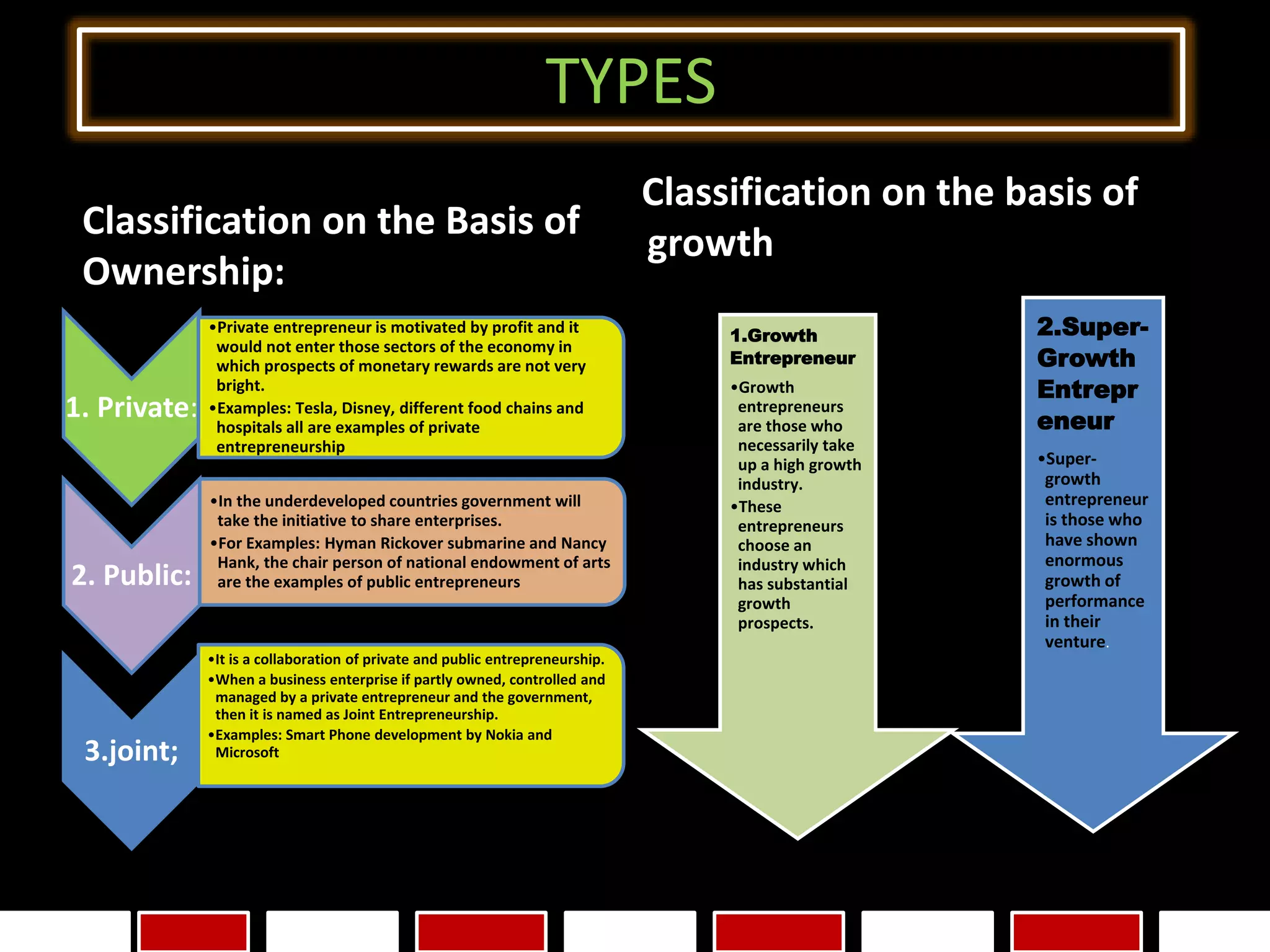
TYPES
Classification on the Basis of
Ownership:
1. Private:
•Private entrepreneur is motivated by profit and it
would not enter those sectors of the economy in
which prospects of monetary rewards are not very
bright.
•Examples: Tesla, Disney, different food chains and
hospitals all are examples of private
entrepreneurship
2. Public:
•In the underdeveloped countries government will
take the initiative to share enterprises.
•For Examples: Hyman Rickover submarine and Nancy
Hank, the chair person of national endowment of arts
are the examples of public entrepreneurs
3.joint;
•It is a collaboration of private and public entrepreneurship.
•When a business enterprise if partly owned, controlled and
managed by a private entrepreneur and the government,
then it is named as Joint Entrepreneurship.
•Examples: Smart Phone development by Nokia and
Microsoft
Classification on the basis of
growth
1.Growth
Entrepreneur
•Growth
entrepreneurs
are those who
necessarily take
up a high growth
industry.
•These
entrepreneurs
choose an
industry which
has substantial
growth
prospects.
2.Super-
Growth
Entrepr
eneur
•Super-
growth
entrepreneur
is those who
have shown
enormous
growth of
performance
in their
venture.
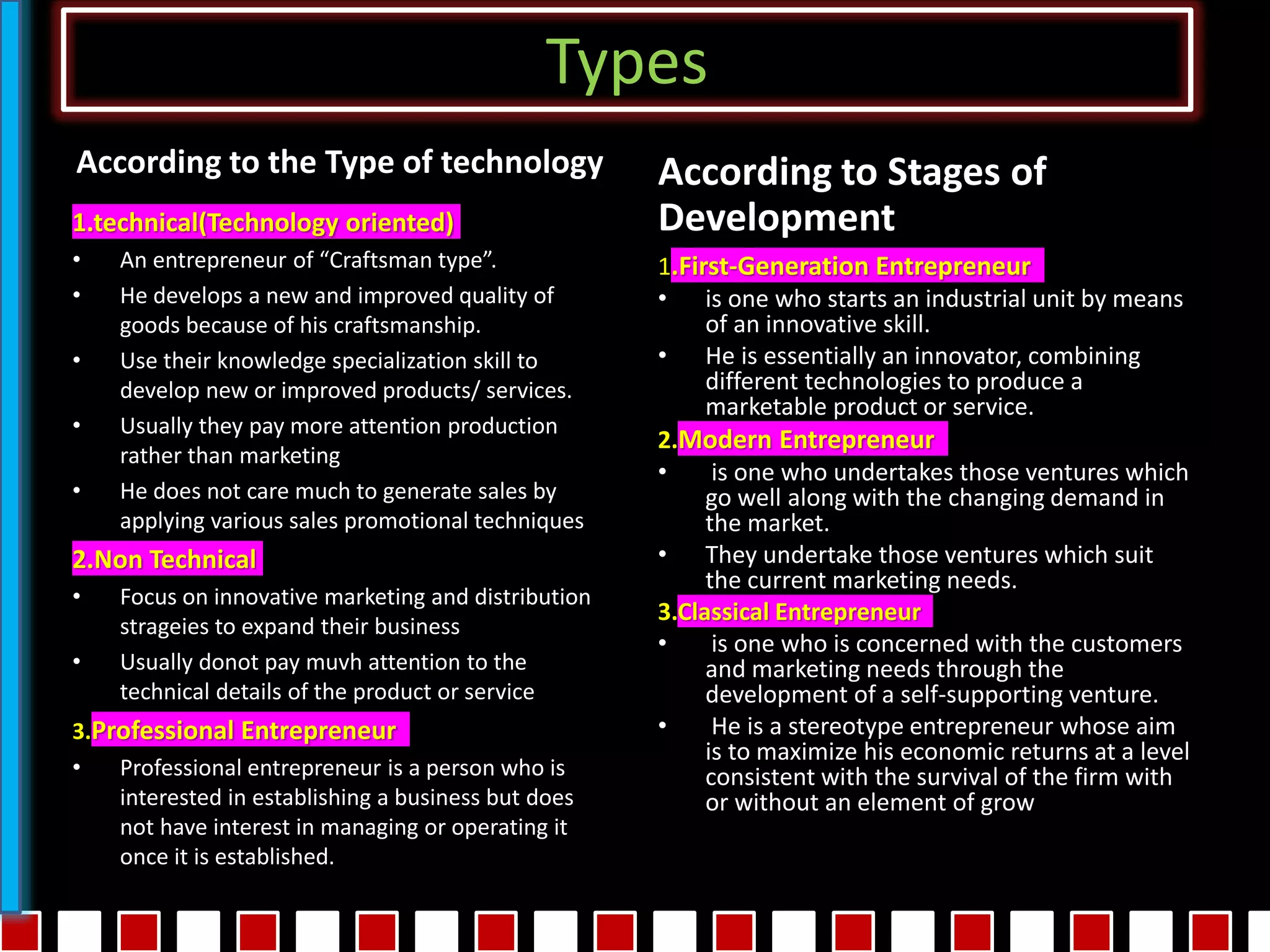
Types
According to the Type of technology
1.technical(Technology oriented)
• An entrepreneur of “Craftsman type”.
• He develops a new and improved quality of
goods because of his craftsmanship.
• Use their knowledge specialization skill to
develop new or improved products/ services.
• Usually they pay more attention production
rather than marketing
• He does not care much to generate sales by
applying various sales promotional techniques
2.Non Technical
• Focus on innovative marketing and distribution
strageies to expand their business
• Usually donot pay muvh attention to the
technical details of the product or service
3.Professional Entrepreneur
• Professional entrepreneur is a person who is
interested in establishing a business but does
not have interest in managing or operating it
once it is established.
According to Stages of
Development
1.First-Generation Entrepreneur
• is one who starts an industrial unit by means
of an innovative skill.
• He is essentially an innovator, combining
different technologies to produce a
marketable product or service.
2.Modern Entrepreneur
• is one who undertakes those ventures which
go well along with the changing demand in
the market.
• They undertake those ventures which suit
the current marketing needs.
3.Classical Entrepreneur
• is one who is concerned with the customers
and marketing needs through the
development of a self-supporting venture.
• He is a stereotype entrepreneur whose aim
is to maximize his economic returns at a level
consistent with the survival of the firm with
or without an element of grow
According to the Type of Business
1. Business Entrepreneur
•Most common,Business entrepreneurs
are individuals who conceive an idea for
a new product or service and then
create a business to materialize their
idea into reality.
2.Trading entrepreneur
•These are a kind of mediator between the
manufacturer of a product and its customers or
retailers or wholesalers
•Perform the trade either in house or overseas or
both
•Closely watch the market for the demand for
any product or service and exploit it
economically.
•They’re the fore runners to implement the ideas
and stand ahead of others
3.Industrial Entrepreneur
•Is one who establishe that manufacture
products or provide services which are high in
demand
•They exploit the economic resourses into
economically viable ventures
•Example-The enterprise maruti Suzuki India
ltd which is in the business of car
manufacturing and offering car released
services
4.Corporate Entrepreneur
•essentially a manufacturer who identifies the
potential needs of customers and tailor
product or service to meet the marketing
needs.
•Who control or manage or organize an
enterprise in the most productive and
economic way through their innovative ideas
5.Agricultural Entrepreneur
•Are in the business of agriculture and
related products and services
•Use innovatives techniques,machinery
equipment irrigation methods to grow and
market the crops
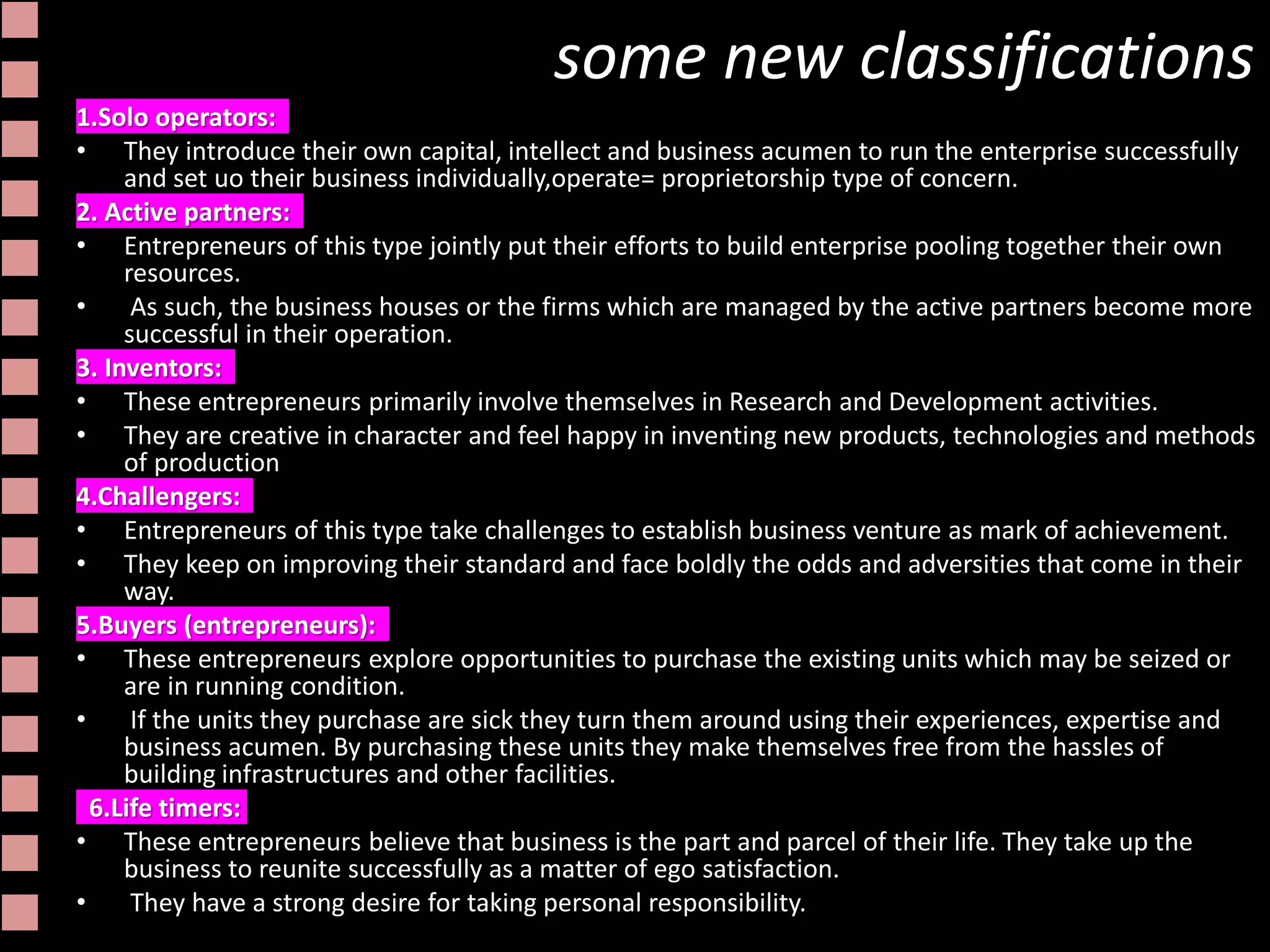
some new classifications
1.Solo operators:
• They introduce their own capital, intellect and business acumen to run the enterprise successfully
and set uo their business individually,operate= proprietorship type of concern.
2. Active partners:
• Entrepreneurs of this type jointly put their efforts to build enterprise pooling together their own
resources.
• As such, the business houses or the firms which are managed by the active partners become more
successful in their operation.
3. Inventors:
• These entrepreneurs primarily involve themselves in Research and Development activities.
• They are creative in character and feel happy in inventing new products, technologies and methods
of production
4.Challengers:
• Entrepreneurs of this type take challenges to establish business venture as mark of achievement.
• They keep on improving their standard and face boldly the odds and adversities that come in their
way.
5.Buyers (entrepreneurs):
• These entrepreneurs explore opportunities to purchase the existing units which may be seized or
are in running condition.
• If the units they purchase are sick they turn them around using their experiences, expertise and
business acumen. By purchasing these units they make themselves free from the hassles of
building infrastructures and other facilities.
6.Life timers:
• These entrepreneurs believe that business is the part and parcel of their life. They take up the
business to reunite successfully as a matter of ego satisfaction.
• They have a strong desire for taking personal responsibility.
1.Trailblazer-
•Aggressive and risk taking entrepreneurs who are-
Ambitious ,Goal based,Competitive
•Want to take everything into their hands and drive any
task with lots of energy
•Make decisions based on-
analysis,practicality,logic,realistic approaches.
•Highly innovative and like to start their own business
instead of taking a franchise
4.Pure Entrepreneur
•is an individual who is motivated by
psychological and economic rewards.
3.Managers
•Are dominant and love working independently
•Goal and process focused and not people oriented
•Are not always time bound
•Are customer oriented too and contribute a lot to the
growth of business
•Difficulty in working with others they should hire
employees who are very good listeners and people
2.Go getters-
•Dominant and sociable entrepreneurs
•Are self driven and like to work independently and are
competitive
•Highly initiative and get the things done at a very fast
place
•Good leadership,good managers and motivate the
people surrounding them
5.Induced –
is one who is being induced to take up an
entrepreneurial task due to the policy
measures of the government that provides
assistance, incentives, concessions and
necessary overhead facilities to start a
venture.
•They come into being because of the
possibility of making and marketing
some new product for the use of
consumers
7. Motivated
•New entrepreneurs are motivated
by the desire for self-fulfillment
•They come into be According to motivation possibility of making
and mark
7.Spontaneous Entrepreneur
• They are persons with initiative, boldness and confidence in
their ability which motive by reward in terms of profit and
enlarged customer network
Thank
You!!

Types of entrepreneur

  • 2.
    Exhausted list ontypes of entrepreneurship “ ‘’Entrepreneur” French verb ‘entrepredre’
  • 3.
    INTRODUCTION Am I anEntrepreneur? • If you have your own business you could be deemed an entrepreneur, but with setting up businesses being so simple nowadays this term is being coined all too easily. The definition of an entrepreneur is this… ‘‘a person that starts a business, taking on financial risks in the hope of profit.” The definition of an entrepreneurship is this…. ‘‘It is a philosophy or process through which an entrepreneur seeks innovation and employment.’’ Entrepreneur Person/ an individual Entrepreneur- ship Process or philosophy Enterprise Object/business entity
  • 4.
    1-What is anOnline Entrepreneurship? An online entrepreneur is someone who makes their living online. 2-What is a Wantrepreneurship? A person who aspires to be an entrepreneur, but never takes any action towards this goal. An entrepreneur is driven by his passion for his business.Wantrepreneurs follow the trend, simply because it has proven successful already. Additionally, they introduce the low-cost non-reusable syringes for clinics that lack money globally. Since its foundation, this firm has delivered more than 4 billion safe injections in more than 50 nations around the globe It is controlled by Marc Koska and involved in the world of redesigning medical tools. One of the Premier Examples about Social Entrepreneurship is SafePoint Trust. If your goal is about changing the world for the better, then you’re probably a socialpreneur. They recognize a need in their community or in society as a whole and then seek out ways to feed this need while still being able to turn a profit. Socialpreneurs are folks who pay attention to the world around them. 3-What is Socialpreneurship?
  • 5.
    Webpreneurship is notfor the weak-willed A webpreneur is a blend word made from the world wide web and entrepreneur. 6. Webpreneurship? At the highest level of entrepreneurship sits the angel investor. This is the silicon valley type of entrepreneur who made their money starting businesses and now is looking to help the next generation. 5. Investor Entrepreneurship? The influencer entrepreneur shares their knowledge for free but then charges advertisers to sell to their audience An influencer is someone that built an audience around a topic and then sells exposure to that audience. 4. Influencer Entrepreneurship?
  • 6.
    7. Solopreneurship? A Solopreneuris someone who runs their business alone and is ultimately responsible for its success or failure. A Solopreneur is a mixture of two words, Solo and Entrepreneur. It means that you are an entrepreneur that prefers to work alone or solo. “A successful Solopreneur is someone who has developed a business with NO Employees, that’s Portable, Scalable, and produces Passive Income.” 8. Intrapreneurship? This term was coined by Gifford Pinchot in the year 1973. An intrapreneur is an employee who is tasked with developing an innovative idea or project within a company. The intrapreneur may not face the outsized risks or reap the outsized rewards of an entrepreneur. Intrapreneurship is the act of behaving like an entrepreneur while working within a large organization. The intrapreneur can be every bit as valuable to the business as an entrepreneur because they can be irreplaceable to the decision- makers.. For instance, some of the examples of this type of entrepreneurship are Google, Intel, 3M and so on.
  • 7.
    10. Multipreneurship? Multipreneurs areentrepreneurs who have multiple businesses or business projects going at once. Many entrepreneurs have too many ideas to stop at one business and decide to branch into several fields or pursue multiple business ideas. Ex-If being an entrepreneur requires a good deal of work and energy, being a multipreneur requires the same in volume, so it’s definitely not for everyone. 11. Entremanureship?  A classic example of an entremanure is someone who gets sacked as an employee and then the following day his bio reads “CEO’’ of thriving new business”.  The definition of an entremanure is a new business owner who lacks experience in management, marketing, accounting and all major requirements that entrepreneurs really have in their arsenal. .. A contrepreneur is someone getting rich selling bullshit online courses because you believe there is some kind of secret formula to create passive income 12. Contrepreneurship?
  • 8.
    14. Dadpreneurship?  Adadpreneur refers to male business owners who actively balance the role of dad and the role of entrepreneur.  Dadpreneur is a slang term describing men who start or run their own businesses while also acting as a full-time parent, where dadpreneur is a combination of the words “dad” and “entrepreneur”.  Dadpreneurship is a growing term used online because many are having to balance family with the workload of trying to build a successful business  A mompreneur refers to female business owners who actively balance the role of mom and the role of entrepreneur.  Mompreneur is a slang term describing women who start or run their own businesses while also acting as a full-time parent, where Mompreneur is a combination of the words “mom” and “entrepreneur”.  Mompreneurship is a relatively new trend in entrepreneurship, and have come to increase prominence especially in the internet age. 13. Mompreneurship?
  • 9.
    15-Administrative Entrepreneurship It givesa very effective way to manage all the current as well as future situations that avail the business with merits and a competitive edge. There are few examples of Administrative Entrepreneurship that can give an idea such as management of quality, redesigning of job, new techniques to do things and management by consensus. Examples: The government of Bangladesh consider old-age pension scheme as administrative entrepreneurship. 16-Opportunistic Entrepreneurship “Hit the iron when it is hot” this proverb describes this kind of entrepreneurship and is the best exhibit of the features of Opportunistic Entrepreneurship. The opportunistic entrepreneurship describes as identifying, exploiting and performs the upcoming opportunities in the first hand Examples: FedEx, Arthur Fry and Lan Hancock etc. 17-Acquisitive Entrepreneurship This type of entrepreneurship learns from the collection of demonstrable features and skills that allows as well as improves the efficiency of the business and other related competencies is known as Acquisitive Entrepreneurship Examples: Imagesbazaar.com is an example of Acquisitive entrepreneurship, the founder Sandeep Maheshwari failed to produce the master piece in his first year of lauch, but later on he discovered how he can make his a idea big success The generation of new sort of ideas and ventures within the premises of the organization is involved in this category of Entrepreneurship 18-Incubative Entrepreneurship some of the tech companies like Microsoft and Nokia always discover and promote new technologies in a wide range of products and forms differentiation among all the categories of the products in the marketplace 19-Individual Entrepreneurship It is entrepreneurship that is managed and executed by an individual or a member of a family with some personal motives as well as initiatives, thus it is called as individual Entrepreneurship. Examples: Steve Jobs, J.k Rolling and Mark Zukerberg etc.
  • 10.
    20-Individual Entrepreneurship • Itis managed and executed by an individual or a member of a family with some personal motives as well as initiatives, thus it is called as individual Entrepreneurship. • Examples: Steve Jobs, J.k Rolling and Mark Zukerberg etc. 21-Mass Entrepreneurship • The emergence of this category of entrepreneurship occurs when there is a presence of a lot of favourable climate of encouragement as well as a motivation among the common masses and this describes the Mass Entrepreneurship. • Examples: Food caterers, beauty salon and local shops 22-Cultural Entrepreneurship • These entrepreneurs’ changes culturally who organize cultural, financial, social as well as human capital to make a profit out of it. They produce products that are culturally good and generating a lot of opportunities for economy, society and culture. • Such entrepreneurship works in cultural professions such as artists, writers, musicians, dancers, advertisers, bloggers, architects and so on. • Examples: Singers, Musicians, Artists and Writers. 23-International Entrepreneurship • It is the whole process of entrepreneurship conducts ad, performs the activities of the business across the boundaries of the nation. • The highlighted purpose of this entrepreneurship is to fulfill and satisfy the needs and wants of the target audiences. • Examples: Google, Apple and Mcdonalds etc. 24-Ecopreneurship • It is also named as “Green entrepreneurship”. It involves the perspectives that signify corporation with the environment by working on their goals as well as profitability. This term gained popularity in the year 1990s and termed as “Environmental entrepreneurship” • Examples: Body Shop and Ben and Jerry’s, Patagoina, Clif Bars and Grow Green Happiness etc.
  • 11.
    25-Transpreneurship • When thepeople from various groups of gender such as transgender and Hijda, comes up with some small scale businesses to fulfil their day to day needs, then it is widely known as Transpreneruship. • It is associated with the third class of gender where people are not only beggars or sex workers, but they get their bread and butter from doing any small scale business. • For example: A fair was organized by “Anam Prem” in Mumbai where thirty-five stalls were there and most of the shopkeepers belong to transgender started their stalls of different products such as food, artificial jewellery, artificial flowers and so on. 26-E- Entrepreneurship/Cyberpreneurship • In this world of full of technology, the sea of opportunities is there where individual, organizations as well as social and nations can use their mobile phone and computer again and again to access the online services. • Examples: Amazon, Ebay and Etsy etc. 27-Domestic Entrepreneurship • When a business owner produces goods and provides services within the boundaries of a nation, then it is known as Domestic Entrepreneurship. They follow all the rules and regulations related to the business established by the government of the country to grow their business domestically. For Examples: House Cleaning, Dog Walking and Freelance writing etc. 28-State Entrepreneurship • When a business firm is managed and operated wholly by the state or the government of the state, then it is defined as “State Entrepreneurship”. • Examples: Any Business that is based on state like Invest punjab in India.
  • 12.
    ‘’Clarence Danhof Classification’’ •Areconservative or orthodox in outlook (alz comfortable in old fashion) •Are laggards who follow the traditional way of doing business •Reluctant to any change even if they face losses •Donot utilize the oppurtunities they come across •Go for change only for the fear of failure and loss (crucial behavior) •Exhibit resistance to venture or risk •Adopt and follow conventional approaches •Firm in their rigid and fundamental approaches •Flexible to adopt their ideas •They start the enterprise by imitating others people’s idea and set up their enterprise in the same manner •They bring about the change and are very crucial for the underdeveloped economics socities. •(agent of economic dev.) • Introduce new products/services/new markets/ improve upon them • Very aggressive and intelligent to put their ideas into practice • Very much helpful for their • country • because they bring about • a transformation in life style Innovative Imitative DroneFabian
  • 13.
    Based on Arthur H.Cole Classification: 1.Empirical: • He is an entrepreneur hardly introduces anything revolutionary and follows the • principle of rule of thumb. 2. Rational • The rational entrepreneur is well informed about the general economic conditions and introduces changes which look more revolutionary. 3. Cognitive: • Cognitive entrepreneur is well informed, draws upon the advice and services of experts and introduces changes that reflect complete break from the existing scheme of • enterprise. Classification Based on the Scale of Enterprise: •popular in the underdeveloped countries. •Small entrepreneurs do not possess the necessary talents and resources to initiate large scale production. •Examples: Mint.com, core power, ozone coffee and Birchbox. 1. Small scale: •Popular in the developed countries most entrepreneurs deal with large scale enterprises. •Are able to sustain and develop a high level of technical progress. •Some Examples of Large Company Entrepreneurship are LG, Tata, Microsoft, etc. 2. Large scale:
  • 14.
    TYPES Classification on theBasis of Ownership: 1. Private: •Private entrepreneur is motivated by profit and it would not enter those sectors of the economy in which prospects of monetary rewards are not very bright. •Examples: Tesla, Disney, different food chains and hospitals all are examples of private entrepreneurship 2. Public: •In the underdeveloped countries government will take the initiative to share enterprises. •For Examples: Hyman Rickover submarine and Nancy Hank, the chair person of national endowment of arts are the examples of public entrepreneurs 3.joint; •It is a collaboration of private and public entrepreneurship. •When a business enterprise if partly owned, controlled and managed by a private entrepreneur and the government, then it is named as Joint Entrepreneurship. •Examples: Smart Phone development by Nokia and Microsoft Classification on the basis of growth 1.Growth Entrepreneur •Growth entrepreneurs are those who necessarily take up a high growth industry. •These entrepreneurs choose an industry which has substantial growth prospects. 2.Super- Growth Entrepr eneur •Super- growth entrepreneur is those who have shown enormous growth of performance in their venture.
  • 15.
    Types According to theType of technology 1.technical(Technology oriented) • An entrepreneur of “Craftsman type”. • He develops a new and improved quality of goods because of his craftsmanship. • Use their knowledge specialization skill to develop new or improved products/ services. • Usually they pay more attention production rather than marketing • He does not care much to generate sales by applying various sales promotional techniques 2.Non Technical • Focus on innovative marketing and distribution strageies to expand their business • Usually donot pay muvh attention to the technical details of the product or service 3.Professional Entrepreneur • Professional entrepreneur is a person who is interested in establishing a business but does not have interest in managing or operating it once it is established. According to Stages of Development 1.First-Generation Entrepreneur • is one who starts an industrial unit by means of an innovative skill. • He is essentially an innovator, combining different technologies to produce a marketable product or service. 2.Modern Entrepreneur • is one who undertakes those ventures which go well along with the changing demand in the market. • They undertake those ventures which suit the current marketing needs. 3.Classical Entrepreneur • is one who is concerned with the customers and marketing needs through the development of a self-supporting venture. • He is a stereotype entrepreneur whose aim is to maximize his economic returns at a level consistent with the survival of the firm with or without an element of grow
  • 16.
    According to theType of Business 1. Business Entrepreneur •Most common,Business entrepreneurs are individuals who conceive an idea for a new product or service and then create a business to materialize their idea into reality. 2.Trading entrepreneur •These are a kind of mediator between the manufacturer of a product and its customers or retailers or wholesalers •Perform the trade either in house or overseas or both •Closely watch the market for the demand for any product or service and exploit it economically. •They’re the fore runners to implement the ideas and stand ahead of others 3.Industrial Entrepreneur •Is one who establishe that manufacture products or provide services which are high in demand •They exploit the economic resourses into economically viable ventures •Example-The enterprise maruti Suzuki India ltd which is in the business of car manufacturing and offering car released services 4.Corporate Entrepreneur •essentially a manufacturer who identifies the potential needs of customers and tailor product or service to meet the marketing needs. •Who control or manage or organize an enterprise in the most productive and economic way through their innovative ideas 5.Agricultural Entrepreneur •Are in the business of agriculture and related products and services •Use innovatives techniques,machinery equipment irrigation methods to grow and market the crops
  • 17.
    some new classifications 1.Solooperators: • They introduce their own capital, intellect and business acumen to run the enterprise successfully and set uo their business individually,operate= proprietorship type of concern. 2. Active partners: • Entrepreneurs of this type jointly put their efforts to build enterprise pooling together their own resources. • As such, the business houses or the firms which are managed by the active partners become more successful in their operation. 3. Inventors: • These entrepreneurs primarily involve themselves in Research and Development activities. • They are creative in character and feel happy in inventing new products, technologies and methods of production 4.Challengers: • Entrepreneurs of this type take challenges to establish business venture as mark of achievement. • They keep on improving their standard and face boldly the odds and adversities that come in their way. 5.Buyers (entrepreneurs): • These entrepreneurs explore opportunities to purchase the existing units which may be seized or are in running condition. • If the units they purchase are sick they turn them around using their experiences, expertise and business acumen. By purchasing these units they make themselves free from the hassles of building infrastructures and other facilities. 6.Life timers: • These entrepreneurs believe that business is the part and parcel of their life. They take up the business to reunite successfully as a matter of ego satisfaction. • They have a strong desire for taking personal responsibility.
  • 18.
    1.Trailblazer- •Aggressive and risktaking entrepreneurs who are- Ambitious ,Goal based,Competitive •Want to take everything into their hands and drive any task with lots of energy •Make decisions based on- analysis,practicality,logic,realistic approaches. •Highly innovative and like to start their own business instead of taking a franchise 4.Pure Entrepreneur •is an individual who is motivated by psychological and economic rewards. 3.Managers •Are dominant and love working independently •Goal and process focused and not people oriented •Are not always time bound •Are customer oriented too and contribute a lot to the growth of business •Difficulty in working with others they should hire employees who are very good listeners and people 2.Go getters- •Dominant and sociable entrepreneurs •Are self driven and like to work independently and are competitive •Highly initiative and get the things done at a very fast place •Good leadership,good managers and motivate the people surrounding them 5.Induced – is one who is being induced to take up an entrepreneurial task due to the policy measures of the government that provides assistance, incentives, concessions and necessary overhead facilities to start a venture. •They come into being because of the possibility of making and marketing some new product for the use of consumers 7. Motivated •New entrepreneurs are motivated by the desire for self-fulfillment •They come into be According to motivation possibility of making and mark 7.Spontaneous Entrepreneur • They are persons with initiative, boldness and confidence in their ability which motive by reward in terms of profit and enlarged customer network
  • 19.