Two Worlds Collide Bringing the Category Captain Model to E-commerce   Michael Stich  Bridge Worldwide November 12 th , 2008
E-commerce Agenda Introduction The History of E-commerce, and Why It Matters Today Who’s Succeeding and Why The Big Opportunity For The Future
Bridge Worldwide
Top 25 Best Small Companies to Work  for in America (2006, 2007, and 2008) Part of WPP Group, the largest agency holding company in the world with 2,000 offices in 106 countries. Affiliation: 200 people including Creative, Technology, Research, Strategy, Experience Planning and Account Service. Employee Makeup: Cincinnati Headquarters: 1979 Founded:
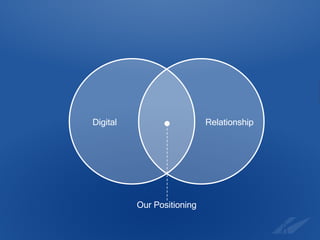
Our Positioning Digital Relationship
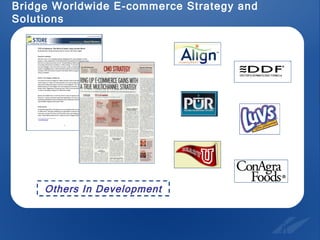
Bridge Worldwide E-commerce Strategy and Solutions Others In Development
Looking Forward By Looking Back
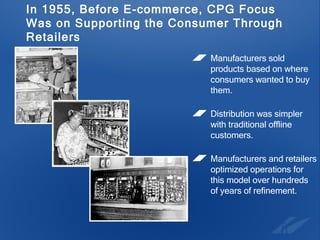
In 1955, Before E-commerce, CPG Focus Was on Supporting the Consumer Through Retailers Manufacturers sold products based on where consumers wanted to buy them. Distribution was simpler with traditional offline customers. Manufacturers and retailers optimized operations for this model over hundreds of years of refinement.
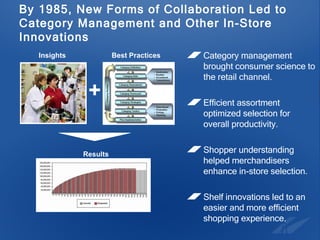
By 1985, New Forms of Collaboration Led to Category Management and Other In-Store Innovations Category management brought consumer science to the retail channel. Efficient assortment optimized selection for overall productivity. Shopper understanding helped merchandisers enhance in-store selection. Shelf innovations led to an  easier and more efficient shopping experience. Insights Best Practices + Results
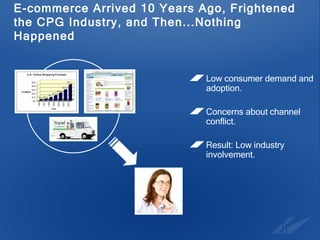
E-commerce Arrived 10 Years Ago, Frightened the CPG Industry, and Then...Nothing Happened Low consumer demand and adoption. Concerns about channel conflict. Result: Low industry involvement.
Since Then,  E-commerce Has Come To Mean More Than PC’s, Books and Tickets… Online Home & Garden, Food & Beverage, Child & Baby Care are $1B markets.
In Fact, A Strange Thing Has Occurred -  US CPG E-commerce Is Now a $12B market More consumers are getting online, researching online, and buying online. Early-adopter consumers buying even more categories, for very important reasons Traditional retailers starting to get it. *Includes baby products, cosmetics, fragrances, food, medicine, personal care, home care, pet supplies. Source: 2006 Forrester Research, 2007 Bernstein, Bridge Analysis More Consumers… Number of US E-commerce Households (MM) ..Buying More CPG Products… Total US CPG E-commerce Sales ($B) 10 15 Food + Beverage Baby All Others ..From More Customers Total US E-commerce Sales by Vendor, % $125MM Amazon.com Traditional Retailers All Others 100%=$90MM
2008: What’s The “Right” Way  To Approach E-commerce?  A Few Winning Strategies
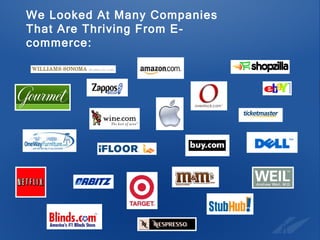
We Looked At Many Companies That Are Thriving From E-commerce:
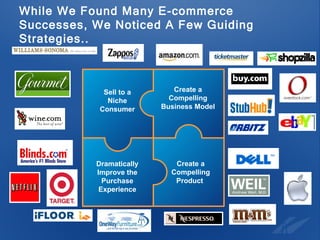
While We Found Many E-commerce Successes, We Noticed A Few Guiding Strategies.. Create a Compelling Product  Dramatically Improve the Purchase Experience Create a Compelling Business Model Sell to a Niche Consumer
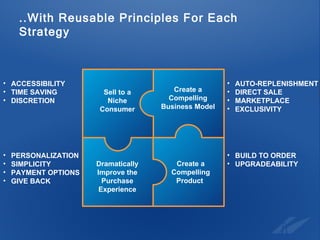
..With Reusable Principles For Each Strategy Create a Compelling Product  Dramatically Improve the Purchase Experience Create a Compelling Business Model Sell to a Niche Consumer ACCESSIBILITY TIME SAVING DISCRETION AUTO-REPLENISHMENT  DIRECT SALE MARKETPLACE EXCLUSIVITY BUILD TO ORDER UPGRADEABILITY PERSONALIZATION SIMPLICITY PAYMENT OPTIONS GIVE BACK
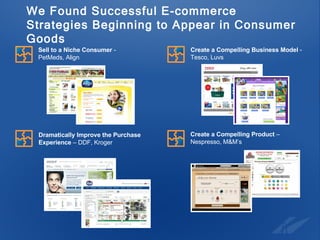
We Found Successful E-commerce Strategies Beginning to Appear in Consumer Goods Create a Compelling Product  –  Nespresso, M&M’s Sell to a Niche Consumer  -  PetMeds, Align Create a Compelling Business Model  -  Tesco, Luvs Dramatically Improve the Purchase  Experience  – DDF, Kroger
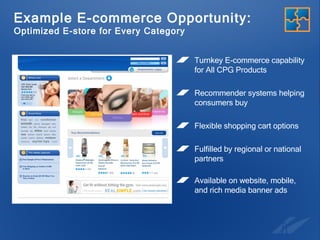
Example E-commerce Opportunity:  Optimized E-store for Every Category Turnkey E-commerce capability for All CPG Products Recommender systems helping consumers buy Flexible shopping cart options Fulfilled by regional or national partners Available on website, mobile, and rich media banner ads
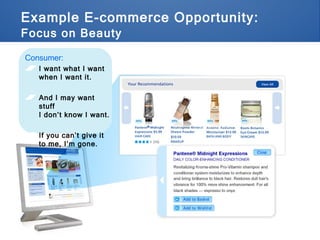
Example E-commerce Opportunity:  Focus on Beauty   Consumer:  I want what I want when I want it.  And I may want stuff  I don’t know I want. If you can’t give it to me, I’m gone.
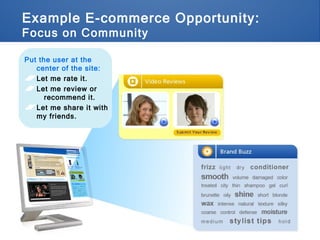
Example E-commerce Opportunity:  Focus on Community Put the user at the center of the site: Let me rate it. Let me review or    recommend it. Let me share it with my friends.
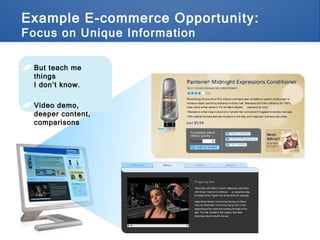
Example E-commerce Opportunity:  Focus on Unique Information But teach me things  I don’t know. Video demo, deeper content, comparisons
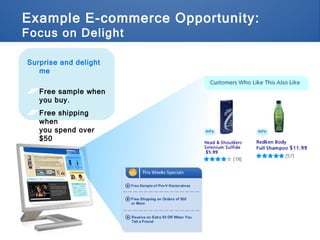
Example E-commerce Opportunity:  Focus on Delight Surprise and delight me Free sample when  you buy. Free shipping when  you spend over $50
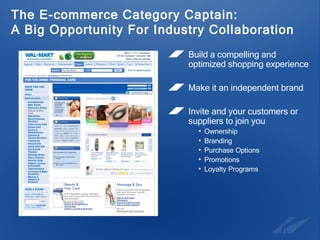
The E-commerce Category Captain:  A Big Opportunity For Industry Collaboration Build a compelling and optimized shopping experience Make it an independent brand Invite and your customers or suppliers to join you Ownership Branding Purchase Options Promotions Loyalty Programs
Great, You’ve Got a Category Model.  Now What?  Multi-Channel Integration
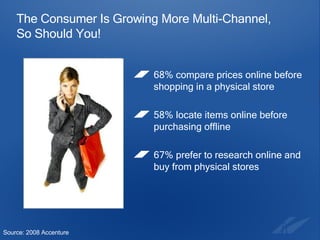
The Consumer Is Growing More Multi-Channel, So Should You! 68% compare prices online before shopping in a physical store  58% locate items online before purchasing offline  67% prefer to research online and buy from physical stores  Source: 2008 Accenture
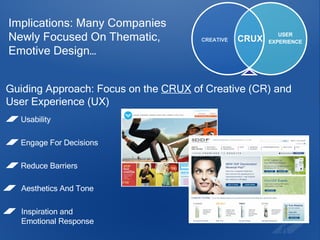
Implications: Many Companies Newly Focused On Thematic, Emotive Design… Guiding Approach: Focus on the  CRUX  of Creative (CR) and User Experience (UX) Usability Engage For Decisions Reduce Barriers USER EXPERIENCE CREATIVE CRUX Aesthetics And Tone Inspiration and Emotional Response
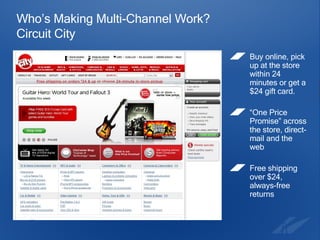
Who’s Making Multi-Channel Work?  Circuit City Buy online, pick up at the store within 24 minutes or get a $24 gift card.  “ One Price Promise” across the store, direct-mail and the web Free shipping over $24, always-free returns
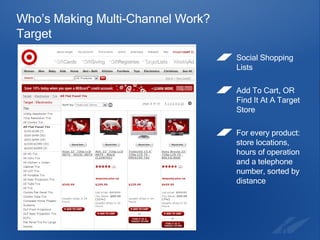
Who’s Making Multi-Channel Work?  Target Social Shopping Lists Add To Cart, OR Find It At A Target Store For every product: store locations, hours of operation and a telephone number, sorted by distance
Where We Are Headed Next?
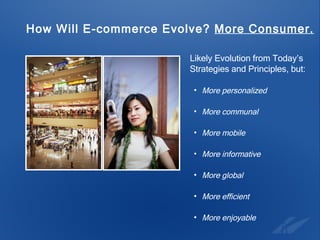
How Will E-commerce Evolve?  More Consumer.   Likely Evolution from Today’s Strategies and Principles, but: More personalized More communal More mobile More informative More global More efficient More enjoyable
How To Get In: Our Recommended Approach Make a new pledge: Support the market with shopper insights in every brand and channel. Address specific E-commerce segments with best-practice business models, promotions, and products Apply the Four Strategies: Niche Consumer, Business Model, Product, Purchase Experience Foster brand-retailer collaboration via the Category Captain model, by sharing consumer insights and optimized e-store properties. Remember CRUX Lead with Web 2.0 (it’s not your E-commerce engine, it’s the consumers’)
Thank You!
Backup
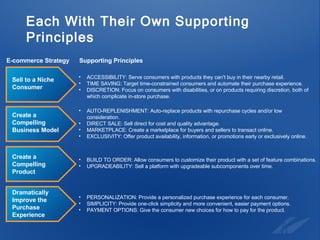
Each With Their Own Supporting Principles ACCESSIBILITY: Serve consumers with products they can't buy in their nearby retail. TIME SAVING: Target time-constrained consumers and automate their purchase experience. DISCRETION: Focus on consumers with disabilities, or on products requiring discretion, both of which complicate in-store purchase. AUTO-REPLENISHMENT: Auto-replace products with repurchase cycles and/or low consideration. DIRECT SALE: Sell direct for cost and quality advantage. MARKETPLACE: Create a marketplace for buyers and sellers to transact online. EXCLUSIVITY: Offer product availability, information, or promotions early or exclusively online. BUILD TO ORDER: Allow consumers to customize their product with a set of feature combinations. UPGRADEABILITY: Sell a platform with upgradeable subcomponents over time. PERSONALIZATION: Provide a personalized purchase experience for each consumer. SIMPLICITY: Provide one-click simplicity and more convenient, easier payment options. PAYMENT OPTIONS: Give the consumer new choices for how to pay for the product. Sell to a Niche Consumer Create a Compelling Business Model Create a Compelling Product  Dramatically Improve the Purchase Experience  E-commerce Strategy Supporting Principles
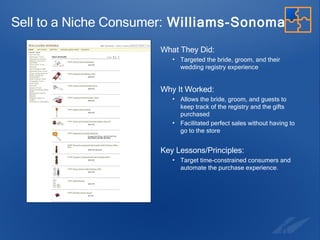
Sell to a Niche Consumer:  Williams-Sonoma What They Did:   Targeted the bride, groom, and their wedding registry experience Why It Worked: Allows the bride, groom, and guests to keep track of the registry and the gifts purchased  Facilitated perfect sales without having to go to the store Key Lessons/Principles: Target time-constrained consumers and automate the purchase experience.
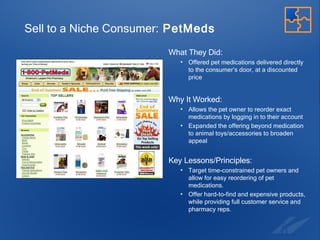
Sell to a Niche Consumer:  PetMeds What They Did:   Offered pet medications delivered directly to the consumer’s door, at a discounted price Why It Worked: Allows the pet owner to reorder exact medications by logging in to their account Expanded the offering beyond medication to animal toys/accessories to broaden appeal  Key Lessons/Principles: Target time-constrained pet owners and allow for easy reordering of pet medications. Offer hard-to-find and expensive products, while providing full customer service and pharmacy reps.
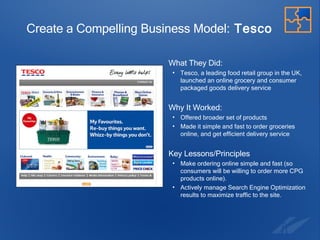
Create a Compelling Business Model:  Tesco What They Did:  Tesco, a leading food retail group in the UK, launched an online grocery and consumer packaged goods delivery service Why It Worked: Offered broader set of products Made it simple and fast to order groceries online, and get efficient delivery service Key Lessons/Principles Make ordering online simple and fast (so consumers will be willing to order more CPG products online). Actively manage Search Engine Optimization results to maximize traffic to the site.
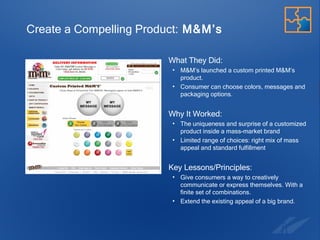
Create a Compelling Product:  M&M’s What They Did:  M&M’s launched a custom printed M&M’s product.  Consumer can choose colors, messages and packaging options. Why It Worked:  The uniqueness and surprise of a customized product inside a mass-market brand  Limited range of choices: right mix of mass appeal and standard fulfillment Key Lessons/Principles: Give consumers a way to creatively communicate or express themselves. With a finite set of combinations. Extend the existing appeal of a big brand.
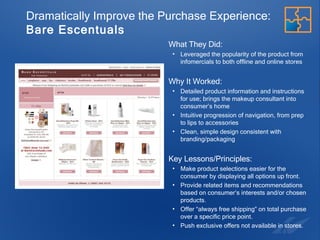
Dramatically Improve the Purchase Experience:   Bare Escentuals What They Did:  Leveraged the popularity of the product from infomercials to both offline and online stores Why It Worked:  Detailed product information and instructions for use; brings the makeup consultant into consumer’s home Intuitive progression of navigation, from prep to lips to accessories Clean, simple design consistent with branding/packaging Key Lessons/Principles: Make product selections easier for the consumer by displaying all options up front. Provide related items and recommendations based on consumer’s interests and/or chosen products. Offer “always free shipping” on total purchase over a specific price point. Push exclusive offers not available in stores.
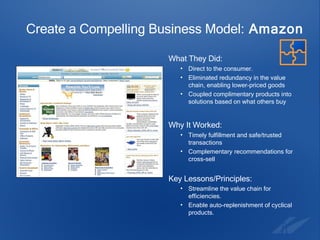
Create a Compelling Business Model:  Amazon What They Did:   Direct to the consumer. Eliminated redundancy in the value chain, enabling lower-priced goods Coupled complimentary products into solutions based on what others buy Why It Worked:   Timely fulfillment and safe/trusted transactions  Complementary recommendations for cross-sell Key Lessons/Principles: Streamline the value chain for efficiencies. Enable auto-replenishment of cyclical products.
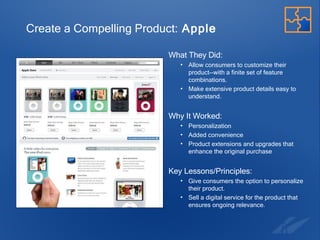
Create a Compelling Product:  Apple What They Did:  Allow consumers to customize their product--with a finite set of feature combinations. Make extensive product details easy to understand.  Why It Worked:   Personalization Added convenience Product extensions and upgrades that enhance the original purchase Key Lessons/Principles: Give consumers the option to personalize their product. Sell a digital service for the product that ensures ongoing relevance.
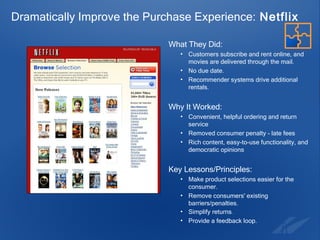
Dramatically Improve the Purchase Experience:  Netflix What They Did:  Customers subscribe and rent online, and movies are delivered through the mail. No due date. Recommender systems drive additional rentals. Why It Worked:  Convenient, helpful ordering and return service Removed consumer penalty - late fees Rich content, easy-to-use functionality, and democratic opinions Key Lessons/Principles: Make product selections easier for the consumer. Remove consumers' existing barriers/penalties. Simplify returns . Provide a feedback loop.
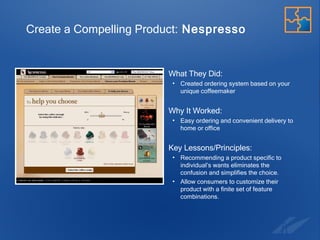
Create a Compelling Product:  Nespresso What They Did:  Created ordering system based on your unique coffeemaker Why It Worked:  Easy ordering and convenient delivery to home or office Key Lessons/Principles: Recommending a product specific to individual’s wants eliminates the confusion and simplifies the choice. Allow consumers to customize their product with a finite set of feature combinations.
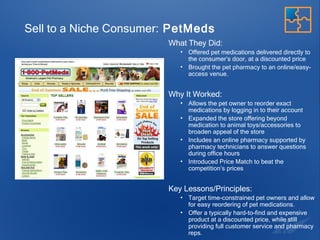
Sell to a Niche Consumer:  PetMeds What They Did:   Offered pet medications delivered directly to the consumer’s door, at a discounted price Brought the pet pharmacy to an online/easy-access venue. Why It Worked: Allows the pet owner to reorder exact medications by logging in to their account Expanded the store offering beyond medication to animal toys/accessories to broaden appeal of the store Includes an online pharmacy supported by pharmacy technicians to answer questions during office hours Introduced Price Match to beat the competition’s prices Key Lessons/Principles: Target time-constrained pet owners and allow for easy reordering of pet medications. Offer a typically hard-to-find and expensive product at a discounted price, while still providing full customer service and pharmacy reps.
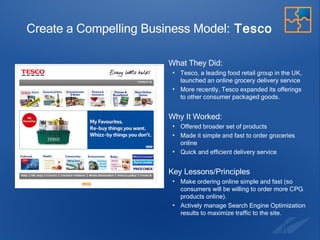
Create a Compelling Business Model:  Tesco What They Did:  Tesco, a leading food retail group in the UK, launched an online grocery delivery service More recently, Tesco expanded its offerings to other consumer packaged goods. Why It Worked: Offered broader set of products Made it simple and fast to order groceries online Quick and efficient delivery service Key Lessons/Principles Make ordering online simple and fast (so consumers will be willing to order more CPG products online). Actively manage Search Engine Optimization results to maximize traffic to the site.
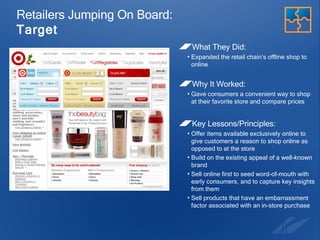
Retailers Jumping On Board:  Target What They Did:  Expanded the retail chain’s offline shop to online Why It Worked: Gave consumers a convenient way to shop at their favorite store and compare prices Key Lessons/Principles: Offer items available exclusively online to  give customers a reason to shop online as opposed to at the store Build on the existing appeal of a well-known brand Sell online first to seed word-of-mouth with early consumers, and to capture key insights from them Sell products that have an embarrassment factor associated with an in-store purchase
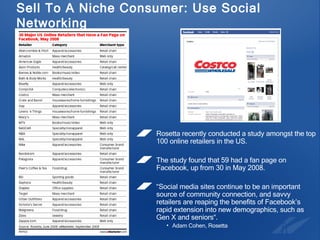
Sell To A Niche Consumer: Use Social Networking Rosetta recently conducted a study amongst the top 100 online retailers in the US.  The study found that 59 had a fan page on Facebook, up from 30 in May 2008.  “ Social media sites continue to be an important source of community connection, and savvy retailers are reaping the benefits of Facebook’s rapid extension into new demographics, such as Gen X and seniors“.  Adam Cohen, Rosetta

Two Worlds Collide: Bringing the Category Captain Model to E-commerce

  • 1.
    Two Worlds CollideBringing the Category Captain Model to E-commerce Michael Stich Bridge Worldwide November 12 th , 2008
  • 2.
    E-commerce Agenda IntroductionThe History of E-commerce, and Why It Matters Today Who’s Succeeding and Why The Big Opportunity For The Future
  • 3.
  • 4.
    Top 25 BestSmall Companies to Work for in America (2006, 2007, and 2008) Part of WPP Group, the largest agency holding company in the world with 2,000 offices in 106 countries. Affiliation: 200 people including Creative, Technology, Research, Strategy, Experience Planning and Account Service. Employee Makeup: Cincinnati Headquarters: 1979 Founded:
  • 5.
  • 6.
    Bridge Worldwide E-commerceStrategy and Solutions Others In Development
  • 7.
    Looking Forward ByLooking Back
  • 8.
    In 1955, BeforeE-commerce, CPG Focus Was on Supporting the Consumer Through Retailers Manufacturers sold products based on where consumers wanted to buy them. Distribution was simpler with traditional offline customers. Manufacturers and retailers optimized operations for this model over hundreds of years of refinement.
  • 9.
    By 1985, NewForms of Collaboration Led to Category Management and Other In-Store Innovations Category management brought consumer science to the retail channel. Efficient assortment optimized selection for overall productivity. Shopper understanding helped merchandisers enhance in-store selection. Shelf innovations led to an easier and more efficient shopping experience. Insights Best Practices + Results
  • 10.
    E-commerce Arrived 10Years Ago, Frightened the CPG Industry, and Then...Nothing Happened Low consumer demand and adoption. Concerns about channel conflict. Result: Low industry involvement.
  • 11.
    Since Then, E-commerce Has Come To Mean More Than PC’s, Books and Tickets… Online Home & Garden, Food & Beverage, Child & Baby Care are $1B markets.
  • 12.
    In Fact, AStrange Thing Has Occurred - US CPG E-commerce Is Now a $12B market More consumers are getting online, researching online, and buying online. Early-adopter consumers buying even more categories, for very important reasons Traditional retailers starting to get it. *Includes baby products, cosmetics, fragrances, food, medicine, personal care, home care, pet supplies. Source: 2006 Forrester Research, 2007 Bernstein, Bridge Analysis More Consumers… Number of US E-commerce Households (MM) ..Buying More CPG Products… Total US CPG E-commerce Sales ($B) 10 15 Food + Beverage Baby All Others ..From More Customers Total US E-commerce Sales by Vendor, % $125MM Amazon.com Traditional Retailers All Others 100%=$90MM
  • 13.
    2008: What’s The“Right” Way To Approach E-commerce? A Few Winning Strategies
  • 14.
    We Looked AtMany Companies That Are Thriving From E-commerce:
  • 15.
    While We FoundMany E-commerce Successes, We Noticed A Few Guiding Strategies.. Create a Compelling Product Dramatically Improve the Purchase Experience Create a Compelling Business Model Sell to a Niche Consumer
  • 16.
    ..With Reusable PrinciplesFor Each Strategy Create a Compelling Product Dramatically Improve the Purchase Experience Create a Compelling Business Model Sell to a Niche Consumer ACCESSIBILITY TIME SAVING DISCRETION AUTO-REPLENISHMENT DIRECT SALE MARKETPLACE EXCLUSIVITY BUILD TO ORDER UPGRADEABILITY PERSONALIZATION SIMPLICITY PAYMENT OPTIONS GIVE BACK
  • 17.
    We Found SuccessfulE-commerce Strategies Beginning to Appear in Consumer Goods Create a Compelling Product – Nespresso, M&M’s Sell to a Niche Consumer - PetMeds, Align Create a Compelling Business Model - Tesco, Luvs Dramatically Improve the Purchase Experience – DDF, Kroger
  • 18.
    Example E-commerce Opportunity: Optimized E-store for Every Category Turnkey E-commerce capability for All CPG Products Recommender systems helping consumers buy Flexible shopping cart options Fulfilled by regional or national partners Available on website, mobile, and rich media banner ads
  • 19.
    Example E-commerce Opportunity: Focus on Beauty Consumer: I want what I want when I want it. And I may want stuff I don’t know I want. If you can’t give it to me, I’m gone.
  • 20.
    Example E-commerce Opportunity: Focus on Community Put the user at the center of the site: Let me rate it. Let me review or recommend it. Let me share it with my friends.
  • 21.
    Example E-commerce Opportunity: Focus on Unique Information But teach me things I don’t know. Video demo, deeper content, comparisons
  • 22.
    Example E-commerce Opportunity: Focus on Delight Surprise and delight me Free sample when you buy. Free shipping when you spend over $50
  • 23.
    The E-commerce CategoryCaptain: A Big Opportunity For Industry Collaboration Build a compelling and optimized shopping experience Make it an independent brand Invite and your customers or suppliers to join you Ownership Branding Purchase Options Promotions Loyalty Programs
  • 24.
    Great, You’ve Gota Category Model. Now What? Multi-Channel Integration
  • 25.
    The Consumer IsGrowing More Multi-Channel, So Should You! 68% compare prices online before shopping in a physical store 58% locate items online before purchasing offline 67% prefer to research online and buy from physical stores Source: 2008 Accenture
  • 26.
    Implications: Many CompaniesNewly Focused On Thematic, Emotive Design… Guiding Approach: Focus on the CRUX of Creative (CR) and User Experience (UX) Usability Engage For Decisions Reduce Barriers USER EXPERIENCE CREATIVE CRUX Aesthetics And Tone Inspiration and Emotional Response
  • 27.
    Who’s Making Multi-ChannelWork? Circuit City Buy online, pick up at the store within 24 minutes or get a $24 gift card. “ One Price Promise” across the store, direct-mail and the web Free shipping over $24, always-free returns
  • 28.
    Who’s Making Multi-ChannelWork? Target Social Shopping Lists Add To Cart, OR Find It At A Target Store For every product: store locations, hours of operation and a telephone number, sorted by distance
  • 29.
    Where We AreHeaded Next?
  • 30.
    How Will E-commerceEvolve? More Consumer. Likely Evolution from Today’s Strategies and Principles, but: More personalized More communal More mobile More informative More global More efficient More enjoyable
  • 31.
    How To GetIn: Our Recommended Approach Make a new pledge: Support the market with shopper insights in every brand and channel. Address specific E-commerce segments with best-practice business models, promotions, and products Apply the Four Strategies: Niche Consumer, Business Model, Product, Purchase Experience Foster brand-retailer collaboration via the Category Captain model, by sharing consumer insights and optimized e-store properties. Remember CRUX Lead with Web 2.0 (it’s not your E-commerce engine, it’s the consumers’)
  • 32.
  • 33.
  • 34.
    Each With TheirOwn Supporting Principles ACCESSIBILITY: Serve consumers with products they can't buy in their nearby retail. TIME SAVING: Target time-constrained consumers and automate their purchase experience. DISCRETION: Focus on consumers with disabilities, or on products requiring discretion, both of which complicate in-store purchase. AUTO-REPLENISHMENT: Auto-replace products with repurchase cycles and/or low consideration. DIRECT SALE: Sell direct for cost and quality advantage. MARKETPLACE: Create a marketplace for buyers and sellers to transact online. EXCLUSIVITY: Offer product availability, information, or promotions early or exclusively online. BUILD TO ORDER: Allow consumers to customize their product with a set of feature combinations. UPGRADEABILITY: Sell a platform with upgradeable subcomponents over time. PERSONALIZATION: Provide a personalized purchase experience for each consumer. SIMPLICITY: Provide one-click simplicity and more convenient, easier payment options. PAYMENT OPTIONS: Give the consumer new choices for how to pay for the product. Sell to a Niche Consumer Create a Compelling Business Model Create a Compelling Product Dramatically Improve the Purchase Experience E-commerce Strategy Supporting Principles
  • 35.
    Sell to aNiche Consumer: Williams-Sonoma What They Did: Targeted the bride, groom, and their wedding registry experience Why It Worked: Allows the bride, groom, and guests to keep track of the registry and the gifts purchased Facilitated perfect sales without having to go to the store Key Lessons/Principles: Target time-constrained consumers and automate the purchase experience.
  • 36.
    Sell to aNiche Consumer: PetMeds What They Did: Offered pet medications delivered directly to the consumer’s door, at a discounted price Why It Worked: Allows the pet owner to reorder exact medications by logging in to their account Expanded the offering beyond medication to animal toys/accessories to broaden appeal Key Lessons/Principles: Target time-constrained pet owners and allow for easy reordering of pet medications. Offer hard-to-find and expensive products, while providing full customer service and pharmacy reps.
  • 37.
    Create a CompellingBusiness Model: Tesco What They Did: Tesco, a leading food retail group in the UK, launched an online grocery and consumer packaged goods delivery service Why It Worked: Offered broader set of products Made it simple and fast to order groceries online, and get efficient delivery service Key Lessons/Principles Make ordering online simple and fast (so consumers will be willing to order more CPG products online). Actively manage Search Engine Optimization results to maximize traffic to the site.
  • 38.
    Create a CompellingProduct: M&M’s What They Did: M&M’s launched a custom printed M&M’s product. Consumer can choose colors, messages and packaging options. Why It Worked: The uniqueness and surprise of a customized product inside a mass-market brand Limited range of choices: right mix of mass appeal and standard fulfillment Key Lessons/Principles: Give consumers a way to creatively communicate or express themselves. With a finite set of combinations. Extend the existing appeal of a big brand.
  • 39.
    Dramatically Improve thePurchase Experience: Bare Escentuals What They Did: Leveraged the popularity of the product from infomercials to both offline and online stores Why It Worked: Detailed product information and instructions for use; brings the makeup consultant into consumer’s home Intuitive progression of navigation, from prep to lips to accessories Clean, simple design consistent with branding/packaging Key Lessons/Principles: Make product selections easier for the consumer by displaying all options up front. Provide related items and recommendations based on consumer’s interests and/or chosen products. Offer “always free shipping” on total purchase over a specific price point. Push exclusive offers not available in stores.
  • 40.
    Create a CompellingBusiness Model: Amazon What They Did: Direct to the consumer. Eliminated redundancy in the value chain, enabling lower-priced goods Coupled complimentary products into solutions based on what others buy Why It Worked: Timely fulfillment and safe/trusted transactions Complementary recommendations for cross-sell Key Lessons/Principles: Streamline the value chain for efficiencies. Enable auto-replenishment of cyclical products.
  • 41.
    Create a CompellingProduct: Apple What They Did: Allow consumers to customize their product--with a finite set of feature combinations. Make extensive product details easy to understand. Why It Worked: Personalization Added convenience Product extensions and upgrades that enhance the original purchase Key Lessons/Principles: Give consumers the option to personalize their product. Sell a digital service for the product that ensures ongoing relevance.
  • 42.
    Dramatically Improve thePurchase Experience: Netflix What They Did: Customers subscribe and rent online, and movies are delivered through the mail. No due date. Recommender systems drive additional rentals. Why It Worked: Convenient, helpful ordering and return service Removed consumer penalty - late fees Rich content, easy-to-use functionality, and democratic opinions Key Lessons/Principles: Make product selections easier for the consumer. Remove consumers' existing barriers/penalties. Simplify returns . Provide a feedback loop.
  • 43.
    Create a CompellingProduct: Nespresso What They Did: Created ordering system based on your unique coffeemaker Why It Worked: Easy ordering and convenient delivery to home or office Key Lessons/Principles: Recommending a product specific to individual’s wants eliminates the confusion and simplifies the choice. Allow consumers to customize their product with a finite set of feature combinations.
  • 44.
    Sell to aNiche Consumer: PetMeds What They Did: Offered pet medications delivered directly to the consumer’s door, at a discounted price Brought the pet pharmacy to an online/easy-access venue. Why It Worked: Allows the pet owner to reorder exact medications by logging in to their account Expanded the store offering beyond medication to animal toys/accessories to broaden appeal of the store Includes an online pharmacy supported by pharmacy technicians to answer questions during office hours Introduced Price Match to beat the competition’s prices Key Lessons/Principles: Target time-constrained pet owners and allow for easy reordering of pet medications. Offer a typically hard-to-find and expensive product at a discounted price, while still providing full customer service and pharmacy reps.
  • 45.
    Create a CompellingBusiness Model: Tesco What They Did: Tesco, a leading food retail group in the UK, launched an online grocery delivery service More recently, Tesco expanded its offerings to other consumer packaged goods. Why It Worked: Offered broader set of products Made it simple and fast to order groceries online Quick and efficient delivery service Key Lessons/Principles Make ordering online simple and fast (so consumers will be willing to order more CPG products online). Actively manage Search Engine Optimization results to maximize traffic to the site.
  • 46.
    Retailers Jumping OnBoard: Target What They Did: Expanded the retail chain’s offline shop to online Why It Worked: Gave consumers a convenient way to shop at their favorite store and compare prices Key Lessons/Principles: Offer items available exclusively online to give customers a reason to shop online as opposed to at the store Build on the existing appeal of a well-known brand Sell online first to seed word-of-mouth with early consumers, and to capture key insights from them Sell products that have an embarrassment factor associated with an in-store purchase
  • 47.
    Sell To ANiche Consumer: Use Social Networking Rosetta recently conducted a study amongst the top 100 online retailers in the US. The study found that 59 had a fan page on Facebook, up from 30 in May 2008. “ Social media sites continue to be an important source of community connection, and savvy retailers are reaping the benefits of Facebook’s rapid extension into new demographics, such as Gen X and seniors“. Adam Cohen, Rosetta