TWO HITS THEORY
Dr Sitaram Swain
Perhaps the most important question in cancer biology is
what causes the cellular alterations that produce a cancer.
A cancerous growth has a number of predictable
properties.
The incidence rates of various cancers are strongly related
to environmental factors and lifestyle, and cancers have
certain growth characteristics, among which are the
abilities to grow in an uncontrolled manner, invade
surrounding tissues, and metastasize.
In most cases cancer is a disease of aging. The
average age at diagnosis is over 65 and malignant
cancers arise from a lifetime accumulation of ‘‘hits’’
on a person’s DNA.
These hits may result from genetic susceptibility to
environmental agents such as chemicals; radiation;
or viral, bacterial, or parasitic infections; or from
endogenously generated agents such as oxygen
radicals.
It is often said that we would all get cancer if we
lived long enough.
THE THEORY OF ‘‘HITS’’
With the exception of childhood malignancies such as
leukemias and sarcomas that occur in children, cancer
incidence increases with age. Most of the common adult
solid tumors begin to increase after age 45 and go up
logarithmically with age.
Most of these hits are thought to be mutational in origin and
to result from chromosomal damage or base changes in
DNA.
In chronic myleogenous leukemia (CML), there is an
inciting chromosomal translocation that involves a
piece of chromosome 22 being lost. This was first
observed by Nowell and Hungerford, who named this
small chromosome the Philadelphia chromosome.
It was later shown by Rowley that this was a
reciprocal translocation between chromosomes 9 and
22, which produces a chimeric protein called Bcr/Abl
that is a constitutively active tyrosine kinase
promoting cell proliferation.
Thus, CML appears to be triggered by this one-hit
event and is probably the reason why the drug
Gleevec, which targets this kinase, is effective as a
single agent in CML.
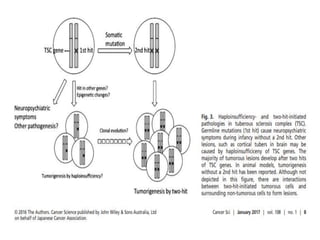
A second example is retinoblastoma. There are two
forms of this disease, hereditary and spontaneous.Both
forms appear to require two initiating genetic events,
leading Knudson, who studied this disease in detail, to
postulate the two-hit hypothesis.
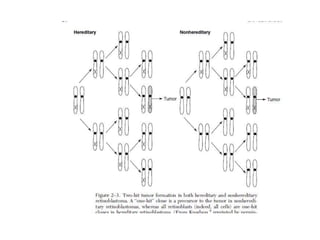
In the hereditary form, one genetic mutation is inherited
at birth and a second one occurs later . This must be the
case, since every cell in the eye contains the hereditary
mutation, but only three to four tumors on average
develop in a retinal cell population of several million
cells in affected individuals.
Knudson's analysis of the age specific incidence of
retinoblastoma led him to propose that two "hits" or
mutagenic events were necessary for retinoblastoma
development.
Retinoblastoma occurs sporadically in most cases, but in
some families it displays autosomal dominant inheritance.
In an individual with the inherited form of the disease,
Knudson proposed that the first hit is present in the
germline and thus in all cells of the body.
However, the presence of a mutation at the susceptibility
locus was argued to be insufficient for tumor formation,
and a second somatic mutation was hypothesized to be
necessary for promoting tumor formation.
On July 10, 2016, Alfred G. Knudson, Jr, died at the age
of 93 years. He was a man with great insight into cancer
genetics and a leader in the cancer research field.
He inspired many younger scientists to seek
understanding of the mechanisms of tumorigeneis,
especially the cell-of-origin of cancer, and to strive to
prevent this disease.
He was a personal mentor of this review’s author (O.H.)
as well as a valued adviser to cancer geneticists in
Japan.
Memorial figures for Knudson.
The cover of the special issue
of Genes Chromosomes &
Cancer on Knudson’s 80th
birthday (December 2003; vol.
38, issue 4, with the
permission of John Wiley &
Sons, Inc.).
Two hits theory.pptx

Two hits theory.pptx

  • 1.
    TWO HITS THEORY DrSitaram Swain
  • 2.
    Perhaps the mostimportant question in cancer biology is what causes the cellular alterations that produce a cancer. A cancerous growth has a number of predictable properties. The incidence rates of various cancers are strongly related to environmental factors and lifestyle, and cancers have certain growth characteristics, among which are the abilities to grow in an uncontrolled manner, invade surrounding tissues, and metastasize.
  • 3.
    In most casescancer is a disease of aging. The average age at diagnosis is over 65 and malignant cancers arise from a lifetime accumulation of ‘‘hits’’ on a person’s DNA. These hits may result from genetic susceptibility to environmental agents such as chemicals; radiation; or viral, bacterial, or parasitic infections; or from endogenously generated agents such as oxygen radicals. It is often said that we would all get cancer if we lived long enough.
  • 4.
    THE THEORY OF‘‘HITS’’ With the exception of childhood malignancies such as leukemias and sarcomas that occur in children, cancer incidence increases with age. Most of the common adult solid tumors begin to increase after age 45 and go up logarithmically with age. Most of these hits are thought to be mutational in origin and to result from chromosomal damage or base changes in DNA.
  • 5.
    In chronic myleogenousleukemia (CML), there is an inciting chromosomal translocation that involves a piece of chromosome 22 being lost. This was first observed by Nowell and Hungerford, who named this small chromosome the Philadelphia chromosome. It was later shown by Rowley that this was a reciprocal translocation between chromosomes 9 and 22, which produces a chimeric protein called Bcr/Abl that is a constitutively active tyrosine kinase promoting cell proliferation. Thus, CML appears to be triggered by this one-hit event and is probably the reason why the drug Gleevec, which targets this kinase, is effective as a single agent in CML.
  • 6.
    A second exampleis retinoblastoma. There are two forms of this disease, hereditary and spontaneous.Both forms appear to require two initiating genetic events, leading Knudson, who studied this disease in detail, to postulate the two-hit hypothesis. In the hereditary form, one genetic mutation is inherited at birth and a second one occurs later . This must be the case, since every cell in the eye contains the hereditary mutation, but only three to four tumors on average develop in a retinal cell population of several million cells in affected individuals.
  • 7.
    Knudson's analysis ofthe age specific incidence of retinoblastoma led him to propose that two "hits" or mutagenic events were necessary for retinoblastoma development. Retinoblastoma occurs sporadically in most cases, but in some families it displays autosomal dominant inheritance. In an individual with the inherited form of the disease, Knudson proposed that the first hit is present in the germline and thus in all cells of the body. However, the presence of a mutation at the susceptibility locus was argued to be insufficient for tumor formation, and a second somatic mutation was hypothesized to be necessary for promoting tumor formation.
  • 9.
    On July 10,2016, Alfred G. Knudson, Jr, died at the age of 93 years. He was a man with great insight into cancer genetics and a leader in the cancer research field. He inspired many younger scientists to seek understanding of the mechanisms of tumorigeneis, especially the cell-of-origin of cancer, and to strive to prevent this disease. He was a personal mentor of this review’s author (O.H.) as well as a valued adviser to cancer geneticists in Japan.
  • 10.
    Memorial figures forKnudson. The cover of the special issue of Genes Chromosomes & Cancer on Knudson’s 80th birthday (December 2003; vol. 38, issue 4, with the permission of John Wiley & Sons, Inc.).