Twitter Community Extraction
(Beware of geeks bearing .gifs?)
https://github.com/kingsBSD
http://big­social­data.net/
@kingsBSD
Our Data Ourselves Project:
Giles Greenway, Tobias Blanke, Jennifer Pybus & Mark Coté.
Departments of Digital Humanities &  Culture, Media & Creative 
Industries, King's College London
“Our aims are to increase our understanding of the nature 
and role of the data that young people produce when they 
use platforms and applications on their smartphones.”
Social network community extraction is part of this. 
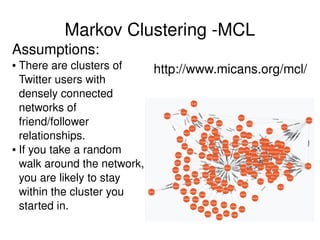
Markov Clustering ­MCL
Assumptions:
● There are clusters of 
Twitter users with 
densely connected 
networks of 
friend/follower 
relationships.
● If you take a random 
walk around the network, 
you are likely to stay 
within the cluster you 
started in.
http://www.micans.org/mcl/
MCL ­A Trivial Example
1: Build an adjacency matrix for the graph.
2: Normalize the columns to produce 
transition probabilities.
MCL ­A Trivial Example
3: Square the matrix to get probabilities 
after two steps.
MCL ­A Trivial Example
4: Element wise square the matrix and re­
normalize.
5: Rinse and repeat until convergence.
The matrix entries will be 0 or 1. Interpret 
rows as: “If I'm in this row node, which 
column nodes are credible start­points?” 
Does it work?
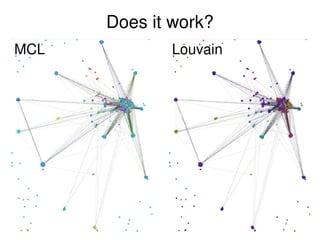
Gephi's “OpenOrd” layout is meant to 
emphasise clusters. Are nodes in the same 
cluster close together?
Compare with Gephi's own “modularity 
algorithm”, the Louvain method.
MCL was applied to two Twitter accounts of 
digital culture researchers with ~7000 once­
removed friend­follower relationships.
Does it work?
MCL Louvain
Does it work?
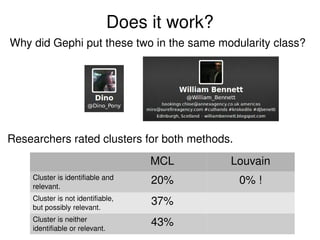
Why did Gephi put these two in the same modularity class?
Researchers rated clusters for both methods.
MCL Louvain
Cluster is identifiable and 
relevant.
20% 0% !
Cluster is not identifiable, 
but possibly relevant.
37%
Cluster is neither 
identifiable or relevant.
43%
Tools
● Acquire Twitter data with 
Twython/Celery/Redis/RabbbitMQ.
● Store Twitter data with: Neo4J/Py2Neo.
● Perform MCL with NumPy.
● Export to Gephi with NetworkX.
Conclusions
● The Louvain method works by combining smaller 
clusters to maximize modularity. Does the very high 
degree of Twitter networks harm its performance?
●  MCL produces highly relevant clusterings, albeit rather 
slowly.
Tools
● Acquire Twitter data with 
Twython/Celery/Redis/RabbbitMQ.
● Store Twitter data with: Neo4J/Py2Neo.
● Perform MCL with NumPy.
● Export to Gephi with NetworkX.
Conclusions
● The Louvain method works by combining smaller 
clusters to maximize modularity. Does the very high 
degree of Twitter networks harm its performance?
●  MCL produces highly relevant clusterings, albeit rather 
slowly.

Twitter Community Extraction by Markov Clustering