Twig in the Wild
Jeremy Koulish
August 24, 2018
Twig in the Wild
Jeremy Koulish
August 24, 2018
How to Work Drupal Templating Magic
Without Being a PHP Wizard
Why Twig?
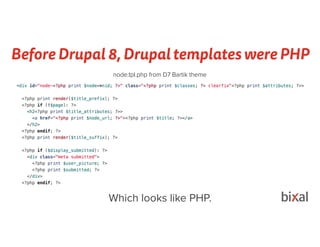
Before Drupal 8, Drupal templates were PHP
Which looks like PHP.
node.tpl.php from D7 Bartik theme
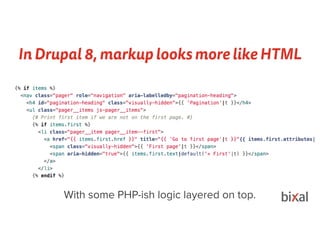
In Drupal 8, markup looks more like HTML
With some PHP-ish logic layered on top.
How to Twig
Using Twig
1. Create a custom theme piggybacking off a base theme
(usually “Classy” theme from core).
2. Trigger custom overrides by using specific filenames
within your custom theme’s “templates” folder.
• Those filenames are automagically determined and
prioritized by Twig.
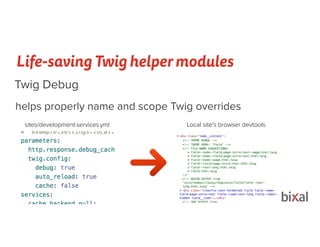
Life-saving Twig helper modules
Twig Debug
helps properly name and scope Twig overrides
sites/development.services.yml Local site’s browser devtools
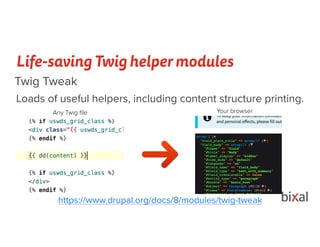
Life-saving Twig helper modules
Twig Tweak
Loads of useful helpers, including content structure printing.
https://www.drupal.org/docs/8/modules/twig-tweak
Any Twig file Your browser
That’s all nice…..
but what can you DO with Twig?
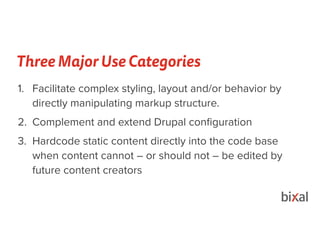
Three Major Use Categories
1. Facilitate complex styling, layout and/or behavior by
directly manipulating markup structure.
2. Complement and extend Drupal configuration
3. Hardcode static content directly into the code base
when content cannot – or should not – be edited by
future content creators
•
Use Type #1: Facilitate Complex
Theming and Behavior
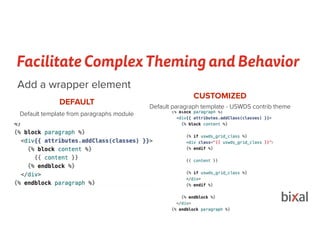
Facilitate Complex Theming and Behavior
Add a wrapper element
DEFAULT
CUSTOMIZED
Default template from paragraphs module
Default paragraph template - USWDS contrib theme
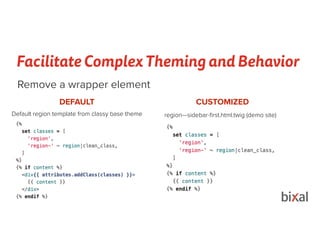
Facilitate Complex Theming and Behavior
Remove a wrapper element
DEFAULT CUSTOMIZED
Default region template from classy base theme region—sidebar-first.html.twig (demo site)
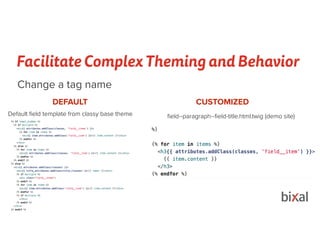
Facilitate Complex Theming and Behavior
Change a tag name
DEFAULT CUSTOMIZED
Default field template from classy base theme field--paragraph--field-title.html.twig (demo site)
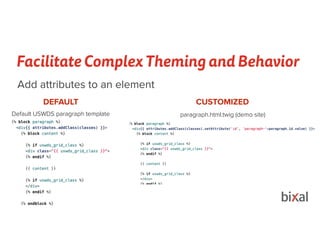
Facilitate Complex Theming and Behavior
Add attributes to an element
DEFAULT CUSTOMIZED
Default USWDS paragraph template paragraph.html.twig (demo site)
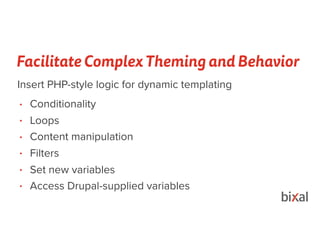
Facilitate Complex Theming and Behavior
• Conditionality
• Loops
• Content manipulation
• Filters
• Set new variables
• Access Drupal-supplied variables
Insert PHP-style logic for dynamic templating
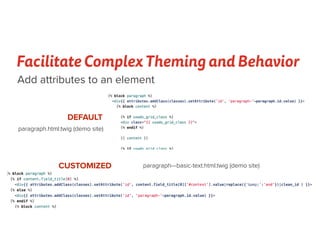
Facilitate Complex Theming and Behavior
Add attributes to an element
DEFAULT
CUSTOMIZED
paragraph.html.twig (demo site)
paragraph—basic-text.html.twig (demo site)
Use Type #2: Complement and
Extend Drupal Configuration
Complement/Extend Drupal Configuration
Editing display config through view modes can get very
complicated, very fast.
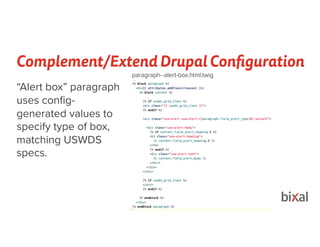
Complement/Extend Drupal Configuration
“Alert box” paragraph
uses config-
generated values to
specify type of box,
matching USWDS
specs.
paragraph--alert-box.html.twig
Use Type #3: Hardcode Content
Directly Into the Template
Hardcode Content Directly In the Template
• Hard for content creators/editors to parse.
• Not completely WYSIWYG in complex cases.
• Easy to delete content or internal markup, but much
harder to recover it.
• It already deviates from the Drupal Way.
Because sometimes, a WYSIWYG box just won’t cut it.
Hardcode Content Directly In the Template
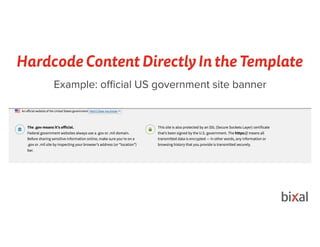
Example: official US government site banner
Hardcode Content Directly In the Template
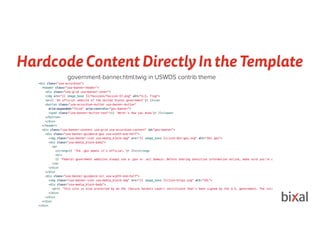
government-banner.html.twig in USWDS contrib theme
Hardcode Content Directly In the Template
Only hardcode content if you don’t
expect it to change anytime soon.
Or ever.
Conclusion
There is no one right way to Twig……but it’s a powerful tool.
USE IT RESPONSIBLY!
Resources
Twig Documentation:
https://twig.symfony.com/doc/1.x/
Twig Tweak docs:
https://www.drupal.org/docs/8/modules/twig-tweak
Presentation demo code:
https://github.com/jkoul/twiginthewild
Presentation demo site:
LINK TBD
Thank You!
jeremy.koulish@bixal.com
http://kouli.sh
http://www.bixal.com

Twig in the wild august 2018 drupal govcon draft

  • 1.
    Twig in theWild Jeremy Koulish August 24, 2018
  • 2.
    Twig in theWild Jeremy Koulish August 24, 2018 How to Work Drupal Templating Magic Without Being a PHP Wizard
  • 3.
  • 4.
    Before Drupal 8,Drupal templates were PHP Which looks like PHP. node.tpl.php from D7 Bartik theme
  • 5.
    In Drupal 8,markup looks more like HTML With some PHP-ish logic layered on top.
  • 6.
  • 7.
    Using Twig 1. Createa custom theme piggybacking off a base theme (usually “Classy” theme from core). 2. Trigger custom overrides by using specific filenames within your custom theme’s “templates” folder. • Those filenames are automagically determined and prioritized by Twig.
  • 8.
    Life-saving Twig helpermodules Twig Debug helps properly name and scope Twig overrides sites/development.services.yml Local site’s browser devtools
  • 9.
    Life-saving Twig helpermodules Twig Tweak Loads of useful helpers, including content structure printing. https://www.drupal.org/docs/8/modules/twig-tweak Any Twig file Your browser
  • 10.
    That’s all nice….. butwhat can you DO with Twig?
  • 11.
    Three Major UseCategories 1. Facilitate complex styling, layout and/or behavior by directly manipulating markup structure. 2. Complement and extend Drupal configuration 3. Hardcode static content directly into the code base when content cannot – or should not – be edited by future content creators •
  • 12.
    Use Type #1:Facilitate Complex Theming and Behavior
  • 13.
    Facilitate Complex Themingand Behavior Add a wrapper element DEFAULT CUSTOMIZED Default template from paragraphs module Default paragraph template - USWDS contrib theme
  • 14.
    Facilitate Complex Themingand Behavior Remove a wrapper element DEFAULT CUSTOMIZED Default region template from classy base theme region—sidebar-first.html.twig (demo site)
  • 15.
    Facilitate Complex Themingand Behavior Change a tag name DEFAULT CUSTOMIZED Default field template from classy base theme field--paragraph--field-title.html.twig (demo site)
  • 16.
    Facilitate Complex Themingand Behavior Add attributes to an element DEFAULT CUSTOMIZED Default USWDS paragraph template paragraph.html.twig (demo site)
  • 17.
    Facilitate Complex Themingand Behavior • Conditionality • Loops • Content manipulation • Filters • Set new variables • Access Drupal-supplied variables Insert PHP-style logic for dynamic templating
  • 18.
    Facilitate Complex Themingand Behavior Add attributes to an element DEFAULT CUSTOMIZED paragraph.html.twig (demo site) paragraph—basic-text.html.twig (demo site)
  • 19.
    Use Type #2:Complement and Extend Drupal Configuration
  • 20.
    Complement/Extend Drupal Configuration Editingdisplay config through view modes can get very complicated, very fast.
  • 21.
    Complement/Extend Drupal Configuration “Alertbox” paragraph uses config- generated values to specify type of box, matching USWDS specs. paragraph--alert-box.html.twig
  • 22.
    Use Type #3:Hardcode Content Directly Into the Template
  • 23.
    Hardcode Content DirectlyIn the Template • Hard for content creators/editors to parse. • Not completely WYSIWYG in complex cases. • Easy to delete content or internal markup, but much harder to recover it. • It already deviates from the Drupal Way. Because sometimes, a WYSIWYG box just won’t cut it.
  • 24.
    Hardcode Content DirectlyIn the Template Example: official US government site banner
  • 25.
    Hardcode Content DirectlyIn the Template government-banner.html.twig in USWDS contrib theme
  • 26.
    Hardcode Content DirectlyIn the Template Only hardcode content if you don’t expect it to change anytime soon. Or ever.
  • 27.
    Conclusion There is noone right way to Twig……but it’s a powerful tool. USE IT RESPONSIBLY!
  • 28.
    Resources Twig Documentation: https://twig.symfony.com/doc/1.x/ Twig Tweakdocs: https://www.drupal.org/docs/8/modules/twig-tweak Presentation demo code: https://github.com/jkoul/twiginthewild Presentation demo site: LINK TBD
  • 29.