Thriller Genre

   By Nuala McKevitt
Thrillers
The thriller genre in film is programming that creates tension, anticipation and
suspense. They do this so that the audiences’ mood is uncertain, the expectation is
always there and the eagerness of what's approaching is unbelievable. Thriller films
give people an adrenaline rush and they are often very fast paced.
Thriller movies rely on sound and editing. Also in thrillers black and white are also
conventions as they bring a more dark and gloomy feel to the movie. Lighting and
shadows are emphasised a lot in thrillers as well as mirrors and stairs due to the more
psychological approach.
The main aim for thrillers is to keep the audience on the edge of their seats and to
keep their eyes pealed on the film. They create a rush of moments and excitement
with the audience.
To distinguish a thriller movie from any other movie is usually if the film engages the
audience and plays with their mind. Music is essential as it builds up the tension and
the use of lighting helps to create shadows which gives a mystery feel towards the
thriller.
Sub-genres in film
• The thriller genre has many sub-genres and here are some of them:
•   Conspiracy Thriller - In which the hero/heroine confronts a large, authoritative group of enemies whose true
    extent who only they know of their bad qualities.
•   Crime thriller: This genre is a mixture of both crime films and thrillers that offers a gripping version of either failed
    or successful crimes. These films usually focus on the criminals in the film rather then the good people e.g.
    policemen.
•   Political Thriller: In which the hero/heroine must guarantee the strength of the management that pays him.
•   Psychological Thriller: Is when the war between the main characters is both mental and emotional, instead of
    physical. Characters somehow get themselves involved into dangerous situations whether its by their own choice
    or by accident. Characters are reliant on their mental skills over their physical strength to overcome their enemies.
    A lot of psychological films include the characters solving mysteries.
•   Spy Thriller: The central character is normally a government agent who must take violent action against agents of
    a rival government or (in recent years) terrorists. The subgenre usually deals with the subject of fictional
    espionage in a realistic way. It is a significant aspect of British cinema with leading British directors such as Alfred
    Hitchcock and Carol Reed making notable contributions and many films set in the British Secret Service. The spy
    film usually fuses the action and science fiction genres, however, some spy films fall safely in the action genre
    rather than thriller (i.e. James Bond), especially those having frequent shootouts and car chases.
•   Supernatural thriller: The film brings in an strange element e.g. fantasy and/or supernatural mixed with tension,
    suspense and plot twists. Sometimes the central character and/or villain has some psychic ability and
    superpowers.
•   Techno thriller: A suspense film where the use of refined technology plays a significant part. There is also a bit of
    action and science fiction involved.
Codes
Codes are systems of signs, which create meaning. Codes can be divided into two
categories – technical and symbolic:

• Technical codes –
Are all the ways in which equipment is used to tell the story of a media text, for
example the camera work in a film.

• Symbolic codes –
Show what is beneath the surface of what we see. For example, a characters actions
show you how the character is feeling.

Some codes can fit both categories for example music can be both technical and
symbolic.
Convections
Convections are the generally accepted ways of doing something. There are general
conventions in any medium, such as the interviewee quotes in a print article, but
conventions are also genre specific.


How do codes and convections apply in media studies?
Codes and convections are used together in any study of genre – it is not enough to
discuss a technical code used such as camera work, without saying how it is
conventionally used in a genre. For example, the technical code of lighting is used in
some way in all film genres. It is a convention of the horror genre that side and back
lighting is used to create mystery and suspense – an integral part of any horror movie.
Codes and Convections in Thrillers
Also in thrillers black and white are also conventions used as they bring a more dark
and gloomy feel to the movie. Lighting and shadows are emphasised a lot in thrillers
as well as mirrors and stairs due to the more psychological approach.
Mirrors are used are a convection by using a reflection of ones inner self, mirrors can
also signify darkness within some characters. Shadows are used to create suspense
and a sort of mysterious feel to a film. They can also be used to hide someone's
identity.
Flashbacks can create a sense of time, space and confusion to complicate the
audience. It’s a convection used in thrillers so it can give the audience an insight into
the characters past life. This tells them more about a character as it reveals more
about them.
Codes in thrillers are often fast paced camera angle changes as this creates tension
and suspense among the viewers.
Psycho
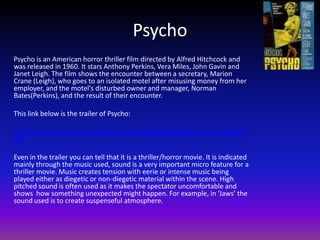
Psycho is an American horror thriller film directed by Alfred Hitchcock and
was released in 1960. It stars Anthony Perkins, Vera Miles, John Gavin and
Janet Leigh. The film shows the encounter between a secretary, Marion
Crane (Leigh), who goes to an isolated motel after misusing money from her
employer, and the motel's disturbed owner and manager, Norman
Bates(Perkins), and the result of their encounter.

This link below is the trailer of Psycho:

http://www.youtube.com/watch?v=Wz719b9QUqY&feature=fvwrel&safe=ac
tive

Even in the trailer you can tell that it is a thriller/horror movie. It is indicated
mainly through the music used, sound is a very important micro feature for a
thriller movie. Music creates tension with eerie or intense music being
played either as diegetic or non-diegetic material within the scene. High
pitched sound is often used as it makes the spectator uncomfortable and
shows how something unexpected might happen. For example, in ‘Jaws’ the
sound used is to create suspenseful atmosphere.
Alfred Hitchcock
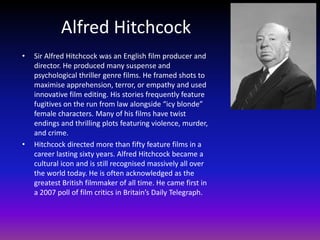
•   Sir Alfred Hitchcock was an English film producer and
    director. He produced many suspense and
    psychological thriller genre films. He framed shots to
    maximise apprehension, terror, or empathy and used
    innovative film editing. His stories frequently feature
    fugitives on the run from law alongside “icy blonde”
    female characters. Many of his films have twist
    endings and thrilling plots featuring violence, murder,
    and crime.
•   Hitchcock directed more than fifty feature films in a
    career lasting sixty years. Alfred Hitchcock became a
    cultural icon and is still recognised massively all over
    the world today. He is often acknowledged as the
    greatest British filmmaker of all time. He came first in
    a 2007 poll of film critics in Britain’s Daily Telegraph.
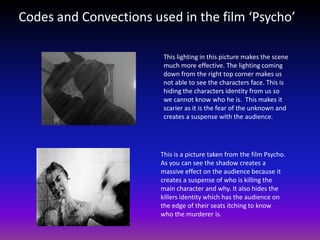
Codes and Convections used in the film ‘Psycho’

                         This lighting in this picture makes the scene
                         much more effective. The lighting coming
                         down from the right top corner makes us
                         not able to see the characters face. This is
                         hiding the characters identity from us so
                         we cannot know who he is. This makes it
                         scarier as it is the fear of the unknown and
                         creates a suspense with the audience.


                        This is a picture taken from the film Psycho.
                        As you can see the shadow creates a
                        massive effect on the audience because it
                        creates a suspense of who is killing the
                        main character and why. It also hides the
                        killers identity which has the audience on
                        the edge of their seats itching to know
                        who the murderer is.

Media – thriller genre

  • 1.
    Thriller Genre By Nuala McKevitt
  • 2.
    Thrillers The thriller genrein film is programming that creates tension, anticipation and suspense. They do this so that the audiences’ mood is uncertain, the expectation is always there and the eagerness of what's approaching is unbelievable. Thriller films give people an adrenaline rush and they are often very fast paced. Thriller movies rely on sound and editing. Also in thrillers black and white are also conventions as they bring a more dark and gloomy feel to the movie. Lighting and shadows are emphasised a lot in thrillers as well as mirrors and stairs due to the more psychological approach. The main aim for thrillers is to keep the audience on the edge of their seats and to keep their eyes pealed on the film. They create a rush of moments and excitement with the audience. To distinguish a thriller movie from any other movie is usually if the film engages the audience and plays with their mind. Music is essential as it builds up the tension and the use of lighting helps to create shadows which gives a mystery feel towards the thriller.
  • 3.
    Sub-genres in film •The thriller genre has many sub-genres and here are some of them: • Conspiracy Thriller - In which the hero/heroine confronts a large, authoritative group of enemies whose true extent who only they know of their bad qualities. • Crime thriller: This genre is a mixture of both crime films and thrillers that offers a gripping version of either failed or successful crimes. These films usually focus on the criminals in the film rather then the good people e.g. policemen. • Political Thriller: In which the hero/heroine must guarantee the strength of the management that pays him. • Psychological Thriller: Is when the war between the main characters is both mental and emotional, instead of physical. Characters somehow get themselves involved into dangerous situations whether its by their own choice or by accident. Characters are reliant on their mental skills over their physical strength to overcome their enemies. A lot of psychological films include the characters solving mysteries. • Spy Thriller: The central character is normally a government agent who must take violent action against agents of a rival government or (in recent years) terrorists. The subgenre usually deals with the subject of fictional espionage in a realistic way. It is a significant aspect of British cinema with leading British directors such as Alfred Hitchcock and Carol Reed making notable contributions and many films set in the British Secret Service. The spy film usually fuses the action and science fiction genres, however, some spy films fall safely in the action genre rather than thriller (i.e. James Bond), especially those having frequent shootouts and car chases. • Supernatural thriller: The film brings in an strange element e.g. fantasy and/or supernatural mixed with tension, suspense and plot twists. Sometimes the central character and/or villain has some psychic ability and superpowers. • Techno thriller: A suspense film where the use of refined technology plays a significant part. There is also a bit of action and science fiction involved.
  • 4.
    Codes Codes are systemsof signs, which create meaning. Codes can be divided into two categories – technical and symbolic: • Technical codes – Are all the ways in which equipment is used to tell the story of a media text, for example the camera work in a film. • Symbolic codes – Show what is beneath the surface of what we see. For example, a characters actions show you how the character is feeling. Some codes can fit both categories for example music can be both technical and symbolic.
  • 5.
    Convections Convections are thegenerally accepted ways of doing something. There are general conventions in any medium, such as the interviewee quotes in a print article, but conventions are also genre specific. How do codes and convections apply in media studies? Codes and convections are used together in any study of genre – it is not enough to discuss a technical code used such as camera work, without saying how it is conventionally used in a genre. For example, the technical code of lighting is used in some way in all film genres. It is a convention of the horror genre that side and back lighting is used to create mystery and suspense – an integral part of any horror movie.
  • 6.
    Codes and Convectionsin Thrillers Also in thrillers black and white are also conventions used as they bring a more dark and gloomy feel to the movie. Lighting and shadows are emphasised a lot in thrillers as well as mirrors and stairs due to the more psychological approach. Mirrors are used are a convection by using a reflection of ones inner self, mirrors can also signify darkness within some characters. Shadows are used to create suspense and a sort of mysterious feel to a film. They can also be used to hide someone's identity. Flashbacks can create a sense of time, space and confusion to complicate the audience. It’s a convection used in thrillers so it can give the audience an insight into the characters past life. This tells them more about a character as it reveals more about them. Codes in thrillers are often fast paced camera angle changes as this creates tension and suspense among the viewers.
  • 7.
    Psycho Psycho is anAmerican horror thriller film directed by Alfred Hitchcock and was released in 1960. It stars Anthony Perkins, Vera Miles, John Gavin and Janet Leigh. The film shows the encounter between a secretary, Marion Crane (Leigh), who goes to an isolated motel after misusing money from her employer, and the motel's disturbed owner and manager, Norman Bates(Perkins), and the result of their encounter. This link below is the trailer of Psycho: http://www.youtube.com/watch?v=Wz719b9QUqY&feature=fvwrel&safe=ac tive Even in the trailer you can tell that it is a thriller/horror movie. It is indicated mainly through the music used, sound is a very important micro feature for a thriller movie. Music creates tension with eerie or intense music being played either as diegetic or non-diegetic material within the scene. High pitched sound is often used as it makes the spectator uncomfortable and shows how something unexpected might happen. For example, in ‘Jaws’ the sound used is to create suspenseful atmosphere.
  • 8.
    Alfred Hitchcock • Sir Alfred Hitchcock was an English film producer and director. He produced many suspense and psychological thriller genre films. He framed shots to maximise apprehension, terror, or empathy and used innovative film editing. His stories frequently feature fugitives on the run from law alongside “icy blonde” female characters. Many of his films have twist endings and thrilling plots featuring violence, murder, and crime. • Hitchcock directed more than fifty feature films in a career lasting sixty years. Alfred Hitchcock became a cultural icon and is still recognised massively all over the world today. He is often acknowledged as the greatest British filmmaker of all time. He came first in a 2007 poll of film critics in Britain’s Daily Telegraph.
  • 9.
    Codes and Convectionsused in the film ‘Psycho’ This lighting in this picture makes the scene much more effective. The lighting coming down from the right top corner makes us not able to see the characters face. This is hiding the characters identity from us so we cannot know who he is. This makes it scarier as it is the fear of the unknown and creates a suspense with the audience. This is a picture taken from the film Psycho. As you can see the shadow creates a massive effect on the audience because it creates a suspense of who is killing the main character and why. It also hides the killers identity which has the audience on the edge of their seats itching to know who the murderer is.