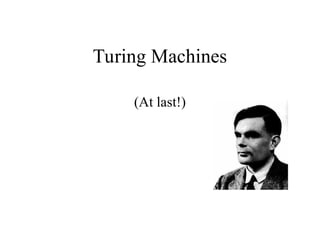
Designing Universal Computational
DevicesWas Not The Only
Contribution from Alan Turing…
Enter the year 1940:
•The world is at war
•Nazi Germany has succeeded in conquering most of west
Europe
•Britain is under siege
•British supply lines are threaten by German
•Germany used the Enigma Code, considered unbreakable
•Alan Turing led a group of scientist that broke the
enigma code
Enter the year 2006: The National Security Agency (NSA)
needs people! (www.nsa.gov)
3.
Background
•Automata accepts regularlanguages only
For example, {an
bn
: n = 0, 1, …} is not regular
•Pushdown Automata accepts context-free languages only
For example, {an
bn
cn
: w *} is not context-free
•We can easily write an algorithm (in C) recognizing if a
sequence of characters have the form an
bn
cn
or not
4.
The Key Question
•Isit possible to design a formal model of a computational
device that capture the capabilities of any algorithm?
Alan Turing, 1940’s: Yes!
5.
Basic Idea
Turing decomposedoperations in the device as follows:
•Computational steps erase a symbol observed
by the pencil and write a new one in its place
•The decision about which symbol should be
written and which will be observed next depend on:
•A pencil will be “observing” symbols from a paper
1. The current symbol being observed
2. The “state of mind” of the device
This device is called a Turing Machine
•The pencil can move left and right
6.
Turing Machine LooksSimilar to
Finite Automata
Common:
•A “state of mind” sounds like the collection of states
•A “pencil” sounds like the pointer for the next word
Main differences:
•Turing machines can write on the “paper”
•Turing machines can backup and read symbols again
This turns out to be a major difference!
7.
In Turing’s OwnWords
... which can be made to do the work of any special-purpose
machine, that is to say to carry out any piece of computing,
if a tape bearing suitable "instructions" is inserted into it.
8.
Expressivity of TuringMachines (TMs)
•TMs can simulate any data structure
•TMs can simulate major components of imperative
languages: sequence, branching and loop
•TMs can control branching and loops
•Several extensions have been attempted: adding multiple
heads (pencils), tapes, non-determinism, etc. But we can
show that TMs can simulate each of these extensions
9.
Church-Turing Thesis
Every computeralgorithm can be
implemented as a Turing machine
Therefore, C, C++, Prolog, Lisp, Small talk, and Java programs
can be simulated in Turing machines
Definition: a programming language is Turing-complete if it is
equivalent to a Turing machine.
Informal Description (II)
•Newcells can be added to the right of the tape as needed
(similar to RAM memory)
•These new cells contain the blank symbol,
•The tape is bounded to the left
12.
Preliminaries to FormalDescription
denotes the alphabet of characters in language as usual.
denotes the set of symbols that can be written on tape
•It contains and all symbols in
• Transitions can be described by (Case I):
((s,a),(q,b,)) If the machine is in state s and the
current cell has an a then jump to state q
and write b in the current cell and moves
head to right
13.
Preliminaries to FormalDescription (II)
• Transitions can be described by (Case II):
((s,a),(q,b,)) If the machine is in state s and the
current cell has an a then jump to state q
and write b in the current cell and moves
head to left
14.
Formal Definition
Definition. ATuring machine is a 7-tuple (Q, , , , q0, qaccept, qreject),
where:
•Q is a set of states
is a set of symbols (the alphabet)
is a set of symbols that can be written in tape, and
•q0 Q is the initial state
• qaccept is the accepting state
•qreject is the rejecting state, qreject qaccept
15.
Formal Definition (II)
is a collection of transitions defined by the function:
: (Q {qaccept, qreject }) Q {, }
16.
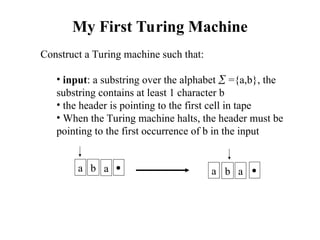
My First TuringMachine
Construct a Turing machine such that:
• input: a substring over the alphabet ={a,b}, the
substring contains at least 1 character b
• the header is pointing to the first cell in tape
• When the Turing machine halts, the header must be
pointing to the first occurrence of b in the input
a b a a b a
17.
Discussion: Are yousure that such a simple model can simulate
my C++ program for computing the Minimum Spanning Tree?
18.
The “Eraser” TM
Constructa Turing machine that receives as input a
substring of a’s and replace each a for a blank space,
a a a
19.
Configuration for TuringMachines
Configuration:
•The current state, q
•The symbol pointed by the head, h
•The string left of the head, LS
•The string right of the head, RS
(q,h,LS,RS)
20.
Configuration for TuringMachines (2)
Instead of writing: (q,h,LS,RS), we write:LSqhRS
Examples:
- Initial configuration with 3 a’s for the eraser TM: eq0aaa
- Accepting configuration starting with eq0aaa: qaccept
If q = qaccept, then LSqhRS is called an accepting configuration
If q = qreject, then LSqhRS is called a rejecting configuration
21.
Computation in TuringMachines
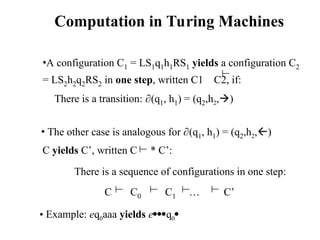
•A configuration C1 = LS1q1h1RS1 yields a configuration C2
= LS2h2q2RS2 in one step, written C1 C2, if:
There is a transition: (q1, h1) = (q2,h2,)
C yields C’, written C * C’:
There is a sequence of configurations in one step:
C C0 C1 … C’
• The other case is analogous for (q1, h1) = (q2,h2,)
• Example: eq0aaa yields eq0
22.
Two Forms ofComputability
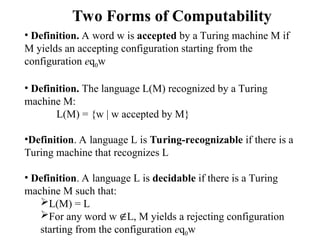
• Definition. A word w is accepted by a Turing machine M if
M yields an accepting configuration starting from the
configuration eq0w
• Definition. The language L(M) recognized by a Turing
machine M:
L(M) = {w | w accepted by M}
•Definition. A language L is Turing-recognizable if there is a
Turing machine that recognizes L
• Definition. A language L is decidable if there is a Turing
machine M such that:
L(M) = L
For any word w L, M yields a rejecting configuration
starting from the configuration eq0w
23.
Constructing Complex TuringMachines
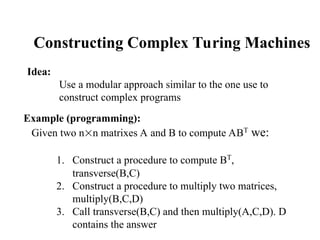
Idea:
Use a modular approach similar to the one use to
construct complex programs
Example (programming):
Given two nn matrixes A and B to compute ABT
we:
1. Construct a procedure to compute BT
,
transverse(B,C)
2. Construct a procedure to multiply two matrices,
multiply(B,C,D)
3. Call transverse(B,C) and then multiply(A,C,D). D
contains the answer
24.
Graphical Conventions
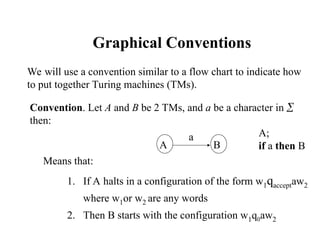
We willuse a convention similar to a flow chart to indicate how
to put together Turing machines (TMs).
Convention. Let A and B be 2 TMs, and a be a character in
then:
A
a
B
Means that:
1. If A halts in a configuration of the form w1qacceptaw2
where w1or w2 are any words
2. Then B starts with the configuration w1q0aw2
A;
if a then B
25.
Graphical Conventions (2)
Meansthat:
• If M halts in a configuration of the form w1qacceptaw2,
then A starts with the configuration w1q0aw2
• If M halts in a configuration of the form w1 qacceptw2
with a, then B starts with the configuration
w1q0w2
A
a
B
M
a M;
If a then A
else B
26.
Graphical Conventions (3)
Meansthat:
• If the initial configuration has the form w1q0w2,
then A starts with this configuration if a, where
s is the initial state in A
• If A halts in a configuration of the form w1qacceptw2
with a, then A starts with the configuration
A
a while (not a) do
A
a
27.
Basic Turing Machines
aDenotes “write a on the current cell” (a is a
character in )
Denotes “move to the right of the current
cell” (the book uses “R” instead of “”)
Denotes “move to the left of the current
cell” (the book uses “L” instead of “”)
28.
Other Simple TuringMachines
b
a
Machine What it does
“if current cell has an a, then
replace it with a b”
a
“if current cell has a
character a different than ,
then move once to the right
and write that a”
29.
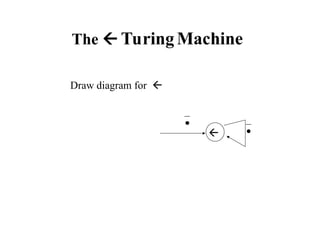
The TuringMachine
•What it does?
–
–
Move to the right until if finds
and
––
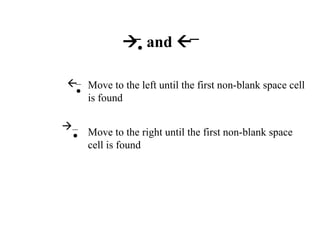
–
–
Move to the left until the first non-blank space cell
is found
Move to the right until the first non-blank space
cell is found
32.
The Conventions
• 2simple rules:
• Rule # 1:
• Rule # 2:
R
“move to the right until you find “
Note: first check. Then move (think of a “while”)
“Never forget Rule # 1”
(Mr Miogi, The Karate Kid)
R
“move to the right until you find a symbol other than “