
Philippines Wine “Tuba”
Making Process
Sap From the Heart
of the Coconut Tree
Prepared by The Farmer
8/11/2013
Introduction
The Art of Tuba Making
•The coconut tree is one of the prime crops of the Philippines. Provably next to
rice, man is graciously gifted with this tree, the coconut tree. It has multiple uses.
The main coconut product, copra is extracted for coconut oil. Next to copra is
“vinegar” which is fermented tuba. Then, “lambanog” which is a distilled
vinegar. Lambanog has a high alcohol content.
•To name a few more, aside from tuba, the sub-products are: Young coconut
meat or buko, the tree as post to build houses, fences and fishing traps, the leaves
are used as roofing materials for homes, and the list adds on.
•Tube wine is made from a process of extracting the sap of unopened coconut
bud. This delicate process is a one-man operation by a farmer from tuba making
to delivery.
•See the process illustration on the following slides.
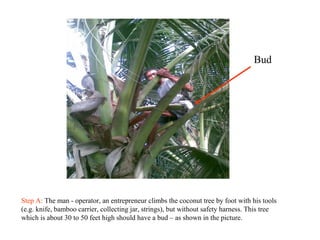
Step A: The man - operator, an entrepreneur climbs the coconut tree by foot with his tools
(e.g. knife, bamboo carrier, collecting jar, strings), but without safety harness. This tree
which is about 30 to 50 feet high should have a bud – as shown in the picture.
Bud
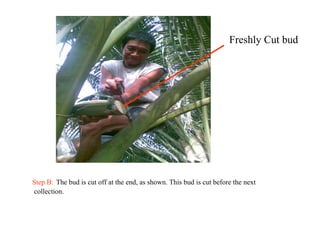
Step B: The bud is cut off at the end, as shown. This bud is cut before the next
collection.
Freshly Cut bud
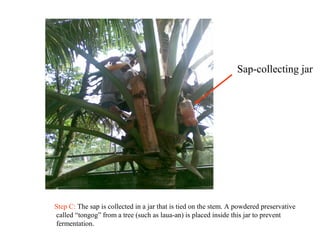
Sap-collecting jar
Step C: The sap is collected in a jar that is tied on the stem. A powdered preservative
called “tongog” from a tree (such as laua-an) is placed inside this jar to prevent
fermentation.
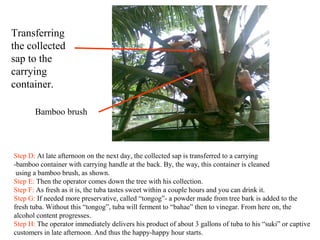
Transferring
the collected
sap to the
carrying
container.
Step D: At late afternoon on the next day, the collected sap is transferred to a carrying
-bamboo container with carrying handle at the back. By, the way, this container is cleaned
using a bamboo brush, as shown.
Step E: Then the operator comes down the tree with his collection.
Step F: As fresh as it is, the tuba tastes sweet within a couple hours and you can drink it.
Step G: If needed more preservative, called “tongog”- a powder made from tree bark is added to the
fresh tuba. Without this “tongog”, tuba will ferment to “bahae” then to vinegar. From here on, the
alcohol content progresses.
Step H: The operator immediately delivers his product of about 3 gallons of tuba to his “suki” or captive
customers in late afternoon. And thus the happy-happy hour starts.
Bamboo brush
Enjoy!

Tuba process

  • 1.
    Philippines Wine “Tuba” MakingProcess Sap From the Heart of the Coconut Tree Prepared by The Farmer 8/11/2013
  • 2.
    Introduction The Art ofTuba Making •The coconut tree is one of the prime crops of the Philippines. Provably next to rice, man is graciously gifted with this tree, the coconut tree. It has multiple uses. The main coconut product, copra is extracted for coconut oil. Next to copra is “vinegar” which is fermented tuba. Then, “lambanog” which is a distilled vinegar. Lambanog has a high alcohol content. •To name a few more, aside from tuba, the sub-products are: Young coconut meat or buko, the tree as post to build houses, fences and fishing traps, the leaves are used as roofing materials for homes, and the list adds on. •Tube wine is made from a process of extracting the sap of unopened coconut bud. This delicate process is a one-man operation by a farmer from tuba making to delivery. •See the process illustration on the following slides.
  • 3.
    Step A: Theman - operator, an entrepreneur climbs the coconut tree by foot with his tools (e.g. knife, bamboo carrier, collecting jar, strings), but without safety harness. This tree which is about 30 to 50 feet high should have a bud – as shown in the picture. Bud
  • 4.
    Step B: Thebud is cut off at the end, as shown. This bud is cut before the next collection. Freshly Cut bud
  • 5.
    Sap-collecting jar Step C:The sap is collected in a jar that is tied on the stem. A powdered preservative called “tongog” from a tree (such as laua-an) is placed inside this jar to prevent fermentation.
  • 6.
    Transferring the collected sap tothe carrying container. Step D: At late afternoon on the next day, the collected sap is transferred to a carrying -bamboo container with carrying handle at the back. By, the way, this container is cleaned using a bamboo brush, as shown. Step E: Then the operator comes down the tree with his collection. Step F: As fresh as it is, the tuba tastes sweet within a couple hours and you can drink it. Step G: If needed more preservative, called “tongog”- a powder made from tree bark is added to the fresh tuba. Without this “tongog”, tuba will ferment to “bahae” then to vinegar. From here on, the alcohol content progresses. Step H: The operator immediately delivers his product of about 3 gallons of tuba to his “suki” or captive customers in late afternoon. And thus the happy-happy hour starts. Bamboo brush
  • 7.