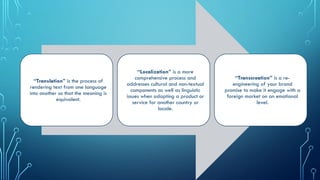
“Translation” is theprocess of
rendering text from one language
into another so that the meaning is
equivalent.
“Localization” is a more
comprehensive process and
addresses cultural and non-textual
components as well as linguistic
issues when adapting a product or
service for another country or
locale.
“Transcreation” is a re-
engineering of your brand
promise to make it engage with a
foreign market on an emotional
level.
3.
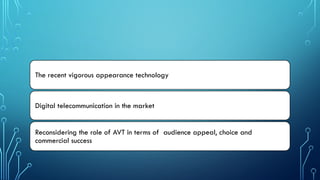
The recent vigorousappearance technology
Digital telecommunication in the market
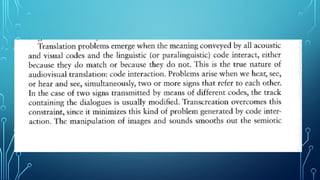
Reconsidering the role of AVT in terms of audience appeal, choice and
commercial success
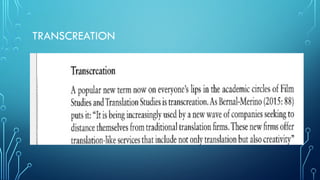
TRANSCREATION
Transcreation is inother words
creative translation. It is crucial in
advertising, branding and marketing
content.
The difference between translation
and transcreation is essentially the
text that is being translated and the
way it is being treated.
Transcreation involves translating with
more artistic flare, which means that
the transcreator not only stays true to
the original text, but also can
incorporate copywriting
6.
It is notonly translating but also recreating the original text in a new language, whilst making sure it still
depicts the desired context.
Advertising campaigns or film trailers are loaded with emotions and semiotics that need to be translated
accurately for certain audiences.
That’s why more personal approach is needed – a person transcreating a campaign must have the cultural
knowledge of the market the text or visuals will be broadcasted to. Otherwise, the campaign might be
completely misunderstood.
Therefore, transcreation preserves the original meaning, but also ensures the content appeals to the new
audience by conveying the tone and emotion of words.
WEBSITE LOCALIZATION
• Websitelocalization covers adapting website content, design, and user
experience to suit different languages and cultures. The process covers
adjusting design elements to cater to local aesthetics, and even modifying
navigation and layout to match browsing habits.
28.
Airbnb does outstandingwebsite localization. It's possible to view the platform in 62
languages, and the site's content, imagery, and even rental rules are adapted based on
the user's location.
Weglot's automatic content detection feature scans all the content on site for translation.
Its integrated translation management makes collaboration between translators,
marketers, and developers easy, and with its tools for improving multilingual SEO,
businesses can ensure that their localized websites rank well on search engines, driving
more traffic and conversions.
30.
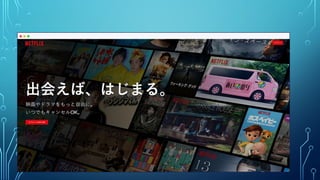
NETFLIX
Netflix's localization strategyis a prime example of how tailoring content
(and the user experience) to different regions can boost growth.
The streaming giant has harnessed the power of localization to attract
American audiences and fortify its standing in the global entertainment
industry.
32.
SACRED GAMES, THEIRHIT SERIES IN INDIA.
Set in Mumbai, the show is saturated with Indian cultural references and
most of the dialogue is in Hindi.
Currently the show sits at an 8.8/10 on IMDB, with 96% positive Google
reviews -- if that's not telling of their success in a completely new region,
then I'm not sure what.
33.
Central to Netflix'sstrategy is the meticulous adaptation of its content. Subtitles and dubbing in multiple languages
aren't just an afterthought, they're a crucial part of the production process. The company invests significantly in high-
quality translation and localization services to make its original content accessible and culturally relevant across its 200+
markets.
Netflix's localization strategy extends to the user interface as well. Everything, from language settings to personalized
recommendations, is fine-tuned to create a native-like viewing experience, which makes navigation nice and easy, too.
Marketing efforts are also keenly localized with region-specific promotional strategies. These can include collaborating
with local influencers or creating country-specific social media campaigns to ensure that Netflix's message connects to
different audiences. These initiatives pay off, fostering a strong connection with the brand and stimulating subscriber
growth in individual regions.
34.
KFC
KFC has perfectedthe art of merging global uniformity with local flavor. As a result, KFC has carved out a strong foothold in
diverse markets around the world.
At the heart of KFC's localization strategy is the careful adaptation of its menu. Food preferences vary widely across cultures,
after all, and KFC goes the extra mile to cater to local tastes. Whether it's introducing 'Chizza' (a fusion of Chicken and Pizza) in
the Philippines, 'Spicy Sichuan Chicken' in China, or 'Paneer Zinger' in India, KFC's localized menus echo local tastes, making the
brand a familiar and welcoming place for customers just about anywhere.
Beyond the menu, KFC also tailors its marketing campaigns and store designs to suit different cultures. Its commercials are often
localized to reflect the social and cultural nuances of the target market. For instance, in Japan, where Christmas is seen as a
romantic holiday rather than a family occasion, KFC launched a successful marketing campaign portraying its chicken as the
ideal Christmas Eve dinner!
35.
NINTENDO STANDS OUTAS A PIONEER
With its localization strategy, Nintendo has mastered the art of creating universally engaging games that transcend cultural and
linguistic barriers.
At the core of Nintendo's localization strategy is the transformation of its games to cater to different markets. This takes more
than just translating text, and involves modifying cultural references, jokes, and even gameplay elements to align with the target
culture. This meticulous attention to detail creates a native-like gaming experience that any and all players can connect to. Take
the Pokémon franchise, for example, where Pokémon names, dialogues, and cultural cues are carefully adapted for each locale.
Marketing materials and branding elements also get the thorough localization treatment at Nintendo. Commercials and
campaigns are tailored to reflect cultural nuances, and ensure that Nintendo's messages strike a chord with gamers across
different cultures.
36.
• 72.1% ofconsumers visit websites in their local language
• 72.4% said they would visit websites with local translation.
• 56.2% of those surveyed said that they might pay more to receive translated
information about a product or service.
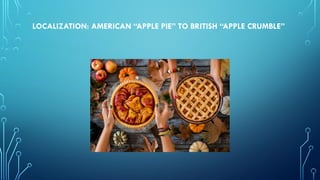
Consider the aboveexample of communicating tonight’s dessert to our British and American friends: both speak English so do
we need to translate? No. But do we need to localize – or should we say localise – to communicate to both markets effectively:
Spelling can be different: z’s become s’s (as in “localize” becomes “localise”), o’s become ou’s (as in “color” becomes “colour”).
Certain words are used differently: elevator/lift, vacation/holiday, pie/crumble.
Expressions and idioms are very different as well.
And lastly, visuals need to be considered because, after all, these are two different cultures.
39.
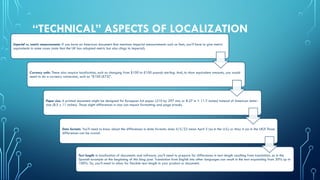
“TECHNICAL” ASPECTS OFLOCALIZATION
Imperial vs. metric measurements: If you have an American document that mentions imperial measurements such as feet, you’ll have to give metric
equivalents in some cases (note that the UK has adopted metric but also clings to imperial).
Currency units: These also require localization, such as changing from $100 to £100 pounds sterling. And, to show equivalent amounts, you would
need to do a currency conversion, such as “$100 (£75)”.
Paper size: A printed document might be designed for European A4 paper (210 by 297 mm, or 8.27 in × 11.7 inches) instead of American letter-
size (8.5 x 11 inches). Those slight differences in size can impact formatting and page breaks.
Date formats: You’ll need to know about the differences in date formats: does 4/5/22 mean April 5 (as in the U.S.) or May 4 (as in the UK)? Those
differences can be crucial.
Text length: In localization of documents and software, you’ll need to prepare for differences in text length resulting from translation, as in the
Spanish example at the beginning of this blog post. Translation from English into other languages can result in the text expanding from 30% up to
100%. So, you’ll need to allow for flexible text length in your product or document.
40.
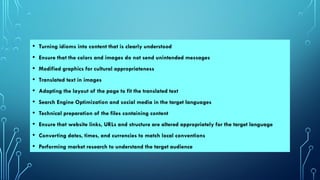
• Turning idiomsinto content that is clearly understood
• Ensure that the colors and images do not send unintended messages
• Modified graphics for cultural appropriateness
• Translated text in images
• Adapting the layout of the page to fit the translated text
• Search Engine Optimization and social media in the target languages
• Technical preparation of the files containing content
• Ensure that website links, URLs and structure are altered appropriately for the target language
• Converting dates, times, and currencies to match local conventions
• Performing market research to understand the target audience