Name of Presentation
Transit System Review Bus Network
Scenarios
Public Meetings - March 2014
In association with:
OpTrans, Jarrett Walker + Associates, E-Squared Engineering, and
Burton Planning Services
Transit System ReviewIBI Group
Welcome
March 2014Central Ohio Transit Authority 2
Meeting Purpose:
• Update progress to date on the Transit System
Review (TSR)
• Present three bus network scenarios that illustrate
how COTA could design its bus network
• Seek your input and ideas on these network
scenarios
• Explain next steps
Transit System ReviewIBI Group
Study Purpose
• Purpose:
The Transit System Review’s intent is to improve the
effectiveness and continued expansion of COTA’s bus network,
downtown operations, and technologies to meet the needs of
growing and changing land uses in the central Ohio region.
The recommendations will be constrained by COTA’s current
funding levels.
The TSR is being developed by consultants led by IBI Group
who have assessed current service and regional characteristics,
and are soliciting input from COTA’s customers, community
leaders and other stakeholders.
March 17, 2014Central Ohio Transit Authority 3
Transit System ReviewIBI Group
Factors and Outcomes
• A comprehensive review of our bus network looks at:
– Number of riders
– Number and performance of lines
– Population and job density
– Facilities and bus requirements
– Future technology needs
• TSR Outcome:
– Bus Network Plan
– Downtown Operations Plan
– Technology Investment Plan
– Implementation Plan
Central Ohio Transit Authority 4March 2014
Transit System ReviewIBI Group
Study Timeline
• Transit Advisory Committee (TAC) meeting January 13th
• Focus Group meetings January 21st and 22nd
• Develop three bus network scenarios
• TAC and Public meetings March 17th to 20th
• Board workshop end April
• In May develop final draft proposed service network and downtown
operations plan
• May/June another round of public meetings
• Final plan presented to COTA Board of Trustees June/July
• September - Final report completed
• 2015 – 2017 - Implement Plan (timeframe depends on number of
changes)
Central Ohio Transit Authority 5March 2014
Transit System ReviewIBI Group
Bus Network Scenarios
• Three Bus Network Scenarios:
– Illustrate how COTA could invest in its bus system within
current funding resources
– Show contrasting options for discussion
– Has the same cost (projected 2017 funding levels)
– Differs on how COTA should invest in service (Ridership or
Coverage)
Central Ohio Transit Authority 6March 2014
Transit System ReviewIBI Group
Bus Network Scenarios
• Key Question: How should COTA invest its resources in its bus
network within available funding?
• Consultants developed three bus network scenarios to
illustrate possible ways to invest in service:
– Ridership: Maximize ridership through frequent service
in areas favorable to transit.
– Coverage: Provide some level of service to as many
people possible by spreading service throughout the
region.
– Midpoint: Combination of Ridership and Coverage
Scenarios
Central Ohio Transit Authority 7March 2014
Transit System ReviewIBI Group
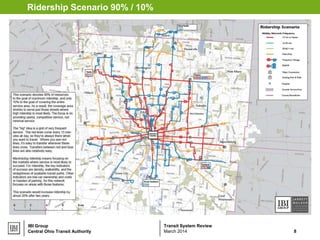
Ridership Scenario 90% / 10%
Central Ohio Transit Authority 8March 2014
Transit System ReviewIBI Group
Ridership Scenario 90% / 10%
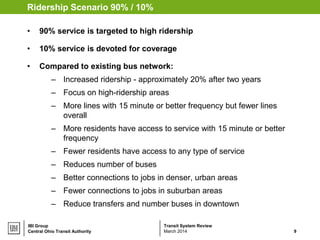
• 90% service is targeted to high ridership
• 10% service is devoted for coverage
• Compared to existing bus network:
– Increased ridership - approximately 20% after two years
– Focus on high-ridership areas
– More lines with 15 minute or better frequency but fewer lines
overall
– More residents have access to service with 15 minute or better
frequency
– Fewer residents have access to any type of service
– Reduces number of buses
– Better connections to jobs in denser, urban areas
– Fewer connections to jobs in suburban areas
– Reduce transfers and number buses in downtown
Central Ohio Transit Authority 9March 2014
Transit System ReviewIBI Group
Coverage Scenario 50% / 50%
Central Ohio Transit Authority 10March 2014
Transit System ReviewIBI Group
Coverage Scenario 50% / 50%
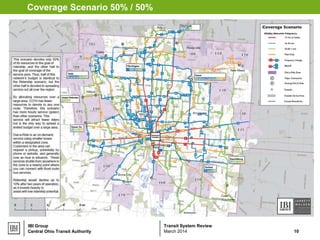
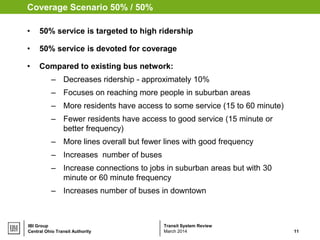
• 50% service is targeted to high ridership
• 50% service is devoted for coverage
• Compared to existing bus network:
– Decreases ridership - approximately 10%
– Focuses on reaching more people in suburban areas
– More residents have access to some service (15 to 60 minute)
– Fewer residents have access to good service (15 minute or
better frequency)
– More lines overall but fewer lines with good frequency
– Increases number of buses
– Increase connections to jobs in suburban areas but with 30
minute or 60 minute frequency
– Increases number of buses in downtown
Central Ohio Transit Authority 11March 2014
Transit System ReviewIBI Group
Midpoint Scenario 70% / 30%
Central Ohio Transit Authority 12March 2014
Transit System ReviewIBI Group
Midpoint Scenario 70% / 30%
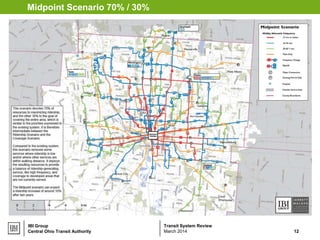
• Similar to the existing COTA network
• 70% service is targeted to high ridership
• 30% service is devoted for coverage
• Compared to existing bus network:
– Increased ridership (approximately 10% after two years)
– Focus on providing most service in high-ridership areas and
some service to other areas
– Decreases number of buses marginally
– Similar number of residents who have access to transit
– Similar number of people with access to jobs
– Decreases number of transfers and buses in downtown
– Redistributing some lower productive service into higher
productive areas
– Fewer express lines and park and rides in suburbs
Central Ohio Transit Authority 13March 2014
Transit System ReviewIBI Group
What do you think?
• How should COTA focus its resources? Where?
– On ridership or on coverage or somewhere in
between?
– What areas should COTA be serving?
Tell us what you think!
Comment sheets available for your input
Central Ohio Transit Authority 14March 2014

Tsr public meeting_1finalrevcp

  • 1.
    Name of Presentation TransitSystem Review Bus Network Scenarios Public Meetings - March 2014 In association with: OpTrans, Jarrett Walker + Associates, E-Squared Engineering, and Burton Planning Services
  • 2.
    Transit System ReviewIBIGroup Welcome March 2014Central Ohio Transit Authority 2 Meeting Purpose: • Update progress to date on the Transit System Review (TSR) • Present three bus network scenarios that illustrate how COTA could design its bus network • Seek your input and ideas on these network scenarios • Explain next steps
  • 3.
    Transit System ReviewIBIGroup Study Purpose • Purpose: The Transit System Review’s intent is to improve the effectiveness and continued expansion of COTA’s bus network, downtown operations, and technologies to meet the needs of growing and changing land uses in the central Ohio region. The recommendations will be constrained by COTA’s current funding levels. The TSR is being developed by consultants led by IBI Group who have assessed current service and regional characteristics, and are soliciting input from COTA’s customers, community leaders and other stakeholders. March 17, 2014Central Ohio Transit Authority 3
  • 4.
    Transit System ReviewIBIGroup Factors and Outcomes • A comprehensive review of our bus network looks at: – Number of riders – Number and performance of lines – Population and job density – Facilities and bus requirements – Future technology needs • TSR Outcome: – Bus Network Plan – Downtown Operations Plan – Technology Investment Plan – Implementation Plan Central Ohio Transit Authority 4March 2014
  • 5.
    Transit System ReviewIBIGroup Study Timeline • Transit Advisory Committee (TAC) meeting January 13th • Focus Group meetings January 21st and 22nd • Develop three bus network scenarios • TAC and Public meetings March 17th to 20th • Board workshop end April • In May develop final draft proposed service network and downtown operations plan • May/June another round of public meetings • Final plan presented to COTA Board of Trustees June/July • September - Final report completed • 2015 – 2017 - Implement Plan (timeframe depends on number of changes) Central Ohio Transit Authority 5March 2014
  • 6.
    Transit System ReviewIBIGroup Bus Network Scenarios • Three Bus Network Scenarios: – Illustrate how COTA could invest in its bus system within current funding resources – Show contrasting options for discussion – Has the same cost (projected 2017 funding levels) – Differs on how COTA should invest in service (Ridership or Coverage) Central Ohio Transit Authority 6March 2014
  • 7.
    Transit System ReviewIBIGroup Bus Network Scenarios • Key Question: How should COTA invest its resources in its bus network within available funding? • Consultants developed three bus network scenarios to illustrate possible ways to invest in service: – Ridership: Maximize ridership through frequent service in areas favorable to transit. – Coverage: Provide some level of service to as many people possible by spreading service throughout the region. – Midpoint: Combination of Ridership and Coverage Scenarios Central Ohio Transit Authority 7March 2014
  • 8.
    Transit System ReviewIBIGroup Ridership Scenario 90% / 10% Central Ohio Transit Authority 8March 2014
  • 9.
    Transit System ReviewIBIGroup Ridership Scenario 90% / 10% • 90% service is targeted to high ridership • 10% service is devoted for coverage • Compared to existing bus network: – Increased ridership - approximately 20% after two years – Focus on high-ridership areas – More lines with 15 minute or better frequency but fewer lines overall – More residents have access to service with 15 minute or better frequency – Fewer residents have access to any type of service – Reduces number of buses – Better connections to jobs in denser, urban areas – Fewer connections to jobs in suburban areas – Reduce transfers and number buses in downtown Central Ohio Transit Authority 9March 2014
  • 10.
    Transit System ReviewIBIGroup Coverage Scenario 50% / 50% Central Ohio Transit Authority 10March 2014
  • 11.
    Transit System ReviewIBIGroup Coverage Scenario 50% / 50% • 50% service is targeted to high ridership • 50% service is devoted for coverage • Compared to existing bus network: – Decreases ridership - approximately 10% – Focuses on reaching more people in suburban areas – More residents have access to some service (15 to 60 minute) – Fewer residents have access to good service (15 minute or better frequency) – More lines overall but fewer lines with good frequency – Increases number of buses – Increase connections to jobs in suburban areas but with 30 minute or 60 minute frequency – Increases number of buses in downtown Central Ohio Transit Authority 11March 2014
  • 12.
    Transit System ReviewIBIGroup Midpoint Scenario 70% / 30% Central Ohio Transit Authority 12March 2014
  • 13.
    Transit System ReviewIBIGroup Midpoint Scenario 70% / 30% • Similar to the existing COTA network • 70% service is targeted to high ridership • 30% service is devoted for coverage • Compared to existing bus network: – Increased ridership (approximately 10% after two years) – Focus on providing most service in high-ridership areas and some service to other areas – Decreases number of buses marginally – Similar number of residents who have access to transit – Similar number of people with access to jobs – Decreases number of transfers and buses in downtown – Redistributing some lower productive service into higher productive areas – Fewer express lines and park and rides in suburbs Central Ohio Transit Authority 13March 2014
  • 14.
    Transit System ReviewIBIGroup What do you think? • How should COTA focus its resources? Where? – On ridership or on coverage or somewhere in between? – What areas should COTA be serving? Tell us what you think! Comment sheets available for your input Central Ohio Transit Authority 14March 2014