Laksamee Putnam
lputnam@towson.edu
Research & Instruction Librarian
http://bit.ly/tsemthompsonsp16c2
Please login to a
computer and go to this
URL
First…
 Laksamee Putnam
 lputnam@towson.edu
 Cook Library Reference:
 410.704.2462.
 IM/email
 Phone: 410.704.3746.
 Twitter: @CookLibraryofTU
 Albert S. Cook Facebook profile!
Agenda
 Pre-class reading Discussion
 Evaluating Resources - TIL
 Keywords
 Find a website resource
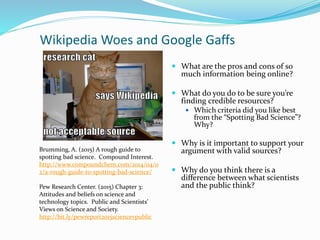
Wikipedia Woes and Google Gaffs
 What are the pros and cons of so
much information being online?
 What do you do to be sure you’re
finding credible resources?
 Which criteria did you like best
from the “Spotting Bad Science”?
Why?
 Why is it important to support your
argument with valid sources?
 Why do you think there is a
difference between what scientists
and the public think?
Brumming, A. (2015) A rough guide to
spotting bad science. Compound Interest.
http://www.compoundchem.com/2014/04/0
2/a-rough-guide-to-spotting-bad-science/
Pew Research Center. (2015) Chapter 3:
Attitudes and beliefs on science and
technology topics. Public and Scientists’
Views on Science and Society.
http://bit.ly/pewreport2015sciencevpublic
Today I Learned (TIL)
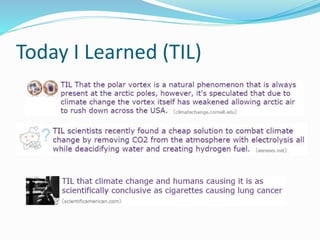
 In Reddit people share “headlines” in TIL format
 Which resources are “good”
 Which resources are “bad”
 How do you know?
Today I Learned (TIL)
Check for CRAP
Currency
Reliability
Authority
Purpose/Point of View
Check for CRAP
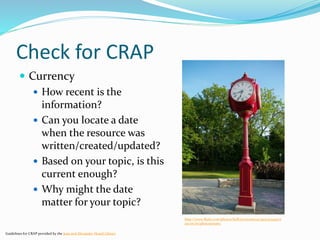
 Currency
 How recent is the
information?
 Can you locate a date
when the resource was
written/created/updated?
 Based on your topic, is this
current enough?
 Why might the date
matter for your topic?
Guidelines for CRAP provided by the Jean and Alexander Heard Library
http://www.flickr.com/photos/helloeveryone123/3937374193/si
zes/m/in/photostream/
Check for CRAP
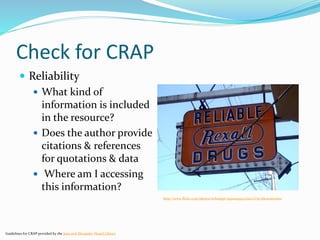
 Reliability
 What kind of
information is included
in the resource?
 Does the author provide
citations & references
for quotations & data
 Where am I accessing
this information?
Guidelines for CRAP provided by the Jean and Alexander Heard Library
http://www.flickr.com/photos/schnappi/5930145952/sizes/l/in/photostream/
Check for CRAP
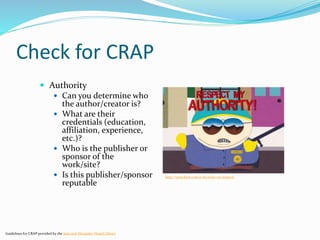
 Authority
 Can you determine who
the author/creator is?
 What are their
credentials (education,
affiliation, experience,
etc.)?
 Who is the publisher or
sponsor of the
work/site?
 Is this publisher/sponsor
reputable
Guidelines for CRAP provided by the Jean and Alexander Heard Library
http://rantchick.com/a-doctrine-on-respect/
Check for CRAP
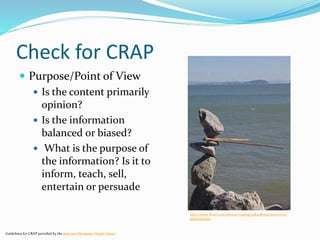
 Purpose/Point of View
 Is the content primarily
opinion?
 Is the information
balanced or biased?
 What is the purpose of
the information? Is it to
inform, teach, sell,
entertain or persuade
Guidelines for CRAP provided by the Jean and Alexander Heard Library
http://www.flickr.com/photos/cogdog/5484085301/sizes/m/in/
photostream/
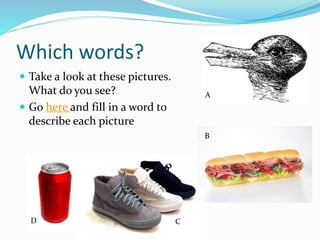
Which words?
 Take a look at these pictures.
What do you see?
 Go here and fill in a word to
describe each picture
A
D C
B
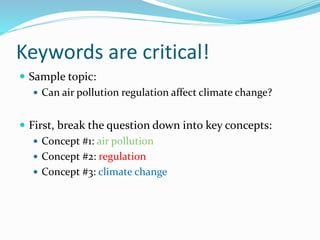
Keywords are critical!
 Sample topic:
 Can air pollution regulation affect climate change?
 First, break the question down into key concepts:
 Concept #1: air pollution
 Concept #2: regulation
 Concept #3: climate change
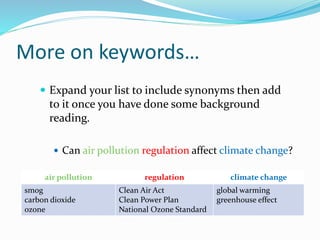
More on keywords…
 Expand your list to include synonyms then add
to it once you have done some background
reading.
 Can air pollution regulation affect climate change?
air pollution regulation climate change
smog
carbon dioxide
ozone
Clean Air Act
Clean Power Plan
National Ozone Standard
global warming
greenhouse effect
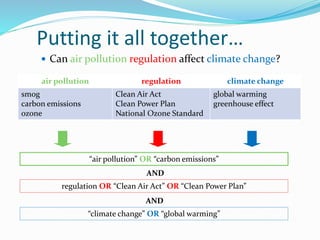
Putting it all together…
 Can air pollution regulation affect climate change?
“air pollution” OR “carbon emissions”
AND
regulation OR “Clean Air Act” OR “Clean Power Plan”
AND
“climate change” OR “global warming”
air pollution regulation climate change
smog
carbon emissions
ozone
Clean Air Act
Clean Power Plan
National Ozone Standard
global warming
greenhouse effect
Create keywords
 Complete Part 1 of your worksheet
 Write your research topic on your worksheet
 Pass it to a group member
 Group member fills in key concepts and synonyms
 Give the worksheet back to the original owner
Potential Topics
 What role do chlorofluorocarbons play in climate
change?
 What do global circulation models predict for the
future?
 How is human health altered by climate change?
 What are environmental refugees and how can we help
them?
 How long will our fresh water resources last?
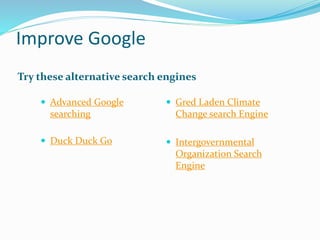
Improve Google
 Advanced Google
searching
 Duck Duck Go
 Gred Laden Climate
Change search Engine
 Intergovernmental
Organization Search
Engine
Try these alternative search engines
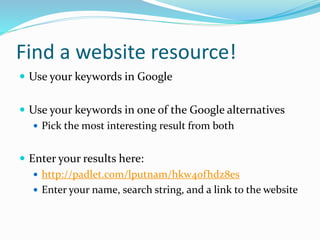
Find a website resource!
 Use your keywords in Google
 Use your keywords in one of the Google alternatives
 Pick the most interesting result from both
 Enter your results here:
 http://padlet.com/lputnam/hkw40fhdz8es
 Enter your name, search string, and a link to the website
Take a look at the results
 Assess the results posted with the CRAP assessment
 What problems did you have ….
 Coming up with keywords?
 Searching for a website?
Thanks for listening!
 Fill out Part 2 of your paper worksheet
 Fill out 3 TIL statements about your library session today
 Hand the worksheet in to the librarian
 Next library session:
 Pre-class reading and prepare for discussion
 Use your keywords to find books/articles
Questions?
 Feel free to contact me:
 Laksamee Putnam
 lputnam@towson.edu
 410.704.3746.
 Twitter: @CookLibraryofTU
 Or any reference librarian:
 Visit Cook Library Reference Desk
 410.704.2462.
 IM – tucookchat

Tsem Spring 2016 Thompson class 2

  • 1.
    Laksamee Putnam lputnam@towson.edu Research &Instruction Librarian http://bit.ly/tsemthompsonsp16c2 Please login to a computer and go to this URL
  • 2.
    First…  Laksamee Putnam lputnam@towson.edu  Cook Library Reference:  410.704.2462.  IM/email  Phone: 410.704.3746.  Twitter: @CookLibraryofTU  Albert S. Cook Facebook profile!
  • 3.
    Agenda  Pre-class readingDiscussion  Evaluating Resources - TIL  Keywords  Find a website resource
  • 4.
    Wikipedia Woes andGoogle Gaffs  What are the pros and cons of so much information being online?  What do you do to be sure you’re finding credible resources?  Which criteria did you like best from the “Spotting Bad Science”? Why?  Why is it important to support your argument with valid sources?  Why do you think there is a difference between what scientists and the public think? Brumming, A. (2015) A rough guide to spotting bad science. Compound Interest. http://www.compoundchem.com/2014/04/0 2/a-rough-guide-to-spotting-bad-science/ Pew Research Center. (2015) Chapter 3: Attitudes and beliefs on science and technology topics. Public and Scientists’ Views on Science and Society. http://bit.ly/pewreport2015sciencevpublic
  • 5.
    Today I Learned(TIL)  In Reddit people share “headlines” in TIL format  Which resources are “good”  Which resources are “bad”  How do you know?
  • 6.
  • 7.
  • 8.
    Check for CRAP Currency  How recent is the information?  Can you locate a date when the resource was written/created/updated?  Based on your topic, is this current enough?  Why might the date matter for your topic? Guidelines for CRAP provided by the Jean and Alexander Heard Library http://www.flickr.com/photos/helloeveryone123/3937374193/si zes/m/in/photostream/
  • 9.
    Check for CRAP Reliability  What kind of information is included in the resource?  Does the author provide citations & references for quotations & data  Where am I accessing this information? Guidelines for CRAP provided by the Jean and Alexander Heard Library http://www.flickr.com/photos/schnappi/5930145952/sizes/l/in/photostream/
  • 10.
    Check for CRAP Authority  Can you determine who the author/creator is?  What are their credentials (education, affiliation, experience, etc.)?  Who is the publisher or sponsor of the work/site?  Is this publisher/sponsor reputable Guidelines for CRAP provided by the Jean and Alexander Heard Library http://rantchick.com/a-doctrine-on-respect/
  • 11.
    Check for CRAP Purpose/Point of View  Is the content primarily opinion?  Is the information balanced or biased?  What is the purpose of the information? Is it to inform, teach, sell, entertain or persuade Guidelines for CRAP provided by the Jean and Alexander Heard Library http://www.flickr.com/photos/cogdog/5484085301/sizes/m/in/ photostream/
  • 12.
    Which words?  Takea look at these pictures. What do you see?  Go here and fill in a word to describe each picture A D C B
  • 13.
    Keywords are critical! Sample topic:  Can air pollution regulation affect climate change?  First, break the question down into key concepts:  Concept #1: air pollution  Concept #2: regulation  Concept #3: climate change
  • 14.
    More on keywords… Expand your list to include synonyms then add to it once you have done some background reading.  Can air pollution regulation affect climate change? air pollution regulation climate change smog carbon dioxide ozone Clean Air Act Clean Power Plan National Ozone Standard global warming greenhouse effect
  • 15.
    Putting it alltogether…  Can air pollution regulation affect climate change? “air pollution” OR “carbon emissions” AND regulation OR “Clean Air Act” OR “Clean Power Plan” AND “climate change” OR “global warming” air pollution regulation climate change smog carbon emissions ozone Clean Air Act Clean Power Plan National Ozone Standard global warming greenhouse effect
  • 16.
    Create keywords  CompletePart 1 of your worksheet  Write your research topic on your worksheet  Pass it to a group member  Group member fills in key concepts and synonyms  Give the worksheet back to the original owner
  • 17.
    Potential Topics  Whatrole do chlorofluorocarbons play in climate change?  What do global circulation models predict for the future?  How is human health altered by climate change?  What are environmental refugees and how can we help them?  How long will our fresh water resources last?
  • 18.
    Improve Google  AdvancedGoogle searching  Duck Duck Go  Gred Laden Climate Change search Engine  Intergovernmental Organization Search Engine Try these alternative search engines
  • 19.
    Find a websiteresource!  Use your keywords in Google  Use your keywords in one of the Google alternatives  Pick the most interesting result from both  Enter your results here:  http://padlet.com/lputnam/hkw40fhdz8es  Enter your name, search string, and a link to the website
  • 20.
    Take a lookat the results  Assess the results posted with the CRAP assessment  What problems did you have ….  Coming up with keywords?  Searching for a website?
  • 21.
    Thanks for listening! Fill out Part 2 of your paper worksheet  Fill out 3 TIL statements about your library session today  Hand the worksheet in to the librarian  Next library session:  Pre-class reading and prepare for discussion  Use your keywords to find books/articles
  • 22.
    Questions?  Feel freeto contact me:  Laksamee Putnam  lputnam@towson.edu  410.704.3746.  Twitter: @CookLibraryofTU  Or any reference librarian:  Visit Cook Library Reference Desk  410.704.2462.  IM – tucookchat

Editor's Notes

  • #7 http://climatechange.cornell.edu/what-is-a-polar-vortex/ http://www.eenews.net/stories/1059981902 http://www.scientificamerican.com/article/climate-risks-as-conclusive-as-link-between-smoking-and-lung-cancer/
  • #13 https://www.polleverywhere.com/free_text_polls/6OIQK1gUXBfz5Mc?preview=true https://www.polleverywhere.com/free_text_polls/WIeyBan3NG3hR3Z?preview=true https://www.polleverywhere.com/free_text_polls/LboApAPWwdDvgvW?preview=true https://www.polleverywhere.com/free_text_polls/m8zzmpKI3fYxZiG?preview=true