
T-SDN:
Controllers for
Transport
Networks
Sabidur Rahman
Netlab, UC Davis.
krahman@ucdavis.edu
http://www.linkedin.com/in/kmsabidurrahman/
Agenda
• How T-SDN is different from SDN
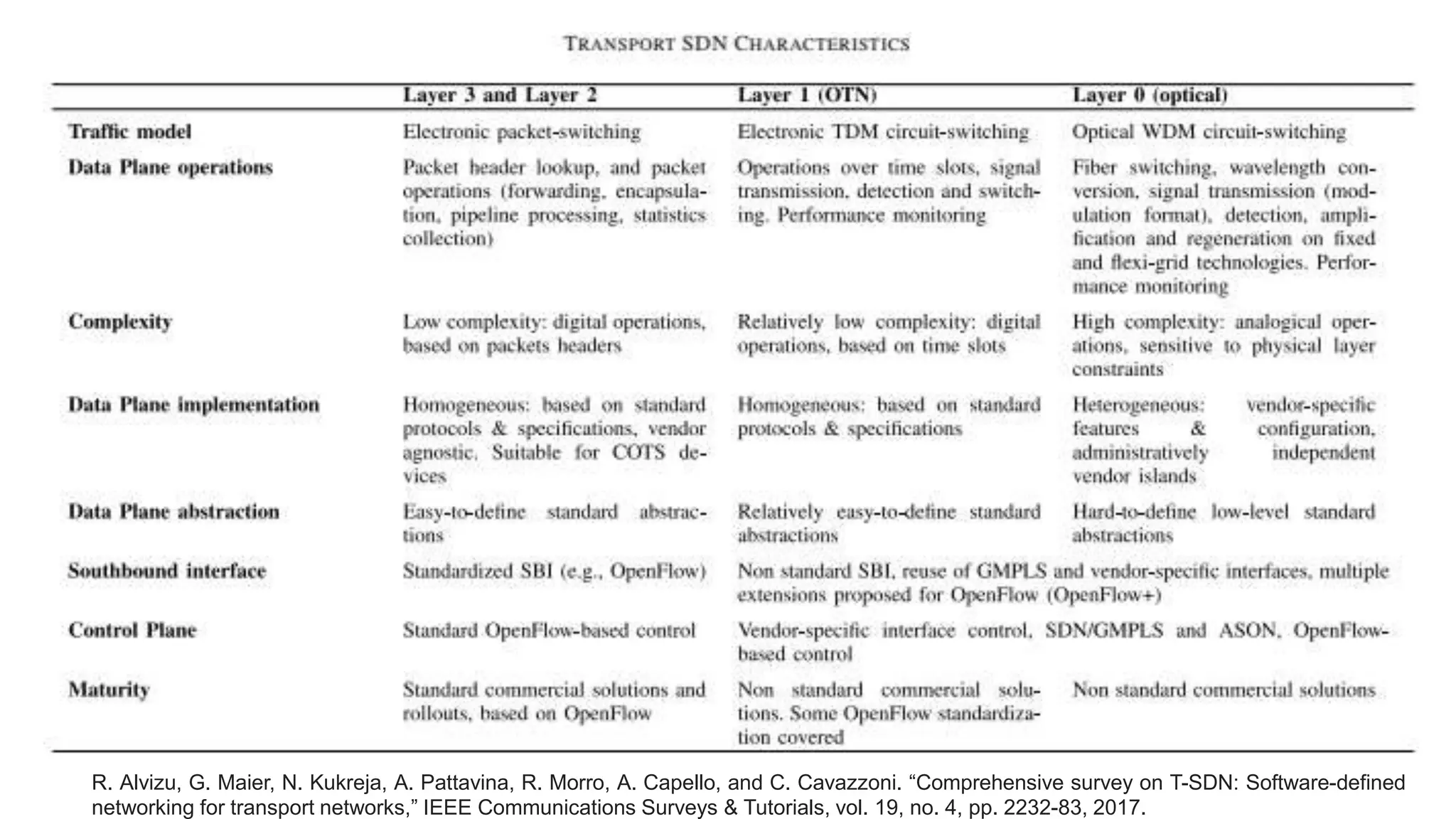
• How layer 0 is different from layer 1 and layer 2-3
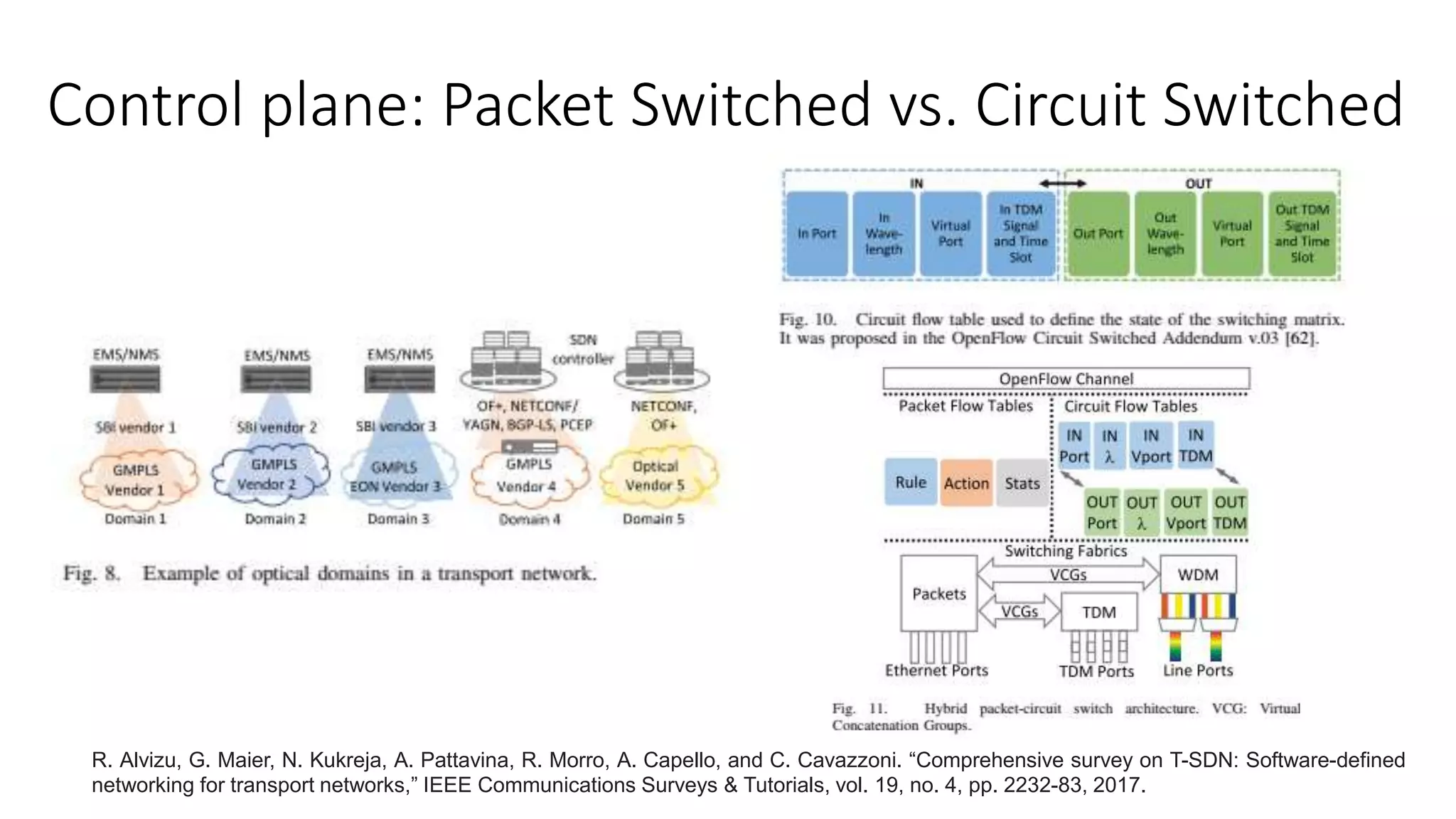
• Control plane: Packet switched vs. Circuit Switched
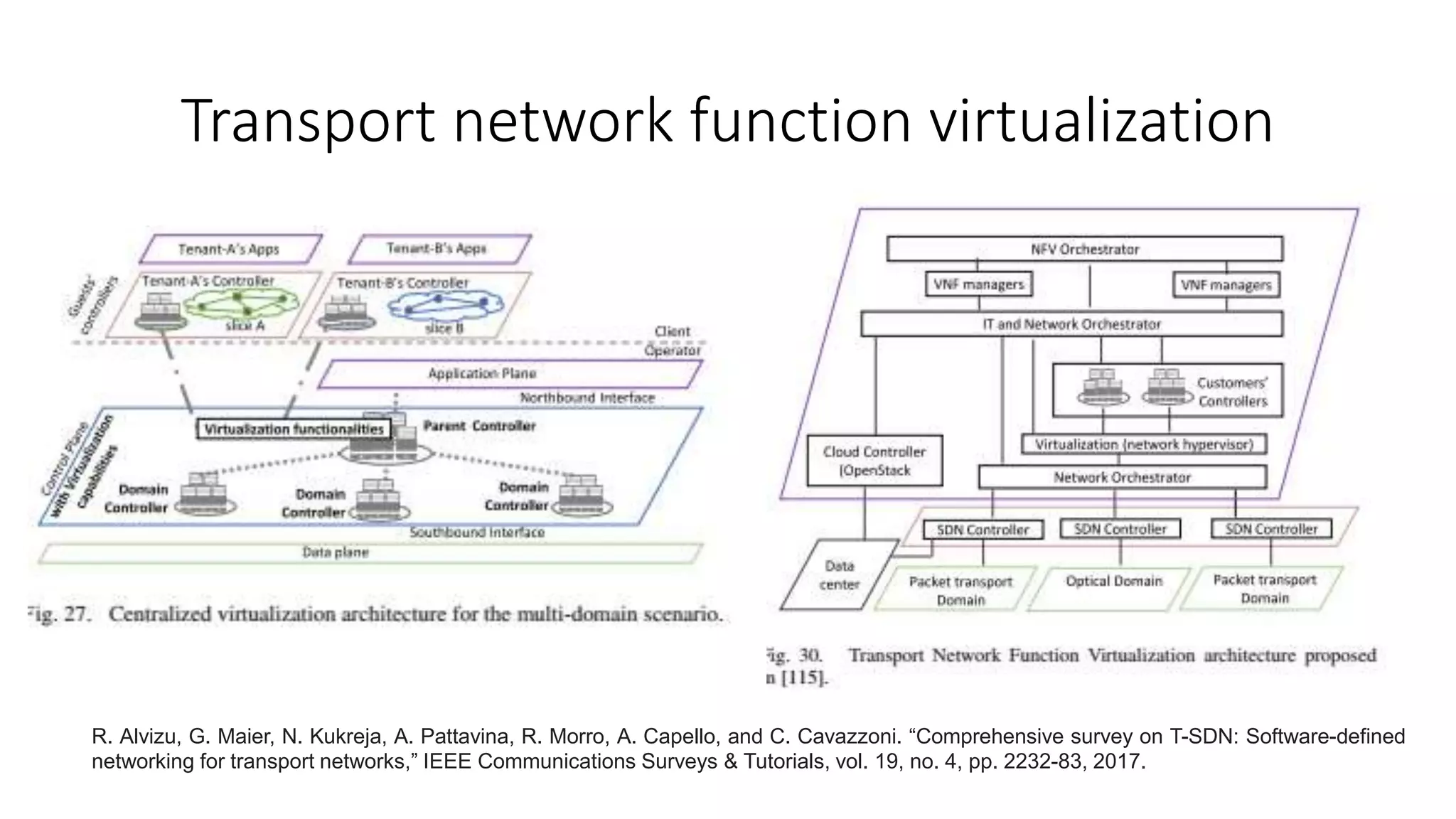
• Transport network function virtualization
• Research directions
How T-SDN is different from SDN?
• Transport SDN (T-SDN) is an SDN-based architecture for control and
management of transport networks, that could involve multi-layer, multi-
domain, and multi-vendor scenarios
• Transport networks have features usually not present in computer
networks where SDN paradigm arose, like resilience, sophisticated
architectures, heterogeneous technologies (MPLS and others), and optical
domain impairments
• In this sense, T-SDN is as a subset of SDN-architecture that comprises
extensions to abstractions, interfaces, protocols, and control plane
elements to cope with transport networks peculiarities and limitations
R. Alvizu, G. Maier, N. Kukreja, A. Pattavina, R. Morro, A. Capello, and C. Cavazzoni. “Comprehensive survey on T-SDN: Software-defined
networking for transport networks,” IEEE Communications Surveys & Tutorials, vol. 19, no. 4, pp. 2232-83, 2017.
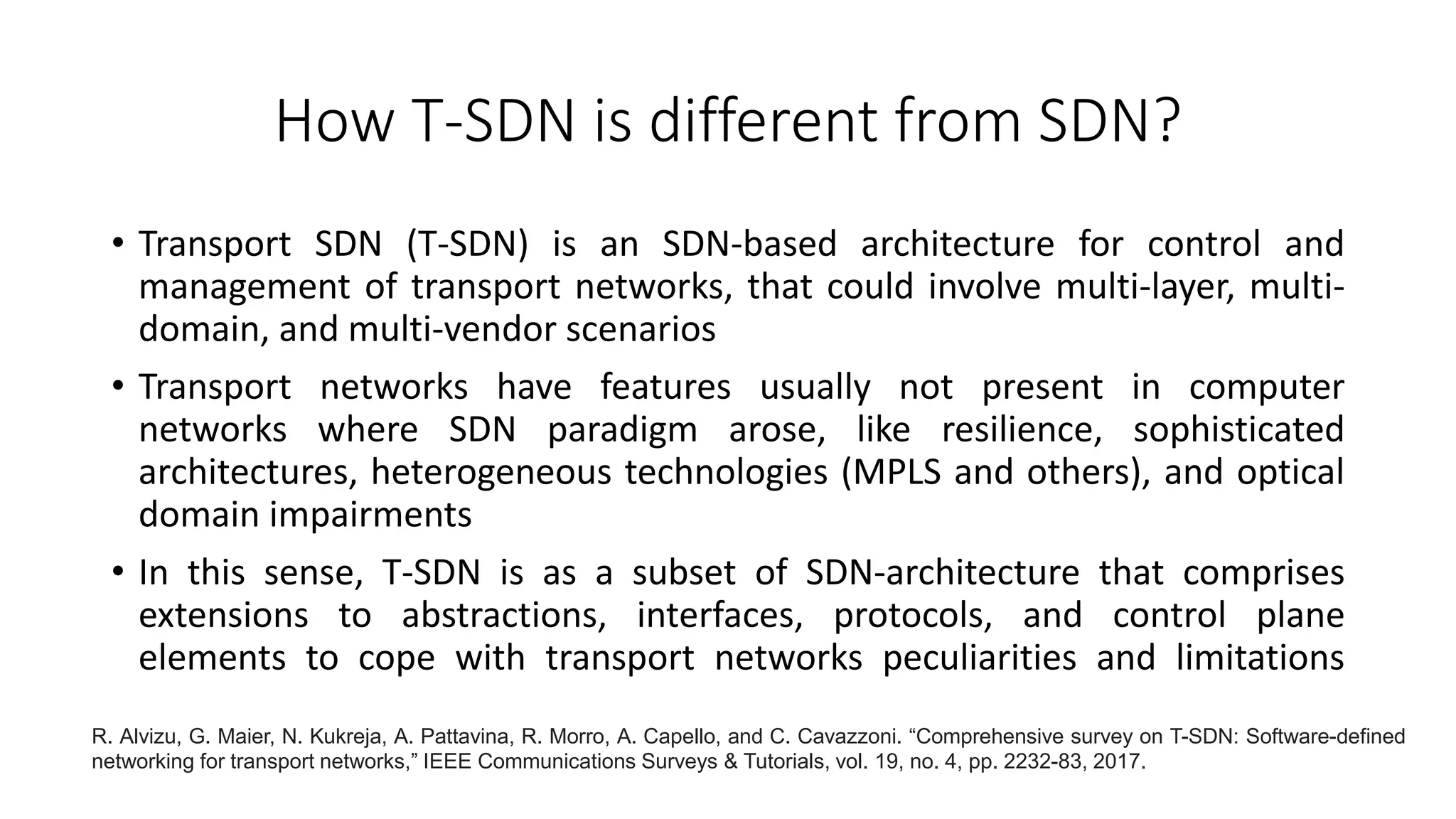
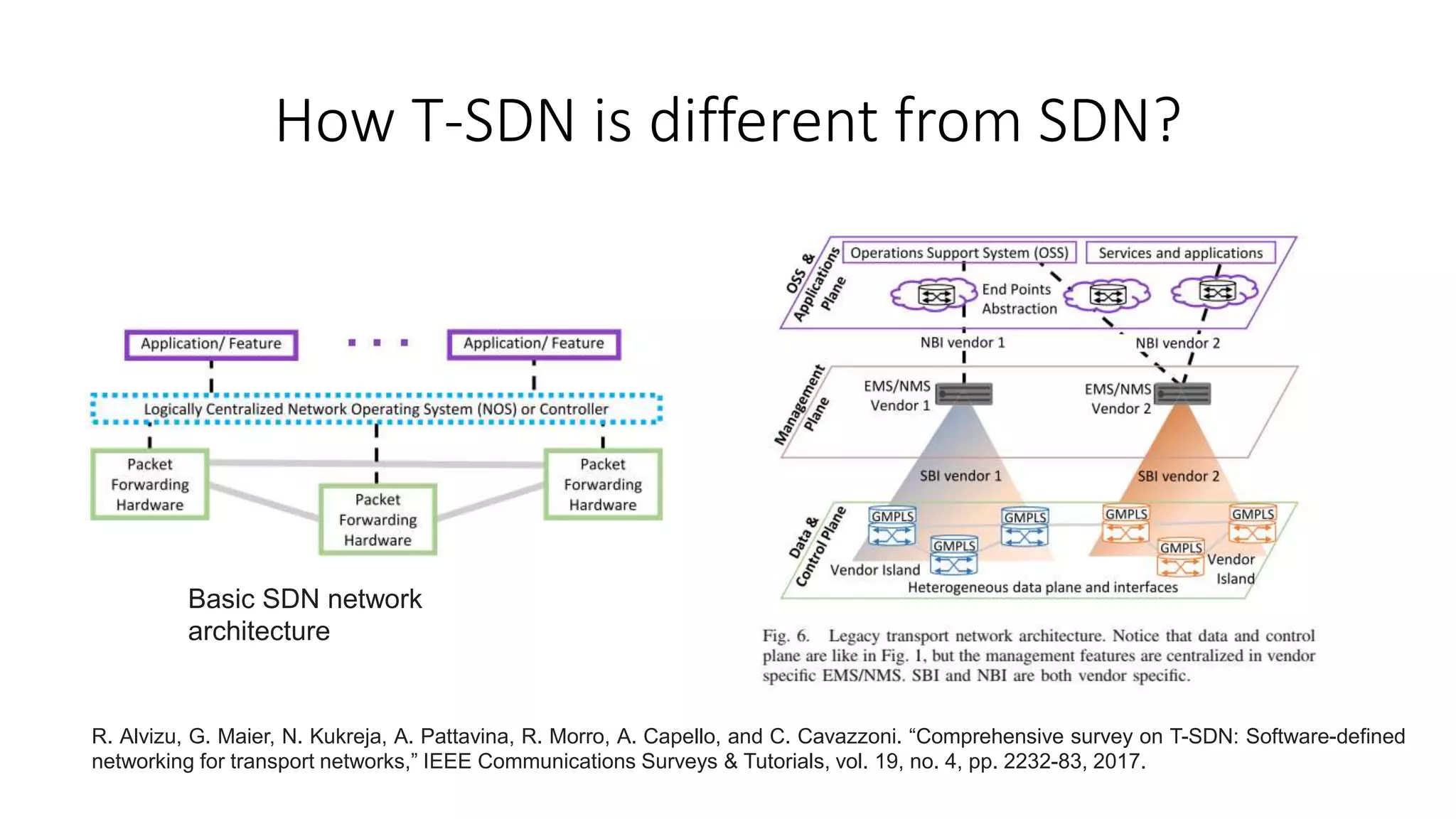
How T-SDN is different from SDN?
Basic SDN network
architecture
R. Alvizu, G. Maier, N. Kukreja, A. Pattavina, R. Morro, A. Capello, and C. Cavazzoni. “Comprehensive survey on T-SDN: Software-defined
networking for transport networks,” IEEE Communications Surveys & Tutorials, vol. 19, no. 4, pp. 2232-83, 2017.
R. Alvizu, G. Maier, N. Kukreja, A. Pattavina, R. Morro, A. Capello, and C. Cavazzoni. “Comprehensive survey on T-SDN: Software-defined
networking for transport networks,” IEEE Communications Surveys & Tutorials, vol. 19, no. 4, pp. 2232-83, 2017.
Control plane: Packet Switched vs. Circuit Switched
R. Alvizu, G. Maier, N. Kukreja, A. Pattavina, R. Morro, A. Capello, and C. Cavazzoni. “Comprehensive survey on T-SDN: Software-defined
networking for transport networks,” IEEE Communications Surveys & Tutorials, vol. 19, no. 4, pp. 2232-83, 2017.
Transport network function virtualization
R. Alvizu, G. Maier, N. Kukreja, A. Pattavina, R. Morro, A. Capello, and C. Cavazzoni. “Comprehensive survey on T-SDN: Software-defined
networking for transport networks,” IEEE Communications Surveys & Tutorials, vol. 19, no. 4, pp. 2232-83, 2017.
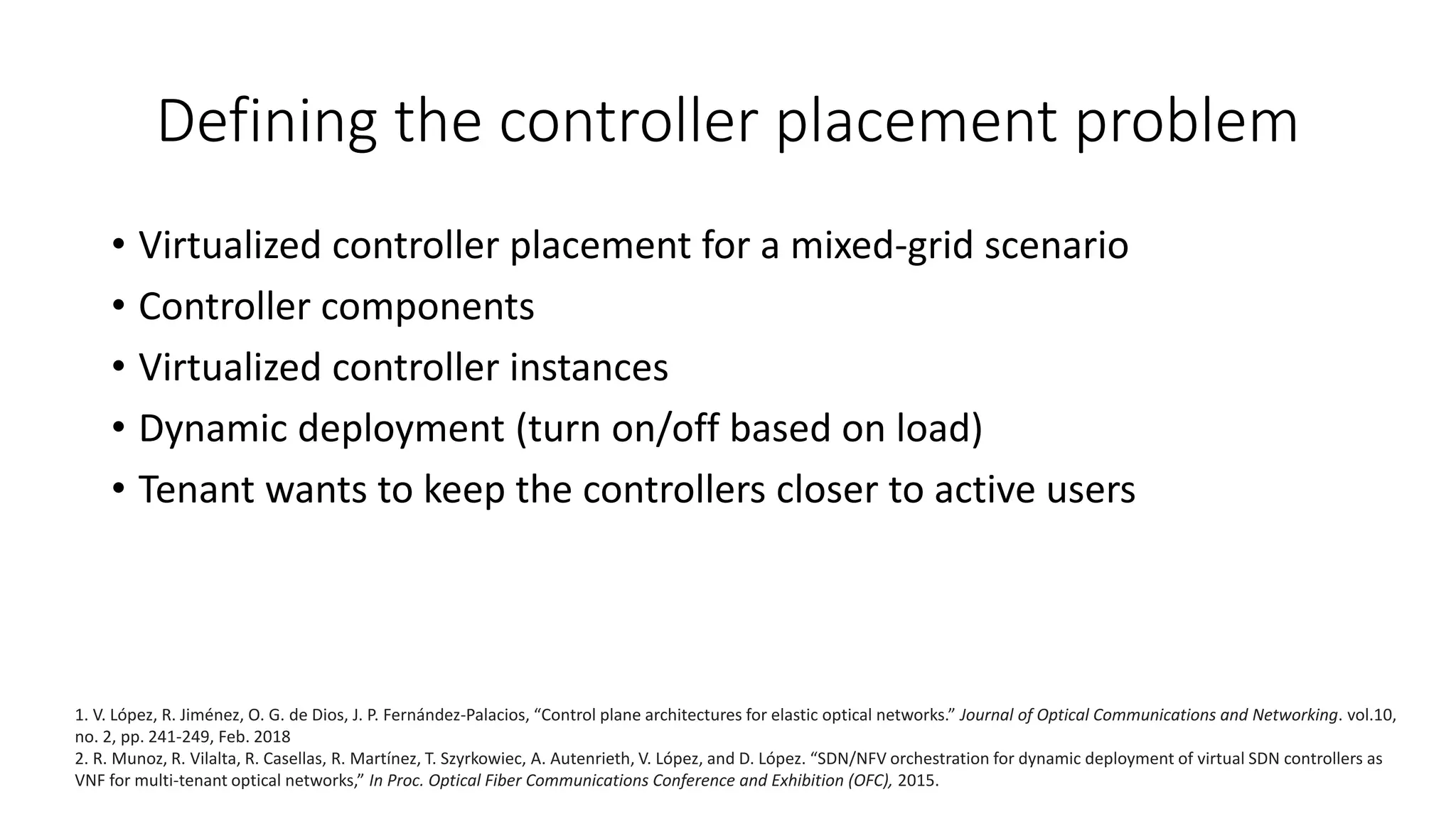
Defining the controller placement problem
• Virtualized controller placement for a mixed-grid scenario
• Controller components
• Virtualized controller instances
• Dynamic deployment (turn on/off based on load)
• Tenant wants to keep the controllers closer to active users
1. V. López, R. Jiménez, O. G. de Dios, J. P. Fernández-Palacios, “Control plane architectures for elastic optical networks.” Journal of Optical Communications and Networking. vol.10,
no. 2, pp. 241-249, Feb. 2018
2. R. Munoz, R. Vilalta, R. Casellas, R. Martínez, T. Szyrkowiec, A. Autenrieth, V. López, and D. López. “SDN/NFV orchestration for dynamic deployment of virtual SDN controllers as
VNF for multi-tenant optical networks,” In Proc. Optical Fiber Communications Conference and Exhibition (OFC), 2015.
Summary
• Transport networks are controlled by a mixed controller scenario with
multiple domains, multiple tenants, multiple vendors, and so on
• Control plane becomes much more complex if we consider mixed-grid
scenario where Fixed-grid and Flex-grid optical network co-exists
• Introducing virtualized controllers enable dynamic deployment of
these controllers
• Exploring the problem statement in this direction will solve an
important problem
Thanks!
krahman@ucdavis.edu
http://www.linkedin.com/in/kmsabidurrahman/

T-SDN Controllers for Transport Network

  • 1.
    T-SDN: Controllers for Transport Networks Sabidur Rahman Netlab,UC Davis. krahman@ucdavis.edu http://www.linkedin.com/in/kmsabidurrahman/
  • 2.
    Agenda • How T-SDNis different from SDN • How layer 0 is different from layer 1 and layer 2-3 • Control plane: Packet switched vs. Circuit Switched • Transport network function virtualization • Research directions
  • 3.
    How T-SDN isdifferent from SDN? • Transport SDN (T-SDN) is an SDN-based architecture for control and management of transport networks, that could involve multi-layer, multi- domain, and multi-vendor scenarios • Transport networks have features usually not present in computer networks where SDN paradigm arose, like resilience, sophisticated architectures, heterogeneous technologies (MPLS and others), and optical domain impairments • In this sense, T-SDN is as a subset of SDN-architecture that comprises extensions to abstractions, interfaces, protocols, and control plane elements to cope with transport networks peculiarities and limitations R. Alvizu, G. Maier, N. Kukreja, A. Pattavina, R. Morro, A. Capello, and C. Cavazzoni. “Comprehensive survey on T-SDN: Software-defined networking for transport networks,” IEEE Communications Surveys & Tutorials, vol. 19, no. 4, pp. 2232-83, 2017.
  • 4.
    How T-SDN isdifferent from SDN? Basic SDN network architecture R. Alvizu, G. Maier, N. Kukreja, A. Pattavina, R. Morro, A. Capello, and C. Cavazzoni. “Comprehensive survey on T-SDN: Software-defined networking for transport networks,” IEEE Communications Surveys & Tutorials, vol. 19, no. 4, pp. 2232-83, 2017.
  • 5.
    R. Alvizu, G.Maier, N. Kukreja, A. Pattavina, R. Morro, A. Capello, and C. Cavazzoni. “Comprehensive survey on T-SDN: Software-defined networking for transport networks,” IEEE Communications Surveys & Tutorials, vol. 19, no. 4, pp. 2232-83, 2017.
  • 6.
    Control plane: PacketSwitched vs. Circuit Switched R. Alvizu, G. Maier, N. Kukreja, A. Pattavina, R. Morro, A. Capello, and C. Cavazzoni. “Comprehensive survey on T-SDN: Software-defined networking for transport networks,” IEEE Communications Surveys & Tutorials, vol. 19, no. 4, pp. 2232-83, 2017.
  • 7.
    Transport network functionvirtualization R. Alvizu, G. Maier, N. Kukreja, A. Pattavina, R. Morro, A. Capello, and C. Cavazzoni. “Comprehensive survey on T-SDN: Software-defined networking for transport networks,” IEEE Communications Surveys & Tutorials, vol. 19, no. 4, pp. 2232-83, 2017.
  • 8.
    Defining the controllerplacement problem • Virtualized controller placement for a mixed-grid scenario • Controller components • Virtualized controller instances • Dynamic deployment (turn on/off based on load) • Tenant wants to keep the controllers closer to active users 1. V. López, R. Jiménez, O. G. de Dios, J. P. Fernández-Palacios, “Control plane architectures for elastic optical networks.” Journal of Optical Communications and Networking. vol.10, no. 2, pp. 241-249, Feb. 2018 2. R. Munoz, R. Vilalta, R. Casellas, R. Martínez, T. Szyrkowiec, A. Autenrieth, V. López, and D. López. “SDN/NFV orchestration for dynamic deployment of virtual SDN controllers as VNF for multi-tenant optical networks,” In Proc. Optical Fiber Communications Conference and Exhibition (OFC), 2015.
  • 9.
    Summary • Transport networksare controlled by a mixed controller scenario with multiple domains, multiple tenants, multiple vendors, and so on • Control plane becomes much more complex if we consider mixed-grid scenario where Fixed-grid and Flex-grid optical network co-exists • Introducing virtualized controllers enable dynamic deployment of these controllers • Exploring the problem statement in this direction will solve an important problem
  • 10.