Aum gam ganapataye namya.


Abstract & Agile
Schedule Collaboration


Shivmani Tripathi
Schneider ELECTRIC
Contents
   1.1    Abstract                                       3
   1.2    Introduction                                   4
   1.3    Challenges in multi country projects           4
   1.4    Abstract Schedule                              5
   1.5    Abstract Schedule Collaboration                6
   1.6    Agile Detailed Schedule                        7
   1.7    Agile Detailed Schedule Collaboration          9
   1.8    The sample deployment                          9
   1.9    Conclusion                                     11
   1.10   Acronyms & Abbreviations                       11
   1.11   Author(s) Profile                              12


2|Page
1.1 Abstract
         Project Management of the R&D projects that involve resource organizations located
         in different countries have unique challenges in terms of budgeting, milestone tracking
         and detailed scheduling. The competency levels, productivity, labor rates, holiday list,
         currency rates, process…etc. are all different in each center while the project is same.

         The VPs expect the five quarter forecast on project budgeting where as historical data
         to use for estimation may not be good enough as the new technology project has
         nothing in common with previous one. The effort estimates from other centers also
         need to be converted to cost based on the labor and currency rates.

         Tracking the project's actual cost, work completed may pose another difficulty due to
         geographical distance, limited communication and different time reporting methods in
         each center.

         The PM may find it difficult to decide on the level of detailed scheduling that is needed.
         This is so as more strict execution may impact technical innovation and flexibility. The
         resource assignment is another challenging area as each center resource manager
         expects to have freedom on assigning the resources to the project. They also expect
         to view the resource utilization of their department and balance the same with this
         flexibility.

         The PMO of such an organization has responsibility of presenting the portfolio, project
         status, loading of different resource centers, the budget allocation etc. at an abstract
         level that's easy to understand while ensuring it's based on facts.

         In brief the challenge is to provide an abstract view of all the involved organizations
         while ensuring the detailed planning is not overlooked. It must provide agility in
         planning while keeping a strong synchronization between abstract view for
         management and agile detailed plan for team members working on the project.

         To summarize, the key problems in such an environment are,

             How to forecast the budget for each center working on a project and improve it
             during project execution,
             How to allow the multiple resource managers in these locations to assign
             resources on the project,
             How to track the milestones at an abstract level that is based on actual effort of
             resources located in different countries,
             What are key indicators to track in such an environment,
              How to enable each center to have their own detailed plan that is agile and used
             for tracking the progress,
             How to collaborate to ensure a strong synchronization between abstract and
             detailed view ,
         Some of the challenges can be met by planning and tracking at stage gate level to
         bring simplicity. The detailed scheduling can be managed by detailing the near term
         task while keeping the one line abstraction on future tasks. The whole approach of
         collaboration can be achieved through proper web based tool deployment.


3|Page
The paper is an attempt to highlight the project management difficulties faced by PMs
         in such an environment and present a workable solution through a case study.


         1.2 Introduction
         The more and more MNCs are opting for multi-location R&D centers to take
         advantage of talent availability, lower cost and proximity to customers. These R&D
         centers need to work in a collaborative environment based on forecast, actual and
         refinement to forecast. They need to collaborate on budget, list of projects, resource
         needs, assignments, competencies and actual of all these from project execution
         perspective.

         The projects have team members located in different countries and working in
         collaboration to execute different work packages of the same project. The business
         unit head need to forecast the projects, budget and resource requirements at each
         resource center.

         The local resource managers need to plan the staffing based on this forecast and
         deploy and monitor the efficient utilization of these resources. They need to account
         for actual effort spent and report it back to global planning. The resources need to be
         communicated the projects they are assigned on and need to charge there time on
         project or non project activities.

         The project manager needs to plan the project at abstract level indicating stage gate
         dates, project type, different resources centers involved, the work packages of each
         resource center, their planned cost and its distribution. He needs to capture the actual
         cost of each center and present reports in terms of S curve, earned value and
         expected completion. He also needs to have detailed schedule indicating tasks that
         need to be completed by team members at each center. Considering the size and
         duration of project a lot of changes make the detail schedule to be updated frequently
         and it becomes a haunting task due to interdependency and complexity. In most case
         the schedule activities and actual activities being performed at any time do no match.


         1.3 Challenges in multi country projects
         The major challenges in these projects may be listed as follows,

             Project forecast for each center,
             Allocation of project budget to each center,
             Estimation, forecast, collection of actual cost, realignment of forecast,
             Detailed scheduling and keeping it updated,
             Reports at abstract and detailed scheduled level,
             Strong collaboration to share the plan, actual and issues,
             Tracking the project and achieving

         Though there may be different methods to deal with these the challenge is to have a
         consistent framework that can be implemented across organization meeting abstract
         and detailed needs of different stakeholders.


4|Page
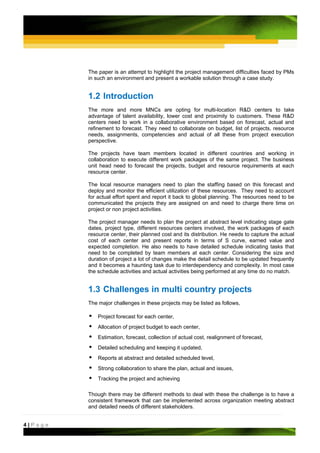
The figure 1 shows the framework the can be used to address the challenges
         mentioned above.


                                 Figure 1: Abstract & Agile Schedule


         1.4 Abstract Schedule
         The purpose of abstract schedule is to meet the needs of portfolio management and
         abstract planning and tracking. It shall provide the visibility on capacity utilization, type
         of projects being planned or under execution, the distribution of projects across global
         centers, the planned budget and its consumption, the projects status etc.


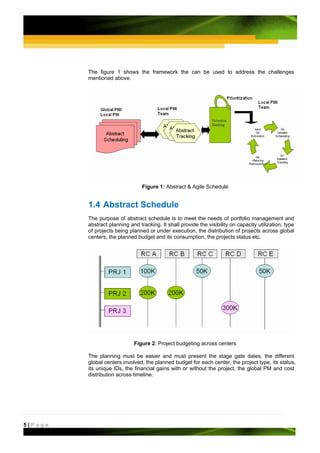
                             Figure 2: Project budgeting across centers

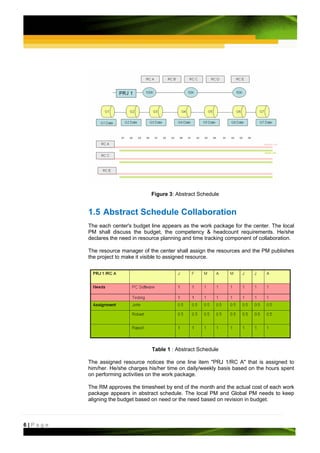
         The planning must be easier and must present the stage gate dates, the different
         global centers involved, the planned budget for each center, the project type, its status,
         its unique IDs, the financial gains with or without the project, the global PM and cost
         distribution across timeline.


5|Page
Figure 3: Abstract Schedule


         1.5 Abstract Schedule Collaboration
         The each center's budget line appears as the work package for the center. The local
         PM shall discuss the budget, the competency & headcount requirements. He/she
         declares the need in resource planning and time tracking component of collaboration.

         The resource manager of the center shall assign the resources and the PM publishes
         the project to make it visible to assigned resource.


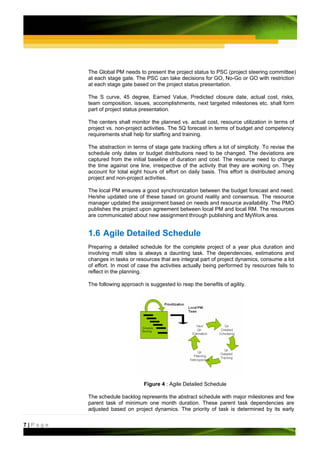
                                  Table 1 : Abstract Schedule

         The assigned resource notices the one line item "PRJ 1/RC A" that is assigned to
         him/her. He/she charges his/her time on daily/weekly basis based on the hours spent
         on performing activities on the work package.

         The RM approves the timesheet by end of the month and the actual cost of each work
         package appears in abstract schedule. The local PM and Global PM needs to keep
         aligning the budget based on need or the need based on revision in budget.


6|Page
The Global PM needs to present the project status to PSC (project steering committee)
         at each stage gate. The PSC can take decisions for GO, No-Go or GO with restriction
         at each stage gate based on the project status presentation.

         The S curve, 45 degree, Earned Value, Predicted closure date, actual cost, risks,
         team composition, issues, accomplishments, next targeted milestones etc. shall form
         part of project status presentation.

         The centers shall monitor the planned vs. actual cost, resource utilization in terms of
         project vs. non-project activities. The 5Q forecast in terms of budget and competency
         requirements shall help for staffing and training.

         The abstraction in terms of stage gate tracking offers a lot of simplicity. To revise the
         schedule only dates or budget distributions need to be changed. The deviations are
         captured from the initial baseline of duration and cost. The resource need to charge
         the time against one line, irrespective of the activity that they are working on. They
         account for total eight hours of effort on daily basis. This effort is distributed among
         project and non-project activities.

         The local PM ensures a good synchronization between the budget forecast and need.
         He/she updated one of these based on ground reality and consensus. The resource
         manager updated the assignment based on needs and resource availability. The PMO
         publishes the project upon agreement between local PM and local RM. The resources
         are communicated about new assignment through publishing and MyWork area.


         1.6 Agile Detailed Schedule
         Preparing a detailed schedule for the complete project of a year plus duration and
         involving multi sites is always a daunting task. The dependencies, estimations and
         changes in tasks or resources that are integral part of project dynamics, consume a lot
         of effort. In most of case the activities actually being performed by resources fails to
         reflect in the planning.

         The following approach is suggested to reap the benefits of agility.


                                 Figure 4 : Agile Detailed Schedule

         The schedule backlog represents the abstract schedule with major milestones and few
         parent task of minimum one month duration. These parent task dependencies are
         adjusted based on project dynamics. The priority of task is determined by its early

7|Page
completion requirement, effort required to complete and its criticality in the project.
         Thus the tasks such as architecture, design, COTS selection etc may have higher
         priority.

         The team along with local PM chooses the list of tasks appearing at top with highest
         priority level. The number of tasks chosen shall be possible to complete within one
         quarter team effort. The teams breaks down these backlog task to further details and
         performs estimation and prepares mini schedule taking into account the previous
         experience and newly evolved project scenario. The team executes this mini schedule
         and no changes are allowed while its under execution. The team tracks the progress
         of execution with daily standing meeting of 10 to 15 minute duration.

         The project documents are updated, the issues are logged, and the resolutions are
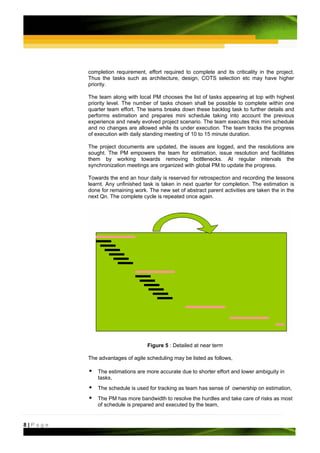
         sought. The PM empowers the team for estimation, issue resolution and facilitates
         them by working towards removing bottlenecks. At regular intervals the
         synchronization meetings are organized with global PM to update the progress.

         Towards the end an hour daily is reserved for retrospection and recording the lessons
         learnt. Any unfinished task is taken in next quarter for completion. The estimation is
         done for remaining work. The new set of abstract parent activities are taken the in the
         next Qn. The complete cycle is repeated once again.


                                 Figure 5 : Detailed at near term

         The advantages of agile scheduling may be listed as follows,

             The estimations are more accurate due to shorter effort and lower ambiguity in
             tasks,
             The schedule is used for tracking as team has sense of ownership on estimation,
             The PM has more bandwidth to resolve the hurdles and take care of risks as most
             of schedule is prepared and executed by the team,


8|Page
PM has more control as he adjusts the priorities of tasks in Schedule Backlog
             The chances of slippage are lower due to shorter duration and team commitment,
             The lessons learnt are more relevant and used of next quarter planning,
             The overall team health is better.


         1.7 Agile Detailed Schedule Collaboration
         The teams working on agile schedule collaborate more frequently than the traditional
         schedule. The daily standing meeting offers a unique opportunity to state the
         yesterday's completed task, today's planned task and issue if any by each team
         member. The complete schedule containing parents for future and detailed children for
         current and past parents is web shared with adequate permissions.

         The PM can update the parents and their order and publish the project. The team
         members can view the assigned tasks from anywhere and work accordingly on daily
         basis. The local PM updates the task completion on daily basis. Each task completion
         is either 0% or 100%. The project issues are logged and assigned. The assignee
         update the status on issues and its closure is tracked. The team uploads the project
         documents for reviews. The new topics discussion threads can be started. The
         lessons learnt are captures and shared.

         The complete agile schedule is available to all stakeholders at any point of time
         through web access and adequate permissions on collaboration. The required reports
         on project metrics are computed and keep getting updated based on project updates.
         The new reports can be designed using appropriate fields to meet the needs of the
         organization.


         1.8 The sample deployment
         The above suggestion is deployed using PSNext 3.0. The snapshots related to topics
         discussed above are as shown below for reference.

             Abstract planning
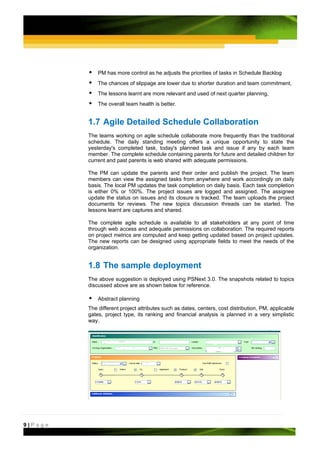
         The different project attributes such as dates, centers, cost distribution, PM, applicable
         gates, project type, its ranking and financial analysis is planned in a very simplistic
         way.


9|Page
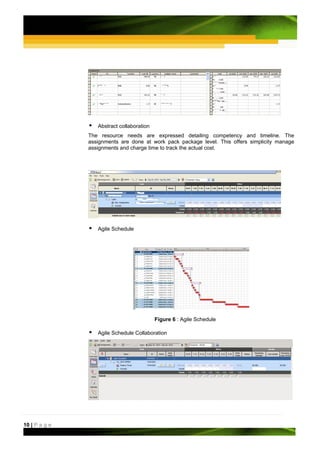
Abstract collaboration
               The resource needs are expressed detailing competency and timeline. The
               assignments are done at work pack package level. This offers simplicity manage
               assignments and charge time to track the actual cost.


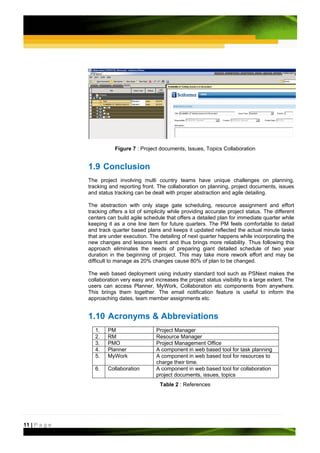
                  Agile Schedule


                                           Figure 6 : Agile Schedule

                  Agile Schedule Collaboration


10 | P a g e
Figure 7 : Project documents, Issues, Topics Collaboration


               1.9 Conclusion
               The project involving multi country teams have unique challenges on planning,
               tracking and reporting front. The collaboration on planning, project documents, issues
               and status tracking can be dealt with proper abstraction and agile detailing.

               The abstraction with only stage gate scheduling, resource assignment and effort
               tracking offers a lot of simplicity while providing accurate project status. The different
               centers can build agile schedule that offers a detailed plan for immediate quarter while
               keeping it as a one line item for future quarters. The PM feels comfortable to detail
               and track quarter based plans and keeps it updated reflected the actual minute tasks
               that are under execution. The detailing of next quarter happens while incorporating the
               new changes and lessons learnt and thus brings more reliability. Thus following this
               approach eliminates the needs of preparing giant detailed schedule of two year
               duration in the beginning of project. This may take more rework effort and may be
               difficult to manage as 20% changes cause 80% of plan to be changed.

               The web based deployment using industry standard tool such as PSNext makes the
               collaboration very easy and increases the project status visibility to a large extent. The
               users can access Planner, MyWork, Collaboration etc components from anywhere.
               This brings them together. The email notification feature is useful to inform the
               approaching dates, team member assignments etc.


               1.10 Acronyms & Abbreviations
                  1.   PM                   Project Manager
                  2.   RM                   Resource Manager
                  3.   PMO                  Project Management Office
                  4.   Planner              A component in web based tool for task planning
                  5.   MyWork               A component in web based tool for resources to
                                            charge their time.
                  6.   Collaboration        A component in web based tool for collaboration
                                            project documents, issues, topics
                                              Table 2 : References


11 | P a g e
1.11 Author(s) Profile


               Shivmani Tripathi an Electronics Engineer with MBA (Marketing) and MS
               (Software Systems) is currently working at AOCI, Schneider Electric as PMO
               Head. In 2004 he started the SoftwareOperations for the company in
               Bangalore. He has been engaged with HCL Technologies,Celstream,
               Thomson Multimedia and ONIDA during his last 17 years. During this period
               heworked in USA, France, Germany, Singapore and Israel in different
               capacities. He is a Certified SCRUM Master.

               E-mail: shivmanit@yahoo.com


12 | P a g e

Trn 06

  • 1.
    Aum gam ganapatayenamya. Abstract & Agile Schedule Collaboration Shivmani Tripathi Schneider ELECTRIC
  • 2.
    Contents 1.1 Abstract 3 1.2 Introduction 4 1.3 Challenges in multi country projects 4 1.4 Abstract Schedule 5 1.5 Abstract Schedule Collaboration 6 1.6 Agile Detailed Schedule 7 1.7 Agile Detailed Schedule Collaboration 9 1.8 The sample deployment 9 1.9 Conclusion 11 1.10 Acronyms & Abbreviations 11 1.11 Author(s) Profile 12 2|Page
  • 3.
    1.1 Abstract Project Management of the R&D projects that involve resource organizations located in different countries have unique challenges in terms of budgeting, milestone tracking and detailed scheduling. The competency levels, productivity, labor rates, holiday list, currency rates, process…etc. are all different in each center while the project is same. The VPs expect the five quarter forecast on project budgeting where as historical data to use for estimation may not be good enough as the new technology project has nothing in common with previous one. The effort estimates from other centers also need to be converted to cost based on the labor and currency rates. Tracking the project's actual cost, work completed may pose another difficulty due to geographical distance, limited communication and different time reporting methods in each center. The PM may find it difficult to decide on the level of detailed scheduling that is needed. This is so as more strict execution may impact technical innovation and flexibility. The resource assignment is another challenging area as each center resource manager expects to have freedom on assigning the resources to the project. They also expect to view the resource utilization of their department and balance the same with this flexibility. The PMO of such an organization has responsibility of presenting the portfolio, project status, loading of different resource centers, the budget allocation etc. at an abstract level that's easy to understand while ensuring it's based on facts. In brief the challenge is to provide an abstract view of all the involved organizations while ensuring the detailed planning is not overlooked. It must provide agility in planning while keeping a strong synchronization between abstract view for management and agile detailed plan for team members working on the project. To summarize, the key problems in such an environment are, How to forecast the budget for each center working on a project and improve it during project execution, How to allow the multiple resource managers in these locations to assign resources on the project, How to track the milestones at an abstract level that is based on actual effort of resources located in different countries, What are key indicators to track in such an environment, How to enable each center to have their own detailed plan that is agile and used for tracking the progress, How to collaborate to ensure a strong synchronization between abstract and detailed view , Some of the challenges can be met by planning and tracking at stage gate level to bring simplicity. The detailed scheduling can be managed by detailing the near term task while keeping the one line abstraction on future tasks. The whole approach of collaboration can be achieved through proper web based tool deployment. 3|Page
  • 4.
    The paper isan attempt to highlight the project management difficulties faced by PMs in such an environment and present a workable solution through a case study. 1.2 Introduction The more and more MNCs are opting for multi-location R&D centers to take advantage of talent availability, lower cost and proximity to customers. These R&D centers need to work in a collaborative environment based on forecast, actual and refinement to forecast. They need to collaborate on budget, list of projects, resource needs, assignments, competencies and actual of all these from project execution perspective. The projects have team members located in different countries and working in collaboration to execute different work packages of the same project. The business unit head need to forecast the projects, budget and resource requirements at each resource center. The local resource managers need to plan the staffing based on this forecast and deploy and monitor the efficient utilization of these resources. They need to account for actual effort spent and report it back to global planning. The resources need to be communicated the projects they are assigned on and need to charge there time on project or non project activities. The project manager needs to plan the project at abstract level indicating stage gate dates, project type, different resources centers involved, the work packages of each resource center, their planned cost and its distribution. He needs to capture the actual cost of each center and present reports in terms of S curve, earned value and expected completion. He also needs to have detailed schedule indicating tasks that need to be completed by team members at each center. Considering the size and duration of project a lot of changes make the detail schedule to be updated frequently and it becomes a haunting task due to interdependency and complexity. In most case the schedule activities and actual activities being performed at any time do no match. 1.3 Challenges in multi country projects The major challenges in these projects may be listed as follows, Project forecast for each center, Allocation of project budget to each center, Estimation, forecast, collection of actual cost, realignment of forecast, Detailed scheduling and keeping it updated, Reports at abstract and detailed scheduled level, Strong collaboration to share the plan, actual and issues, Tracking the project and achieving Though there may be different methods to deal with these the challenge is to have a consistent framework that can be implemented across organization meeting abstract and detailed needs of different stakeholders. 4|Page
  • 5.
    The figure 1shows the framework the can be used to address the challenges mentioned above. Figure 1: Abstract & Agile Schedule 1.4 Abstract Schedule The purpose of abstract schedule is to meet the needs of portfolio management and abstract planning and tracking. It shall provide the visibility on capacity utilization, type of projects being planned or under execution, the distribution of projects across global centers, the planned budget and its consumption, the projects status etc. Figure 2: Project budgeting across centers The planning must be easier and must present the stage gate dates, the different global centers involved, the planned budget for each center, the project type, its status, its unique IDs, the financial gains with or without the project, the global PM and cost distribution across timeline. 5|Page
  • 6.
    Figure 3: AbstractSchedule 1.5 Abstract Schedule Collaboration The each center's budget line appears as the work package for the center. The local PM shall discuss the budget, the competency & headcount requirements. He/she declares the need in resource planning and time tracking component of collaboration. The resource manager of the center shall assign the resources and the PM publishes the project to make it visible to assigned resource. Table 1 : Abstract Schedule The assigned resource notices the one line item "PRJ 1/RC A" that is assigned to him/her. He/she charges his/her time on daily/weekly basis based on the hours spent on performing activities on the work package. The RM approves the timesheet by end of the month and the actual cost of each work package appears in abstract schedule. The local PM and Global PM needs to keep aligning the budget based on need or the need based on revision in budget. 6|Page
  • 7.
    The Global PMneeds to present the project status to PSC (project steering committee) at each stage gate. The PSC can take decisions for GO, No-Go or GO with restriction at each stage gate based on the project status presentation. The S curve, 45 degree, Earned Value, Predicted closure date, actual cost, risks, team composition, issues, accomplishments, next targeted milestones etc. shall form part of project status presentation. The centers shall monitor the planned vs. actual cost, resource utilization in terms of project vs. non-project activities. The 5Q forecast in terms of budget and competency requirements shall help for staffing and training. The abstraction in terms of stage gate tracking offers a lot of simplicity. To revise the schedule only dates or budget distributions need to be changed. The deviations are captured from the initial baseline of duration and cost. The resource need to charge the time against one line, irrespective of the activity that they are working on. They account for total eight hours of effort on daily basis. This effort is distributed among project and non-project activities. The local PM ensures a good synchronization between the budget forecast and need. He/she updated one of these based on ground reality and consensus. The resource manager updated the assignment based on needs and resource availability. The PMO publishes the project upon agreement between local PM and local RM. The resources are communicated about new assignment through publishing and MyWork area. 1.6 Agile Detailed Schedule Preparing a detailed schedule for the complete project of a year plus duration and involving multi sites is always a daunting task. The dependencies, estimations and changes in tasks or resources that are integral part of project dynamics, consume a lot of effort. In most of case the activities actually being performed by resources fails to reflect in the planning. The following approach is suggested to reap the benefits of agility. Figure 4 : Agile Detailed Schedule The schedule backlog represents the abstract schedule with major milestones and few parent task of minimum one month duration. These parent task dependencies are adjusted based on project dynamics. The priority of task is determined by its early 7|Page
  • 8.
    completion requirement, effortrequired to complete and its criticality in the project. Thus the tasks such as architecture, design, COTS selection etc may have higher priority. The team along with local PM chooses the list of tasks appearing at top with highest priority level. The number of tasks chosen shall be possible to complete within one quarter team effort. The teams breaks down these backlog task to further details and performs estimation and prepares mini schedule taking into account the previous experience and newly evolved project scenario. The team executes this mini schedule and no changes are allowed while its under execution. The team tracks the progress of execution with daily standing meeting of 10 to 15 minute duration. The project documents are updated, the issues are logged, and the resolutions are sought. The PM empowers the team for estimation, issue resolution and facilitates them by working towards removing bottlenecks. At regular intervals the synchronization meetings are organized with global PM to update the progress. Towards the end an hour daily is reserved for retrospection and recording the lessons learnt. Any unfinished task is taken in next quarter for completion. The estimation is done for remaining work. The new set of abstract parent activities are taken the in the next Qn. The complete cycle is repeated once again. Figure 5 : Detailed at near term The advantages of agile scheduling may be listed as follows, The estimations are more accurate due to shorter effort and lower ambiguity in tasks, The schedule is used for tracking as team has sense of ownership on estimation, The PM has more bandwidth to resolve the hurdles and take care of risks as most of schedule is prepared and executed by the team, 8|Page
  • 9.
    PM has morecontrol as he adjusts the priorities of tasks in Schedule Backlog The chances of slippage are lower due to shorter duration and team commitment, The lessons learnt are more relevant and used of next quarter planning, The overall team health is better. 1.7 Agile Detailed Schedule Collaboration The teams working on agile schedule collaborate more frequently than the traditional schedule. The daily standing meeting offers a unique opportunity to state the yesterday's completed task, today's planned task and issue if any by each team member. The complete schedule containing parents for future and detailed children for current and past parents is web shared with adequate permissions. The PM can update the parents and their order and publish the project. The team members can view the assigned tasks from anywhere and work accordingly on daily basis. The local PM updates the task completion on daily basis. Each task completion is either 0% or 100%. The project issues are logged and assigned. The assignee update the status on issues and its closure is tracked. The team uploads the project documents for reviews. The new topics discussion threads can be started. The lessons learnt are captures and shared. The complete agile schedule is available to all stakeholders at any point of time through web access and adequate permissions on collaboration. The required reports on project metrics are computed and keep getting updated based on project updates. The new reports can be designed using appropriate fields to meet the needs of the organization. 1.8 The sample deployment The above suggestion is deployed using PSNext 3.0. The snapshots related to topics discussed above are as shown below for reference. Abstract planning The different project attributes such as dates, centers, cost distribution, PM, applicable gates, project type, its ranking and financial analysis is planned in a very simplistic way. 9|Page
  • 10.
    Abstract collaboration The resource needs are expressed detailing competency and timeline. The assignments are done at work pack package level. This offers simplicity manage assignments and charge time to track the actual cost. Agile Schedule Figure 6 : Agile Schedule Agile Schedule Collaboration 10 | P a g e
  • 11.
    Figure 7 :Project documents, Issues, Topics Collaboration 1.9 Conclusion The project involving multi country teams have unique challenges on planning, tracking and reporting front. The collaboration on planning, project documents, issues and status tracking can be dealt with proper abstraction and agile detailing. The abstraction with only stage gate scheduling, resource assignment and effort tracking offers a lot of simplicity while providing accurate project status. The different centers can build agile schedule that offers a detailed plan for immediate quarter while keeping it as a one line item for future quarters. The PM feels comfortable to detail and track quarter based plans and keeps it updated reflected the actual minute tasks that are under execution. The detailing of next quarter happens while incorporating the new changes and lessons learnt and thus brings more reliability. Thus following this approach eliminates the needs of preparing giant detailed schedule of two year duration in the beginning of project. This may take more rework effort and may be difficult to manage as 20% changes cause 80% of plan to be changed. The web based deployment using industry standard tool such as PSNext makes the collaboration very easy and increases the project status visibility to a large extent. The users can access Planner, MyWork, Collaboration etc components from anywhere. This brings them together. The email notification feature is useful to inform the approaching dates, team member assignments etc. 1.10 Acronyms & Abbreviations 1. PM Project Manager 2. RM Resource Manager 3. PMO Project Management Office 4. Planner A component in web based tool for task planning 5. MyWork A component in web based tool for resources to charge their time. 6. Collaboration A component in web based tool for collaboration project documents, issues, topics Table 2 : References 11 | P a g e
  • 12.
    1.11 Author(s) Profile Shivmani Tripathi an Electronics Engineer with MBA (Marketing) and MS (Software Systems) is currently working at AOCI, Schneider Electric as PMO Head. In 2004 he started the SoftwareOperations for the company in Bangalore. He has been engaged with HCL Technologies,Celstream, Thomson Multimedia and ONIDA during his last 17 years. During this period heworked in USA, France, Germany, Singapore and Israel in different capacities. He is a Certified SCRUM Master. E-mail: shivmanit@yahoo.com 12 | P a g e