Aum gam ganapataye namya.


Orchestrating Change:
The role of a Strategic
PMO in Managing
Organizational
Transformation


Niloofer (Darbary) Narendran, PMP
Hewlett Packard Ltd


    This paper is copyright to Hewlett Packard Ltd and PMI cannot reproduce this paper in any other
            publication without the written consent of the Author and Hewlett Packard Ltd
Contents
   1.1     What is a Strategic PMO?                                                                  5
   1.1.1   Moving from Strategy to Execution:                                                        5
   1.2     The Strategic PMO framework                                                               6
   1.2.1   Vision Statement                                                                          6
   1.2.2   Mission statement                                                                         6
   1.2.3   Mission elements:                                                                         7
   1.2.4   Work streams:                                                                             7
   1.3     The STrategic PMO structure                                                               7
   1.3.1   Executive council:                                                                        8
   1.3.2   Steering committee:                                                                       8
   1.3.3   SPMO:                                                                                     8
   1.3.4   Maintain focus:                                                                           8
   1.3.5   Overall governance                                                                        8
   1.3.6   Manage behaviors and communication                                                        9
   1.3.7   Work stream leads:                                                                        9
   1.3.8   Sub work stream initiative lead:                                                          9
   1.4     The lifecycle of an SPMO:                                                                 9
   1.4.1   Mobilizing:                                                                               9
   1.4.2   Planning:                                                                                 9
   1.4.3   Implementing:                                                                             10
   1.4.4   Transitioning:                                                                            10
   1.5     Moving from a publicily listed entity to a wholly owned Subsidiary of a global IT major   10
   1.5.1   Background:                                                                               10
   1.5.2   Integration Challenges:                                                                   10
   1.5.3   The transformational journey                                                              11
   1.5.4   INTEGRATION PMO STRUCTURE                                                                 11
   1.6     Moving from a HIGHLY localized set up to a SHARED Global Delivery model                   11
   1.6.1   Background:                                                                               11
   1.6.2   Vision:                                                                                   11
   1.6.3   Mission:                                                                                  11
   1.6.4   Setting up the GD PMO                                                                     12
   1.6.5   Challenges                                                                                13
   1.7     Innovation driven thru the Centers of Excellence                                          13
   1.7.1   Background:                                                                               13
   1.7.2   The PMO requirement:                                                                      13
   1.8     Conclusion:                                                                               14

2|Page
1.9    References         14
   1.10   Author’s Profile   14


3|Page
Have you ever noticed how a strong and successful principle conductor can
         orchestrate the right instrumentalists to create fantastic music? Similarly, the key to
         success for an organization in the midst of change is to have a strong PMO that can
         orchestrate a cohesive change far more successful than if initiatives were driven
         individually. Many large organizations with well intended strategies have been
         unsuccessful in their implementation. With individual entities working in silo’s driving
         their own charter, it is critical to have an overarching organization responsible for
         ensuring that all the pieces fit together seamlessly.

         The presentation “orchestrating change”, will touch upon the creation of such strategic
         PMO’s to maneuver an organization thru ambiguous periods of change and emerge
         successful. The presentation touches upon three strategic initiatives that benefit from
         a strong PMO set up, namely; an organization that is reinventing itself while going thru
         a merger or acquisition, an organization that is moving from a highly localized set up
         to a Global Delivery model, and an organization striving to drive technology innovation
         at the grass root level.

         In today’s global environment the strategic PMO plays a key role in managing
         initiatives that run across functions and across geographical boundaries. Having the
         right PMO setup with a right level of authority can be instrumental in putting strategy in
         action and driving organizational transformation globally


         1.1 Keywords:
         Strategy in action, Strategic PMO, Mergers & Acquisitions, Global Delivery, Innovation

         1.2 Introduction
          “It is not the strongest of the species that survives, nor the most intelligent, but
                    the one that is most responsive to change” - Charles Darwin

         Have you ever had to embrace change in your current organization? How effectively
         do you believe you were able to cope with this change? Looking back, do you believe
         the change worked in your favor?

         The only thing constant is change, and with it change brings uncertainty, chaos and
         confusion. Change forces us to depart from our regular ways and moves us out of our
         orbit of inertia. Organizations who embrace change and guide their employees thru
         the sea of change with minimal disruption are the ones who can actually execute on
         their vision successfully.

            “In symphonic music, when you are conducting, you are feeling the whole
          orchestra, thinking ahead so you can prepare for a change.” - David Amram

         Managing change is a challenge that every organization has to deal with. The
         Strategic Program Managers Office (referred to as SPMO) plays a key role in
         orchestrating this change. Just like a principle conductor the SPMO has the bigger
         picture in mind, is always looking ahead focused on achieving the overarching goal
         and preparing the team to embrace change effectively


4|Page
1.3 What is a Strategic PMO?
         To understand the functioning of the strategic PMO, let us first look at the definitions of
         its constituents

         Strategy1, a word of military origin, refers to a plan of action designed to achieve a
         particular goal – (Wikipedia)

         A Program2 is a group of related projects managed in a coordinated way to obtain
         benefits and control not available from managing them individually“

         The PMO3 is an organizational body or entity assigned various responsibilities related
         to the centralized and coordinated management of those projects under its domain.

         The strategic PMO embodies the essence of all these three requirements.

             The Strategic “Program” Managers Office is
             focused around achieving a specific goal
             has a clear plan of action driven thru a group of initiatives or programs
             works on centralized and coordinated management of all the initiatives/programs
             under its domain, required to achieve its stated objective
         While a regular PMO is typically set up as an operational function within an
         organization, the Strategic PMO is a temporary structure set up for the organization to
         meet a specific strategic objective. While the regular PMO function typically manages
         similar projects under its domain, the strategic PMO links diverse initiatives that would
         typically be managed as a silos’ in the organization.

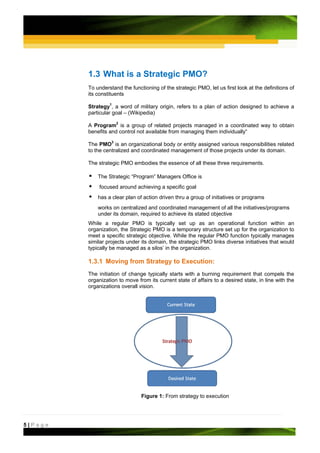
         1.3.1 Moving from Strategy to Execution:
         The initiation of change typically starts with a burning requirement that compels the
         organization to move from its current state of affairs to a desired state, in line with the
         organizations overall vision.


                                Figure 1: From strategy to execution


5|Page
The transformation journey from the current state, to the desired state is bridged by
         the Strategic PMO. Once the desired state is clearly articulated the PMO plays a
         critical role in the transformational journey ensuring the organization is kept focused
         while steering the ship towards the desired state.


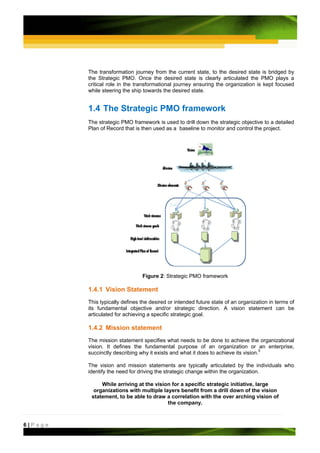
         1.4 The Strategic PMO framework
         The strategic PMO framework is used to drill down the strategic objective to a detailed
         Plan of Record that is then used as a baseline to monitor and control the project.


                                Figure 2: Strategic PMO framework

         1.4.1 Vision Statement
         This typically defines the desired or intended future state of an organization in terms of
         its fundamental objective and/or strategic direction. A vision statement can be
         articulated for achieving a specific strategic goal.

         1.4.2 Mission statement
         The mission statement specifies what needs to be done to achieve the organizational
         vision. It defines the fundamental purpose of an organization or an enterprise,
         succinctly describing why it exists and what it does to achieve its vision.5

         The vision and mission statements are typically articulated by the individuals who
         identify the need for driving the strategic change within the organization.

              While arriving at the vision for a specific strategic initiative, large
           organizations with multiple layers benefit from a drill down of the vision
          statement, to be able to draw a correlation with the over arching vision of
                                         the company.


6|Page
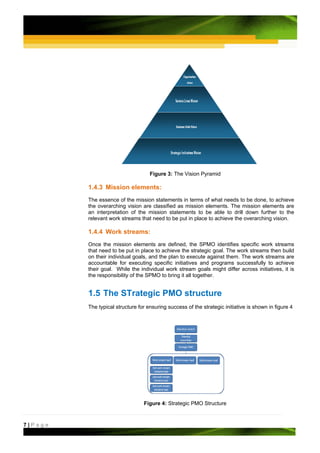
Figure 3: The Vision Pyramid

         1.4.3 Mission elements:
         The essence of the mission statements in terms of what needs to be done, to achieve
         the overarching vision are classified as mission elements. The mission elements are
         an interpretation of the mission statements to be able to drill down further to the
         relevant work streams that need to be put in place to achieve the overarching vision.

         1.4.4 Work streams:
         Once the mission elements are defined, the SPMO identifies specific work streams
         that need to be put in place to achieve the strategic goal. The work streams then build
         on their individual goals, and the plan to execute against them. The work streams are
         accountable for executing specific initiatives and programs successfully to achieve
         their goal. While the individual work stream goals might differ across initiatives, it is
         the responsibility of the SPMO to bring it all together.


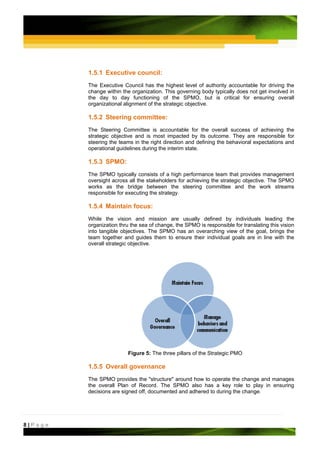
         1.5 The STrategic PMO structure
         The typical structure for ensuring success of the strategic initiative is shown in figure 4


                                 Figure 4: Strategic PMO Structure


7|Page
1.5.1 Executive council:
         The Executive Council has the highest level of authority accountable for driving the
         change within the organization. This governing body typically does not get involved in
         the day to day functioning of the SPMO, but is critical for ensuring overall
         organizational alignment of the strategic objective.

         1.5.2 Steering committee:
         The Steering Committee is accountable for the overall success of achieving the
         strategic objective and is most impacted by its outcome. They are responsible for
         steering the teams in the right direction and defining the behavioral expectations and
         operational guidelines during the interim state.

         1.5.3 SPMO:
         The SPMO typically consists of a high performance team that provides management
         oversight across all the stakeholders for achieving the strategic objective. The SPMO
         works as the bridge between the steering committee and the work streams
         responsible for executing the strategy.

         1.5.4 Maintain focus:
         While the vision and mission are usually defined by individuals leading the
         organization thru the sea of change, the SPMO is responsible for translating this vision
         into tangible objectives. The SPMO has an overarching view of the goal, brings the
         team together and guides them to ensure their individual goals are in line with the
         overall strategic objective.


                          Figure 5: The three pillars of the Strategic PMO

         1.5.5 Overall governance
         The SPMO provides the "structure" around how to operate the change and manages
         the overall Plan of Record. The SPMO also has a key role to play in ensuring
         decisions are signed off, documented and adhered to during the change.


8|Page
1.5.6 Manage behaviors and communication
         Perhaps the most important function of the SPMO is managing communication and
         the cultural nuances of interacting with diverse teams. Communication is the key to
         success for achieving an organizations strategic goal and is the vehicle to bring all the
         stakeholders to work towards a common vision. The SPMO is responsible for ensuring
         the right communication is shared across stakeholders at the right frequency. The
         SPMO also works as a common thread across all the work streams to ensure linkages
         are established and no decisions are taken in isolation without analyzing the impact it
         could potentially have on the overall initiative.

         1.5.7 Work stream leads:
         The work stream leads are responsible for defining the objectives for their individual
         work streams and are accountable for executing specific initiatives and programs
         successfully to achieve their objective.

         1.5.8 Sub work stream initiative lead:
         The sub work stream initiative leads are specifically focused around managing the
         successful execution of their specific initiative.


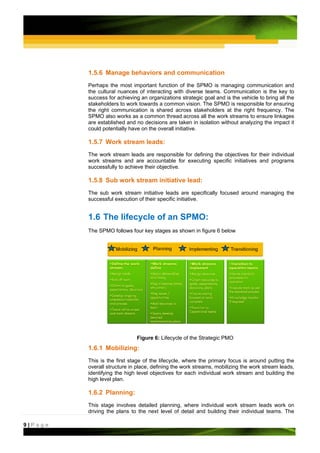
         1.6 The lifecycle of an SPMO:
         The SPMO follows four key stages as shown in figure 6 below


                              Figure 6: Lifecycle of the Strategic PMO
         1.6.1 Mobilizing:
         This is the first stage of the lifecycle, where the primary focus is around putting the
         overall structure in place, defining the work streams, mobilizing the work stream leads,
         identifying the high level objectives for each individual work stream and building the
         high level plan.

         1.6.2 Planning:
         This stage involves detailed planning, where individual work stream leads work on
         driving the plans to the next level of detail and building their individual teams. The

9|Page
work stream plans are then aggregated into an overall Plan of Record, which is
               managed by the SPMO

               1.6.3 Implementing:
               This stage involves driving the execution of individual work stream plans to achieve
               their stated objective.

               1.6.4 Transitioning:
               This phase focuses on handing over the baton to the ongoing operations team,
               responsible for managing the work stream deliverables on a regular basis.

               Individual work streams are typically be at different stages of the lifecycle depending
               on the complexity of their initiatives. The SPMO oversees the entire lifecycle across all
               the work streams until the desired objective is met.


               1.7 Moving from a publicily listed entity to a
               wholly owned Subsidiary of a global IT major
               1.7.1 Background:
               In the year 2004 a publicaly listed Indian IT firm, with a 51% shareholding of a global
               IT major was one of the first few companies to use the reverse book building process
               to delist from the Indian Stock exchange. The Indian IT firm (A) became a wholly
               owned subsidiary of the global It major, while continuing to retain its cost
               competitiveness. The Global IT major also merged one of its smaller services unit (B)
               within India with this entity with the objective that the combined entity would serve as a
               back office for it to build its services presence offshore.

               1.7.2 Integration Challenges:
               The Indian IT firm was a publicly listed entity accountable to its shareholders, with
               aggressive growth targets. Transforming itself from a P&L focused organization, to a
               back office cost center brought in its own degree of complexity. Also, a complete
               integration with the global IT majors worldwide policies and processes would diminish
               the cost competitive advantage that the entity had enjoyed so far.


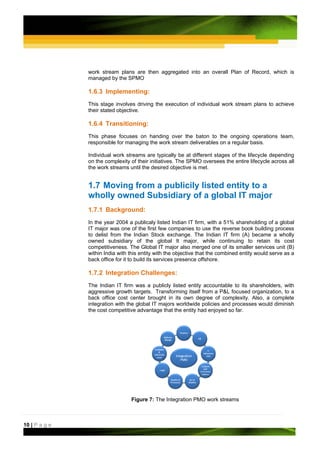
                                 Figure 7: The Integration PMO work streams


10 | P a g e
1.7.3 The transformational journey
               The organization needed a strong PMO structure to manage the integration of the two
               entities while transforming itself into a strategic back office center. The PMO‘s
               objective was to design, develop, and implement the new merged organization, while
               achieving accelerated business growth, ensuring expected synergies were realized
               and easing the complexity of the integration for the organization.

               The integration was managed thru multiple work streams (refer to figure 7) driving
               their own agenda, while the PMO ensured management oversight across the
               workstreams to ensure the overall objective was met.

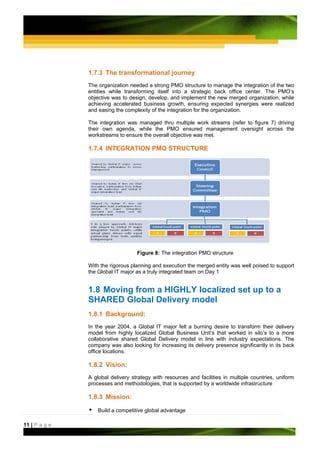
               1.7.4 INTEGRATION PMO STRUCTURE


                                   Figure 8: The integration PMO structure

               With the rigorous planning and execution the merged entity was well poised to support
               the Global IT major as a truly integrated team on Day 1


               1.8 Moving from a HIGHLY localized set up to a
               SHARED Global Delivery model
               1.8.1 Background:
               In the year 2004, a Global IT major felt a burning desire to transform their delivery
               model from highly localized Global Business Unit’s that worked in silo’s to a more
               collaborative shared Global Delivery model in line with industry expectations. The
               company was also looking for increasing its delivery presence significantly in its back
               office locations.

               1.8.2 Vision:
               A global delivery strategy with resources and facilities in multiple countries, uniform
               processes and methodologies, that is supported by a worldwide infrastructure

               1.8.3 Mission:

                   Build a competitive global advantage

11 | P a g e
Leverage capabilities and assets more broadly
                  Reduce the unit cost of service
                  Improve quality and seamless efficiency
                  Ensure consistency and reliability
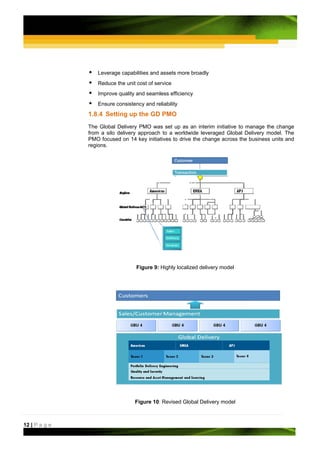
               1.8.4 Setting up the GD PMO
               The Global Delivery PMO was set up as an interim initiative to manage the change
               from a silo delivery approach to a worldwide leveraged Global Delivery model. The
               PMO focused on 14 key initiatives to drive the change across the business units and
               regions.


                                  Figure 9: Highly localized delivery model


                                 Figure 10: Revised Global Delivery model


12 | P a g e
1.8.5 Challenges
               Considering the negative       connotations and sensitivities around the term “Global
               Delivery”, as well as the     legal aspects of rolling out the initiative across different
               regions with differing laws   of the land, the SPMO had to manage expectations, drive
               the right behaviors and        ensure the right level of communication reached its
               stakeholders.


               1.9 Innovation driven thru the Centers of
               Excellence
               1.9.1 Background:
               The Applications unit of a Global IT major was formed as an amalgamation of centers
               brought together thru mergers, resource acquisitions in large accounts and focused
               growth in strategic locations. While the centers rolled up to a global function, they
               were still operating as independent units within the organization. The technology
               departments within these centers each worked on their own charter for building their
               own capability within the centers without an overall strategy for nurturing technology
               competence across the organization

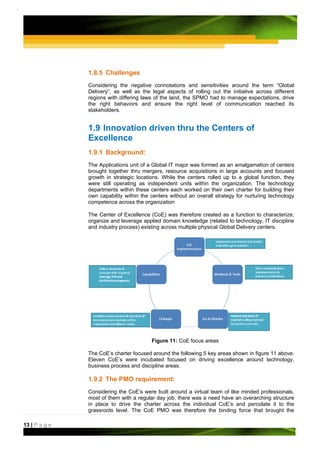
               The Center of Excellence (CoE) was therefore created as a function to characterize,
               organize and leverage applied domain knowledge (related to technology, IT discipline
               and industry process) existing across multiple physical Global Delivery centers.


                                             Figure 11: CoE focus areas

               The CoE’s charter focused around the following 5 key areas shown in figure 11 above.
               Eleven CoE’s were incubated focused on driving excellence around technology,
               business process and discipline areas.

               1.9.2 The PMO requirement:
               Considering the CoE’s were built around a virtual team of like minded professionals,
               most of them with a regular day job, there was a need have an overarching structure
               in place to drive the charter across the individual CoE’s and percolate it to the
               grassroots level. The CoE PMO was therefore the binding force that brought the

13 | P a g e
teams together under a common charter and managed the operational framework
               around the execution of the CoE’s.


               1.10 Conclusion:
               While a lot of organizations are very familiar with the standard PMO function, there are
               very limited Strategic PMO’s set up to manage change in organizations today. The
               strategic PMO plays a critical role in translating an organizations vision into a tangible
               plan that can be monitored and controlled with a lot of rigor. Companies that are built
               to succeed are the ones where detailed strategic planning is followed by a clear plan
               of action, which ensures execution towards achieving the companies desired outcome.


               1.11 References
               [1] Wikipedia, webpage: http://en.wikipedia.org/wiki/Strategy
               [2] PMBOK® Guide-Third Edition
               [3] PMBOK, Guide-Third Edition
               [4] Wikipedia webpage
               http://en.wikipedia.org/wiki/Vision_statement#Mission_statements_and_vision
               _statements
               [5] Wikipedia webpage http://en.wikipedia.org/wiki/Vision_statement #
               Mission_statements_and_vision_statements
               [6] Mike Taylor, CEO Summit - Managing People in Turbulent Times, slide 21


               1.12 Author’s Profile


                Niloofer (Darbary) Narendran, PMP, APJ Liaison Manager at Hewlett
               Packard Ltd, has significant experience working with senior management
               to build and execute on strategic direction. She has been a key member of
               strategic PMO's set up to manage complex, multi-functional projects
               across global multi-cultural teams, including mergers & acquisitions.

               E-mail: niloofer.darbary@hp.com


14 | P a g e

Trn 01

  • 1.
    Aum gam ganapatayenamya. Orchestrating Change: The role of a Strategic PMO in Managing Organizational Transformation Niloofer (Darbary) Narendran, PMP Hewlett Packard Ltd This paper is copyright to Hewlett Packard Ltd and PMI cannot reproduce this paper in any other publication without the written consent of the Author and Hewlett Packard Ltd
  • 2.
    Contents 1.1 What is a Strategic PMO? 5 1.1.1 Moving from Strategy to Execution: 5 1.2 The Strategic PMO framework 6 1.2.1 Vision Statement 6 1.2.2 Mission statement 6 1.2.3 Mission elements: 7 1.2.4 Work streams: 7 1.3 The STrategic PMO structure 7 1.3.1 Executive council: 8 1.3.2 Steering committee: 8 1.3.3 SPMO: 8 1.3.4 Maintain focus: 8 1.3.5 Overall governance 8 1.3.6 Manage behaviors and communication 9 1.3.7 Work stream leads: 9 1.3.8 Sub work stream initiative lead: 9 1.4 The lifecycle of an SPMO: 9 1.4.1 Mobilizing: 9 1.4.2 Planning: 9 1.4.3 Implementing: 10 1.4.4 Transitioning: 10 1.5 Moving from a publicily listed entity to a wholly owned Subsidiary of a global IT major 10 1.5.1 Background: 10 1.5.2 Integration Challenges: 10 1.5.3 The transformational journey 11 1.5.4 INTEGRATION PMO STRUCTURE 11 1.6 Moving from a HIGHLY localized set up to a SHARED Global Delivery model 11 1.6.1 Background: 11 1.6.2 Vision: 11 1.6.3 Mission: 11 1.6.4 Setting up the GD PMO 12 1.6.5 Challenges 13 1.7 Innovation driven thru the Centers of Excellence 13 1.7.1 Background: 13 1.7.2 The PMO requirement: 13 1.8 Conclusion: 14 2|Page
  • 3.
    1.9 References 14 1.10 Author’s Profile 14 3|Page
  • 4.
    Have you evernoticed how a strong and successful principle conductor can orchestrate the right instrumentalists to create fantastic music? Similarly, the key to success for an organization in the midst of change is to have a strong PMO that can orchestrate a cohesive change far more successful than if initiatives were driven individually. Many large organizations with well intended strategies have been unsuccessful in their implementation. With individual entities working in silo’s driving their own charter, it is critical to have an overarching organization responsible for ensuring that all the pieces fit together seamlessly. The presentation “orchestrating change”, will touch upon the creation of such strategic PMO’s to maneuver an organization thru ambiguous periods of change and emerge successful. The presentation touches upon three strategic initiatives that benefit from a strong PMO set up, namely; an organization that is reinventing itself while going thru a merger or acquisition, an organization that is moving from a highly localized set up to a Global Delivery model, and an organization striving to drive technology innovation at the grass root level. In today’s global environment the strategic PMO plays a key role in managing initiatives that run across functions and across geographical boundaries. Having the right PMO setup with a right level of authority can be instrumental in putting strategy in action and driving organizational transformation globally 1.1 Keywords: Strategy in action, Strategic PMO, Mergers & Acquisitions, Global Delivery, Innovation 1.2 Introduction “It is not the strongest of the species that survives, nor the most intelligent, but the one that is most responsive to change” - Charles Darwin Have you ever had to embrace change in your current organization? How effectively do you believe you were able to cope with this change? Looking back, do you believe the change worked in your favor? The only thing constant is change, and with it change brings uncertainty, chaos and confusion. Change forces us to depart from our regular ways and moves us out of our orbit of inertia. Organizations who embrace change and guide their employees thru the sea of change with minimal disruption are the ones who can actually execute on their vision successfully. “In symphonic music, when you are conducting, you are feeling the whole orchestra, thinking ahead so you can prepare for a change.” - David Amram Managing change is a challenge that every organization has to deal with. The Strategic Program Managers Office (referred to as SPMO) plays a key role in orchestrating this change. Just like a principle conductor the SPMO has the bigger picture in mind, is always looking ahead focused on achieving the overarching goal and preparing the team to embrace change effectively 4|Page
  • 5.
    1.3 What isa Strategic PMO? To understand the functioning of the strategic PMO, let us first look at the definitions of its constituents Strategy1, a word of military origin, refers to a plan of action designed to achieve a particular goal – (Wikipedia) A Program2 is a group of related projects managed in a coordinated way to obtain benefits and control not available from managing them individually“ The PMO3 is an organizational body or entity assigned various responsibilities related to the centralized and coordinated management of those projects under its domain. The strategic PMO embodies the essence of all these three requirements. The Strategic “Program” Managers Office is focused around achieving a specific goal has a clear plan of action driven thru a group of initiatives or programs works on centralized and coordinated management of all the initiatives/programs under its domain, required to achieve its stated objective While a regular PMO is typically set up as an operational function within an organization, the Strategic PMO is a temporary structure set up for the organization to meet a specific strategic objective. While the regular PMO function typically manages similar projects under its domain, the strategic PMO links diverse initiatives that would typically be managed as a silos’ in the organization. 1.3.1 Moving from Strategy to Execution: The initiation of change typically starts with a burning requirement that compels the organization to move from its current state of affairs to a desired state, in line with the organizations overall vision. Figure 1: From strategy to execution 5|Page
  • 6.
    The transformation journeyfrom the current state, to the desired state is bridged by the Strategic PMO. Once the desired state is clearly articulated the PMO plays a critical role in the transformational journey ensuring the organization is kept focused while steering the ship towards the desired state. 1.4 The Strategic PMO framework The strategic PMO framework is used to drill down the strategic objective to a detailed Plan of Record that is then used as a baseline to monitor and control the project. Figure 2: Strategic PMO framework 1.4.1 Vision Statement This typically defines the desired or intended future state of an organization in terms of its fundamental objective and/or strategic direction. A vision statement can be articulated for achieving a specific strategic goal. 1.4.2 Mission statement The mission statement specifies what needs to be done to achieve the organizational vision. It defines the fundamental purpose of an organization or an enterprise, succinctly describing why it exists and what it does to achieve its vision.5 The vision and mission statements are typically articulated by the individuals who identify the need for driving the strategic change within the organization. While arriving at the vision for a specific strategic initiative, large organizations with multiple layers benefit from a drill down of the vision statement, to be able to draw a correlation with the over arching vision of the company. 6|Page
  • 7.
    Figure 3: TheVision Pyramid 1.4.3 Mission elements: The essence of the mission statements in terms of what needs to be done, to achieve the overarching vision are classified as mission elements. The mission elements are an interpretation of the mission statements to be able to drill down further to the relevant work streams that need to be put in place to achieve the overarching vision. 1.4.4 Work streams: Once the mission elements are defined, the SPMO identifies specific work streams that need to be put in place to achieve the strategic goal. The work streams then build on their individual goals, and the plan to execute against them. The work streams are accountable for executing specific initiatives and programs successfully to achieve their goal. While the individual work stream goals might differ across initiatives, it is the responsibility of the SPMO to bring it all together. 1.5 The STrategic PMO structure The typical structure for ensuring success of the strategic initiative is shown in figure 4 Figure 4: Strategic PMO Structure 7|Page
  • 8.
    1.5.1 Executive council: The Executive Council has the highest level of authority accountable for driving the change within the organization. This governing body typically does not get involved in the day to day functioning of the SPMO, but is critical for ensuring overall organizational alignment of the strategic objective. 1.5.2 Steering committee: The Steering Committee is accountable for the overall success of achieving the strategic objective and is most impacted by its outcome. They are responsible for steering the teams in the right direction and defining the behavioral expectations and operational guidelines during the interim state. 1.5.3 SPMO: The SPMO typically consists of a high performance team that provides management oversight across all the stakeholders for achieving the strategic objective. The SPMO works as the bridge between the steering committee and the work streams responsible for executing the strategy. 1.5.4 Maintain focus: While the vision and mission are usually defined by individuals leading the organization thru the sea of change, the SPMO is responsible for translating this vision into tangible objectives. The SPMO has an overarching view of the goal, brings the team together and guides them to ensure their individual goals are in line with the overall strategic objective. Figure 5: The three pillars of the Strategic PMO 1.5.5 Overall governance The SPMO provides the "structure" around how to operate the change and manages the overall Plan of Record. The SPMO also has a key role to play in ensuring decisions are signed off, documented and adhered to during the change. 8|Page
  • 9.
    1.5.6 Manage behaviorsand communication Perhaps the most important function of the SPMO is managing communication and the cultural nuances of interacting with diverse teams. Communication is the key to success for achieving an organizations strategic goal and is the vehicle to bring all the stakeholders to work towards a common vision. The SPMO is responsible for ensuring the right communication is shared across stakeholders at the right frequency. The SPMO also works as a common thread across all the work streams to ensure linkages are established and no decisions are taken in isolation without analyzing the impact it could potentially have on the overall initiative. 1.5.7 Work stream leads: The work stream leads are responsible for defining the objectives for their individual work streams and are accountable for executing specific initiatives and programs successfully to achieve their objective. 1.5.8 Sub work stream initiative lead: The sub work stream initiative leads are specifically focused around managing the successful execution of their specific initiative. 1.6 The lifecycle of an SPMO: The SPMO follows four key stages as shown in figure 6 below Figure 6: Lifecycle of the Strategic PMO 1.6.1 Mobilizing: This is the first stage of the lifecycle, where the primary focus is around putting the overall structure in place, defining the work streams, mobilizing the work stream leads, identifying the high level objectives for each individual work stream and building the high level plan. 1.6.2 Planning: This stage involves detailed planning, where individual work stream leads work on driving the plans to the next level of detail and building their individual teams. The 9|Page
  • 10.
    work stream plansare then aggregated into an overall Plan of Record, which is managed by the SPMO 1.6.3 Implementing: This stage involves driving the execution of individual work stream plans to achieve their stated objective. 1.6.4 Transitioning: This phase focuses on handing over the baton to the ongoing operations team, responsible for managing the work stream deliverables on a regular basis. Individual work streams are typically be at different stages of the lifecycle depending on the complexity of their initiatives. The SPMO oversees the entire lifecycle across all the work streams until the desired objective is met. 1.7 Moving from a publicily listed entity to a wholly owned Subsidiary of a global IT major 1.7.1 Background: In the year 2004 a publicaly listed Indian IT firm, with a 51% shareholding of a global IT major was one of the first few companies to use the reverse book building process to delist from the Indian Stock exchange. The Indian IT firm (A) became a wholly owned subsidiary of the global It major, while continuing to retain its cost competitiveness. The Global IT major also merged one of its smaller services unit (B) within India with this entity with the objective that the combined entity would serve as a back office for it to build its services presence offshore. 1.7.2 Integration Challenges: The Indian IT firm was a publicly listed entity accountable to its shareholders, with aggressive growth targets. Transforming itself from a P&L focused organization, to a back office cost center brought in its own degree of complexity. Also, a complete integration with the global IT majors worldwide policies and processes would diminish the cost competitive advantage that the entity had enjoyed so far. Figure 7: The Integration PMO work streams 10 | P a g e
  • 11.
    1.7.3 The transformationaljourney The organization needed a strong PMO structure to manage the integration of the two entities while transforming itself into a strategic back office center. The PMO‘s objective was to design, develop, and implement the new merged organization, while achieving accelerated business growth, ensuring expected synergies were realized and easing the complexity of the integration for the organization. The integration was managed thru multiple work streams (refer to figure 7) driving their own agenda, while the PMO ensured management oversight across the workstreams to ensure the overall objective was met. 1.7.4 INTEGRATION PMO STRUCTURE Figure 8: The integration PMO structure With the rigorous planning and execution the merged entity was well poised to support the Global IT major as a truly integrated team on Day 1 1.8 Moving from a HIGHLY localized set up to a SHARED Global Delivery model 1.8.1 Background: In the year 2004, a Global IT major felt a burning desire to transform their delivery model from highly localized Global Business Unit’s that worked in silo’s to a more collaborative shared Global Delivery model in line with industry expectations. The company was also looking for increasing its delivery presence significantly in its back office locations. 1.8.2 Vision: A global delivery strategy with resources and facilities in multiple countries, uniform processes and methodologies, that is supported by a worldwide infrastructure 1.8.3 Mission: Build a competitive global advantage 11 | P a g e
  • 12.
    Leverage capabilities andassets more broadly Reduce the unit cost of service Improve quality and seamless efficiency Ensure consistency and reliability 1.8.4 Setting up the GD PMO The Global Delivery PMO was set up as an interim initiative to manage the change from a silo delivery approach to a worldwide leveraged Global Delivery model. The PMO focused on 14 key initiatives to drive the change across the business units and regions. Figure 9: Highly localized delivery model Figure 10: Revised Global Delivery model 12 | P a g e
  • 13.
    1.8.5 Challenges Considering the negative connotations and sensitivities around the term “Global Delivery”, as well as the legal aspects of rolling out the initiative across different regions with differing laws of the land, the SPMO had to manage expectations, drive the right behaviors and ensure the right level of communication reached its stakeholders. 1.9 Innovation driven thru the Centers of Excellence 1.9.1 Background: The Applications unit of a Global IT major was formed as an amalgamation of centers brought together thru mergers, resource acquisitions in large accounts and focused growth in strategic locations. While the centers rolled up to a global function, they were still operating as independent units within the organization. The technology departments within these centers each worked on their own charter for building their own capability within the centers without an overall strategy for nurturing technology competence across the organization The Center of Excellence (CoE) was therefore created as a function to characterize, organize and leverage applied domain knowledge (related to technology, IT discipline and industry process) existing across multiple physical Global Delivery centers. Figure 11: CoE focus areas The CoE’s charter focused around the following 5 key areas shown in figure 11 above. Eleven CoE’s were incubated focused on driving excellence around technology, business process and discipline areas. 1.9.2 The PMO requirement: Considering the CoE’s were built around a virtual team of like minded professionals, most of them with a regular day job, there was a need have an overarching structure in place to drive the charter across the individual CoE’s and percolate it to the grassroots level. The CoE PMO was therefore the binding force that brought the 13 | P a g e
  • 14.
    teams together undera common charter and managed the operational framework around the execution of the CoE’s. 1.10 Conclusion: While a lot of organizations are very familiar with the standard PMO function, there are very limited Strategic PMO’s set up to manage change in organizations today. The strategic PMO plays a critical role in translating an organizations vision into a tangible plan that can be monitored and controlled with a lot of rigor. Companies that are built to succeed are the ones where detailed strategic planning is followed by a clear plan of action, which ensures execution towards achieving the companies desired outcome. 1.11 References [1] Wikipedia, webpage: http://en.wikipedia.org/wiki/Strategy [2] PMBOK® Guide-Third Edition [3] PMBOK, Guide-Third Edition [4] Wikipedia webpage http://en.wikipedia.org/wiki/Vision_statement#Mission_statements_and_vision _statements [5] Wikipedia webpage http://en.wikipedia.org/wiki/Vision_statement # Mission_statements_and_vision_statements [6] Mike Taylor, CEO Summit - Managing People in Turbulent Times, slide 21 1.12 Author’s Profile Niloofer (Darbary) Narendran, PMP, APJ Liaison Manager at Hewlett Packard Ltd, has significant experience working with senior management to build and execute on strategic direction. She has been a key member of strategic PMO's set up to manage complex, multi-functional projects across global multi-cultural teams, including mergers & acquisitions. E-mail: niloofer.darbary@hp.com 14 | P a g e