EmbryologyEmbryology
of theof the
TrigeminalTrigeminal
NerveNerve
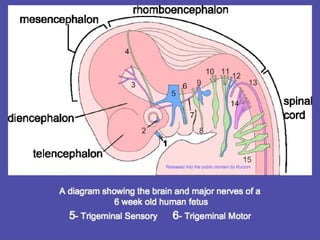
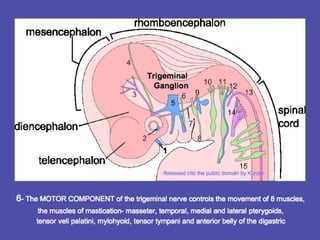
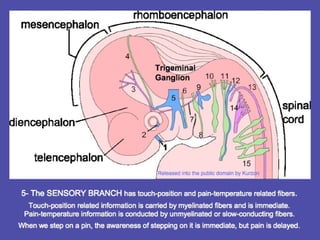
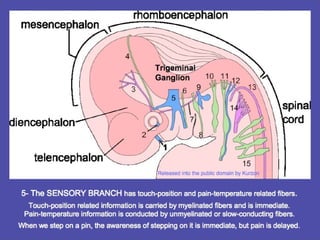
Trigeminal
Ganglion
Trigeminal
Ganglion
Trigeminal
Ganglion(5)
Pathway of thePathway of the
TrigeminalTrigeminal
NerveNerve
The trigeminal nerve receives sensory
input from many areas including:
• oral cavity, teeth and TMJ
• nasopharynx and nasal cavity
• most of the face and the scalp
• eyeballs and conjunctiva
• ear pinae and external ear canal
• lacrimal glands(tears)
• meningeal membranes of the
anterior and middle cranial fossae
• portions of the superior tentorium
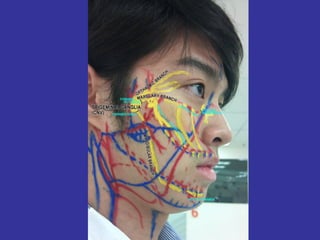
Dermatomes-
Sensory areas of
the head- the
trigeminal nerve
and cervical
plexus
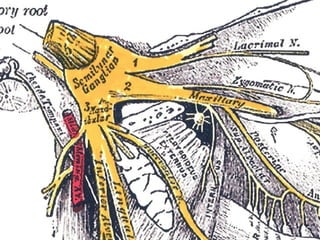
from Henry Gray- Anatomy of the Human Body before 1858
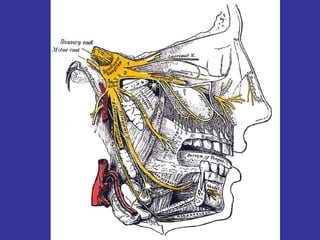
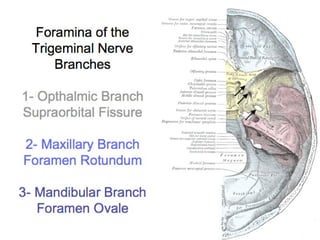
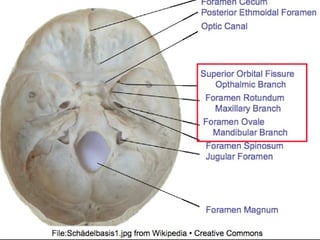
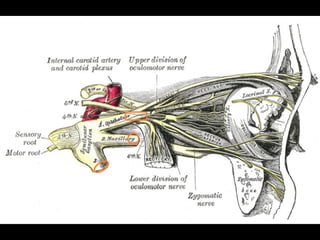
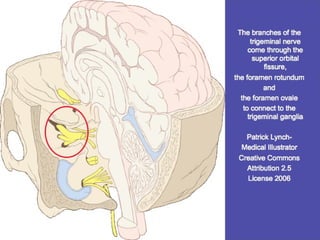
Three branches of the trigeminal nerve enter
the skull through three different foramina in
the sphenoid bone:
The Mandibular Branch (V3) enters through
the foramen ovale.
The Maxillary Branch (V2) enters through
the foramen rotundum.
The Opthalmic Branch (V1) enters through
the superior orbital fissure.
Midway between theMidway between the
peripheral nervesperipheral nerves
and trigeminal nucleiand trigeminal nuclei
in the brain stem,in the brain stem,
there is a ganglionthere is a ganglion
or junctionor junction
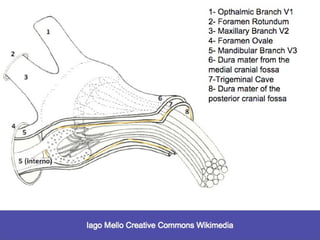
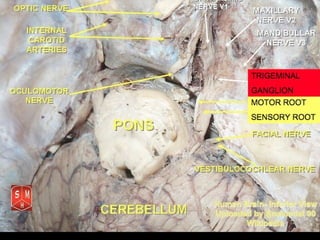
The trigeminal ganglion is locatedThe trigeminal ganglion is located
near the apex of the petrousnear the apex of the petrous
portion of the temporal boneportion of the temporal bone
and is surrounded byand is surrounded by
cerebrospinal fluidcerebrospinal fluid
and nested in anand nested in an
arachnoid poucharachnoid pouch
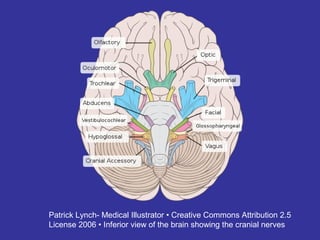
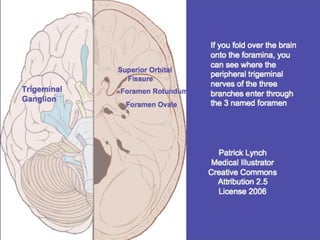
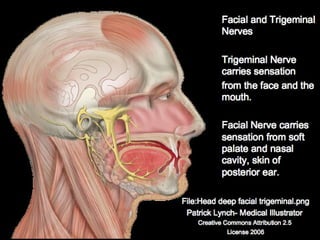
Patrick Lynch- Medical Illustrator • Creative Commons Attribution 2.5
License 2006 • Inferior view of the brain showing the cranial nerves
Trigeminal
Ganglion
Foramen Ovale
Foramen Rotundum
Superior Orbital
Fissure
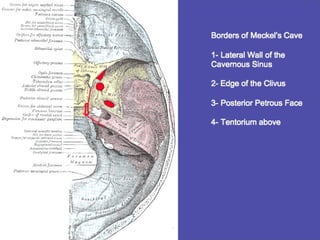
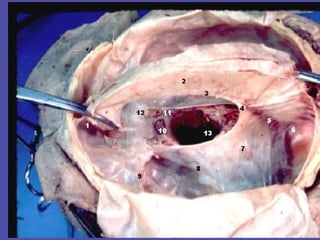
The Trigeminal Cave is alsoThe Trigeminal Cave is also
known as Meckel's Cave.known as Meckel's Cave.
It is an arachnoidal pouch containingIt is an arachnoidal pouch containing
cerebrospinal fluidcerebrospinal fluid
formed by two layers of dura materformed by two layers of dura mater
which are part of an evagination of thewhich are part of an evagination of the
tentorium cerebellitentorium cerebelli
The Trigeminal CaveThe Trigeminal Cave
envelops theenvelops the
trigeminal ganglion.trigeminal ganglion.
It is named forIt is named for
Johann Friedrich Meckel the ElderJohann Friedrich Meckel the Elder..
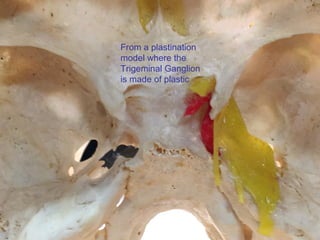
From a plastination
model where the
Trigeminal Ganglion
is made of plastic
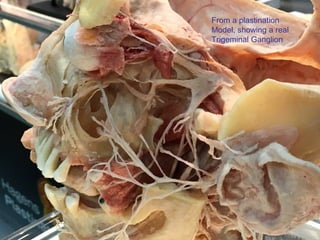
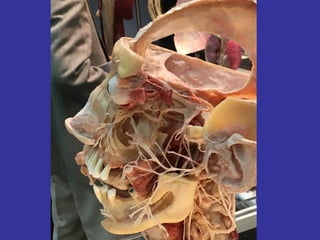
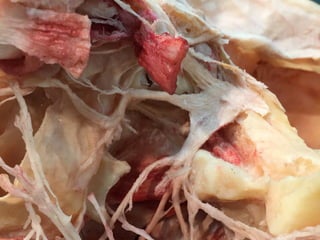
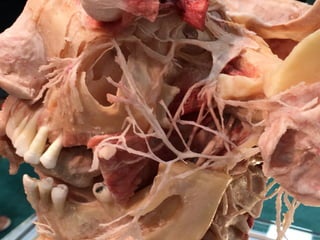
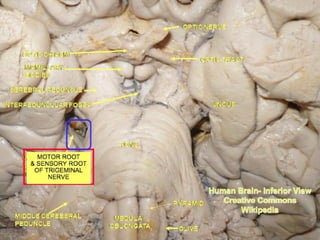
From a plastination
Model, showing a real
Trigeminal Ganglion
There is about a 2 cmThere is about a 2 cm
connection from theconnection from the trigeminaltrigeminal
ganglionganglion
to the trigeminal nucleusto the trigeminal nucleus
TheThe
Trigeminal NucleusTrigeminal Nucleus
in thein the
Brain StemBrain Stem
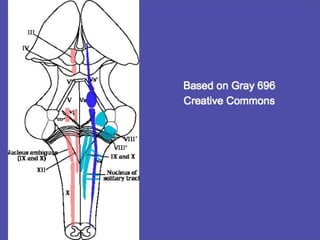
The trigeminal nucleus is dividedThe trigeminal nucleus is divided
anatomically into three parts,anatomically into three parts,
visible in microscopic sections of the brainstem.visible in microscopic sections of the brainstem.
From caudal to rostralFrom caudal to rostral
going up from the medulla to the midbraingoing up from the medulla to the midbrain
they are:they are:
1- The spinal trigeminal nucleus1- The spinal trigeminal nucleus
2- The main trigeminal nucleus2- The main trigeminal nucleus
3- The mesencephalic trigeminal3- The mesencephalic trigeminal
nucleus.nucleus.
The three parts of the trigeminal nucleus receiveThe three parts of the trigeminal nucleus receive
different types of sensory information:different types of sensory information:
1- The spinal trigeminal nucleus (lowest)1- The spinal trigeminal nucleus (lowest)
receivesreceives pain/temperature fibers.pain/temperature fibers.
2- The main trigeminal nucleus (middle)2- The main trigeminal nucleus (middle)
receivesreceives touch/position fibers.touch/position fibers.
3- The mesencephalic nucleus (highest)3- The mesencephalic nucleus (highest)
receivesreceives proprioceptor andproprioceptor and
mechanoreceptormechanoreceptor
fibers from the jaws and teeth.fibers from the jaws and teeth.
It is not widely appreciatedIt is not widely appreciated
that all sensory informationthat all sensory information
from the facefrom the face (all touch/position(all touch/position
information and allinformation and all
pain/temperature information)pain/temperature information) isis
sent to thesent to the
trigeminal nucleus.trigeminal nucleus.
In classical anatomy, most sensoryIn classical anatomy, most sensory
information from the face is carried by theinformation from the face is carried by the
fifth (trigeminal) nerve.fifth (trigeminal) nerve.
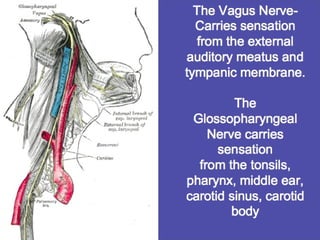
Sensation from certain parts of the mouth,Sensation from certain parts of the mouth,
certain parts of the ear and certain parts ofcertain parts of the ear and certain parts of
the meninges is carried bythe meninges is carried by
"general somatic afferent" (GSA)"general somatic afferent" (GSA)
fibers in cranial nervesfibers in cranial nerves
VII (the facial nerve)VII (the facial nerve)
IX (the glossopharyngeal nerve) andIX (the glossopharyngeal nerve) and
X (the vagus nerve).X (the vagus nerve).
Without exception, however,
all sensory fibers from these nerves (VII,
IX, X) terminate in the trigeminal nucleus.
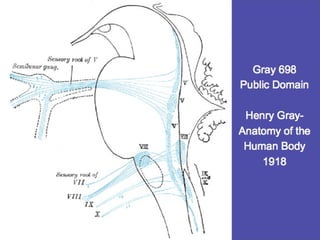
On entering the brainstem,On entering the brainstem,
sensory fibers from V, VII, IX, and Xsensory fibers from V, VII, IX, and X
are sorted out and sent to theare sorted out and sent to the
trigeminal nucleus, which thus contains atrigeminal nucleus, which thus contains a
complete sensory map of the face and mouth.complete sensory map of the face and mouth.
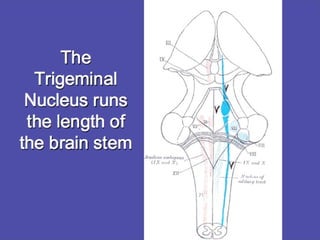
The trigeminal nucleus extendsThe trigeminal nucleus extends
throughout the entire brainstem, from thethroughout the entire brainstem, from the
midbrain to the medulla, and continuesmidbrain to the medulla, and continues
into the cervical cord. It contains ainto the cervical cord. It contains a
sensory map of the face, mouth andsensory map of the face, mouth and
relates to cranial membranes.relates to cranial membranes.
The trigeminal nucleus merges with theThe trigeminal nucleus merges with the
dorsal horn cells of the spinal cord whichdorsal horn cells of the spinal cord which
contain a sensory map of the rest of thecontain a sensory map of the rest of the
body.body.
The coverings of the brain are called meningesThe coverings of the brain are called meninges
and consist of the dura, arachnoid and pia. Theand consist of the dura, arachnoid and pia. The
dura in particular has a lot of pain receptors anddura in particular has a lot of pain receptors and
may be responsible for many headaches. As amay be responsible for many headaches. As a
neurosurgeon I have seen this first hand duringneurosurgeon I have seen this first hand during
awake brain surgery when we open the dura.awake brain surgery when we open the dura.
The patient usually doesn't report any painThe patient usually doesn't report any pain
when you drill a hole in their skull. However, theywhen you drill a hole in their skull. However, they
start to report dull pain or headache whenstart to report dull pain or headache when
you stimulate or touch the dura.you stimulate or touch the dura.
Brain Surgeon responseBrain Surgeon response
Not only is the trigeminal nerve (V)Not only is the trigeminal nerve (V)
feeding informationfeeding information
into the trigeminal nucleus,into the trigeminal nucleus,
but also sensory informationbut also sensory information
related to cranial nerves VII, IX, and X.related to cranial nerves VII, IX, and X.
All four of these nerves are part ofAll four of these nerves are part of
Porges Polyvagal TheoryPorges Polyvagal Theory
Pain related to thePain related to the
Trigeminal NerveTrigeminal Nerve
Trigeminal
Ganglion(5)
A headache or cephalalgia is pain anywhere inA headache or cephalalgia is pain anywhere in
the region of the head or neck. It can be athe region of the head or neck. It can be a
symptom of a number of different conditions ofsymptom of a number of different conditions of
the head and neck. The brain tissue itself is notthe head and neck. The brain tissue itself is not
sensitive to pain because it lacks pain receptors.sensitive to pain because it lacks pain receptors.
Rather, the pain is caused by disturbance of theRather, the pain is caused by disturbance of the
pain-sensitive structures around the brain.pain-sensitive structures around the brain.
Nine areas of the head and neck have these pain-Nine areas of the head and neck have these pain-
sensitive structures, which are thesensitive structures, which are the
•• Cranium (The periosteum of the skull)Cranium (The periosteum of the skull)
• MusclesMuscles
• NervesNerves
• Arteries and veinsArteries and veins
• Subcutaneous tissuesSubcutaneous tissues
• EyesEyes
• EarsEars
• Sinuses and mucous membranesSinuses and mucous membranes
The complex processing of pain-temperatureThe complex processing of pain-temperature
information in the thalamus and cortexinformation in the thalamus and cortex
reflects a phylogenetically olderreflects a phylogenetically older
and more primitive sensory systemand more primitive sensory system
relative to the simple processingrelative to the simple processing
of touch-position information.of touch-position information.
Pain is an individualized sensationPain is an individualized sensation
that varies among people andthat varies among people and
is conditionedis conditioned
by memory and emotion.by memory and emotion.
All information from touch-position andAll information from touch-position and
pain-temperature receptors is sent to thepain-temperature receptors is sent to the
primary somato-sensory cortex.primary somato-sensory cortex.
However, pain-temperature information isHowever, pain-temperature information is
communicated with more cortical centers thancommunicated with more cortical centers than
the touch-position fibers.the touch-position fibers.
It communicates with:It communicates with:
• the medial dorsal thalamic nucleus which• the medial dorsal thalamic nucleus which
projects to the anterior cingulate gyrus.projects to the anterior cingulate gyrus.
•• the ventromedial nucleus of the thalamusthe ventromedial nucleus of the thalamus
which is then sent to the insular cortex.which is then sent to the insular cortex.
• some fibers are sent from the• some fibers are sent from the
intralaminar nucleus of the thalamusintralaminar nucleus of the thalamus
via the reticular formation.via the reticular formation.
Trigeminal NeuralgiaTrigeminal Neuralgia
TN is a severe neuropathic chronic painTN is a severe neuropathic chronic pain
disorder affecting the trigeminal nerve.disorder affecting the trigeminal nerve.
There is intense pain along theThere is intense pain along the
trigeminal nerve divisions.trigeminal nerve divisions.
Evidence indicates it is causedEvidence indicates it is caused
by a loss of myelin from theby a loss of myelin from the
sensory fibers within thesensory fibers within the
nerve root itself.nerve root itself.
In type 1, it is characterized by sudden severeIn type 1, it is characterized by sudden severe
pain along the trigeminal nerve itself.pain along the trigeminal nerve itself.
Sometimes in type 2, there is constant painSometimes in type 2, there is constant pain
that varies from dull to excruciating.that varies from dull to excruciating.
Experts say this is one of the mostExperts say this is one of the most
painful medical conditions possible.painful medical conditions possible.
Dental work and herpes zosterDental work and herpes zoster
may be contributing factors.may be contributing factors.
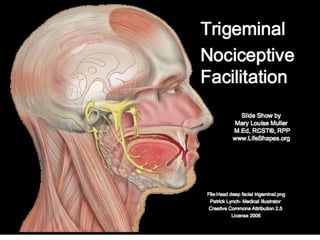
TrigeminalTrigeminal
NociceptiveNociceptive
FacilitationFacilitation
LifeShapes Institute
Powerpoint by Mary Louise MullerPowerpoint by Mary Louise Muller
www.LifeShapes.org

Trigeminal Nociceptive Facilitation

  • 2.
  • 3.
  • 4.
  • 5.
  • 6.
    Pathway of thePathwayof the TrigeminalTrigeminal NerveNerve
  • 9.
    The trigeminal nervereceives sensory input from many areas including: • oral cavity, teeth and TMJ • nasopharynx and nasal cavity • most of the face and the scalp • eyeballs and conjunctiva • ear pinae and external ear canal • lacrimal glands(tears) • meningeal membranes of the anterior and middle cranial fossae • portions of the superior tentorium
  • 10.
    Dermatomes- Sensory areas of thehead- the trigeminal nerve and cervical plexus from Henry Gray- Anatomy of the Human Body before 1858
  • 11.
    Three branches ofthe trigeminal nerve enter the skull through three different foramina in the sphenoid bone: The Mandibular Branch (V3) enters through the foramen ovale. The Maxillary Branch (V2) enters through the foramen rotundum. The Opthalmic Branch (V1) enters through the superior orbital fissure.
  • 15.
    Midway between theMidwaybetween the peripheral nervesperipheral nerves and trigeminal nucleiand trigeminal nuclei in the brain stem,in the brain stem, there is a ganglionthere is a ganglion or junctionor junction
  • 16.
    The trigeminal ganglionis locatedThe trigeminal ganglion is located near the apex of the petrousnear the apex of the petrous portion of the temporal boneportion of the temporal bone and is surrounded byand is surrounded by cerebrospinal fluidcerebrospinal fluid and nested in anand nested in an arachnoid poucharachnoid pouch
  • 17.
    Patrick Lynch- MedicalIllustrator • Creative Commons Attribution 2.5 License 2006 • Inferior view of the brain showing the cranial nerves
  • 19.
  • 21.
    The Trigeminal Caveis alsoThe Trigeminal Cave is also known as Meckel's Cave.known as Meckel's Cave. It is an arachnoidal pouch containingIt is an arachnoidal pouch containing cerebrospinal fluidcerebrospinal fluid formed by two layers of dura materformed by two layers of dura mater which are part of an evagination of thewhich are part of an evagination of the tentorium cerebellitentorium cerebelli
  • 23.
    The Trigeminal CaveTheTrigeminal Cave envelops theenvelops the trigeminal ganglion.trigeminal ganglion. It is named forIt is named for Johann Friedrich Meckel the ElderJohann Friedrich Meckel the Elder..
  • 26.
    From a plastination modelwhere the Trigeminal Ganglion is made of plastic
  • 27.
    From a plastination Model,showing a real Trigeminal Ganglion
  • 31.
    There is abouta 2 cmThere is about a 2 cm connection from theconnection from the trigeminaltrigeminal ganglionganglion to the trigeminal nucleusto the trigeminal nucleus
  • 35.
    TheThe Trigeminal NucleusTrigeminal Nucleus inthein the Brain StemBrain Stem
  • 37.
    The trigeminal nucleusis dividedThe trigeminal nucleus is divided anatomically into three parts,anatomically into three parts, visible in microscopic sections of the brainstem.visible in microscopic sections of the brainstem. From caudal to rostralFrom caudal to rostral going up from the medulla to the midbraingoing up from the medulla to the midbrain they are:they are: 1- The spinal trigeminal nucleus1- The spinal trigeminal nucleus 2- The main trigeminal nucleus2- The main trigeminal nucleus 3- The mesencephalic trigeminal3- The mesencephalic trigeminal nucleus.nucleus.
  • 38.
    The three partsof the trigeminal nucleus receiveThe three parts of the trigeminal nucleus receive different types of sensory information:different types of sensory information: 1- The spinal trigeminal nucleus (lowest)1- The spinal trigeminal nucleus (lowest) receivesreceives pain/temperature fibers.pain/temperature fibers. 2- The main trigeminal nucleus (middle)2- The main trigeminal nucleus (middle) receivesreceives touch/position fibers.touch/position fibers. 3- The mesencephalic nucleus (highest)3- The mesencephalic nucleus (highest) receivesreceives proprioceptor andproprioceptor and mechanoreceptormechanoreceptor fibers from the jaws and teeth.fibers from the jaws and teeth.
  • 40.
    It is notwidely appreciatedIt is not widely appreciated that all sensory informationthat all sensory information from the facefrom the face (all touch/position(all touch/position information and allinformation and all pain/temperature information)pain/temperature information) isis sent to thesent to the trigeminal nucleus.trigeminal nucleus.
  • 41.
    In classical anatomy,most sensoryIn classical anatomy, most sensory information from the face is carried by theinformation from the face is carried by the fifth (trigeminal) nerve.fifth (trigeminal) nerve. Sensation from certain parts of the mouth,Sensation from certain parts of the mouth, certain parts of the ear and certain parts ofcertain parts of the ear and certain parts of the meninges is carried bythe meninges is carried by "general somatic afferent" (GSA)"general somatic afferent" (GSA) fibers in cranial nervesfibers in cranial nerves VII (the facial nerve)VII (the facial nerve) IX (the glossopharyngeal nerve) andIX (the glossopharyngeal nerve) and X (the vagus nerve).X (the vagus nerve).
  • 42.
    Without exception, however, allsensory fibers from these nerves (VII, IX, X) terminate in the trigeminal nucleus. On entering the brainstem,On entering the brainstem, sensory fibers from V, VII, IX, and Xsensory fibers from V, VII, IX, and X are sorted out and sent to theare sorted out and sent to the trigeminal nucleus, which thus contains atrigeminal nucleus, which thus contains a complete sensory map of the face and mouth.complete sensory map of the face and mouth.
  • 43.
    The trigeminal nucleusextendsThe trigeminal nucleus extends throughout the entire brainstem, from thethroughout the entire brainstem, from the midbrain to the medulla, and continuesmidbrain to the medulla, and continues into the cervical cord. It contains ainto the cervical cord. It contains a sensory map of the face, mouth andsensory map of the face, mouth and relates to cranial membranes.relates to cranial membranes. The trigeminal nucleus merges with theThe trigeminal nucleus merges with the dorsal horn cells of the spinal cord whichdorsal horn cells of the spinal cord which contain a sensory map of the rest of thecontain a sensory map of the rest of the body.body.
  • 44.
    The coverings ofthe brain are called meningesThe coverings of the brain are called meninges and consist of the dura, arachnoid and pia. Theand consist of the dura, arachnoid and pia. The dura in particular has a lot of pain receptors anddura in particular has a lot of pain receptors and may be responsible for many headaches. As amay be responsible for many headaches. As a neurosurgeon I have seen this first hand duringneurosurgeon I have seen this first hand during awake brain surgery when we open the dura.awake brain surgery when we open the dura. The patient usually doesn't report any painThe patient usually doesn't report any pain when you drill a hole in their skull. However, theywhen you drill a hole in their skull. However, they start to report dull pain or headache whenstart to report dull pain or headache when you stimulate or touch the dura.you stimulate or touch the dura. Brain Surgeon responseBrain Surgeon response
  • 45.
    Not only isthe trigeminal nerve (V)Not only is the trigeminal nerve (V) feeding informationfeeding information into the trigeminal nucleus,into the trigeminal nucleus, but also sensory informationbut also sensory information related to cranial nerves VII, IX, and X.related to cranial nerves VII, IX, and X. All four of these nerves are part ofAll four of these nerves are part of Porges Polyvagal TheoryPorges Polyvagal Theory
  • 49.
    Pain related tothePain related to the Trigeminal NerveTrigeminal Nerve
  • 50.
  • 51.
    A headache orcephalalgia is pain anywhere inA headache or cephalalgia is pain anywhere in the region of the head or neck. It can be athe region of the head or neck. It can be a symptom of a number of different conditions ofsymptom of a number of different conditions of the head and neck. The brain tissue itself is notthe head and neck. The brain tissue itself is not sensitive to pain because it lacks pain receptors.sensitive to pain because it lacks pain receptors. Rather, the pain is caused by disturbance of theRather, the pain is caused by disturbance of the pain-sensitive structures around the brain.pain-sensitive structures around the brain.
  • 52.
    Nine areas ofthe head and neck have these pain-Nine areas of the head and neck have these pain- sensitive structures, which are thesensitive structures, which are the •• Cranium (The periosteum of the skull)Cranium (The periosteum of the skull) • MusclesMuscles • NervesNerves • Arteries and veinsArteries and veins • Subcutaneous tissuesSubcutaneous tissues • EyesEyes • EarsEars • Sinuses and mucous membranesSinuses and mucous membranes
  • 53.
    The complex processingof pain-temperatureThe complex processing of pain-temperature information in the thalamus and cortexinformation in the thalamus and cortex reflects a phylogenetically olderreflects a phylogenetically older and more primitive sensory systemand more primitive sensory system relative to the simple processingrelative to the simple processing of touch-position information.of touch-position information. Pain is an individualized sensationPain is an individualized sensation that varies among people andthat varies among people and is conditionedis conditioned by memory and emotion.by memory and emotion.
  • 54.
    All information fromtouch-position andAll information from touch-position and pain-temperature receptors is sent to thepain-temperature receptors is sent to the primary somato-sensory cortex.primary somato-sensory cortex. However, pain-temperature information isHowever, pain-temperature information is communicated with more cortical centers thancommunicated with more cortical centers than the touch-position fibers.the touch-position fibers. It communicates with:It communicates with: • the medial dorsal thalamic nucleus which• the medial dorsal thalamic nucleus which projects to the anterior cingulate gyrus.projects to the anterior cingulate gyrus. •• the ventromedial nucleus of the thalamusthe ventromedial nucleus of the thalamus which is then sent to the insular cortex.which is then sent to the insular cortex. • some fibers are sent from the• some fibers are sent from the intralaminar nucleus of the thalamusintralaminar nucleus of the thalamus via the reticular formation.via the reticular formation.
  • 55.
    Trigeminal NeuralgiaTrigeminal Neuralgia TNis a severe neuropathic chronic painTN is a severe neuropathic chronic pain disorder affecting the trigeminal nerve.disorder affecting the trigeminal nerve. There is intense pain along theThere is intense pain along the trigeminal nerve divisions.trigeminal nerve divisions. Evidence indicates it is causedEvidence indicates it is caused by a loss of myelin from theby a loss of myelin from the sensory fibers within thesensory fibers within the nerve root itself.nerve root itself.
  • 56.
    In type 1,it is characterized by sudden severeIn type 1, it is characterized by sudden severe pain along the trigeminal nerve itself.pain along the trigeminal nerve itself. Sometimes in type 2, there is constant painSometimes in type 2, there is constant pain that varies from dull to excruciating.that varies from dull to excruciating. Experts say this is one of the mostExperts say this is one of the most painful medical conditions possible.painful medical conditions possible. Dental work and herpes zosterDental work and herpes zoster may be contributing factors.may be contributing factors.
  • 61.
    TrigeminalTrigeminal NociceptiveNociceptive FacilitationFacilitation LifeShapes Institute Powerpoint byMary Louise MullerPowerpoint by Mary Louise Muller www.LifeShapes.org