JANASHRIT SHRESTHA
ROLL NO.- 21
INTRODUCTION
Protozoal disease caused by ciliate protozoan
Trichodina spp.
Scientific Classification
Phylum-Ciliophora
Sub-phylum-Intramacronucleata
Class-Oligohymenophorea
Subclass-Peritrichia
Order-Mobilida
Family-Trichodinidae
Genus-Trichodina
Genera
Trichodina
Paratrichodina
Trichodonella
Tripartiella
Vauchomia
 Dorsoventrally flattened oval ciliated protozoa of
marine and freshwater species of fish
 Side view-Saucer shaped
 Distinctive character of this protozoa –Presence of
prominent denticular ring
 Lives on mulm of substrate;fish body somewhat acts
as substratum
 Feed upon suspended particles in water,bacteria and
dead skin cells of fish
 Found on skin and gills and sometimes on urogenital
system
 Infection depends upon
 Protozoal load
Adverse climatic conditions
Fish under stress
Reproduce by simple binary fission
Poor Quality water
High Bacterial count
Source of food for protozoa
Leads to high number of protozoa
Seasonal Dynamics and Body size
High temperature of water in summer (29°C)
prevent proliferation of Trichodinids
High prevalance in spring (18°C)
Young fish and fry more susceptible than
mature fishes
Factors Affecting Trichodiniasis
 High stocking density -Spread fast and lower
production
Generous feeding rate –Leads to high ammonia
concentration creating ideal environment for
reproduction of Trichodina
Clinical Presentation…
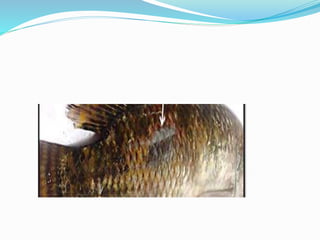
Affected fish produce excess mucus and develop white
cast to skin
Focal areas of reddening
Lays near substrate to rub against surface
Lethargic
Often gill swelling
HISTOPATHOLOGY
 Host response to ciliate infection is an inflammatory
response
Disrupt first line defense in skin and gills
Results in
 Hyperplasia of epithelial cells of skin
Clubbing of gill filaments
Massive manifestation leads to superficial to deep
ulceration allowing putative route for secondary and
fungal infection
Prevention…
Decrease stocking density
Decrease organic debris
Maintain Quality of water
Installation of heating system
Treatment ..
• Mixture solution of CuSo4 and FeSo4(5:2)
dispersed over evenly whole affected pond.
• Disinfect the fingerlings with 9 ppm Cuso4 soln
for 20-30 min 0r with 1-2% aqueous soln of table
salt for 2-10 min.
• Formalin at concentration of 30 ppm can kill
trichodina however affects the water quality and
fish appetite.
THANK YOU……….

Trichodiniasis

  • 1.
  • 2.
    INTRODUCTION Protozoal disease causedby ciliate protozoan Trichodina spp. Scientific Classification Phylum-Ciliophora Sub-phylum-Intramacronucleata Class-Oligohymenophorea Subclass-Peritrichia Order-Mobilida Family-Trichodinidae Genus-Trichodina
  • 3.
  • 4.
     Dorsoventrally flattenedoval ciliated protozoa of marine and freshwater species of fish  Side view-Saucer shaped  Distinctive character of this protozoa –Presence of prominent denticular ring  Lives on mulm of substrate;fish body somewhat acts as substratum  Feed upon suspended particles in water,bacteria and dead skin cells of fish
  • 7.
     Found onskin and gills and sometimes on urogenital system  Infection depends upon  Protozoal load Adverse climatic conditions Fish under stress Reproduce by simple binary fission
  • 8.
    Poor Quality water HighBacterial count Source of food for protozoa Leads to high number of protozoa
  • 9.
    Seasonal Dynamics andBody size High temperature of water in summer (29°C) prevent proliferation of Trichodinids High prevalance in spring (18°C) Young fish and fry more susceptible than mature fishes
  • 10.
    Factors Affecting Trichodiniasis High stocking density -Spread fast and lower production Generous feeding rate –Leads to high ammonia concentration creating ideal environment for reproduction of Trichodina
  • 11.
    Clinical Presentation… Affected fishproduce excess mucus and develop white cast to skin Focal areas of reddening Lays near substrate to rub against surface Lethargic Often gill swelling
  • 14.
    HISTOPATHOLOGY  Host responseto ciliate infection is an inflammatory response Disrupt first line defense in skin and gills Results in  Hyperplasia of epithelial cells of skin Clubbing of gill filaments Massive manifestation leads to superficial to deep ulceration allowing putative route for secondary and fungal infection
  • 15.
    Prevention… Decrease stocking density Decreaseorganic debris Maintain Quality of water Installation of heating system
  • 16.
    Treatment .. • Mixturesolution of CuSo4 and FeSo4(5:2) dispersed over evenly whole affected pond. • Disinfect the fingerlings with 9 ppm Cuso4 soln for 20-30 min 0r with 1-2% aqueous soln of table salt for 2-10 min. • Formalin at concentration of 30 ppm can kill trichodina however affects the water quality and fish appetite.
  • 17.