TRIBE
S OF
INDIA
CREATED BY BHAGYASHRI SATWANE
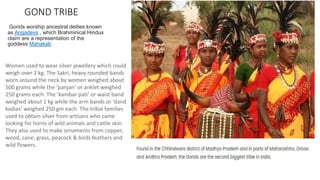
GOND TRIBE
Gonds worship ancestral deities known
as Angadevs , which Brahminical Hindus
claim are a representation of the
goddess Mahakali.
Women used to wear silver jewellery which could
weigh over 2 kg. The Sakri, heavy rounded bands
worn around the neck by women weighed about
500 grams while the ‘panjan’ or anklet weighed
250 grams each. The ‘kambar pati’ or waist band
weighed about 1 kg while the arm bands or ‘dand
kadias’ weighed 250 gm each. The tribal families
used to obtain silver from artisans who came
looking for horns of wild animals and cattle skin.
They also used to make ornaments from copper,
wood, cane, grass, peacock & birds feathers and
wild flowers.
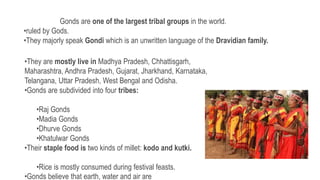
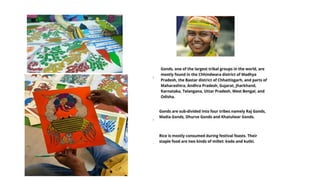
Gonds are one of the largest tribal groups in the world.
•ruled by Gods.
•They majorly speak Gondi which is an unwritten language of the Dravidian family.
•They are mostly live in Madhya Pradesh, Chhattisgarh,
Maharashtra, Andhra Pradesh, Gujarat, Jharkhand, Karnataka,
Telangana, Uttar Pradesh, West Bengal and Odisha.
•Gonds are subdivided into four tribes:
•Raj Gonds
•Madia Gonds
•Dhurve Gonds
•Khatulwar Gonds
•Their staple food is two kinds of millet: kodo and kutki.
•Rice is mostly consumed during festival feasts.
•Gonds believe that earth, water and air are
GOND TRIBES of
MP lives in
PATALKOT VALLEY
of CHINDWARA
DISTRICT
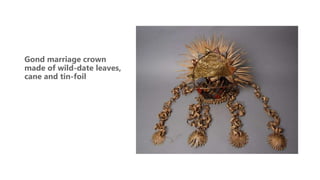
Gond marriage crown
made of wild-date leaves,
cane and tin-foil
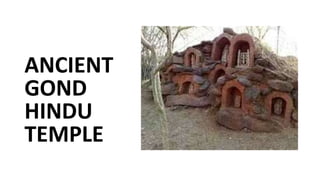
ANCIENT
GOND
HINDU
TEMPLE
SAILA &
GENDI
DANCE
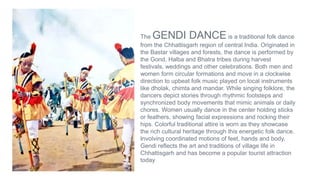
The GENDI DANCE is a traditional folk dance
from the Chhattisgarh region of central India. Originated in
the Bastar villages and forests, the dance is performed by
the Gond, Halba and Bhatra tribes during harvest
festivals, weddings and other celebrations. Both men and
women form circular formations and move in a clockwise
direction to upbeat folk music played on local instruments
like dholak, chimta and mandar. While singing folklore, the
dancers depict stories through rhythmic footsteps and
synchronized body movements that mimic animals or daily
chores. Women usually dance in the center holding sticks
or feathers, showing facial expressions and rocking their
hips. Colorful traditional attire is worn as they showcase
the rich cultural heritage through this energetic folk dance.
Involving coordinated motions of feet, hands and body,
Gendi reflects the art and traditions of village life in
Chhattisgarh and has become a popular tourist attraction
today
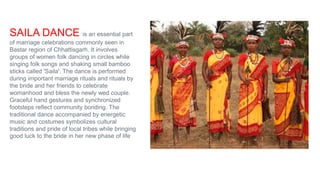
SAILA DANCE is an essential part
of marriage celebrations commonly seen in
Bastar region of Chhattisgarh. It involves
groups of women folk dancing in circles while
singing folk songs and shaking small bamboo
sticks called 'Saila'. The dance is performed
during important marriage rituals and rituals by
the bride and her friends to celebrate
womanhood and bless the newly wed couple.
Graceful hand gestures and synchronized
footsteps reflect community bonding. The
traditional dance accompanied by energetic
music and costumes symbolizes cultural
traditions and pride of local tribes while bringing
good luck to the bride in her new phase of life
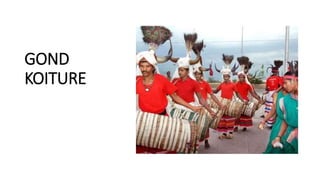
GOND
KOITURE
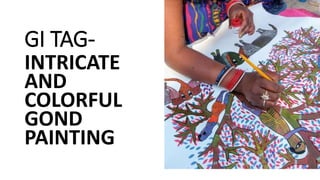
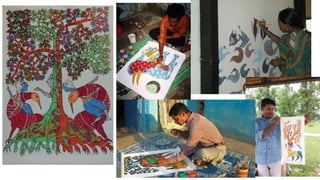
GI TAG-
INTRICATE
AND
COLORFUL
GOND
PAINTING
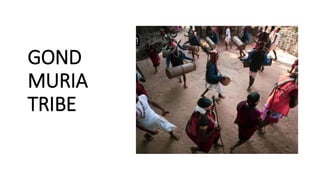
GOND
MURIA
TRIBE
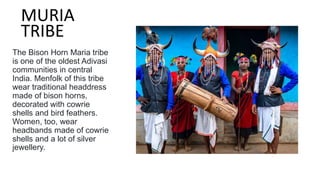
The Bison Horn Maria tribe
is one of the oldest Adivasi
communities in central
India. Menfolk of this tribe
wear traditional headdress
made of bison horns,
decorated with cowrie
shells and bird feathers.
Women, too, wear
headbands made of cowrie
shells and a lot of silver
jewellery.
MURIA
TRIBE
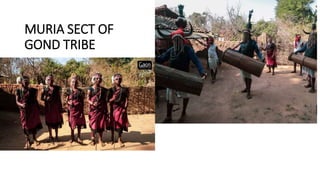
MURIA SECT OF
GOND TRIBE
CHATTISGARH
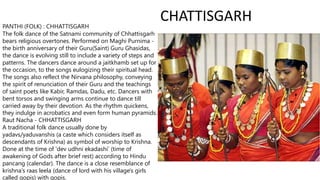
PANTHI (FOLK) : CHHATTISGARH
The folk dance of the Satnami community of Chhattisgarh
bears religious overtones. Performed on Maghi Purnima -
the birth anniversary of their Guru(Saint) Guru Ghasidas,
the dance is evolving still to include a variety of steps and
patterns. The dancers dance around a jaitkhamb set up for
the occasion, to the songs eulogizing their spiritual head.
The songs also reflect the Nirvana philosophy, conveying
the spirit of renunciation of their Guru and the teachings
of saint poets like Kabir, Ramdas, Dadu, etc. Dancers with
bent torsos and swinging arms continue to dance till
carried away by their devotion. As the rhythm quickens,
they indulge in acrobatics and even form human pyramids.
Raut Nacha - CHHATTISGARH
A traditional folk dance usually done by
yadavs/yaduvanshis (a caste which considers itself as
descendants of Krishna) as symbol of worship to Krishna.
Done at the time of 'dev udhni ekadashi' (time of
awakening of Gods after brief rest) according to Hindu
pancang (calendar). The dance is a close resemblance of
krishna's raas leela (dance of lord with his village's girls
called gopis) with gopis.
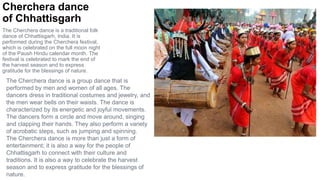
Cherchera dance
of Chhattisgarh
The Cherchera dance is a traditional folk
dance of Chhattisgarh, India. It is
performed during the Cherchera festival,
which is celebrated on the full moon night
of the Paush Hindu calendar month. The
festival is celebrated to mark the end of
the harvest season and to express
gratitude for the blessings of nature.
The Cherchera dance is a group dance that is
performed by men and women of all ages. The
dancers dress in traditional costumes and jewelry, and
the men wear bells on their waists. The dance is
characterized by its energetic and joyful movements.
The dancers form a circle and move around, singing
and clapping their hands. They also perform a variety
of acrobatic steps, such as jumping and spinning.
The Cherchera dance is more than just a form of
entertainment; it is also a way for the people of
Chhattisgarh to connect with their culture and
traditions. It is also a way to celebrate the harvest
season and to express gratitude for the blessings of
nature.
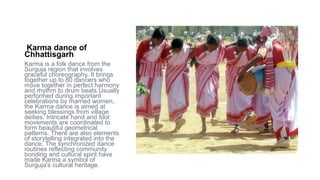
Karma dance of
Chhattisgarh
Karma is a folk dance from the
Surguja region that involves
graceful choreography. It brings
together up to 80 dancers who
move together in perfect harmony
and rhythm to drum beats.Usually
performed during important
celebrations by married women,
the Karma dance is aimed at
seeking blessings from village
deities. Intricate hand and foot
movements are coordinated to
form beautiful geometrical
patterns. There are also elements
of storytelling integrated into the
dance. The synchronized dance
routines reflecting community
bonding and cultural spirit have
made Karma a symbol of
Surguja's cultural heritage.
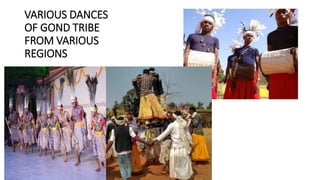
VARIOUS DANCES
OF GOND TRIBE
FROM VARIOUS
REGIONS
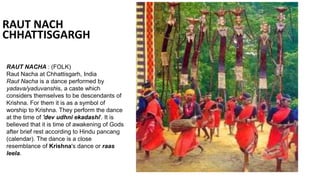
RAUT NACH
CHHATTISGARGH
RAUT NACHA : (FOLK)
Raut Nacha at Chhattisgarh, India
Raut Nacha is a dance performed by
yadava/yaduvanshis, a caste which
considers themselves to be descendants of
Krishna. For them it is as a symbol of
worship to Krishna. They perform the dance
at the time of 'dev udhni ekadashi'. It is
believed that it is time of awakening of Gods
after brief rest according to Hindu pancang
(calendar). The dance is a close
resemblance of Krishna's dance or raas
leela.
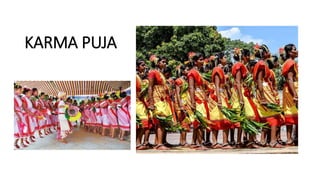
KARMA PUJA
KARMA
DANCE
Karma/Munda (JHARKHAND):
The traditional dance gets its name
from the Karma tree[ambiguous],
which stands for fortune and good
luck. The ceremony starts with the
planting of the trees. Dancers, both
men and women, form circles around it
and dance with their arms around each
other's waists. As the drum beats get
quicker and louder, the dancers gain
momentum and generally end in an
uproarious tumult.
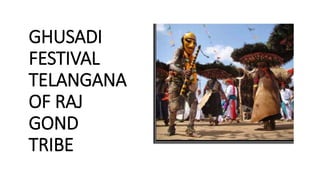
GHUSADI
FESTIVAL
TELANGANA
OF RAJ
GOND
TRIBE
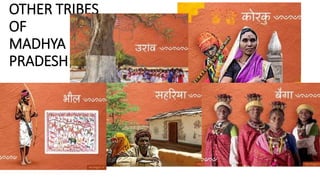
OTHER TRIBES
OF
MADHYA
PRADESH
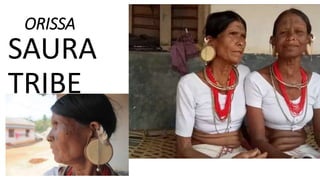
ORISSA
SAURA
TRIBE
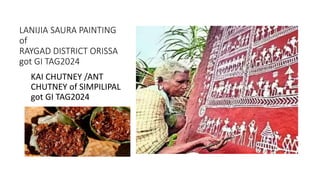
LANIJIA SAURA PAINTING
of
RAYGAD DISTRICT ORISSA
got GI TAG2024
KAI CHUTNEY /ANT
CHUTNEY of SIMPILIPAL
got GI TAG2024
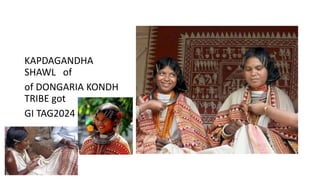
KAPDAGANDHA
SHAWL of
of DONGARIA KONDH
TRIBE got
GI TAG2024
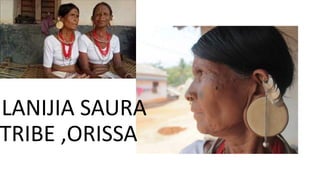
LANIJIA SAURA
TRIBE ,ORISSA
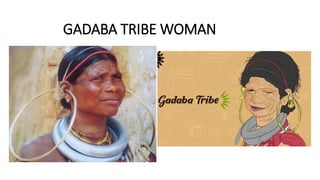
GADABA TRIBE WOMAN
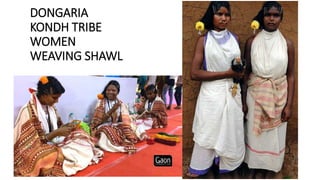
DONGARIA
KONDH TRIBE
WOMEN
WEAVING SHAWL
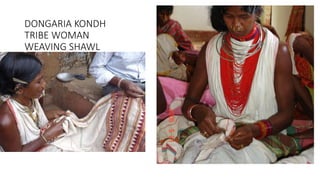
DONGARIA KONDH
TRIBE WOMAN
WEAVING SHAWL
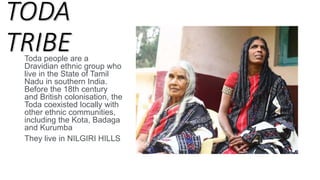
TODA
TRIBE
Toda people are a
Dravidian ethnic group who
live in the State of Tamil
Nadu in southern India.
Before the 18th century
and British colonisation, the
Toda coexisted locally with
other ethnic communities,
including the Kota, Badaga
and Kurumba
They live in NILGIRI HILLS
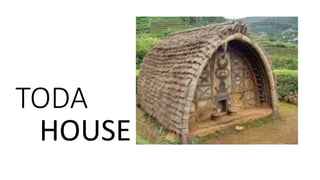
TODA
HOUSE
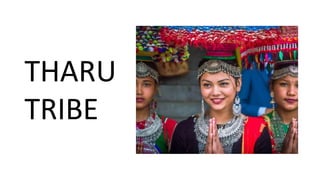
THARU
TRIBE
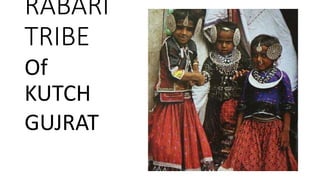
RABARI
TRIBE
Of
KUTCH
GUJRAT
BHUNGA HOUSE OF
RABARI TRIBE
They live in bhungas that
are mud houses, circular in
shape to keep the houses
cool during the harsh
summers. Lippan means
'clay' or 'dung' in Gujarati
and 'kaam' is work. Hence
Lippan Kaam refers to the
mud work that was done on
the interior as well as the
exterior walls of the circular
homes of these tribes.
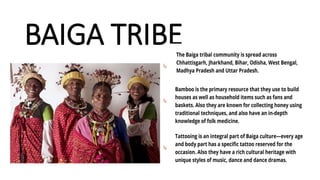
BAIGA TRIBE
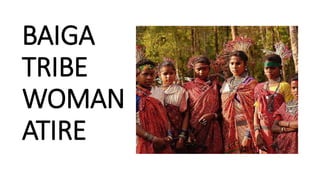
BAIGA
TRIBE
WOMAN
ATIRE
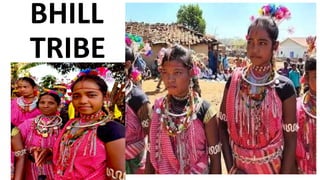
BHILL
TRIBE
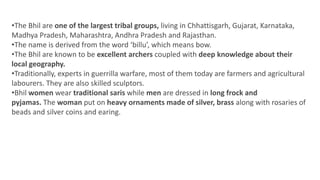
•The Bhil are one of the largest tribal groups, living in Chhattisgarh, Gujarat, Karnataka,
Madhya Pradesh, Maharashtra, Andhra Pradesh and Rajasthan.
•The name is derived from the word ‘billu’, which means bow.
•The Bhil are known to be excellent archers coupled with deep knowledge about their
local geography.
•Traditionally, experts in guerrilla warfare, most of them today are farmers and agricultural
labourers. They are also skilled sculptors.
•Bhil women wear traditional saris while men are dressed in long frock and
pyjamas. The woman put on heavy ornaments made of silver, brass along with rosaries of
beads and silver coins and earing.
SANTHAL
TRIBE
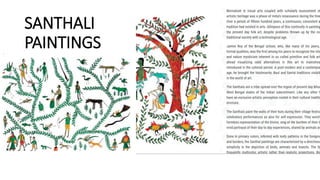
SANTHALI
PAINTINGS
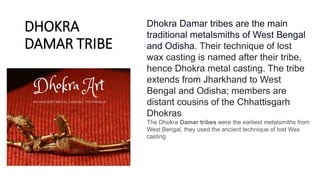
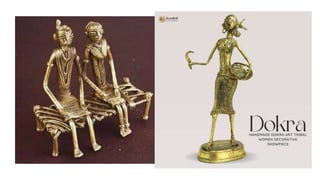
DHOKRA
DAMAR TRIBE
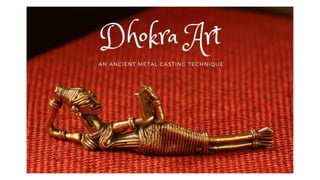
Dhokra Damar tribes are the main
traditional metalsmiths of West Bengal
and Odisha. Their technique of lost
wax casting is named after their tribe,
hence Dhokra metal casting. The tribe
extends from Jharkhand to West
Bengal and Odisha; members are
distant cousins of the Chhattisgarh
Dhokras.
The Dhokra Damar tribes were the earliest metalsmiths from
West Bengal, they used the ancient technique of lost Wax
casting
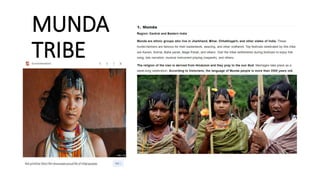
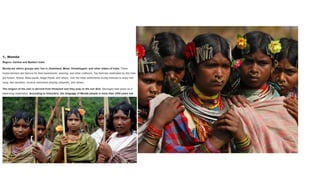
MUNDA
TRIBE
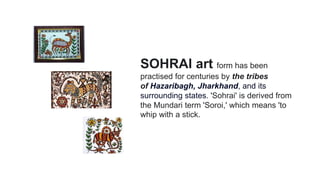
SOHRAI art form has been
practised for centuries by the tribes
of Hazaribagh, Jharkhand, and its
surrounding states. 'Sohrai' is derived from
the Mundari term 'Soroi,' which means 'to
whip with a stick.
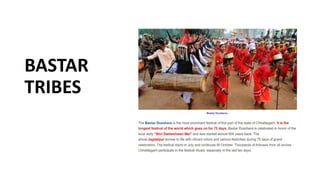
BASTAR
TRIBES
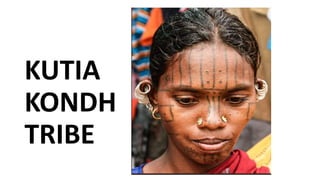
KUTIA
KONDH
TRIBE
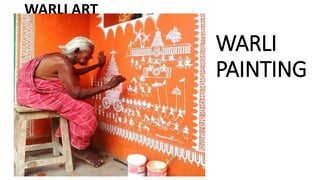
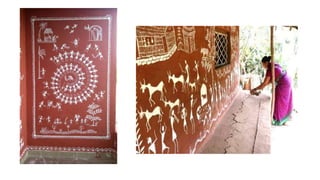
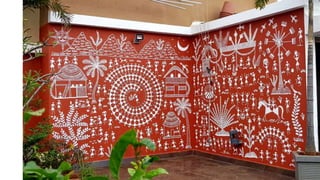
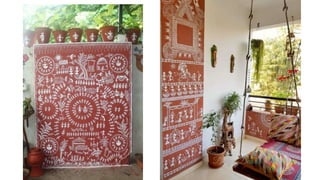
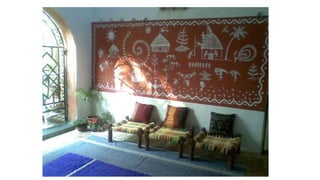
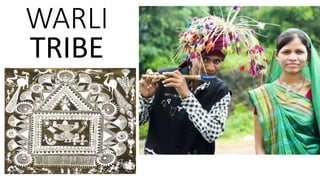
WARLI
TRIBE
WARLI ART
WARLI
PAINTING
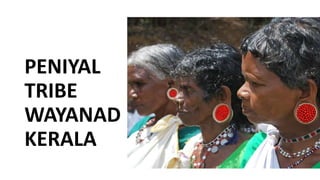
PENIYAL
TRIBE
WAYANAD
KERALA
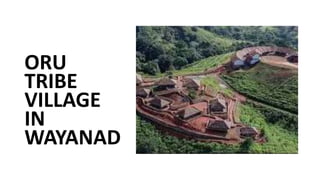
ORU
TRIBE
VILLAGE
IN
WAYANAD
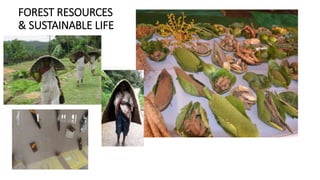
FOREST RESOURCES
& SUSTAINABLE LIFE
EN ORU
TRIBAL
HERITAGE
VILLAGE
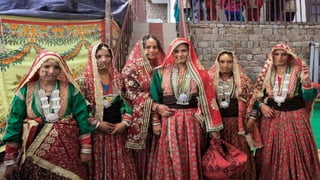
GADDI
TRIBE
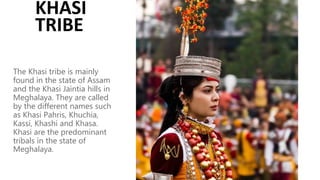
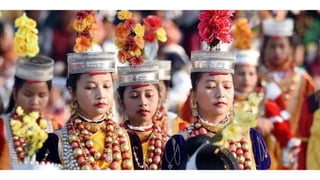
The Khasi tribe is mainly
found in the state of Assam
and the Khasi Jaintia hills in
Meghalaya. They are called
by the different names such
as Khasi Pahris, Khuchia,
Kassi, Khashi and Khasa.
Khasi are the predominant
tribals in the state of
Meghalaya.
KHASI
TRIBE
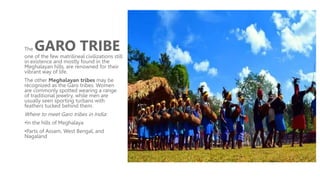
The GARO TRIBE
one of the few matrilineal civilizations still
in existence and mostly found in the
Meghalayan hills, are renowned for their
vibrant way of life.
The other Meghalayan tribes may be
recognized as the Garo tribes. Women
are commonly spotted wearing a range
of traditional jewelry, while men are
usually seen sporting turbans with
feathers tucked behind them.
Where to meet Garo tribes in India:
•In the hills of Meghalaya
•Parts of Assam, West Bengal, and
Nagaland
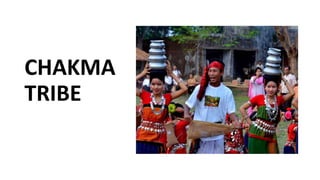
CHAKMA
TRIBE
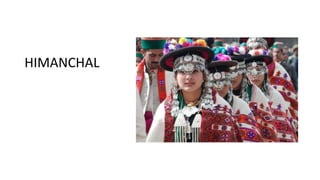
HIMANCHAL
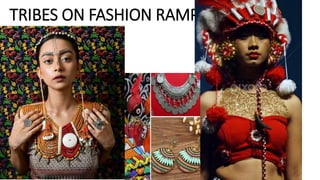
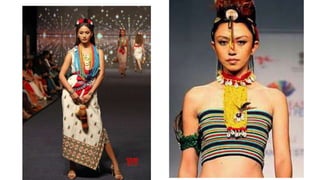
TRIBES ON FASHION RAMP
The End

tribes of indiah.pptx

  • 1.
    TRIBE S OF INDIA CREATED BYBHAGYASHRI SATWANE
  • 2.
    GOND TRIBE Gonds worshipancestral deities known as Angadevs , which Brahminical Hindus claim are a representation of the goddess Mahakali. Women used to wear silver jewellery which could weigh over 2 kg. The Sakri, heavy rounded bands worn around the neck by women weighed about 500 grams while the ‘panjan’ or anklet weighed 250 grams each. The ‘kambar pati’ or waist band weighed about 1 kg while the arm bands or ‘dand kadias’ weighed 250 gm each. The tribal families used to obtain silver from artisans who came looking for horns of wild animals and cattle skin. They also used to make ornaments from copper, wood, cane, grass, peacock & birds feathers and wild flowers.
  • 3.
    Gonds are oneof the largest tribal groups in the world. •ruled by Gods. •They majorly speak Gondi which is an unwritten language of the Dravidian family. •They are mostly live in Madhya Pradesh, Chhattisgarh, Maharashtra, Andhra Pradesh, Gujarat, Jharkhand, Karnataka, Telangana, Uttar Pradesh, West Bengal and Odisha. •Gonds are subdivided into four tribes: •Raj Gonds •Madia Gonds •Dhurve Gonds •Khatulwar Gonds •Their staple food is two kinds of millet: kodo and kutki. •Rice is mostly consumed during festival feasts. •Gonds believe that earth, water and air are
  • 4.
    GOND TRIBES of MPlives in PATALKOT VALLEY of CHINDWARA DISTRICT
  • 5.
    Gond marriage crown madeof wild-date leaves, cane and tin-foil
  • 6.
  • 7.
  • 8.
    The GENDI DANCEis a traditional folk dance from the Chhattisgarh region of central India. Originated in the Bastar villages and forests, the dance is performed by the Gond, Halba and Bhatra tribes during harvest festivals, weddings and other celebrations. Both men and women form circular formations and move in a clockwise direction to upbeat folk music played on local instruments like dholak, chimta and mandar. While singing folklore, the dancers depict stories through rhythmic footsteps and synchronized body movements that mimic animals or daily chores. Women usually dance in the center holding sticks or feathers, showing facial expressions and rocking their hips. Colorful traditional attire is worn as they showcase the rich cultural heritage through this energetic folk dance. Involving coordinated motions of feet, hands and body, Gendi reflects the art and traditions of village life in Chhattisgarh and has become a popular tourist attraction today
  • 10.
    SAILA DANCE isan essential part of marriage celebrations commonly seen in Bastar region of Chhattisgarh. It involves groups of women folk dancing in circles while singing folk songs and shaking small bamboo sticks called 'Saila'. The dance is performed during important marriage rituals and rituals by the bride and her friends to celebrate womanhood and bless the newly wed couple. Graceful hand gestures and synchronized footsteps reflect community bonding. The traditional dance accompanied by energetic music and costumes symbolizes cultural traditions and pride of local tribes while bringing good luck to the bride in her new phase of life
  • 11.
  • 12.
  • 15.
  • 16.
    The Bison HornMaria tribe is one of the oldest Adivasi communities in central India. Menfolk of this tribe wear traditional headdress made of bison horns, decorated with cowrie shells and bird feathers. Women, too, wear headbands made of cowrie shells and a lot of silver jewellery. MURIA TRIBE
  • 17.
  • 20.
    CHATTISGARH PANTHI (FOLK) :CHHATTISGARH The folk dance of the Satnami community of Chhattisgarh bears religious overtones. Performed on Maghi Purnima - the birth anniversary of their Guru(Saint) Guru Ghasidas, the dance is evolving still to include a variety of steps and patterns. The dancers dance around a jaitkhamb set up for the occasion, to the songs eulogizing their spiritual head. The songs also reflect the Nirvana philosophy, conveying the spirit of renunciation of their Guru and the teachings of saint poets like Kabir, Ramdas, Dadu, etc. Dancers with bent torsos and swinging arms continue to dance till carried away by their devotion. As the rhythm quickens, they indulge in acrobatics and even form human pyramids. Raut Nacha - CHHATTISGARH A traditional folk dance usually done by yadavs/yaduvanshis (a caste which considers itself as descendants of Krishna) as symbol of worship to Krishna. Done at the time of 'dev udhni ekadashi' (time of awakening of Gods after brief rest) according to Hindu pancang (calendar). The dance is a close resemblance of krishna's raas leela (dance of lord with his village's girls called gopis) with gopis.
  • 21.
    Cherchera dance of Chhattisgarh TheCherchera dance is a traditional folk dance of Chhattisgarh, India. It is performed during the Cherchera festival, which is celebrated on the full moon night of the Paush Hindu calendar month. The festival is celebrated to mark the end of the harvest season and to express gratitude for the blessings of nature. The Cherchera dance is a group dance that is performed by men and women of all ages. The dancers dress in traditional costumes and jewelry, and the men wear bells on their waists. The dance is characterized by its energetic and joyful movements. The dancers form a circle and move around, singing and clapping their hands. They also perform a variety of acrobatic steps, such as jumping and spinning. The Cherchera dance is more than just a form of entertainment; it is also a way for the people of Chhattisgarh to connect with their culture and traditions. It is also a way to celebrate the harvest season and to express gratitude for the blessings of nature.
  • 22.
    Karma dance of Chhattisgarh Karmais a folk dance from the Surguja region that involves graceful choreography. It brings together up to 80 dancers who move together in perfect harmony and rhythm to drum beats.Usually performed during important celebrations by married women, the Karma dance is aimed at seeking blessings from village deities. Intricate hand and foot movements are coordinated to form beautiful geometrical patterns. There are also elements of storytelling integrated into the dance. The synchronized dance routines reflecting community bonding and cultural spirit have made Karma a symbol of Surguja's cultural heritage.
  • 23.
    VARIOUS DANCES OF GONDTRIBE FROM VARIOUS REGIONS
  • 24.
    RAUT NACH CHHATTISGARGH RAUT NACHA: (FOLK) Raut Nacha at Chhattisgarh, India Raut Nacha is a dance performed by yadava/yaduvanshis, a caste which considers themselves to be descendants of Krishna. For them it is as a symbol of worship to Krishna. They perform the dance at the time of 'dev udhni ekadashi'. It is believed that it is time of awakening of Gods after brief rest according to Hindu pancang (calendar). The dance is a close resemblance of Krishna's dance or raas leela.
  • 25.
  • 26.
    KARMA DANCE Karma/Munda (JHARKHAND): The traditionaldance gets its name from the Karma tree[ambiguous], which stands for fortune and good luck. The ceremony starts with the planting of the trees. Dancers, both men and women, form circles around it and dance with their arms around each other's waists. As the drum beats get quicker and louder, the dancers gain momentum and generally end in an uproarious tumult.
  • 27.
  • 28.
  • 29.
  • 30.
    LANIJIA SAURA PAINTING of RAYGADDISTRICT ORISSA got GI TAG2024 KAI CHUTNEY /ANT CHUTNEY of SIMPILIPAL got GI TAG2024
  • 31.
    KAPDAGANDHA SHAWL of of DONGARIAKONDH TRIBE got GI TAG2024
  • 32.
  • 33.
  • 34.
  • 35.
  • 37.
    TODA TRIBE Toda people area Dravidian ethnic group who live in the State of Tamil Nadu in southern India. Before the 18th century and British colonisation, the Toda coexisted locally with other ethnic communities, including the Kota, Badaga and Kurumba They live in NILGIRI HILLS
  • 38.
  • 39.
  • 40.
  • 41.
    BHUNGA HOUSE OF RABARITRIBE They live in bhungas that are mud houses, circular in shape to keep the houses cool during the harsh summers. Lippan means 'clay' or 'dung' in Gujarati and 'kaam' is work. Hence Lippan Kaam refers to the mud work that was done on the interior as well as the exterior walls of the circular homes of these tribes.
  • 42.
  • 43.
  • 44.
  • 46.
    •The Bhil areone of the largest tribal groups, living in Chhattisgarh, Gujarat, Karnataka, Madhya Pradesh, Maharashtra, Andhra Pradesh and Rajasthan. •The name is derived from the word ‘billu’, which means bow. •The Bhil are known to be excellent archers coupled with deep knowledge about their local geography. •Traditionally, experts in guerrilla warfare, most of them today are farmers and agricultural labourers. They are also skilled sculptors. •Bhil women wear traditional saris while men are dressed in long frock and pyjamas. The woman put on heavy ornaments made of silver, brass along with rosaries of beads and silver coins and earing.
  • 47.
  • 49.
  • 52.
    DHOKRA DAMAR TRIBE Dhokra Damartribes are the main traditional metalsmiths of West Bengal and Odisha. Their technique of lost wax casting is named after their tribe, hence Dhokra metal casting. The tribe extends from Jharkhand to West Bengal and Odisha; members are distant cousins of the Chhattisgarh Dhokras. The Dhokra Damar tribes were the earliest metalsmiths from West Bengal, they used the ancient technique of lost Wax casting
  • 55.
  • 56.
    SOHRAI art formhas been practised for centuries by the tribes of Hazaribagh, Jharkhand, and its surrounding states. 'Sohrai' is derived from the Mundari term 'Soroi,' which means 'to whip with a stick.
  • 58.
  • 63.
  • 65.
  • 66.
  • 71.
  • 73.
  • 74.
  • 75.
  • 76.
  • 78.
    The Khasi tribeis mainly found in the state of Assam and the Khasi Jaintia hills in Meghalaya. They are called by the different names such as Khasi Pahris, Khuchia, Kassi, Khashi and Khasa. Khasi are the predominant tribals in the state of Meghalaya. KHASI TRIBE
  • 80.
    The GARO TRIBE oneof the few matrilineal civilizations still in existence and mostly found in the Meghalayan hills, are renowned for their vibrant way of life. The other Meghalayan tribes may be recognized as the Garo tribes. Women are commonly spotted wearing a range of traditional jewelry, while men are usually seen sporting turbans with feathers tucked behind them. Where to meet Garo tribes in India: •In the hills of Meghalaya •Parts of Assam, West Bengal, and Nagaland
  • 81.
  • 82.
  • 83.
  • 85.