LOK NAYAK JAYAPRAKASH NARAYAN NATIONAL 
INSTITUTE OF CRIMINOLOGY AND FORENSIC SCIENCE 
Government of India (Ministry of Home Affairs) 
Jail visit Report 
Submitted By: Shankey Verma 
M.A. (Criminology) 1st Semester
CONTENTS 
1. Acknowledgement 
2. Purpose of visit 
3. Introduction 
4. Organizational setup of prison 
5. Physical Observation 
6. Infrastructure Setup 
7. Case Study - 1 
8. Case Study - 2 
9. Case Study – 3 
10. Personal Observation 
11. Critical Analysis 
12. Suggestions
ACKNOWLEDGEMENT 
I, Shankey Verma student of M.A. Criminology, would like to 
pay my sincere gratitude towards our course director Prof. (Dr.)B.N. 
Chattoraj, for arranging our visit to Rohini Jail for the purpose of 
understanding the Jail organization and its functioning. 
I am also thankful to Mr. Harish Tyagi, the Superintendent 
Rohini Jail, Delhi to make us understand the things in a much practical 
way. 
Shankey Verma
PURPOSE OF THE VISIT 
The main objectives given by our course director was taken into 
consideration before going to the field work in the above mentioned 
institution as followed: 
1. To study the role of Rohini District Jail in treatment of prisoners in 
the framework of rehabilitative and reformative activities given to 
the prisoners. 
2. To study the infrastructure provided by the jail authorities to the 
prisoners. 
3. To study the vision and mission of Rohini District Jail. 
4. To study the behavior of the inmates of the jail. 
5. To study the services and opportunities provided to the inmates by 
the jail authorities. 
6. To study the security system of the jail premises. 
7. The responsibilities of the jail authorities towards the prisoners.
INTRODUCTION 
The prisons now a days are styled as a correctional 
institution rather than as an institution for punishment. This is because 
with the evolution of the society and the increasing importance of human 
rights we have moved into an era of reformation from the era of 
retribution. The main objective of prison is to convert the inmates into 
ordinary members of the society by providing them with useful skills, 
education and respect for the law. 
It aims to improve the inmates’ self esteem and strengthen their desire 
to improve. To engage, rehabilitate and reform its inmates, the current 
prison system in India uses music therapy which involves music training 
sessions and concerts. Many of the inmates continue their higher 
education through distance learning programmes. Thus the prison is 
acting as an adult school. 
What is the vision of the prison department? 
To provide safe and secure detention of the prisoners committed to the 
prison custody. 
To provide for the reformation and rehabilitation of prisoners. 
To provide for Basic Minimum facilities to prisoners to maintain human 
dignity. 
What is the mission of the prison department? 
To provide minimum standard of living/treatment to the prisoners 
remanded to judicial custody and at the same time to reform /rehabilitate 
them by involving them in various vocational, spiritual, educational 
activities so that they become useful citizen of the country after their 
release.
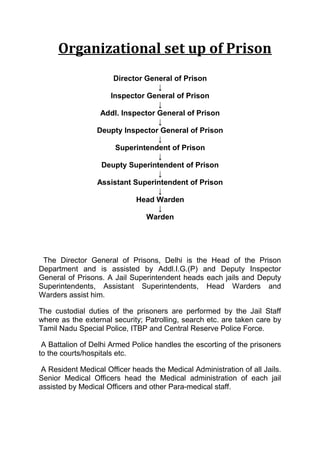
Organizational set up of Prison 
Director General of Prison 
↓ 
Inspector General of Prison 
↓ 
Addl. Inspector General of Prison 
↓ 
Deupty Inspector General of Prison 
↓ 
Superintendent of Prison 
↓ 
Deupty Superintendent of Prison 
↓ 
Assistant Superintendent of Prison 
↓ 
Head Warden 
↓ 
Warden 
The Director General of Prisons, Delhi is the Head of the Prison 
Department and is assisted by Addl.I.G.(P) and Deputy Inspector 
General of Prisons. A Jail Superintendent heads each jails and Deputy 
Superintendents, Assistant Superintendents, Head Warders and 
Warders assist him. 
The custodial duties of the prisoners are performed by the Jail Staff 
where as the external security; Patrolling, search etc. are taken care by 
Tamil Nadu Special Police, ITBP and Central Reserve Police Force. 
A Battalion of Delhi Armed Police handles the escorting of the prisoners 
to the courts/hospitals etc. 
A Resident Medical Officer heads the Medical Administration of all Jails. 
Senior Medical Officers head the Medical administration of each jail 
assisted by Medical Officers and other Para-medical staff.
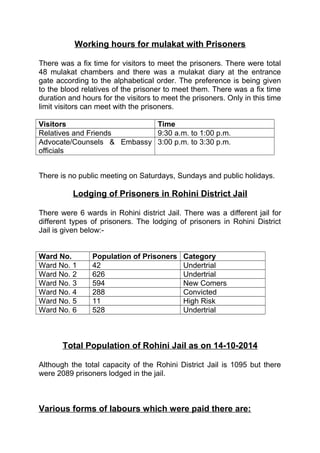
Working hours for mulakat with Prisoners 
There was a fix time for visitors to meet the prisoners. There were total 
48 mulakat chambers and there was a mulakat diary at the entrance 
gate according to the alphabetical order. The preference is being given 
to the blood relatives of the prisoner to meet them. There was a fix time 
duration and hours for the visitors to meet the prisoners. Only in this time 
limit visitors can meet with the prisoners. 
Visitors Time 
Relatives and Friends 9:30 a.m. to 1:00 p.m. 
Advocate/Counsels & Embassy 
3:00 p.m. to 3:30 p.m. 
officials 
There is no public meeting on Saturdays, Sundays and public holidays. 
Lodging of Prisoners in Rohini District Jail 
There were 6 wards in Rohini district Jail. There was a different jail for 
different types of prisoners. The lodging of prisoners in Rohini District 
Jail is given below:- 
Ward No. Population of Prisoners Category 
Ward No. 1 42 Undertrial 
Ward No. 2 626 Undertrial 
Ward No. 3 594 New Comers 
Ward No. 4 288 Convicted 
Ward No. 5 11 High Risk 
Ward No. 6 528 Undertrial 
Total Population of Rohini Jail as on 14-10-2014 
Although the total capacity of the Rohini District Jail is 1095 but there 
were 2089 prisoners lodged in the jail. 
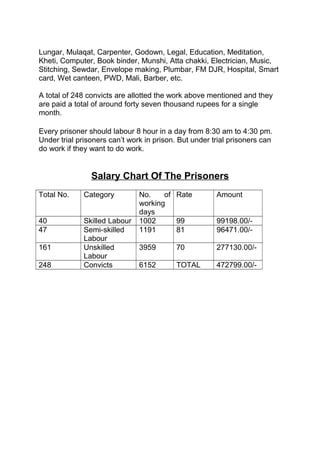
Various forms of labours which were paid there are:
Lungar, Mulaqat, Carpenter, Godown, Legal, Education, Meditation, 
Kheti, Computer, Book binder, Munshi, Atta chakki, Electrician, Music, 
Stitching, Sewdar, Envelope making, Plumbar, FM DJR, Hospital, Smart 
card, Wet canteen, PWD, Mali, Barber, etc. 
A total of 248 convicts are allotted the work above mentioned and they 
are paid a total of around forty seven thousand rupees for a single 
month. 
Every prisoner should labour 8 hour in a day from 8:30 am to 4:30 pm. 
Under trial prisoners can’t work in prison. But under trial prisoners can 
do work if they want to do work. 
Salary Chart Of The Prisoners 
Total No. Category No. of 
working 
days 
Rate Amount 
40 Skilled Labour 1002 99 99198.00/- 
47 Semi-skilled 
Labour 
1191 81 96471.00/- 
161 Unskilled 
Labour 
3959 70 277130.00/- 
248 Convicts 6152 TOTAL 472799.00/-
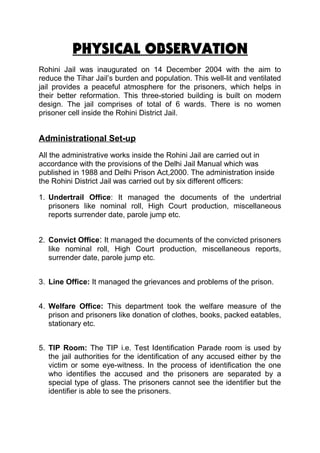
PHYSICAL OBSERVATION 
Rohini Jail was inaugurated on 14 December 2004 with the aim to 
reduce the Tihar Jail’s burden and population. This well-lit and ventilated 
jail provides a peaceful atmosphere for the prisoners, which helps in 
their better reformation. This three-storied building is built on modern 
design. The jail comprises of total of 6 wards. There is no women 
prisoner cell inside the Rohini District Jail. 
Administrational Set-up 
All the administrative works inside the Rohini Jail are carried out in 
accordance with the provisions of the Delhi Jail Manual which was 
published in 1988 and Delhi Prison Act,2000. The administration inside 
the Rohini District Jail was carried out by six different officers: 
1. Undertrail Office: It managed the documents of the undertrial 
prisoners like nominal roll, High Court production, miscellaneous 
reports surrender date, parole jump etc. 
2. Convict Office: It managed the documents of the convicted prisoners 
like nominal roll, High Court production, miscellaneous reports, 
surrender date, parole jump etc. 
3. Line Office: It managed the grievances and problems of the prison. 
4. Welfare Office: This department took the welfare measure of the 
prison and prisoners like donation of clothes, books, packed eatables, 
stationary etc. 
5. TIP Room: The TIP i.e. Test Identification Parade room is used by 
the jail authorities for the identification of any accused either by the 
victim or some eye-witness. In the process of identification the one 
who identifies the accused and the prisoners are separated by a 
special type of glass. The prisoners cannot see the identifier but the 
identifier is able to see the prisoners.
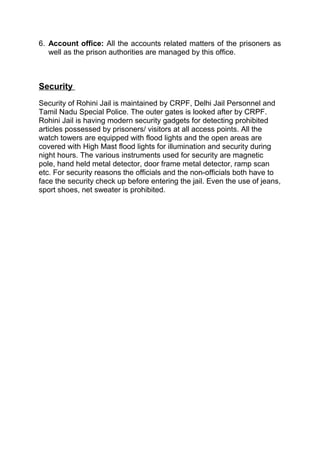
6. Account office: All the accounts related matters of the prisoners as 
well as the prison authorities are managed by this office. 
Security 
Security of Rohini Jail is maintained by CRPF, Delhi Jail Personnel and 
Tamil Nadu Special Police. The outer gates is looked after by CRPF. 
Rohini Jail is having modern security gadgets for detecting prohibited 
articles possessed by prisoners/ visitors at all access points. All the 
watch towers are equipped with flood lights and the open areas are 
covered with High Mast flood lights for illumination and security during 
night hours. The various instruments used for security are magnetic 
pole, hand held metal detector, door frame metal detector, ramp scan 
etc. For security reasons the officials and the non-officials both have to 
face the security check up before entering the jail. Even the use of jeans, 
sport shoes, net sweater is prohibited.
Different activities in Rohini District jail 
Recreational Activities 
The prisoner's participation in games and sports activities within the 
prisons took a big jump with the organization of inter-ward and inter-jail 
competitions twice a year for the last over five years. In all the prisons, 
sports like volleyball, cricket, basketball, kho-kho, kabbaddi, chess, 
carom etc. are organized during. Every year competitions in music, 
dance, sher-o-shairi, quawali, painting, quiz etc. are organised for 
inmates. Eminent personalities from the field of sports and culture are 
invited on these occasions to encourage the prisoners to take part in the 
sports and cultural events, to foster their physical, mental and cultural 
development and inculcate discipline. 
Educational Activities 
Both adult and formal education arrangements have been made for 
prisoners. Educational activities are looked after with the help of 
Government resources as well as NGO's participation. Study Centres of 
the Indira Gandhi National Open University (IGNOU), New Delhi and 
National Institute of Open Schooling (NIOS), Delhi are established at 
Rohini District Prison. Computer training centres are also working in the 
Prisons for imparting computer education to the prisoners. The most 
important aspect of the education system in Rohini District Jail is that 
educated prisoners voluntarily teach less educated prisoners. An 
illiterate person landing in Rohini District Jail can look forward to being 
literate if his stay is more than a week. Library with the support of Non- 
Governmental Organisations has been created in each jail. 
Expenditure on fees for IGNOU / NIOS courses is borne by the 
Government. Study material like note-books, pens etc. is also being 
provided free of cost to inmate students. 
Literate inmates whose conduct is good help the Prison administration in 
imparting education to other inmates. The imparting of education both 
formal and informal is an important component of prisoner daily routine.
Rehabilitation 
The study of the problems faced by the prisoners after release and the 
reasons for committing crime guided Rohini Jail Administration to initiate 
steps, which can go a long way in rehabilitating the prisoners after their 
release. The facility is for both for convicts as well as undertrials. For the 
post-release rehabilitation of the prisoners, the Social Welfare 
Department of Delhi Govt. provides loans for setting up self-employed 
units. 
Legal Aid 
Legal Aid Cells exist in Rohini Jail with facilities for drafting, typing and 
dealing with bail applications, misc. application, appeals, revision etc. on 
behalf of the Jail inmates. With the coming times the demand for legal 
aid and advice has increased considerably. Majority of prisoners belong 
to economically poor class and are not in a position to avail the services 
of expensive lawyers.
INFRASTRUCTURE SETUP 
· Meditation hall – For cleansing and disciplining mind, Yoga and 
meditation classes were started in a big way with the help of various 
voluntary organizations. Staff members are also encouraged, to 
attend meditation courses. This has helped many prisoners in 
changing the whole approach to life. 
· Tailoring Room – This unit was primarily started for imparting 
vocational training to convicts for post release rehabilitation. This 
section caters to tailoring requirements of prisoners and Jail staff 
uniform. Effective quality control measure with rigid scrutiny of 
efficiency has led to remarkable increase in the turnover of this unit. 
· Bakery Section – The inmates are being taught about the process of 
preparing bakery items such as biscuits, namkeens, bread etc. which 
are used for either self consumption or selling purposes. 
· Library – The library of the Rohini Jail was rich in books, magazines, 
journals and newspapers. The books contained epics, stories, novels, 
philosophical items, law books, and different acts etc. which were in 
different languages. The walls of the library were painted beautifully 
by some scenery which was done by inmates. Also various paintaings 
of important figures were hung on the wall. 
· Pharmacy – There was a pharmacy also in the Rohini Jail in ward 
no.2 which was used to provide medicines to the sick patients free of 
cost. 
· Washing Plant – The Rohini Jail had a washing plant for the purpose 
of washing clothes and their ironing. However this facility was on paid 
basis and the inmates has to pay for using this washing plant. 
· Tailoring – There was a separate room in which stitching, tailoring 
and weaving training was given to the prisons as a part of the 
rehabilitational measure.
· Masala Unit – The spices that are used in the kitchen were prepared 
with the help of grinding machines in this room. This was also done 
by the prisoners only. 
· Kitchen – The inmates have to prepare the food for the whole prison 
department and the prisoners as well in this kitchen. Food for about 
2000 people is prepared by the inmates per meal. 
· Music Room – Music room was equipped with various musical 
instruments like dholak, table, sitar, harmonium, mikesand other 
musical instruments. The Rohini Jail’s inmates were having their own 
mandlis. This room was also used by the inmates for the preparation 
of the competitions like “Tihar Idol”. 
· FM DJ Room – The songs were aired to the entire jail premises 
through this room. This was done in order to divert the minds of the 
inmates from bad ideas. The operator of this room was a prison 
inmate. Other inmates can request him to play a song of their choice. 
· Electrical Unit – Special course for electronics was being given to 
the inmates in this room. This was also a part of the vocational and 
recreational activities. 
· Canteen – There were 2 types of canteens inside the jail i.e. the dry 
canteen and the wet canteen. The menu for everyday was fixed. The 
prisoners had to pay from their smartcard in order to buy stuff from 
the canteen. 
· Daily Need Shop – This shop contains the items of the daily needs of 
the prisoners like undergarments, creams, ointments, oil, combs, 
soaps, towel etc. which was run by prisoners only on no-profit basis. 
The others prisoners had to pay from their smartcard to buy these 
items. 
· Padho Aur Padhao Barrack – This was a classroom equipped with 
benches, books, computer and a table. The prisoners come here for 
basic education. The teacher of the inmates is a prisoner only. 
· Video Conferencing Room – This room was used to present the 
prisoner who is either ill or not in the condition to go the court in the 
front of a judge virtually. The accused can give his statements to the 
judge by using this facility. However the provision of video-conferencing 
can be used on the prior order of judge only.
· Closed Circuit Television System - Prison Administration has 
strengthened its security and surveillance on the activities of 
prisoners as well as prison staff by installing closed circuit television 
system in all the prisons. Each jail has a CCTV control room for 
watching the activities and a state of the art Control Room has been 
setup in the Prison Headquarters. The activities can be recorded for 
seven days after which backup are taken. 
· Model Interview Hall - Model Interview Halls are being constructed 
in jails where the prisoners meet their relatives/ friends separated by 
see through toughened glass and in soundproof environment. Each 
cubical is earmarked for a prisoner where he/she can converse with 
his/her relatives/friends through a one to one microphone system. 
This system facilitates visitors to see and converse with their prisoner 
in a proper manner. 
· Bio-Metric Finger Identification System - The Bio Metric System 
has been introduced with Prison Management System, which stores 
photographs and biometric fingerprints of all the inmates. It helps in 
facilitates the identification of correct prisoners for court production 
and release. 
· Food, Clothing and Bedding - Inmates are provided diet as 
approved by the Govt. of National Capital Territory of Delhi. Special 
food is provided on the days of National importance and Festivals. 
Convicts are provided with clothing as per norms of Delhi Jails. Poor 
inmates are provided with free clothing as per the seasonal 
requirement. All inmates are provided with seasonal bedding. 
· Living Condition for Prisoners – Rohini Jail comprises of six wards 
which has different barracks. The inmates living in each barrack 
varies from 35-60. Each barrack has a television. The barracks and 
cells are being provided with mosaic tiles.
CASE STUDY -1 
Personal Information of the offender 
Name Tareeq Khan 
Age of the offender 27 years 
Place Ghaziabad 
Education of the offender 4th Class 
Sections (IPC) 304B 
Offence Dowry Death 
Family Background 
Offender’s family lives in Ghaziabad. His father is running a 
small grocery shop in their area. The offender is having 2 small brothers 
who are only 14 years and 16 years old. His mother is a house wife, 
Offender’s Detail 
The name of the offender is Tareeq Khan. The offender was 
27 years old. The educational background of the offender is very poor. 
Before he was convicted for the offence, he was working as a barber. 
The offender was married 4 months ago before the conviction. He was 
convicted for the offence of killing his wife by burns as his demand for 
dowry was not fulfilled by his wife’s family. 
If we discuss about the views of offender 
According to the offender, his wife’s family has put the false 
allegation of dowry death on him. As per the statement made by the 
offender, his wife does not used to like him and was not happy from their 
marriage. So after 3 months of his marriage she set herself to fire. The 
offender although praised the services being provided to him in the jail 
but also told some of the problems being faced by him in the jail. His 
family members haven’t came to meet him since 2 months and he
doesn’t have any money in his smartcard without which survival inside 
the jail becomes difficult. 
CASE STUDY -2 
Personal Information of the offender 
Name Mohd. Ghulam Jilani 
Age of the offender 42 years 
Father’s Name Abdul Khalid 
Ward Number 5 
Category High Risk 
Place Jammu & Kashmir 
Education of the offender Graduate 
Sections UAPA,1960 
Offence Separatist 
Status Undertrial 
Family Background 
The offender is from Srinagar. His Father’s name is Moh. 
Abdul Khalid. The offender is a member of Hurriyat Conference, a 
conglomerate of separatist parties in Jammu & Kashmir. His family is 
also settled in Kashmir and earning their bread by selling apples. 
Offender’s Detail 
The name of the offender is Moh. Ghulam Jilani. The 
offender was 42 years old. He was arrested from Srinagar in 2000 and is 
undertrial since then. He is requesting for plebiscite but it’s been 
unheard since long. There demand is for free Kashmir: neither India nor 
Pakistan. 
If we discuss the views of offender 
According to offender, he was arrested from Srinagar but the 
officials have shown it as Delhi. He has no faith in criminal justice system
of India as it’s been 4 years that he is in undertrial. He has made his 
mind for independent Kashmir. He is still supporting the members of 
Hurriyat. 
Personal Analysis 
The case of the subject is very sensitive ones. At one side is the 
question of personal safety and integrity and at others fall the freedom of 
choice.The issue needs to be handled with full wisdom keeping the 
Preamble and Basic Structure of Indian Constitution in mind.
CASE STUDY -3 
Personal Information of the offender 
Name Mr. Sahil 
Age of the offender 26 years 
Place Rohini 
Education of the offender B.A. Economics 
Sections (IPC) 302 
Offence Murder 
Offender’s Detail 
His family lives in Sector-11, Rohini. The offender is a graduate in 
Economic from Delhi University. He was the sole bread earner of the 
family and was running a handbag and suitcase store in Pitampura, 
Delhi. The offender was an undertrial for the offence of murder of his 
neighbor. 
If we discuss about the views of offender 
The offender told us about some of the activities of the 
prisoners. As per the statement made by him, the offender was living in 
the prison since 4 years and his case is still going on in the court. The 
offender is running a daily care shop in the ward no.1 of the Rohini Jail 
on no profit basis. Earlier it was difficult for the offender to survive in the 
jail but slowly he started adjusting with the conditions of the jail.
PERSONAL OBSERVATION 
· Every visitor coming to the Rohini District Jail has to enter his/her 
name and visit timings, for which a separate register was maintained 
and looked after by the security staff. 
· Security of prison was maintained by CRPF, Delhi Jail Personnel and 
Tamil Nadu Special Police. The out gates there were looked after by 
the CRPF. Various instruments used for the security check includes 
CCTV camera surveillance, mobile jammers, X-Ray scanners, hand-held 
metal detectors, computerized Prisoner Management System, 
latest weaponry, Quick Reaction Teams and multi layer security 
system. We were asked to remove our shoes for security check-up 
before entering into the prison premises. There was a lady constable 
for the security check-up of the females. No outsider official or non-official 
was allowed to carry anything with himself inside the jail 
premises. We were provided visitor’s card after our security check-up. 
· There was a “MULAQAT KAKSH” i.e. meeting room which was made 
for the prisoners for the purpose of meeting their family members. 
There was a manual system of booking mulaqats in the jail for its 
respective inmates. The convicted inmates were allowed to meet their 
family members twice a week in alphabetical order. The maximum 
time allotted for mulaqat is 35 minutes/ week. 
· The inmates were provided with a SMART CARD, which recently has 
replaced the coupon system, to avail services inside the jail such as 
canteen, blanket, soap, shampoo, oil and other toiletries. 
· Though the jail is considered to be a model jail but still I observed the 
lack of proper ventilation as there was no facility for exhaust in the 
kitchen. There was a separate room for kitchen staff and their routine 
is different from the others. 
· The convicted prisoners have to make a food for rest of the inmates. 
The kitchen was neat & clean and was equipped with wheat grinding 
machine and masala grinding machine for preparation of food in
hygienic manner. Special food is provided on the days of national 
importance and festivals. 
· Medical services were available to the prisoners 24*7 in ward No.1. 
There was a Senior Medical Officer in this ward and an ambulance 
was also available in case of an emergency. There was a pharmacy 
shop also in this ward which provides free medicines to the prisoners. 
Total 6 doctors were available shift wise. There were separate beds 
for the infectious inmates. In MI room there were 14 beds along with a 
washroom. There was a separate room for drugs addict counseling. 
· The jail is running many humanistic schemes for improving the 
condition of the prisoners such as “Sparsh Scheme” in which the 
prisoners whose relatives did not come for the mulaqat for more than 
a month are provided monetary benefits in their account, which they 
can use to avail the services provided in the jail. The prisoners can 
also make use of it to meet the travel expenses when they are 
releases on parole. This fund is borne by Prisoners Welfare Fund. 
· If a prisoner is of good conduct, he is appointed as Sewadar. Most of 
the work inside the prison is monitored by him. There was a provision 
for honoring the Sewadar by the title of “SEWADAR OF THE 
MONTH”. 
· The jail provided various reformative and correctional opportunities to 
the inmates such as vocational training, educational programmes 
through IGNOU, computer courses, baking school, 
yoga/meditation/spiritual courses, libraries, HIV prevention and 
awareness programmes 
· The prisoners who were of good conduct and those who helped in 
educating and reforming other prisoners were awarded separately by 
the jail authorities. One such prisoner came in my contact who was 
awarded by Rs. 11,000/- and a shawl. 
· Elderly prisoner who were above 55 years of age were not interested 
in talking to anyone and attending social gatherings. 
· Jeans, shoes of thick soles, net sweater etc. were prohibited for the 
inmates in the jail premises. 
· There was a Grievance Redressal Room for the inmates but no 
competent authority was present there.
· There was a separate room for the inmates in which there was 
provision of video-conferencing. We were told that only those 
prisoners who were unable to present themselves before the judge 
were allowed to use this mechanism but prior permission of the 
concerned judge is required for that. 
· The prisoners were having the newspaper facility also in different 
language and a separate register was maintained for that. 
· Bar prisons with double door security were there for high security 
prisoners. Ward no.5 of the Rohini District Jail carried such 11 high 
risk prisoners. The category of the prisoners was serial murderers, 
militants, separatists, terrorists, insurgents and some political 
prisoners. Restricted movement was seen in their case.
CRITICAL ANALYSIS 
· It seems over-crowding is a big issue for lack of proper attention 
towards the inmates as the jail can house only 1050 prisoners but it is 
accommodating more than 2000 prisoners, which is just double the 
capacity of the jail. On an average there were 40-45 inmates in one 
barrack. And to my surprise there were 65 prisoners in one of the 
barrack. 
· I was told by the Deputy Superintendent of Jail that the under trial 
prisoners can wear normal casuals and it is mandatory for the 
convicted prisoners to wear uniform which was of white colour. But 
only the Sewadars were wearing white colour uniform. 
· Since every barrack have a separate washroom but it is not sufficient 
for the sanitation of 40-45 prisoners residing in one barrack. It is a 
root-cause of many diseases also such as tuberculosis, hepatitis and 
other water-borne and air-borne diseases. 
· Though it is a fundamental right to privacy of every Indian citizen 
flowing from Article 21 of the Indian Constitution which also includes 
prisoners subject to some restrictions, the privacy to the prisoners is 
not given in few matters such as availing washroom services. The 
washrooms were present in the barrack itself and were not properly 
walled or covered. Moreover there was no exhaust present. 
· Welfare officers present there were competent to counsel the 
prisoners but at the same time he has no time to meet prisoners 
individually. Lack of counseling is major hindrance in the reformation 
of the prisoners. 
· Although the security inside the jail was tight enough regarding the 
inmates but when it comes to the security check-up of the visitors it 
was lenient as during our 3 day visit to Rohini District Jail the security 
staff skipped the security check up of the girls
SUGGESTIONS 
· Over-crowding should be reduced by opening more jails to improve 
the health conditions and personal hygiene of the inmates. 
· Counselor should be appointed at Rohini District Jail which can 
reduce the aggression of the inmates by providing them counseling 
individually. 
· Compensation should be provided to the needy, poor, destitute and 
old-age prisoners. 
· Active involvement of NGOs, CSOs and other organization working 
towards the betterment of the prison system in India and prisoners is 
required. 
· The infrastructural setup for religious and spiritual teachings needs to 
be tightened. 
· Criminologists, sociologists and psychologists should be appointed 
who can work together in understanding the nature of crime and 
criminals, the behavior of the prisoners and their psychology so that 
more stress can be laid on their reformation and social reintegration 
which is the primary purpose the prison system in India. 
· Adequate and quality food and sanitation facilities should be provided 
to the prisoners because they are in prison not for the punishment as 
a punishment. 
· Training of prisoners along with their entertainment should be given 
due importance.

Jail visit report

  • 1.
    LOK NAYAK JAYAPRAKASHNARAYAN NATIONAL INSTITUTE OF CRIMINOLOGY AND FORENSIC SCIENCE Government of India (Ministry of Home Affairs) Jail visit Report Submitted By: Shankey Verma M.A. (Criminology) 1st Semester
  • 2.
    CONTENTS 1. Acknowledgement 2. Purpose of visit 3. Introduction 4. Organizational setup of prison 5. Physical Observation 6. Infrastructure Setup 7. Case Study - 1 8. Case Study - 2 9. Case Study – 3 10. Personal Observation 11. Critical Analysis 12. Suggestions
  • 3.
    ACKNOWLEDGEMENT I, ShankeyVerma student of M.A. Criminology, would like to pay my sincere gratitude towards our course director Prof. (Dr.)B.N. Chattoraj, for arranging our visit to Rohini Jail for the purpose of understanding the Jail organization and its functioning. I am also thankful to Mr. Harish Tyagi, the Superintendent Rohini Jail, Delhi to make us understand the things in a much practical way. Shankey Verma
  • 4.
    PURPOSE OF THEVISIT The main objectives given by our course director was taken into consideration before going to the field work in the above mentioned institution as followed: 1. To study the role of Rohini District Jail in treatment of prisoners in the framework of rehabilitative and reformative activities given to the prisoners. 2. To study the infrastructure provided by the jail authorities to the prisoners. 3. To study the vision and mission of Rohini District Jail. 4. To study the behavior of the inmates of the jail. 5. To study the services and opportunities provided to the inmates by the jail authorities. 6. To study the security system of the jail premises. 7. The responsibilities of the jail authorities towards the prisoners.
  • 5.
    INTRODUCTION The prisonsnow a days are styled as a correctional institution rather than as an institution for punishment. This is because with the evolution of the society and the increasing importance of human rights we have moved into an era of reformation from the era of retribution. The main objective of prison is to convert the inmates into ordinary members of the society by providing them with useful skills, education and respect for the law. It aims to improve the inmates’ self esteem and strengthen their desire to improve. To engage, rehabilitate and reform its inmates, the current prison system in India uses music therapy which involves music training sessions and concerts. Many of the inmates continue their higher education through distance learning programmes. Thus the prison is acting as an adult school. What is the vision of the prison department? To provide safe and secure detention of the prisoners committed to the prison custody. To provide for the reformation and rehabilitation of prisoners. To provide for Basic Minimum facilities to prisoners to maintain human dignity. What is the mission of the prison department? To provide minimum standard of living/treatment to the prisoners remanded to judicial custody and at the same time to reform /rehabilitate them by involving them in various vocational, spiritual, educational activities so that they become useful citizen of the country after their release.
  • 6.
    Organizational set upof Prison Director General of Prison ↓ Inspector General of Prison ↓ Addl. Inspector General of Prison ↓ Deupty Inspector General of Prison ↓ Superintendent of Prison ↓ Deupty Superintendent of Prison ↓ Assistant Superintendent of Prison ↓ Head Warden ↓ Warden The Director General of Prisons, Delhi is the Head of the Prison Department and is assisted by Addl.I.G.(P) and Deputy Inspector General of Prisons. A Jail Superintendent heads each jails and Deputy Superintendents, Assistant Superintendents, Head Warders and Warders assist him. The custodial duties of the prisoners are performed by the Jail Staff where as the external security; Patrolling, search etc. are taken care by Tamil Nadu Special Police, ITBP and Central Reserve Police Force. A Battalion of Delhi Armed Police handles the escorting of the prisoners to the courts/hospitals etc. A Resident Medical Officer heads the Medical Administration of all Jails. Senior Medical Officers head the Medical administration of each jail assisted by Medical Officers and other Para-medical staff.
  • 7.
    Working hours formulakat with Prisoners There was a fix time for visitors to meet the prisoners. There were total 48 mulakat chambers and there was a mulakat diary at the entrance gate according to the alphabetical order. The preference is being given to the blood relatives of the prisoner to meet them. There was a fix time duration and hours for the visitors to meet the prisoners. Only in this time limit visitors can meet with the prisoners. Visitors Time Relatives and Friends 9:30 a.m. to 1:00 p.m. Advocate/Counsels & Embassy 3:00 p.m. to 3:30 p.m. officials There is no public meeting on Saturdays, Sundays and public holidays. Lodging of Prisoners in Rohini District Jail There were 6 wards in Rohini district Jail. There was a different jail for different types of prisoners. The lodging of prisoners in Rohini District Jail is given below:- Ward No. Population of Prisoners Category Ward No. 1 42 Undertrial Ward No. 2 626 Undertrial Ward No. 3 594 New Comers Ward No. 4 288 Convicted Ward No. 5 11 High Risk Ward No. 6 528 Undertrial Total Population of Rohini Jail as on 14-10-2014 Although the total capacity of the Rohini District Jail is 1095 but there were 2089 prisoners lodged in the jail. Various forms of labours which were paid there are:
  • 8.
    Lungar, Mulaqat, Carpenter,Godown, Legal, Education, Meditation, Kheti, Computer, Book binder, Munshi, Atta chakki, Electrician, Music, Stitching, Sewdar, Envelope making, Plumbar, FM DJR, Hospital, Smart card, Wet canteen, PWD, Mali, Barber, etc. A total of 248 convicts are allotted the work above mentioned and they are paid a total of around forty seven thousand rupees for a single month. Every prisoner should labour 8 hour in a day from 8:30 am to 4:30 pm. Under trial prisoners can’t work in prison. But under trial prisoners can do work if they want to do work. Salary Chart Of The Prisoners Total No. Category No. of working days Rate Amount 40 Skilled Labour 1002 99 99198.00/- 47 Semi-skilled Labour 1191 81 96471.00/- 161 Unskilled Labour 3959 70 277130.00/- 248 Convicts 6152 TOTAL 472799.00/-
  • 9.
    PHYSICAL OBSERVATION RohiniJail was inaugurated on 14 December 2004 with the aim to reduce the Tihar Jail’s burden and population. This well-lit and ventilated jail provides a peaceful atmosphere for the prisoners, which helps in their better reformation. This three-storied building is built on modern design. The jail comprises of total of 6 wards. There is no women prisoner cell inside the Rohini District Jail. Administrational Set-up All the administrative works inside the Rohini Jail are carried out in accordance with the provisions of the Delhi Jail Manual which was published in 1988 and Delhi Prison Act,2000. The administration inside the Rohini District Jail was carried out by six different officers: 1. Undertrail Office: It managed the documents of the undertrial prisoners like nominal roll, High Court production, miscellaneous reports surrender date, parole jump etc. 2. Convict Office: It managed the documents of the convicted prisoners like nominal roll, High Court production, miscellaneous reports, surrender date, parole jump etc. 3. Line Office: It managed the grievances and problems of the prison. 4. Welfare Office: This department took the welfare measure of the prison and prisoners like donation of clothes, books, packed eatables, stationary etc. 5. TIP Room: The TIP i.e. Test Identification Parade room is used by the jail authorities for the identification of any accused either by the victim or some eye-witness. In the process of identification the one who identifies the accused and the prisoners are separated by a special type of glass. The prisoners cannot see the identifier but the identifier is able to see the prisoners.
  • 10.
    6. Account office:All the accounts related matters of the prisoners as well as the prison authorities are managed by this office. Security Security of Rohini Jail is maintained by CRPF, Delhi Jail Personnel and Tamil Nadu Special Police. The outer gates is looked after by CRPF. Rohini Jail is having modern security gadgets for detecting prohibited articles possessed by prisoners/ visitors at all access points. All the watch towers are equipped with flood lights and the open areas are covered with High Mast flood lights for illumination and security during night hours. The various instruments used for security are magnetic pole, hand held metal detector, door frame metal detector, ramp scan etc. For security reasons the officials and the non-officials both have to face the security check up before entering the jail. Even the use of jeans, sport shoes, net sweater is prohibited.
  • 11.
    Different activities inRohini District jail Recreational Activities The prisoner's participation in games and sports activities within the prisons took a big jump with the organization of inter-ward and inter-jail competitions twice a year for the last over five years. In all the prisons, sports like volleyball, cricket, basketball, kho-kho, kabbaddi, chess, carom etc. are organized during. Every year competitions in music, dance, sher-o-shairi, quawali, painting, quiz etc. are organised for inmates. Eminent personalities from the field of sports and culture are invited on these occasions to encourage the prisoners to take part in the sports and cultural events, to foster their physical, mental and cultural development and inculcate discipline. Educational Activities Both adult and formal education arrangements have been made for prisoners. Educational activities are looked after with the help of Government resources as well as NGO's participation. Study Centres of the Indira Gandhi National Open University (IGNOU), New Delhi and National Institute of Open Schooling (NIOS), Delhi are established at Rohini District Prison. Computer training centres are also working in the Prisons for imparting computer education to the prisoners. The most important aspect of the education system in Rohini District Jail is that educated prisoners voluntarily teach less educated prisoners. An illiterate person landing in Rohini District Jail can look forward to being literate if his stay is more than a week. Library with the support of Non- Governmental Organisations has been created in each jail. Expenditure on fees for IGNOU / NIOS courses is borne by the Government. Study material like note-books, pens etc. is also being provided free of cost to inmate students. Literate inmates whose conduct is good help the Prison administration in imparting education to other inmates. The imparting of education both formal and informal is an important component of prisoner daily routine.
  • 12.
    Rehabilitation The studyof the problems faced by the prisoners after release and the reasons for committing crime guided Rohini Jail Administration to initiate steps, which can go a long way in rehabilitating the prisoners after their release. The facility is for both for convicts as well as undertrials. For the post-release rehabilitation of the prisoners, the Social Welfare Department of Delhi Govt. provides loans for setting up self-employed units. Legal Aid Legal Aid Cells exist in Rohini Jail with facilities for drafting, typing and dealing with bail applications, misc. application, appeals, revision etc. on behalf of the Jail inmates. With the coming times the demand for legal aid and advice has increased considerably. Majority of prisoners belong to economically poor class and are not in a position to avail the services of expensive lawyers.
  • 13.
    INFRASTRUCTURE SETUP ·Meditation hall – For cleansing and disciplining mind, Yoga and meditation classes were started in a big way with the help of various voluntary organizations. Staff members are also encouraged, to attend meditation courses. This has helped many prisoners in changing the whole approach to life. · Tailoring Room – This unit was primarily started for imparting vocational training to convicts for post release rehabilitation. This section caters to tailoring requirements of prisoners and Jail staff uniform. Effective quality control measure with rigid scrutiny of efficiency has led to remarkable increase in the turnover of this unit. · Bakery Section – The inmates are being taught about the process of preparing bakery items such as biscuits, namkeens, bread etc. which are used for either self consumption or selling purposes. · Library – The library of the Rohini Jail was rich in books, magazines, journals and newspapers. The books contained epics, stories, novels, philosophical items, law books, and different acts etc. which were in different languages. The walls of the library were painted beautifully by some scenery which was done by inmates. Also various paintaings of important figures were hung on the wall. · Pharmacy – There was a pharmacy also in the Rohini Jail in ward no.2 which was used to provide medicines to the sick patients free of cost. · Washing Plant – The Rohini Jail had a washing plant for the purpose of washing clothes and their ironing. However this facility was on paid basis and the inmates has to pay for using this washing plant. · Tailoring – There was a separate room in which stitching, tailoring and weaving training was given to the prisons as a part of the rehabilitational measure.
  • 14.
    · Masala Unit– The spices that are used in the kitchen were prepared with the help of grinding machines in this room. This was also done by the prisoners only. · Kitchen – The inmates have to prepare the food for the whole prison department and the prisoners as well in this kitchen. Food for about 2000 people is prepared by the inmates per meal. · Music Room – Music room was equipped with various musical instruments like dholak, table, sitar, harmonium, mikesand other musical instruments. The Rohini Jail’s inmates were having their own mandlis. This room was also used by the inmates for the preparation of the competitions like “Tihar Idol”. · FM DJ Room – The songs were aired to the entire jail premises through this room. This was done in order to divert the minds of the inmates from bad ideas. The operator of this room was a prison inmate. Other inmates can request him to play a song of their choice. · Electrical Unit – Special course for electronics was being given to the inmates in this room. This was also a part of the vocational and recreational activities. · Canteen – There were 2 types of canteens inside the jail i.e. the dry canteen and the wet canteen. The menu for everyday was fixed. The prisoners had to pay from their smartcard in order to buy stuff from the canteen. · Daily Need Shop – This shop contains the items of the daily needs of the prisoners like undergarments, creams, ointments, oil, combs, soaps, towel etc. which was run by prisoners only on no-profit basis. The others prisoners had to pay from their smartcard to buy these items. · Padho Aur Padhao Barrack – This was a classroom equipped with benches, books, computer and a table. The prisoners come here for basic education. The teacher of the inmates is a prisoner only. · Video Conferencing Room – This room was used to present the prisoner who is either ill or not in the condition to go the court in the front of a judge virtually. The accused can give his statements to the judge by using this facility. However the provision of video-conferencing can be used on the prior order of judge only.
  • 15.
    · Closed CircuitTelevision System - Prison Administration has strengthened its security and surveillance on the activities of prisoners as well as prison staff by installing closed circuit television system in all the prisons. Each jail has a CCTV control room for watching the activities and a state of the art Control Room has been setup in the Prison Headquarters. The activities can be recorded for seven days after which backup are taken. · Model Interview Hall - Model Interview Halls are being constructed in jails where the prisoners meet their relatives/ friends separated by see through toughened glass and in soundproof environment. Each cubical is earmarked for a prisoner where he/she can converse with his/her relatives/friends through a one to one microphone system. This system facilitates visitors to see and converse with their prisoner in a proper manner. · Bio-Metric Finger Identification System - The Bio Metric System has been introduced with Prison Management System, which stores photographs and biometric fingerprints of all the inmates. It helps in facilitates the identification of correct prisoners for court production and release. · Food, Clothing and Bedding - Inmates are provided diet as approved by the Govt. of National Capital Territory of Delhi. Special food is provided on the days of National importance and Festivals. Convicts are provided with clothing as per norms of Delhi Jails. Poor inmates are provided with free clothing as per the seasonal requirement. All inmates are provided with seasonal bedding. · Living Condition for Prisoners – Rohini Jail comprises of six wards which has different barracks. The inmates living in each barrack varies from 35-60. Each barrack has a television. The barracks and cells are being provided with mosaic tiles.
  • 16.
    CASE STUDY -1 Personal Information of the offender Name Tareeq Khan Age of the offender 27 years Place Ghaziabad Education of the offender 4th Class Sections (IPC) 304B Offence Dowry Death Family Background Offender’s family lives in Ghaziabad. His father is running a small grocery shop in their area. The offender is having 2 small brothers who are only 14 years and 16 years old. His mother is a house wife, Offender’s Detail The name of the offender is Tareeq Khan. The offender was 27 years old. The educational background of the offender is very poor. Before he was convicted for the offence, he was working as a barber. The offender was married 4 months ago before the conviction. He was convicted for the offence of killing his wife by burns as his demand for dowry was not fulfilled by his wife’s family. If we discuss about the views of offender According to the offender, his wife’s family has put the false allegation of dowry death on him. As per the statement made by the offender, his wife does not used to like him and was not happy from their marriage. So after 3 months of his marriage she set herself to fire. The offender although praised the services being provided to him in the jail but also told some of the problems being faced by him in the jail. His family members haven’t came to meet him since 2 months and he
  • 17.
    doesn’t have anymoney in his smartcard without which survival inside the jail becomes difficult. CASE STUDY -2 Personal Information of the offender Name Mohd. Ghulam Jilani Age of the offender 42 years Father’s Name Abdul Khalid Ward Number 5 Category High Risk Place Jammu & Kashmir Education of the offender Graduate Sections UAPA,1960 Offence Separatist Status Undertrial Family Background The offender is from Srinagar. His Father’s name is Moh. Abdul Khalid. The offender is a member of Hurriyat Conference, a conglomerate of separatist parties in Jammu & Kashmir. His family is also settled in Kashmir and earning their bread by selling apples. Offender’s Detail The name of the offender is Moh. Ghulam Jilani. The offender was 42 years old. He was arrested from Srinagar in 2000 and is undertrial since then. He is requesting for plebiscite but it’s been unheard since long. There demand is for free Kashmir: neither India nor Pakistan. If we discuss the views of offender According to offender, he was arrested from Srinagar but the officials have shown it as Delhi. He has no faith in criminal justice system
  • 18.
    of India asit’s been 4 years that he is in undertrial. He has made his mind for independent Kashmir. He is still supporting the members of Hurriyat. Personal Analysis The case of the subject is very sensitive ones. At one side is the question of personal safety and integrity and at others fall the freedom of choice.The issue needs to be handled with full wisdom keeping the Preamble and Basic Structure of Indian Constitution in mind.
  • 19.
    CASE STUDY -3 Personal Information of the offender Name Mr. Sahil Age of the offender 26 years Place Rohini Education of the offender B.A. Economics Sections (IPC) 302 Offence Murder Offender’s Detail His family lives in Sector-11, Rohini. The offender is a graduate in Economic from Delhi University. He was the sole bread earner of the family and was running a handbag and suitcase store in Pitampura, Delhi. The offender was an undertrial for the offence of murder of his neighbor. If we discuss about the views of offender The offender told us about some of the activities of the prisoners. As per the statement made by him, the offender was living in the prison since 4 years and his case is still going on in the court. The offender is running a daily care shop in the ward no.1 of the Rohini Jail on no profit basis. Earlier it was difficult for the offender to survive in the jail but slowly he started adjusting with the conditions of the jail.
  • 20.
    PERSONAL OBSERVATION ·Every visitor coming to the Rohini District Jail has to enter his/her name and visit timings, for which a separate register was maintained and looked after by the security staff. · Security of prison was maintained by CRPF, Delhi Jail Personnel and Tamil Nadu Special Police. The out gates there were looked after by the CRPF. Various instruments used for the security check includes CCTV camera surveillance, mobile jammers, X-Ray scanners, hand-held metal detectors, computerized Prisoner Management System, latest weaponry, Quick Reaction Teams and multi layer security system. We were asked to remove our shoes for security check-up before entering into the prison premises. There was a lady constable for the security check-up of the females. No outsider official or non-official was allowed to carry anything with himself inside the jail premises. We were provided visitor’s card after our security check-up. · There was a “MULAQAT KAKSH” i.e. meeting room which was made for the prisoners for the purpose of meeting their family members. There was a manual system of booking mulaqats in the jail for its respective inmates. The convicted inmates were allowed to meet their family members twice a week in alphabetical order. The maximum time allotted for mulaqat is 35 minutes/ week. · The inmates were provided with a SMART CARD, which recently has replaced the coupon system, to avail services inside the jail such as canteen, blanket, soap, shampoo, oil and other toiletries. · Though the jail is considered to be a model jail but still I observed the lack of proper ventilation as there was no facility for exhaust in the kitchen. There was a separate room for kitchen staff and their routine is different from the others. · The convicted prisoners have to make a food for rest of the inmates. The kitchen was neat & clean and was equipped with wheat grinding machine and masala grinding machine for preparation of food in
  • 21.
    hygienic manner. Specialfood is provided on the days of national importance and festivals. · Medical services were available to the prisoners 24*7 in ward No.1. There was a Senior Medical Officer in this ward and an ambulance was also available in case of an emergency. There was a pharmacy shop also in this ward which provides free medicines to the prisoners. Total 6 doctors were available shift wise. There were separate beds for the infectious inmates. In MI room there were 14 beds along with a washroom. There was a separate room for drugs addict counseling. · The jail is running many humanistic schemes for improving the condition of the prisoners such as “Sparsh Scheme” in which the prisoners whose relatives did not come for the mulaqat for more than a month are provided monetary benefits in their account, which they can use to avail the services provided in the jail. The prisoners can also make use of it to meet the travel expenses when they are releases on parole. This fund is borne by Prisoners Welfare Fund. · If a prisoner is of good conduct, he is appointed as Sewadar. Most of the work inside the prison is monitored by him. There was a provision for honoring the Sewadar by the title of “SEWADAR OF THE MONTH”. · The jail provided various reformative and correctional opportunities to the inmates such as vocational training, educational programmes through IGNOU, computer courses, baking school, yoga/meditation/spiritual courses, libraries, HIV prevention and awareness programmes · The prisoners who were of good conduct and those who helped in educating and reforming other prisoners were awarded separately by the jail authorities. One such prisoner came in my contact who was awarded by Rs. 11,000/- and a shawl. · Elderly prisoner who were above 55 years of age were not interested in talking to anyone and attending social gatherings. · Jeans, shoes of thick soles, net sweater etc. were prohibited for the inmates in the jail premises. · There was a Grievance Redressal Room for the inmates but no competent authority was present there.
  • 22.
    · There wasa separate room for the inmates in which there was provision of video-conferencing. We were told that only those prisoners who were unable to present themselves before the judge were allowed to use this mechanism but prior permission of the concerned judge is required for that. · The prisoners were having the newspaper facility also in different language and a separate register was maintained for that. · Bar prisons with double door security were there for high security prisoners. Ward no.5 of the Rohini District Jail carried such 11 high risk prisoners. The category of the prisoners was serial murderers, militants, separatists, terrorists, insurgents and some political prisoners. Restricted movement was seen in their case.
  • 23.
    CRITICAL ANALYSIS ·It seems over-crowding is a big issue for lack of proper attention towards the inmates as the jail can house only 1050 prisoners but it is accommodating more than 2000 prisoners, which is just double the capacity of the jail. On an average there were 40-45 inmates in one barrack. And to my surprise there were 65 prisoners in one of the barrack. · I was told by the Deputy Superintendent of Jail that the under trial prisoners can wear normal casuals and it is mandatory for the convicted prisoners to wear uniform which was of white colour. But only the Sewadars were wearing white colour uniform. · Since every barrack have a separate washroom but it is not sufficient for the sanitation of 40-45 prisoners residing in one barrack. It is a root-cause of many diseases also such as tuberculosis, hepatitis and other water-borne and air-borne diseases. · Though it is a fundamental right to privacy of every Indian citizen flowing from Article 21 of the Indian Constitution which also includes prisoners subject to some restrictions, the privacy to the prisoners is not given in few matters such as availing washroom services. The washrooms were present in the barrack itself and were not properly walled or covered. Moreover there was no exhaust present. · Welfare officers present there were competent to counsel the prisoners but at the same time he has no time to meet prisoners individually. Lack of counseling is major hindrance in the reformation of the prisoners. · Although the security inside the jail was tight enough regarding the inmates but when it comes to the security check-up of the visitors it was lenient as during our 3 day visit to Rohini District Jail the security staff skipped the security check up of the girls
  • 24.
    SUGGESTIONS · Over-crowdingshould be reduced by opening more jails to improve the health conditions and personal hygiene of the inmates. · Counselor should be appointed at Rohini District Jail which can reduce the aggression of the inmates by providing them counseling individually. · Compensation should be provided to the needy, poor, destitute and old-age prisoners. · Active involvement of NGOs, CSOs and other organization working towards the betterment of the prison system in India and prisoners is required. · The infrastructural setup for religious and spiritual teachings needs to be tightened. · Criminologists, sociologists and psychologists should be appointed who can work together in understanding the nature of crime and criminals, the behavior of the prisoners and their psychology so that more stress can be laid on their reformation and social reintegration which is the primary purpose the prison system in India. · Adequate and quality food and sanitation facilities should be provided to the prisoners because they are in prison not for the punishment as a punishment. · Training of prisoners along with their entertainment should be given due importance.