Triage
Instructor Name:
Title:
Unit:
Triage – from the French sort
• In casualty management sorting of a large
number of injured personnel is the 1st stage
in establishing order
• Triage sets the stage for treatment and
eventuates in transport of the injured
Triage is not to be considered
with finality
• Triage categories change based upon
– Number of injured
– Available resources
– Nature and extent of injuries(s)
– State of hostile threat
Things change
• Number of patients
• Extent of resources
• Condition of patient
– Gets better
– Gets worse
– Transport arrives
If you have only 1 patient
• That patient is Pri 1 Immediate regardless of
anything else
• There is no real need for triage
• Once this number increases, the need for
triage arises
Categories
• Immediate
– Threat to life/limb
• A lightly injured is immediate if he can be
returned to duty with immediate simple
management
Urgent
• Patient is at risk if treatment or
transportation is delayed unreasonably
Delayed
• No risk to life or consequence if more
definitive care is not rendered quickly
Expectant
• Regardless of the level of care rendered,
patient is likely to expire
• Tough call to make for unit personnel
START – triage technique
• Simple treat/triage and rapid transport
• All of you within the sound of my voice
– Move towards me
– Doesn’t work well in no/low light or excess
noise
Military Triage
COL Cliff Cloonan
Assistant Professor
Military & Emergency
Medicine Department
Instructor Name:
Title:
Unit:
Triage
• Objectives – Upon completion of this block
of instruction the student will be able to:
Oklahoma City Federal Building Bombing
Triage
• Definition –
– “To Sort”
– From the French word, “trier”
– Has been defined as “doing the greatest good
for the greatest number” BUT triage is simply a
sorting PROCESS that when applied creates a
situation that allows for “doing the greatest
good for the greatest number”
Triage
• What are the OBJECTIVES of doing Triage?
– Rapid sorting of the more serious patients from those
less serious to facilitate the rapid care of the more
serious patients
– When problems exceed resources, triage should
facilitate “doing the greatest good for the greatest
number”
– Bring order to chaos thus facilitating the care of all
patients
Triage
• What is the PROCESS?
– Sorting into categories for evacuation and treatment
• What are the DECISIONS?
– How will the patients be sorted – who goes in which
category?
– What will be done to/with the patients when sorted?
• What factors AFFECT/CHANGE the decisions?
– Resources
– Circumstances
Triage
Special Situations
• Persisting threat to providers/patients
•“Reverse” Triage Situation
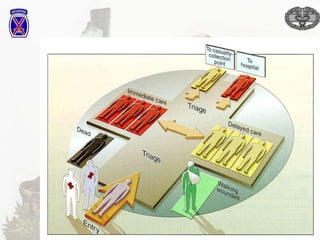
TRIAGE - A CONTINUUM
“Normal”
Triage in
an ED
Triage in
A MASCAL
Situation
Sorting Patients
TRIAGE - A CONTINUUM
“Normal”
Triage in
an ED
Triage in
A MASCAL
Situation
Triage
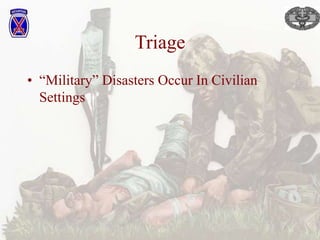
• “Military” Disasters Occur In Civilian
Settings
Triage
• And… “Civilian” disasters occur in military
settings
Truck Accident on Pipeline Rd
Saudi Arabia – Desert Shield
Triage
INPUT
(Patients to
be sorted)
OUTPUT
(Sorted
Patients)
Immediate
Delayed
Minimal
Expectant
Resource
Modifiers
(Manpower,
Equipment,
Expendables,
Time)
Situation
Modifiers
(Risk, Weather,
MET-T, Combat
Situation, etc…)
Disease Process
Modifiers
(Illness,
Injury,
NBC, etc)
Evacuation
Modifiers
(Assets,
Distance, Threat)
Triage
• Military vs. Civilian – Are there differences?
– Continuing risk to medical care providers
• Can occur in both situations
• More common in combat/military triage
– Resource limited
• Can occur in both situations
• More common in combat/military triage
– “Reverse” Triage Situation
• Care provided first to those who when treated can be quickly
returned to duty
• Usually only in a military situation but could occur in a civilian
MASCAL situation (when “Group” survival is at stake)
Civil War
Casualty Collection
Point
Civil War Casualty Collection Poin
and Treatment Station
Vietnam – Mass Heat
Casualties
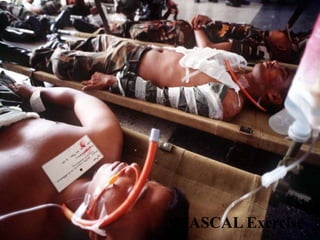
MASCAL Exercise
TRIAGE
- A DYNAMIC
NOT
A STATIC PROCESS
WITHIN THE MILITARY ECHELONED
MEDICAL CARE SYSTEM, TRIAGE OF
CASUALTIES OCCURS (OR SHOULD), AT A
MINIMUM, AT EVERY ECHELON
MILITARY TRIAGE OFTEN
INCLUDES, BUT IS MORE THAN,
MEDICAL PRIORITIZATION
APPROPRIATE MEDICAL
PRIORITIZATION AND
TREATMENT OF INJURIES IN
A SINGLE PATIENT IS THE
GOAL OF ADVANCED TRAUMA
LIFE SUPPORT TRAINING
RPG Wound
Right Knee
- Somalia
What is the Priority
Injury?
What is the
Triage Category?
What is the
Evac Priority?
Burn Victim
- Kosovo
What is the
Priority Injury?
What is the
Triage
Category?
What is the
Evacuation
Priority?
Burn Victim
- Kosovo
SURGICAL PRIORITIZATION,
WHICH, PRIMARILY INVOLVES A
DETERMINATION OF OPERATIVE
PRIORITY, IS NOT TRIAGE
Triage
• Surgical Prioritization Involves -
– Recognizing
• Which patients require surgery to save life/limb/sight
– Knowing
• Numbers of OR’s, doctors, nurses, expendables, blood
(Resources) each operation requires
• Resources (manpower, equip, expendables, blood etc)
required to provide post-op care
• How long each operation will take (Time as a resource)
• The resources that each operation will consume (Must
consider manpower as a consumable resource)
• Probability of successful surgery
Triage
• The Goal of Surgical Prioritization
– Selection of cases with the highest probability
of success that consume the least amount
of resources.
– Make a decision - - and go with it!
• Once a MASCAL situation has been declared don’t
wait for the situation to evolve further before
making a decision.
• Making decisions is more important than what
decisions are made.
– Respect the Triage Decision
Grenade
Fragment
Wound –
Perforating
Bowel
-ICRC Hospital
Afghanistan
Transverse Abdominal
High Velocity Bullet Wound
-ICRC Hospital
Afghanistan
Triage
• Triage Categories used in ICRC Hospitals
– Category I – Priority for Surgery
• Patients who need urgent surgery and who have a good chance
of satisfactory recovery
– Category II – No Surgery
• Patients with wounds so slight that they do not need surgery
AND…
• Patients who are so severely injured that they are unlikely to
survive
– Category III – Can Wait For Surgery
• Patients who need surgery but not urgently
TRIAGE IN A DISASTER IS A MULTI-
DISCIPLINARY PROCESS. IT IS BEST
CARRIED OUT BY SOMEONE WHO IS
FAMILIAR WITH:
•SURGICAL, MEDICAL, AND
PSYCHIATRIC EMERGENCIES
•ALL THE PRE-HOSPITAL AND HOSPITAL-
BASED MEDICAL AND LOGISTICAL
RESOURCES NECESSARY TO EVACUATE
AND PROVIDE CARE FOR A LARGE
NUMBER OF CASUALTIES
BY DEFINITION, TRIAGE IN A DISASTER /
MASCAL SITUATION MEANS THAT LESS
THAN THE NORMAL STANDARD OF
CARE WILL BE PROVIDED FOR
MANY PATIENTS.
EXAMPLE:
FAILURE TO PROVIDE COMPLETE
CONTROL OF THE CERVICAL SPINE IN A
PATIENT WITH MULTIPLE BLUNT TRAUMA
INJURIES IS CONSIDERED MALPRACTICE
EXAMPLE
COMPLETE CERVICAL SPINE
IMMOBILIZATION IS VERY TIME AND
RESOURCE CONSUMING. THE TIME
AND RESOURCES REQUIRED TO
STABILIZE A CERVICAL SPINE MAY
MEAN THAT OTHERS MAY DIE.
ADHERING TO THE PRINCIPLE OF
DOING THE GREATEST
GOOD FOR THE GREATEST NUMBER
MAY REQUIRE THAT LESS
THAN FULL CERVICAL SPINE
IMMOBILIZATION BE PERFORMED
REMEMBER
IF IT WASN'T ALL "SCREWED" UP
IT WOULDN'T BE A DISASTER
REMEMBER
NOT ONLY MAY CHANGES IN A PATIENT'S
MEDICAL CONDITION RESULT IN A CHANGE
IN HIS / HER TRIAGE CATEGORY BUT A
CHANGE IN AVAILABLE RESOURCES MAY ALSO
RESULT IN A CHANGE IN TRIAGE CATEGORY
CAN YOU THINK OF A SITUATION
WHERE IT WOULD EVER BE APPROPRIATE
TO NEGLECT THE MANAGEMENT OF THE
MOST SERIOUSLY WOUNDED IN ORDER TO
TREAT THOSE WITH MORE MINOR INJURIES?
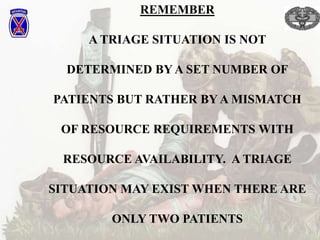
REMEMBER
A TRIAGE SITUATION IS NOT
DETERMINED BY A SET NUMBER OF
PATIENTS BUT RATHER BY A MISMATCH
OF RESOURCE REQUIREMENTS WITH
RESOURCE AVAILABILITY. A TRIAGE
SITUATION MAY EXIST WHEN THERE ARE
ONLY TWO PATIENTS
THE DECISION TO NOT RESUSCITATE
A CRITICALLY INJURED PATIENT WHEN
THERE ARE RESOURCES AVAILABLE TO
DO SO IS NOT THE SAME AS PLACING
A PATIENT IN THE EXPECTANT
CATEGORY IN A DISASTER SITUATION
Triage
• MILITARY TRIAGE DECISIONS ARE
INFLUENCED BY:
– NUMBERS OF PATIENTS AND THEIR MEDICAL
PROBLEMS
– NUMBERS OF EXPENDABLE AND NON-
EXPENDABLE MEDICAL SUPPLIES AND
CAPABILITIES OF MEDICAL TREATMENT
FACILITIES
– NUMBERS AND CAPABILITIES OF MEDICAL
PERSONNEL
Triage
• MILITARY TRIAGE DECISIONS ARE
INFLUENCED BY(CONT):
– NUMBERS AND CAPABILITIES OF
EVACUATION ASSETS
– TACTICAL SITUATION
– WEATHER
– OTHER
TERMINOLOGY
CIVILIAN USE OF THE WORD
"TRIAGE" IS OFTEN NOT
THE SAME AS THE MILITARY
USE OF TRIAGE
IN A MULTI-CASUALTY INCIDENT WHERE
THERE ARE ADEQUATE RESOURCES THE
GOAL IS TO RAPIDLY AND EFFICIENTLY
IDENTIFY PATIENT NEEDS AND THEN TO
MATCH THE RESOURCES WITH THE
PATIENTS WHO REQUIRE THEM
IN A DISASTER SITUATION WHERE
THERE ARE LIMITED RESOURCES THE
GOAL IS TO IDENTIFY PATIENT NEEDS
AND THEN TO DISTRIBUTE THE RESOURCES
IN A MANNER THAT PROVIDES THE BEST
CARE FOR THE MOST POSSIBLE PATIENTS
PROBLEMS WITH STANDARD
TRIAGE TAGS
DON'T CONFUSE TRIAGE
CATEGORIES WITH
EVACUATION PRIORITIES
Triage
• EVACUATION PRIORITIES
– PRIORITY I – URGENT EVACUATION WITHIN
2 HOURS
– PRIORITY IA - URGENT SURGICAL
EVACUATION TO NEAREST SURGICAL
FACILITY WITHIN 2 HOURS
– PRIORITY II – PRIORITY EVACUATION
WITHIN 4 HOURS
– PRIORITY III – ROUTINE EVACUATION
WITHIN 24 HOURS
– PRIORITY IV - CONVENIENCE
MASS CASUALTY
TEACHING POINTS
MASCAL
• Field Response
– What / Who do you send to the disaster site?
• Equipment
– Type – Stick with the basics
» Dressings
» Backboards/litter with straps
» Tourniquets
» Airways / suction devices
– Quantity (lots)
• Personnel
– Type (Surgeon, EM…)(MD, Nurse, PA, EMT-P…)
– Quantity
MASCAL
• Actions on the scene
– Safety and site security FIRST
– Survey the scene
• Estimate number and type of casualties quickly
• Transmit brief initial report to Med Tx Facility
• Request additional equipment (#/type) and
personnel (#/type) as required
MASCAL
• Actions on the scene (cont)
– Quickly choose a casualty collection point
based upon:
• Proximity to patients
• Proximity to potential helicopter landing site
• Safety – Distance from potential hazards, secure
• Geography – Large enough and appropriate for
conduct of Geographic Triage) Separate sites for -
– Immediate (next to transportation)
– Delayed
– Minimal
– Expectant
– Deceased (out of sight of other victims)
MASCAL
• Actions on the scene (cont)
– Collect all ambulatory patients at CCP by
instructing them to walk to CCP
• These patients are mostly in the minimal category
although some may be delayed
• What they are NOT is in the Immediate / Expectant
(except in some burn cases) / Dead categories
MASCAL
• Actions on the scene (cont)
– Put one of the “walking wounded” in charge of
ambulatory patients if limited manpower at
scene
• Most important responsibility is to maintain
accountability and keep patients from leaving CCP
– If more than one medical responder divide the
scene into areas of responsibility and proceed to
rapidly assess / treat / triage all remaining
patients who were unable to walk to the CCP
MASCAL
• Actions on the scene (cont)
– Initially treat ONLY readily correctable airway
problems and obvious external, potentially life-
threatening, bleeding
– No treatment for pulseless /apneic patients.
– Place comatose patients in lateral decubitus
position – then move on
– Apply triage tag to identify location in CCP
where patient is to be taken
MASCAL
• Actions on the scene (cont)
– Have non-medical bystanders and uninjured or
minimally injured patients at the scene act as litter
bearers (at least one experienced litter bearer / team)
and move patients to CCP
– Triage Officer at CCP sorts (“triages”) patients into
separate geographic location based on tags
• Performs rapid reassessment and changes triage category as
required
MASCAL
• Actions on the scene (cont)
– Move rapidly from one patient to next – only
identify and if possible quickly treat life threats
– Identify ALL patients
– Avoid becoming involved in prolonged
procedures
– Avoid becoming distracted by distraught,
minimally injured patients
– Pay attention to administrative concerns – Keep
track of ALL patients (Trust me – you’ll be glad
you did)
MASCAL
• Actions on the scene (cont)
– Transportation Considerations / Decisions
• Do you put all immediate patients on the first
available ambulance?
• Do you send one of your health care providers if
there is no medical care on the transport
• To what facility do you send the ambulance?
– Travel time
– Level I, II, III trauma center?
• Do you wait for a helicopter?
• How secure is the route of travel?
MASCAL
• Medical Treatment Facility Actions
– Maintain Communication with the response
team
• Identify the scope of the problem
• Identify the need for additional resources at the
scene
– Medical
– Security
– Administrative
– Transportation – Ground / Air
– Arrange for helicopter transportation as
appropriate
MASCAL
• Medical Treatment Facility Actions (cont.)
– Notify higher HQ and other medical facilities of the
situation and request that they standby
– Activate Medical Treatment Facility disaster
response plan
• Call in additional staff / keep staff in hospital at end of shift
• Clear receiving area of all stable patients and set up
additional beds as required
• Cancel any non-emergent surgery
• Clear OR’s ASAP
• Prepare hospital beds
– Request higher echelons preposition ambulance at
your medical treatment facility.
MASCAL – Major Teaching
Points
• When ability to provide medical care is
overwhelmed – Bringing organization to the
disaster site is the most important action.
• Avoid the overwhelming impulse to rush in
and being to take care of first patient you
come upon
• Make sure that you do not become a
casualty yourself
MASCAL – Major Teaching
Points
• Remember – All the resources that you have
to deal with a disaster did not come with
you to the scene
• Supervising medical care and ensuring the
proper evacuation order and disposition of
patients may not be glamorous but it will
ultimately be the most important
• Keeping track of the disposition of patients
may seem like a waste of manpower but its
not – trust me.
Triage
• Immediate (examples – not all inclusive)
– Airway
• Generally either must be addressed immediately at which
point patient becomes either
– DELAYED
– DEAD
• Some exceptions
– Breathing
• Correctable on the scene – ie. tension pneumothorax which
when treated may turn patient from IMMEDIATE to
DELAYED
• Uncorrectable on the scene – ie. large pulmonary
contusion/flail chest with hypoxia
– Needs URGENT EVACUATION
Triage
• Immediate (cont.)
– Circulation
• Exsanguinating hemorrhage
– External – usually correctable with a tourniquet
and/or direct pressure at which point patient
becomes DELAYED
– Internal – URGENT EVACUATION
• Cardiac Tamponade
– Even when treated with pericardiocentesis patient
remains IMMEDIATE because underlying cause is
wound to the heart
Triage
• Immediate (cont.)
– Disability
• Closed head injury with deteriorating mental
status
• URGENT EVACUATION required
Triage
• Delayed (examples – not all inclusive)
– All injuries that require surgery but for which a
delay of 4-8 hours will not cause loss of
life/limb/sight
• Penetrating abdominal wounds –
hemodynamically stable
• All fractures requiring ORIF – hemodynamically
stable
• Spinal cord injury – hemodynamically stable
Triage
• Minimal (example – not all inclusive)
– Minor soft tissue wounds not requiring surgical
intervention
– Non-displaced, min. angulated, closed fractures
of the upper extremities or digits
Triage
• Expectant
– When resources are adequate no patients are made
expectant
– The creation of this category presumes inadequate
resources and the types of patients included in this
category is largely dependent on the ratio of
resources/patients – the lower the ratio, the more
patients in this category.
– Examples:
• > 50% TBSA 2nd and 3rd degree burns
• Unresponsive patient with an open head wound and
exposed brain
• Documented exposure to > 500 RADs and immediate signs
of radiation sickness
S.T.A.R.T. - Triage Classification
Protocol
Simple Triage And Rapid Treatment
(adapted from Super, G: START
instructor’s manual)
Able to Walk No
Yes
Delayed Assess
Ventilation
Step 1
Ventilation
Present Yes
< 30/min
> 30/min
Immediate Assess Cap
Refill
No
Position
Airway
Ventilation
Present?
No Yes
Immediate
Expectant
or Dead
Step 2
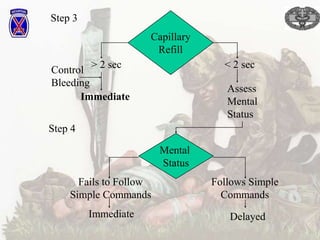
Capillary
Refill
< 2 sec
> 2 sec
Immediate
Control
Bleeding
Assess
Mental
Status
Mental
Status
Follows Simple
Commands
Fails to Follow
Simple Commands
Immediate Delayed
Step 3
Step 4

triage.ppt

  • 1.
  • 2.
    Triage – fromthe French sort • In casualty management sorting of a large number of injured personnel is the 1st stage in establishing order • Triage sets the stage for treatment and eventuates in transport of the injured
  • 3.
    Triage is notto be considered with finality • Triage categories change based upon – Number of injured – Available resources – Nature and extent of injuries(s) – State of hostile threat
  • 4.
    Things change • Numberof patients • Extent of resources • Condition of patient – Gets better – Gets worse – Transport arrives
  • 5.
    If you haveonly 1 patient • That patient is Pri 1 Immediate regardless of anything else • There is no real need for triage • Once this number increases, the need for triage arises
  • 6.
    Categories • Immediate – Threatto life/limb • A lightly injured is immediate if he can be returned to duty with immediate simple management
  • 7.
    Urgent • Patient isat risk if treatment or transportation is delayed unreasonably
  • 8.
    Delayed • No riskto life or consequence if more definitive care is not rendered quickly
  • 9.
    Expectant • Regardless ofthe level of care rendered, patient is likely to expire • Tough call to make for unit personnel
  • 10.
    START – triagetechnique • Simple treat/triage and rapid transport • All of you within the sound of my voice – Move towards me – Doesn’t work well in no/low light or excess noise
  • 11.
    Military Triage COL CliffCloonan Assistant Professor Military & Emergency Medicine Department Instructor Name: Title: Unit:
  • 12.
    Triage • Objectives –Upon completion of this block of instruction the student will be able to:
  • 13.
    Oklahoma City FederalBuilding Bombing
  • 14.
    Oklahoma City FederalBuilding Bombing
  • 15.
    Triage • Definition – –“To Sort” – From the French word, “trier” – Has been defined as “doing the greatest good for the greatest number” BUT triage is simply a sorting PROCESS that when applied creates a situation that allows for “doing the greatest good for the greatest number”
  • 16.
    Triage • What arethe OBJECTIVES of doing Triage? – Rapid sorting of the more serious patients from those less serious to facilitate the rapid care of the more serious patients – When problems exceed resources, triage should facilitate “doing the greatest good for the greatest number” – Bring order to chaos thus facilitating the care of all patients
  • 17.
    Triage • What isthe PROCESS? – Sorting into categories for evacuation and treatment • What are the DECISIONS? – How will the patients be sorted – who goes in which category? – What will be done to/with the patients when sorted? • What factors AFFECT/CHANGE the decisions? – Resources – Circumstances
  • 18.
    Triage Special Situations • Persistingthreat to providers/patients •“Reverse” Triage Situation TRIAGE - A CONTINUUM “Normal” Triage in an ED Triage in A MASCAL Situation Sorting Patients
  • 19.
    TRIAGE - ACONTINUUM “Normal” Triage in an ED Triage in A MASCAL Situation
  • 20.
    Triage • “Military” DisastersOccur In Civilian Settings
  • 21.
    Triage • And… “Civilian”disasters occur in military settings
  • 22.
    Truck Accident onPipeline Rd Saudi Arabia – Desert Shield
  • 23.
    Triage INPUT (Patients to be sorted) OUTPUT (Sorted Patients) Immediate Delayed Minimal Expectant Resource Modifiers (Manpower, Equipment, Expendables, Time) Situation Modifiers (Risk,Weather, MET-T, Combat Situation, etc…) Disease Process Modifiers (Illness, Injury, NBC, etc) Evacuation Modifiers (Assets, Distance, Threat)
  • 26.
    Triage • Military vs.Civilian – Are there differences? – Continuing risk to medical care providers • Can occur in both situations • More common in combat/military triage – Resource limited • Can occur in both situations • More common in combat/military triage – “Reverse” Triage Situation • Care provided first to those who when treated can be quickly returned to duty • Usually only in a military situation but could occur in a civilian MASCAL situation (when “Group” survival is at stake)
  • 27.
  • 28.
    Civil War CasualtyCollection Poin and Treatment Station
  • 29.
    Vietnam – MassHeat Casualties
  • 30.
  • 31.
  • 32.
    WITHIN THE MILITARYECHELONED MEDICAL CARE SYSTEM, TRIAGE OF CASUALTIES OCCURS (OR SHOULD), AT A MINIMUM, AT EVERY ECHELON
  • 33.
    MILITARY TRIAGE OFTEN INCLUDES,BUT IS MORE THAN, MEDICAL PRIORITIZATION
  • 34.
    APPROPRIATE MEDICAL PRIORITIZATION AND TREATMENTOF INJURIES IN A SINGLE PATIENT IS THE GOAL OF ADVANCED TRAUMA LIFE SUPPORT TRAINING
  • 35.
    RPG Wound Right Knee -Somalia What is the Priority Injury? What is the Triage Category? What is the Evac Priority?
  • 36.
    Burn Victim - Kosovo Whatis the Priority Injury? What is the Triage Category? What is the Evacuation Priority?
  • 37.
  • 38.
    SURGICAL PRIORITIZATION, WHICH, PRIMARILYINVOLVES A DETERMINATION OF OPERATIVE PRIORITY, IS NOT TRIAGE
  • 39.
    Triage • Surgical PrioritizationInvolves - – Recognizing • Which patients require surgery to save life/limb/sight – Knowing • Numbers of OR’s, doctors, nurses, expendables, blood (Resources) each operation requires • Resources (manpower, equip, expendables, blood etc) required to provide post-op care • How long each operation will take (Time as a resource) • The resources that each operation will consume (Must consider manpower as a consumable resource) • Probability of successful surgery
  • 40.
    Triage • The Goalof Surgical Prioritization – Selection of cases with the highest probability of success that consume the least amount of resources. – Make a decision - - and go with it! • Once a MASCAL situation has been declared don’t wait for the situation to evolve further before making a decision. • Making decisions is more important than what decisions are made. – Respect the Triage Decision
  • 41.
  • 42.
    Transverse Abdominal High VelocityBullet Wound -ICRC Hospital Afghanistan
  • 43.
    Triage • Triage Categoriesused in ICRC Hospitals – Category I – Priority for Surgery • Patients who need urgent surgery and who have a good chance of satisfactory recovery – Category II – No Surgery • Patients with wounds so slight that they do not need surgery AND… • Patients who are so severely injured that they are unlikely to survive – Category III – Can Wait For Surgery • Patients who need surgery but not urgently
  • 44.
    TRIAGE IN ADISASTER IS A MULTI- DISCIPLINARY PROCESS. IT IS BEST CARRIED OUT BY SOMEONE WHO IS FAMILIAR WITH: •SURGICAL, MEDICAL, AND PSYCHIATRIC EMERGENCIES •ALL THE PRE-HOSPITAL AND HOSPITAL- BASED MEDICAL AND LOGISTICAL RESOURCES NECESSARY TO EVACUATE AND PROVIDE CARE FOR A LARGE NUMBER OF CASUALTIES
  • 45.
    BY DEFINITION, TRIAGEIN A DISASTER / MASCAL SITUATION MEANS THAT LESS THAN THE NORMAL STANDARD OF CARE WILL BE PROVIDED FOR MANY PATIENTS.
  • 46.
    EXAMPLE: FAILURE TO PROVIDECOMPLETE CONTROL OF THE CERVICAL SPINE IN A PATIENT WITH MULTIPLE BLUNT TRAUMA INJURIES IS CONSIDERED MALPRACTICE
  • 47.
    EXAMPLE COMPLETE CERVICAL SPINE IMMOBILIZATIONIS VERY TIME AND RESOURCE CONSUMING. THE TIME AND RESOURCES REQUIRED TO STABILIZE A CERVICAL SPINE MAY MEAN THAT OTHERS MAY DIE.
  • 48.
    ADHERING TO THEPRINCIPLE OF DOING THE GREATEST GOOD FOR THE GREATEST NUMBER MAY REQUIRE THAT LESS THAN FULL CERVICAL SPINE IMMOBILIZATION BE PERFORMED
  • 49.
    REMEMBER IF IT WASN'TALL "SCREWED" UP IT WOULDN'T BE A DISASTER
  • 50.
    REMEMBER NOT ONLY MAYCHANGES IN A PATIENT'S MEDICAL CONDITION RESULT IN A CHANGE IN HIS / HER TRIAGE CATEGORY BUT A CHANGE IN AVAILABLE RESOURCES MAY ALSO RESULT IN A CHANGE IN TRIAGE CATEGORY
  • 51.
    CAN YOU THINKOF A SITUATION WHERE IT WOULD EVER BE APPROPRIATE TO NEGLECT THE MANAGEMENT OF THE MOST SERIOUSLY WOUNDED IN ORDER TO TREAT THOSE WITH MORE MINOR INJURIES?
  • 52.
    REMEMBER A TRIAGE SITUATIONIS NOT DETERMINED BY A SET NUMBER OF PATIENTS BUT RATHER BY A MISMATCH OF RESOURCE REQUIREMENTS WITH RESOURCE AVAILABILITY. A TRIAGE SITUATION MAY EXIST WHEN THERE ARE ONLY TWO PATIENTS
  • 53.
    THE DECISION TONOT RESUSCITATE A CRITICALLY INJURED PATIENT WHEN THERE ARE RESOURCES AVAILABLE TO DO SO IS NOT THE SAME AS PLACING A PATIENT IN THE EXPECTANT CATEGORY IN A DISASTER SITUATION
  • 54.
    Triage • MILITARY TRIAGEDECISIONS ARE INFLUENCED BY: – NUMBERS OF PATIENTS AND THEIR MEDICAL PROBLEMS – NUMBERS OF EXPENDABLE AND NON- EXPENDABLE MEDICAL SUPPLIES AND CAPABILITIES OF MEDICAL TREATMENT FACILITIES – NUMBERS AND CAPABILITIES OF MEDICAL PERSONNEL
  • 55.
    Triage • MILITARY TRIAGEDECISIONS ARE INFLUENCED BY(CONT): – NUMBERS AND CAPABILITIES OF EVACUATION ASSETS – TACTICAL SITUATION – WEATHER – OTHER
  • 56.
    TERMINOLOGY CIVILIAN USE OFTHE WORD "TRIAGE" IS OFTEN NOT THE SAME AS THE MILITARY USE OF TRIAGE
  • 57.
    IN A MULTI-CASUALTYINCIDENT WHERE THERE ARE ADEQUATE RESOURCES THE GOAL IS TO RAPIDLY AND EFFICIENTLY IDENTIFY PATIENT NEEDS AND THEN TO MATCH THE RESOURCES WITH THE PATIENTS WHO REQUIRE THEM
  • 58.
    IN A DISASTERSITUATION WHERE THERE ARE LIMITED RESOURCES THE GOAL IS TO IDENTIFY PATIENT NEEDS AND THEN TO DISTRIBUTE THE RESOURCES IN A MANNER THAT PROVIDES THE BEST CARE FOR THE MOST POSSIBLE PATIENTS
  • 59.
  • 60.
    DON'T CONFUSE TRIAGE CATEGORIESWITH EVACUATION PRIORITIES
  • 61.
    Triage • EVACUATION PRIORITIES –PRIORITY I – URGENT EVACUATION WITHIN 2 HOURS – PRIORITY IA - URGENT SURGICAL EVACUATION TO NEAREST SURGICAL FACILITY WITHIN 2 HOURS – PRIORITY II – PRIORITY EVACUATION WITHIN 4 HOURS – PRIORITY III – ROUTINE EVACUATION WITHIN 24 HOURS – PRIORITY IV - CONVENIENCE
  • 62.
  • 63.
    MASCAL • Field Response –What / Who do you send to the disaster site? • Equipment – Type – Stick with the basics » Dressings » Backboards/litter with straps » Tourniquets » Airways / suction devices – Quantity (lots) • Personnel – Type (Surgeon, EM…)(MD, Nurse, PA, EMT-P…) – Quantity
  • 64.
    MASCAL • Actions onthe scene – Safety and site security FIRST – Survey the scene • Estimate number and type of casualties quickly • Transmit brief initial report to Med Tx Facility • Request additional equipment (#/type) and personnel (#/type) as required
  • 65.
    MASCAL • Actions onthe scene (cont) – Quickly choose a casualty collection point based upon: • Proximity to patients • Proximity to potential helicopter landing site • Safety – Distance from potential hazards, secure • Geography – Large enough and appropriate for conduct of Geographic Triage) Separate sites for - – Immediate (next to transportation) – Delayed – Minimal – Expectant – Deceased (out of sight of other victims)
  • 66.
    MASCAL • Actions onthe scene (cont) – Collect all ambulatory patients at CCP by instructing them to walk to CCP • These patients are mostly in the minimal category although some may be delayed • What they are NOT is in the Immediate / Expectant (except in some burn cases) / Dead categories
  • 67.
    MASCAL • Actions onthe scene (cont) – Put one of the “walking wounded” in charge of ambulatory patients if limited manpower at scene • Most important responsibility is to maintain accountability and keep patients from leaving CCP – If more than one medical responder divide the scene into areas of responsibility and proceed to rapidly assess / treat / triage all remaining patients who were unable to walk to the CCP
  • 68.
    MASCAL • Actions onthe scene (cont) – Initially treat ONLY readily correctable airway problems and obvious external, potentially life- threatening, bleeding – No treatment for pulseless /apneic patients. – Place comatose patients in lateral decubitus position – then move on – Apply triage tag to identify location in CCP where patient is to be taken
  • 69.
    MASCAL • Actions onthe scene (cont) – Have non-medical bystanders and uninjured or minimally injured patients at the scene act as litter bearers (at least one experienced litter bearer / team) and move patients to CCP – Triage Officer at CCP sorts (“triages”) patients into separate geographic location based on tags • Performs rapid reassessment and changes triage category as required
  • 70.
    MASCAL • Actions onthe scene (cont) – Move rapidly from one patient to next – only identify and if possible quickly treat life threats – Identify ALL patients – Avoid becoming involved in prolonged procedures – Avoid becoming distracted by distraught, minimally injured patients – Pay attention to administrative concerns – Keep track of ALL patients (Trust me – you’ll be glad you did)
  • 71.
    MASCAL • Actions onthe scene (cont) – Transportation Considerations / Decisions • Do you put all immediate patients on the first available ambulance? • Do you send one of your health care providers if there is no medical care on the transport • To what facility do you send the ambulance? – Travel time – Level I, II, III trauma center? • Do you wait for a helicopter? • How secure is the route of travel?
  • 72.
    MASCAL • Medical TreatmentFacility Actions – Maintain Communication with the response team • Identify the scope of the problem • Identify the need for additional resources at the scene – Medical – Security – Administrative – Transportation – Ground / Air – Arrange for helicopter transportation as appropriate
  • 73.
    MASCAL • Medical TreatmentFacility Actions (cont.) – Notify higher HQ and other medical facilities of the situation and request that they standby – Activate Medical Treatment Facility disaster response plan • Call in additional staff / keep staff in hospital at end of shift • Clear receiving area of all stable patients and set up additional beds as required • Cancel any non-emergent surgery • Clear OR’s ASAP • Prepare hospital beds – Request higher echelons preposition ambulance at your medical treatment facility.
  • 74.
    MASCAL – MajorTeaching Points • When ability to provide medical care is overwhelmed – Bringing organization to the disaster site is the most important action. • Avoid the overwhelming impulse to rush in and being to take care of first patient you come upon • Make sure that you do not become a casualty yourself
  • 75.
    MASCAL – MajorTeaching Points • Remember – All the resources that you have to deal with a disaster did not come with you to the scene • Supervising medical care and ensuring the proper evacuation order and disposition of patients may not be glamorous but it will ultimately be the most important • Keeping track of the disposition of patients may seem like a waste of manpower but its not – trust me.
  • 76.
    Triage • Immediate (examples– not all inclusive) – Airway • Generally either must be addressed immediately at which point patient becomes either – DELAYED – DEAD • Some exceptions – Breathing • Correctable on the scene – ie. tension pneumothorax which when treated may turn patient from IMMEDIATE to DELAYED • Uncorrectable on the scene – ie. large pulmonary contusion/flail chest with hypoxia – Needs URGENT EVACUATION
  • 77.
    Triage • Immediate (cont.) –Circulation • Exsanguinating hemorrhage – External – usually correctable with a tourniquet and/or direct pressure at which point patient becomes DELAYED – Internal – URGENT EVACUATION • Cardiac Tamponade – Even when treated with pericardiocentesis patient remains IMMEDIATE because underlying cause is wound to the heart
  • 78.
    Triage • Immediate (cont.) –Disability • Closed head injury with deteriorating mental status • URGENT EVACUATION required
  • 79.
    Triage • Delayed (examples– not all inclusive) – All injuries that require surgery but for which a delay of 4-8 hours will not cause loss of life/limb/sight • Penetrating abdominal wounds – hemodynamically stable • All fractures requiring ORIF – hemodynamically stable • Spinal cord injury – hemodynamically stable
  • 80.
    Triage • Minimal (example– not all inclusive) – Minor soft tissue wounds not requiring surgical intervention – Non-displaced, min. angulated, closed fractures of the upper extremities or digits
  • 81.
    Triage • Expectant – Whenresources are adequate no patients are made expectant – The creation of this category presumes inadequate resources and the types of patients included in this category is largely dependent on the ratio of resources/patients – the lower the ratio, the more patients in this category. – Examples: • > 50% TBSA 2nd and 3rd degree burns • Unresponsive patient with an open head wound and exposed brain • Documented exposure to > 500 RADs and immediate signs of radiation sickness
  • 82.
    S.T.A.R.T. - TriageClassification Protocol Simple Triage And Rapid Treatment (adapted from Super, G: START instructor’s manual)
  • 83.
    Able to WalkNo Yes Delayed Assess Ventilation Step 1 Ventilation Present Yes < 30/min > 30/min Immediate Assess Cap Refill No Position Airway Ventilation Present? No Yes Immediate Expectant or Dead Step 2
  • 84.
    Capillary Refill < 2 sec >2 sec Immediate Control Bleeding Assess Mental Status Mental Status Follows Simple Commands Fails to Follow Simple Commands Immediate Delayed Step 3 Step 4