Emergency and Disaster
Nursingin Hospital
Ronny Basirun Simatupang, S.Kep.Ns., M.Si (Han)
International Nursing Webinar
DPK Pendidikan
Sunday, 9 April 2023
2.
LCDR Ronny BasirunSimatupang, RN., M.Sc (Def)
Rank : Liutenant Commander
Position : Relation Department Officer Surgeon General Armed Forces
Date of Birth : Porsea, 3 December 1983
Address : Cluster Taman Asri Blok F/5 Jatiranggon Bekasi City
Religion : Christian
Education : Bachelor of Nursing – North Sumatera University 2005
Law School UNSURYA (2020 – Now)
Disaster Management Master Degree – RIDU 2017
Military Ed : Basic officer Military Training, Health Specialized Mil Training
TOD/TOA : Navy Hospital DR. Gandhi AT Biak - Papua
Marine Hospital Cilandak Jakarta
Organization : EDNA, IDEA (Indonesian Disaster Expert Association)
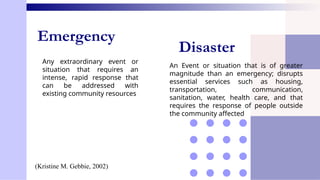
Emergency
Any extraordinary eventor
situation that requires an
intense, rapid response that
can be addressed with
existing community resources
Disaster
An Event or situation that is of greater
magnitude than an emergency; disrupts
essential services such as housing,
transportation, communication,
sanitation, water, health care, and that
requires the response of people outside
the community affected
(Kristine M. Gebbie, 2002)
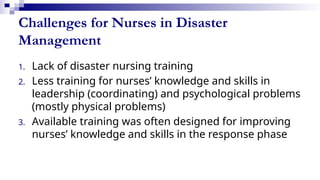
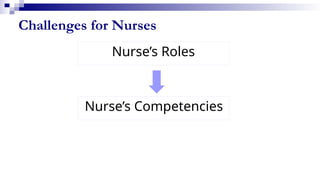
Challenges for Nursesin Disaster
Management
1. Lack of disaster nursing training
2. Less training for nurses’ knowledge and skills in
leadership (coordinating) and psychological problems
(mostly physical problems)
3. Available training was often designed for improving
nurses’ knowledge and skills in the response phase
9.
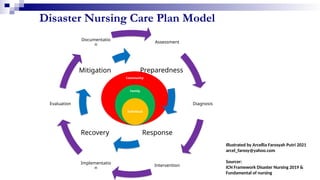
Disaster Nursing CarePlan Model
Assessment
Diagnosis
Intervention
Implementatio
n
Evaluation
Documentatio
n
Community
Family
Individual
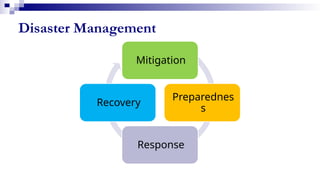
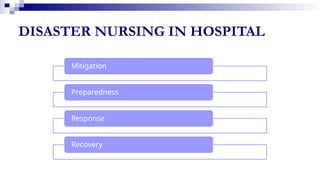
Preparedness
Response
Recovery
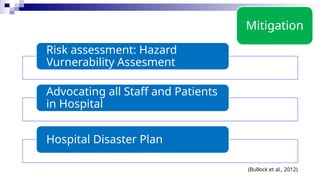
Mitigation
Illustrated by Arcellia Farosyah Putri 2021
arcel_farosy@yahoo.com
Sourcer:
ICN Framework Disaster Nursing 2019 &
Fundamental of nursing
10.
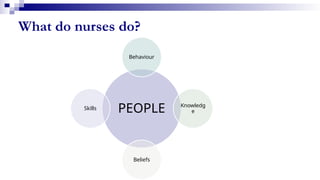
What do nursesdo?
PEOPLE
Behaviour
Knowledg
e
Beliefs
Skills
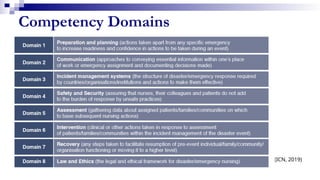
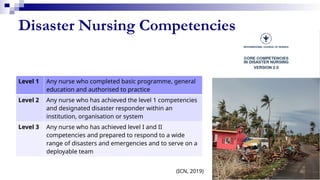
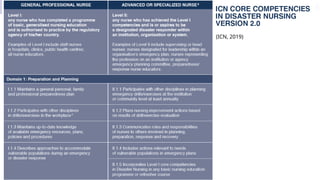
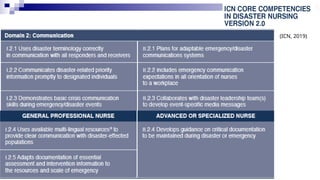
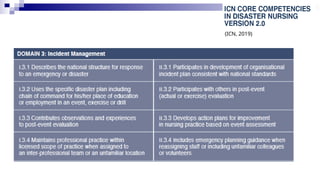
Disaster Nursing Competencies
(ICN,2019)
Level 1 Any nurse who completed basic programme, general
education and authorised to practice
Level 2 Any nurse who has achieved the level 1 competencies
and designated disaster responder within an
institution, organisation or system
Level 3 Any nurse who has achieved level I and II
competencies and prepared to respond to a wide
range of disasters and emergencies and to serve on a
deployable team
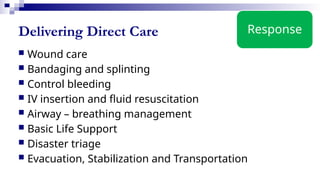
Delivering Direct Care
Wound care
Bandaging and splinting
Control bleeding
IV insertion and fluid resuscitation
Airway – breathing management
Basic Life Support
Disaster triage
Evacuation, Stabilization and Transportation
Response
28.
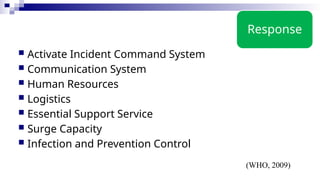
Response
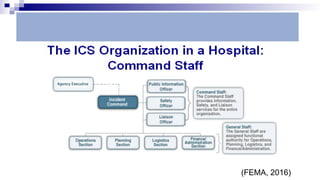
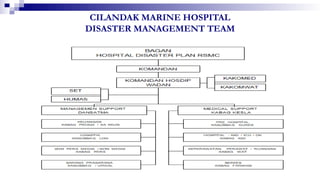
Activate IncidentCommand System
Communication System
Human Resources
Logistics
Essential Support Service
Surge Capacity
Infection and Prevention Control
(WHO, 2009)
Human Resources
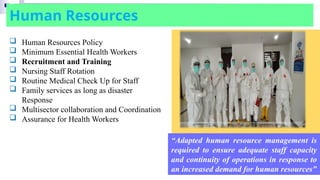
“Adapted humanresource management is
required to ensure adequate staff capacity
and continuity of operations in response to
an increased demand for human resources”
Human Resources Policy
Minimum Essential Health Workers
Recruitment and Training
Nursing Staff Rotation
Routine Medical Check Up for Staff
Family services as long as disaster
Response
Multisector collaboration and Coordination
Assurance for Health Workers
32.
Logistics & SuplayChain Management
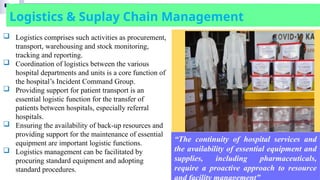
“The continuity of hospital services and
the availability of essential equipment and
supplies, including pharmaceuticals,
require a proactive approach to resource
Logistics comprises such activities as procurement,
transport, warehousing and stock monitoring,
tracking and reporting.
Coordination of logistics between the various
hospital departments and units is a core function of
the hospital’s Incident Command Group.
Providing support for patient transport is an
essential logistic function for the transfer of
patients between hospitals, especially referral
hospitals.
Ensuring the availability of back-up resources and
providing support for the maintenance of essential
equipment are important logistic functions.
Logistics management can be facilitated by
procuring standard equipment and adopting
standard procedures.
33.
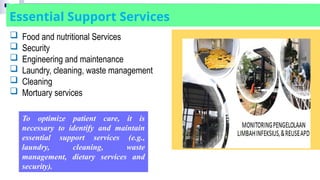
Essential Support Services
Tooptimize patient care, it is
necessary to identify and maintain
essential support services (e.g.,
laundry, cleaning, waste
management, dietary services and
security).
Food and nutritional Services
Security
Engineering and maintenance
Laundry, cleaning, waste management
Cleaning
Mortuary services
34.
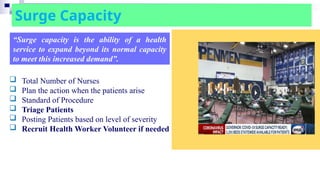
Surge Capacity
“Surge capacityis the ability of a health
service to expand beyond its normal capacity
to meet this increased demand”.
Total Number of Nurses
Plan the action when the patients arise
Standard of Procedure
Triage Patients
Posting Patients based on level of severity
Recruit Health Worker Volunteer if needed
35.
“An operational IPCpolicy is essential to
minimize the risk of transmission of
nosocomial infection to patients,
hospital staff, and visitors”
Infection and Prevention Control (IPC)
Adapt the infection prevention and control
component of the Hospital Emergency Response
Plan
Assess infection prevention and control staffing
needs for the emergency
Make sure that the hospital’s infection prevention
and control policies are consistent with the
presumed mode of transmission of the epidemic
infection and with locally available resources.
Reinforce standard infection control precautions
and establish additional precautions if required by
the specific nature of the epidemic.
Establish patient flow based on transmission
risks and on patients' clinical status
36.
Activities
Preventing outbreaks
Maintaining sanitation and clean environment
Psychological first aid
RE- Evaluation Hospital Disaster Plan
Recovery
Conclusions
1. Good Preparednesswill be a key of good Response
2. Nurses need to have knowledge and skills needed to
carried out their roles in disaster management in
Hospital
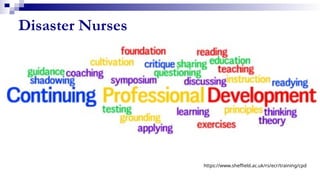
3. Continues professional development for disaster
nurses needs to be established
4. Urgently needs comprehensive disaster nursing
training that addressing each level of disaster nurse’s
competency
References
1. Bullock, J.A., Haddow, G. D., & Coppola, D. P. (2013). Mitigation, Prevention, and
Preparedness. Introduction to Homeland Security, 435–494.
https://doi.org/10.1016/B978-0-12-415802-3.00010-5
2. Efendi, F., Indarwati, R., Aurizki, G. E., Susanti, I. A., & Maulana, A. E. F. (2021).
Policymakers’ perspectives on responding to the elderly’s mental health needs in
post-disaster situations. Journal of Public Health Research, 11(1).
https://doi.org/10.4081/jphr.2021.2386
3. UNDRR https://www.preventionweb.net/
4. ICN. (2019) Core competencies in disaster nursing version 2.0.
https://www.icn.ch/sites/default/files/inline-files/ICN_Disaster-Comp-Report_WEB.pdf
5. Infection prevention and control of epidemic-and pandemic prone acute respiratory
infections in health care - WHO guidelines. World Health Organization, 2014.
#9 Community broad term: organization, institution, dst
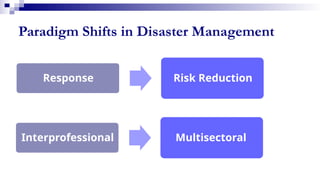
#40 Perawat Bencana Indonesia memiliki unit kerja masing-masing. Perawat OK. Ketika terjadi bencana dikirim (lokal) ke daerah bencana, sebagai tim respon bencana. Setelah bencana selesai kembali ke unit kerja masing-masing. Updatenya adalah PKB Perawat OK. Sementara paradigma penangan bencana fokus ke disaster risk reduction, kesiapsiagaan, dst. Sejawat perawat di puskesmas?
PKB logbook perawat bencana. Target kompetensi perawat bencana.
Kalau PKB Bencana tidak terlaksana secara maksimal perawat tidak bisa secara maksimal menunjukkan eksistensi dan kontribusinya dalam konteks SPDB. Kesiapsiagaan = SPDB.