Trends In EEO and Discrimination
Employment Discrimination  Governed by  Federal laws, regulations State laws, regulations Local and municipal ordinances/codes
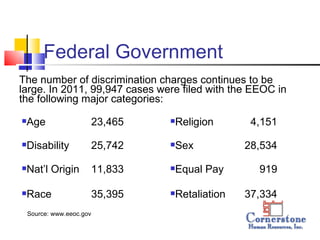
Federal Government  The number of discrimination charges continues to be  large. In 2011, 99,947 cases were filed with the EEOC in the following major categories:  Source: www.eeoc.gov Age  23,465  Religion  4,151 Disability  25,742  Sex  28,534  Nat’l Origin  11,833 Equal Pay  919  Race  35,395  Retaliation  37,334
Other Protected Groups  Federal law prohibits discrimination on the basis of veteran status or liability for service in the United States Armed Forces Whistleblowers are also a federally protected group Federal law also prohibits discrimination based on genetic information
Increasing Costs  The cost of settling the top 10 class action discrimination suits in 2010 was over $346 million, more than four times more than in 2009.  Recent settlements  3M (8/2011) -  $3 million (age discrimination) Wells Fargo (6/11) - $32 million (sex discrimination)  Roadway Express (9/2010) - $10 million (racial harassment)  Eastman Kodak (9/2010) - $21 million (race discrimination)
ADAAA The ADA Amendments Act passed in 2008 went into effect in 2009 The ADAAA broadened the definition of the term “disability” Rejected court interpretations and a portion of the EEOC regulations that interpret the employment section of ADA
GINA The Genetic Information Non-discrimination Act (GINA) signed into law in 2008 went into effect in November, 2009. Final regulations in effect in January, 2011 Prohibits discrimination on the basis of genetic information in health insurance and employment Over 200 EEOC complaints in 2011 Requires posting Employers advised to discontinue requests to applicants and employees for family medical history except in the limited circumstances permitted in connection with a wellness  or disease management program
Other  Laws and Requirements  States and local governments may have their own laws against employment discrimination. They differ from Federal law in  Protected classes  Court procedures  Court interpretations
New Jersey  Very employee-friendly  Additional protected classes: marital status, sexual orientation, certain genetic conditions, domestic partnership status, transgender identity Different approaches to discrimination based on age Different approaches to whistleblower protection  Longer time limit for filing charges  Different Court interpretations (e.g., Gaines v. Bellino)
Have you covered …  Sexual and other workplace harassment prevention training for all staff members Requirements for CEPA poster and notification Requirements for USERRA poster Addition of domestic partnerships to your EEO policy  Addition of GINA ADAAA impact on your procedures

Trends in discrimination claims

  • 1.
    Trends In EEOand Discrimination
  • 2.
    Employment Discrimination Governed by Federal laws, regulations State laws, regulations Local and municipal ordinances/codes
  • 3.
    Federal Government The number of discrimination charges continues to be large. In 2011, 99,947 cases were filed with the EEOC in the following major categories: Source: www.eeoc.gov Age 23,465 Religion 4,151 Disability 25,742 Sex 28,534 Nat’l Origin 11,833 Equal Pay 919 Race 35,395 Retaliation 37,334
  • 4.
    Other Protected Groups Federal law prohibits discrimination on the basis of veteran status or liability for service in the United States Armed Forces Whistleblowers are also a federally protected group Federal law also prohibits discrimination based on genetic information
  • 5.
    Increasing Costs The cost of settling the top 10 class action discrimination suits in 2010 was over $346 million, more than four times more than in 2009. Recent settlements 3M (8/2011) - $3 million (age discrimination) Wells Fargo (6/11) - $32 million (sex discrimination) Roadway Express (9/2010) - $10 million (racial harassment) Eastman Kodak (9/2010) - $21 million (race discrimination)
  • 6.
    ADAAA The ADAAmendments Act passed in 2008 went into effect in 2009 The ADAAA broadened the definition of the term “disability” Rejected court interpretations and a portion of the EEOC regulations that interpret the employment section of ADA
  • 7.
    GINA The GeneticInformation Non-discrimination Act (GINA) signed into law in 2008 went into effect in November, 2009. Final regulations in effect in January, 2011 Prohibits discrimination on the basis of genetic information in health insurance and employment Over 200 EEOC complaints in 2011 Requires posting Employers advised to discontinue requests to applicants and employees for family medical history except in the limited circumstances permitted in connection with a wellness or disease management program
  • 8.
    Other Lawsand Requirements States and local governments may have their own laws against employment discrimination. They differ from Federal law in Protected classes Court procedures Court interpretations
  • 9.
    New Jersey Very employee-friendly Additional protected classes: marital status, sexual orientation, certain genetic conditions, domestic partnership status, transgender identity Different approaches to discrimination based on age Different approaches to whistleblower protection Longer time limit for filing charges Different Court interpretations (e.g., Gaines v. Bellino)
  • 10.
    Have you covered… Sexual and other workplace harassment prevention training for all staff members Requirements for CEPA poster and notification Requirements for USERRA poster Addition of domestic partnerships to your EEO policy Addition of GINA ADAAA impact on your procedures