










TREES
TREES
By: Gloria Martinez & Elena Virgilio
               Pd. 7
!
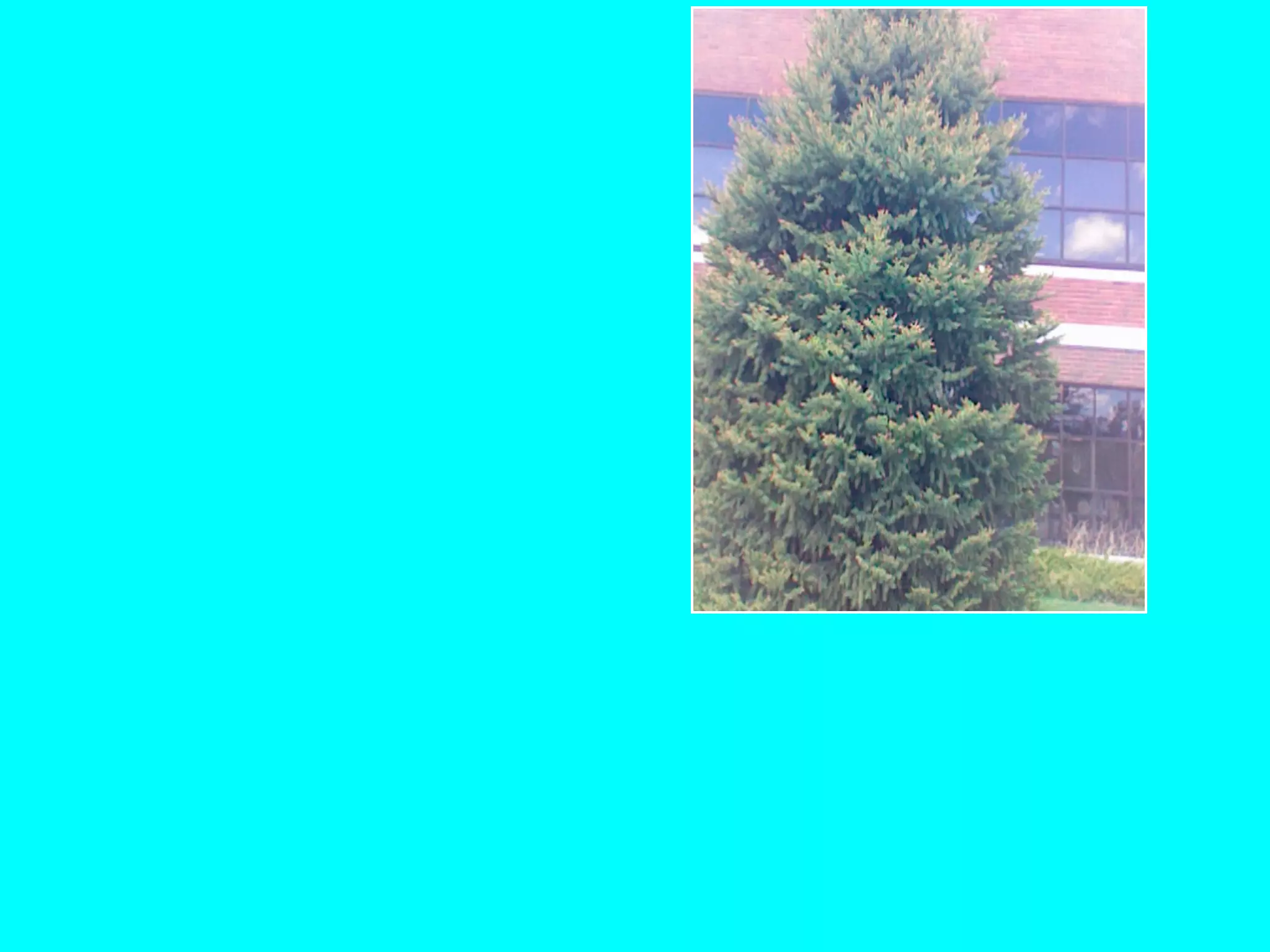
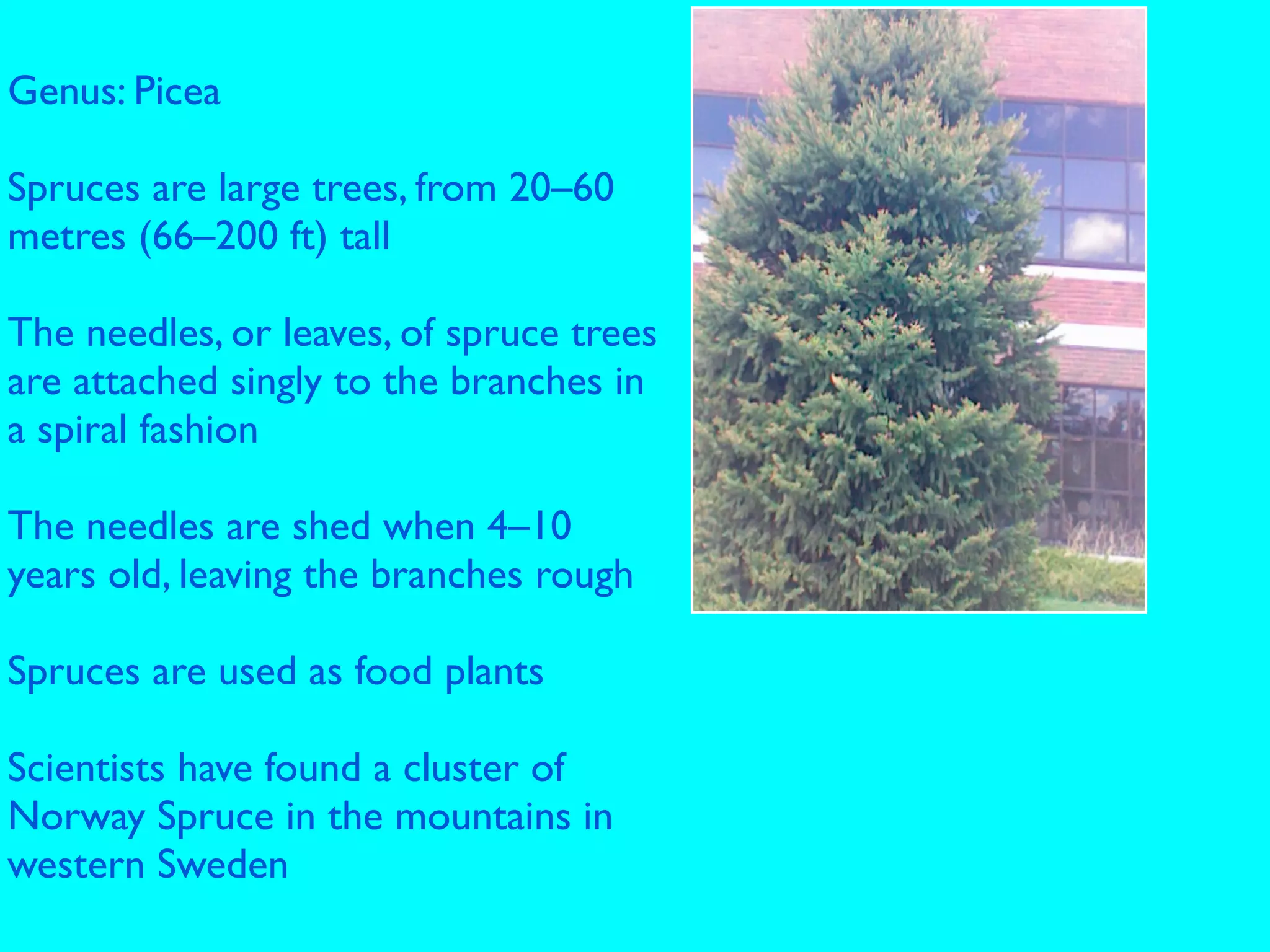
Genus: Picea
                                      !
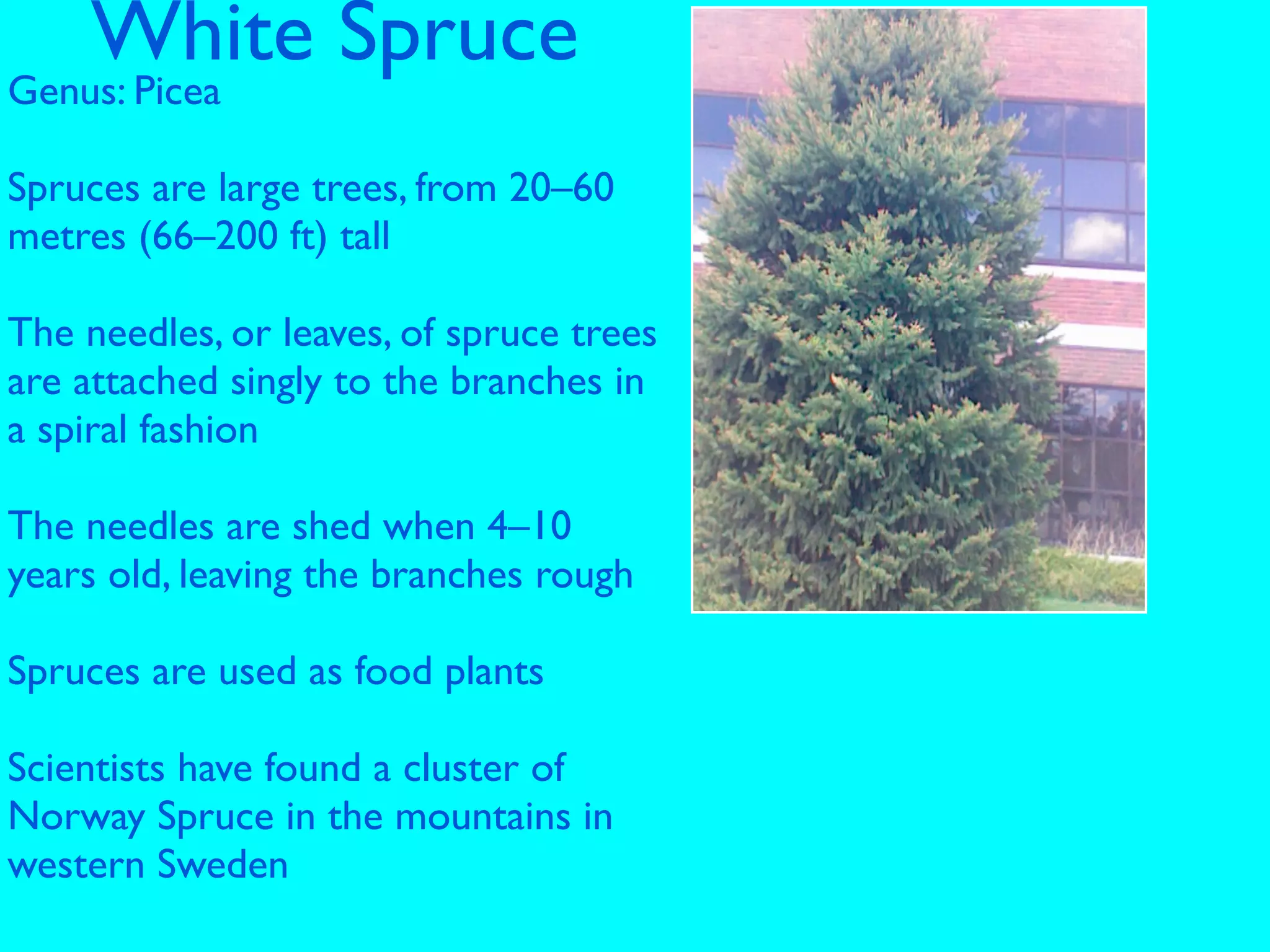
Spruces are large trees, from 20–60
metres (66–200 ft) tall

The needles, or leaves, of spruce trees
are attached singly to the branches in
a spiral fashion

The needles are shed when 4–10
years old, leaving the branches rough

Spruces are used as food plants

Scientists have found a cluster of
Norway Spruce in the mountains in
western Sweden
White Spruce
Genus: Picea
                                      !
Spruces are large trees, from 20–60
metres (66–200 ft) tall

The needles, or leaves, of spruce trees
are attached singly to the branches in
a spiral fashion

The needles are shed when 4–10
years old, leaving the branches rough

Spruces are used as food plants

Scientists have found a cluster of
Norway Spruce in the mountains in
western Sweden
Genus: Juglans

An eastern North American tree having dark
brown wood and a deeply furrowed nut.

The wood of this tree is used especially for
veneer, cabinets, furniture, and gunstocks.

The nut of this tree, having an edible kernel used
especially in confections.

The black walnut is a large deciduous tree
attaining heights of 30–40 feet (9.1–12 m.

Fertile soils in mixed hardwood forests. Also
grows well in pastures, meadows, and slopes.
BlackWalnut
Genus: Juglans

An eastern North American tree having dark
brown wood and a deeply furrowed nut.

The wood of this tree is used especially for
veneer, cabinets, furniture, and gunstocks.

The nut of this tree, having an edible kernel used
especially in confections.

The black walnut is a large deciduous tree
attaining heights of 30–40 feet (9.1–12 m.

Fertile soils in mixed hardwood forests. Also
grows well in pastures, meadows, and slopes.
BlackWalnut
Genus: Juglans

An eastern North American tree having dark
brown wood and a deeply furrowed nut.

The wood of this tree is used especially for
veneer, cabinets, furniture, and gunstocks.

The nut of this tree, having an edible kernel used
especially in confections.

The black walnut is a large deciduous tree
attaining heights of 30–40 feet (9.1–12 m.

Fertile soils in mixed hardwood forests. Also
grows well in pastures, meadows, and slopes.
Black Cherry
Black Cherry
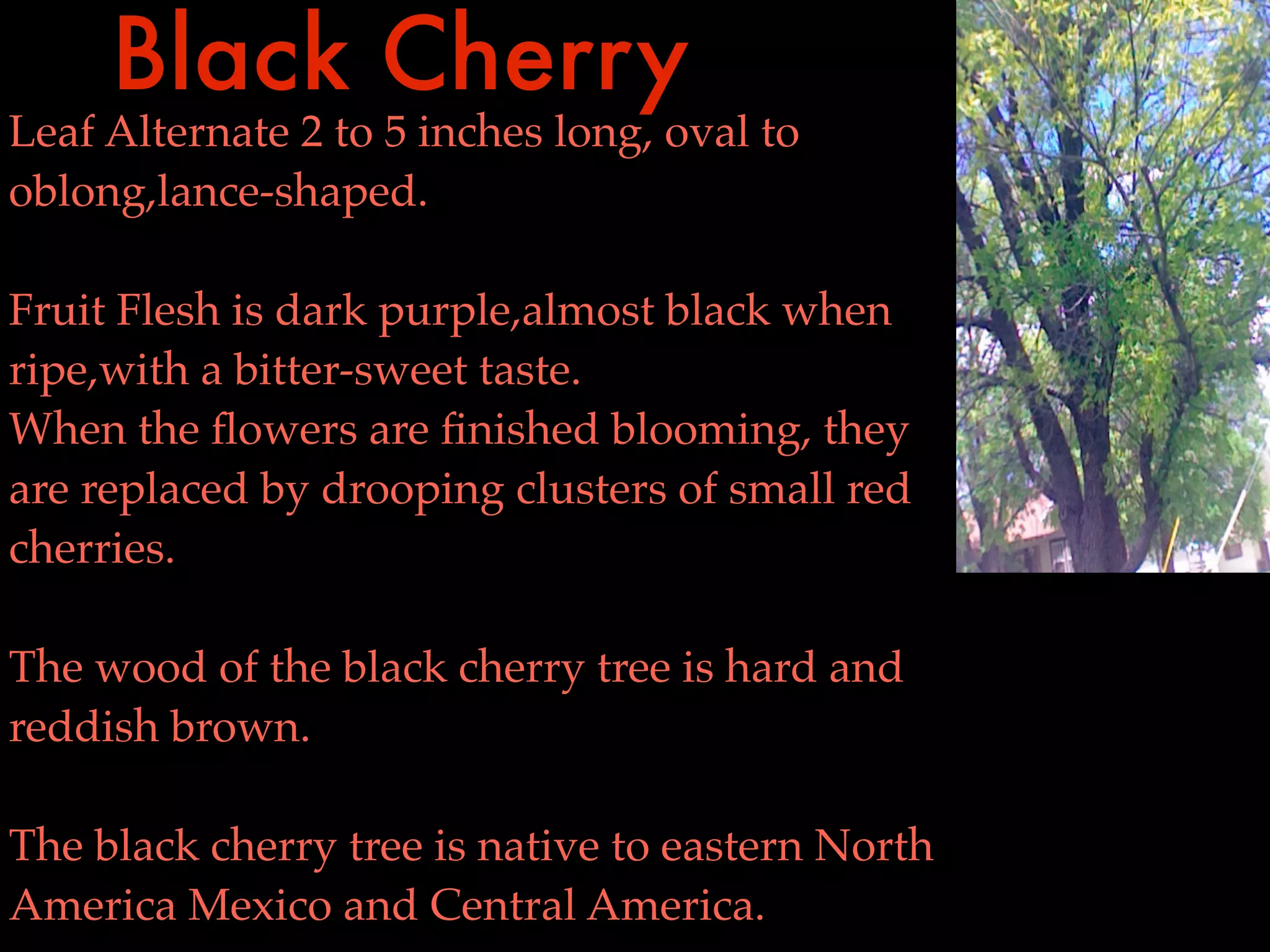
Leaf Alternate 2 to 5 inches long, oval to
oblong,lance-shaped.

Fruit Flesh is dark purple,almost black when
ripe,with a bitter-sweet taste.
When the flowers are finished blooming, they
are replaced by drooping clusters of small red
cherries.

The wood of the black cherry tree is hard and
reddish brown.

The black cherry tree is native to eastern North
America Mexico and Central America.
Black Cherry                            !
Leaf Alternate 2 to 5 inches long, oval to
oblong,lance-shaped.

Fruit Flesh is dark purple,almost black when
ripe,with a bitter-sweet taste.
When the flowers are finished blooming, they
are replaced by drooping clusters of small red
cherries.

The wood of the black cherry tree is hard and
reddish brown.

The black cherry tree is native to eastern North
America Mexico and Central America.
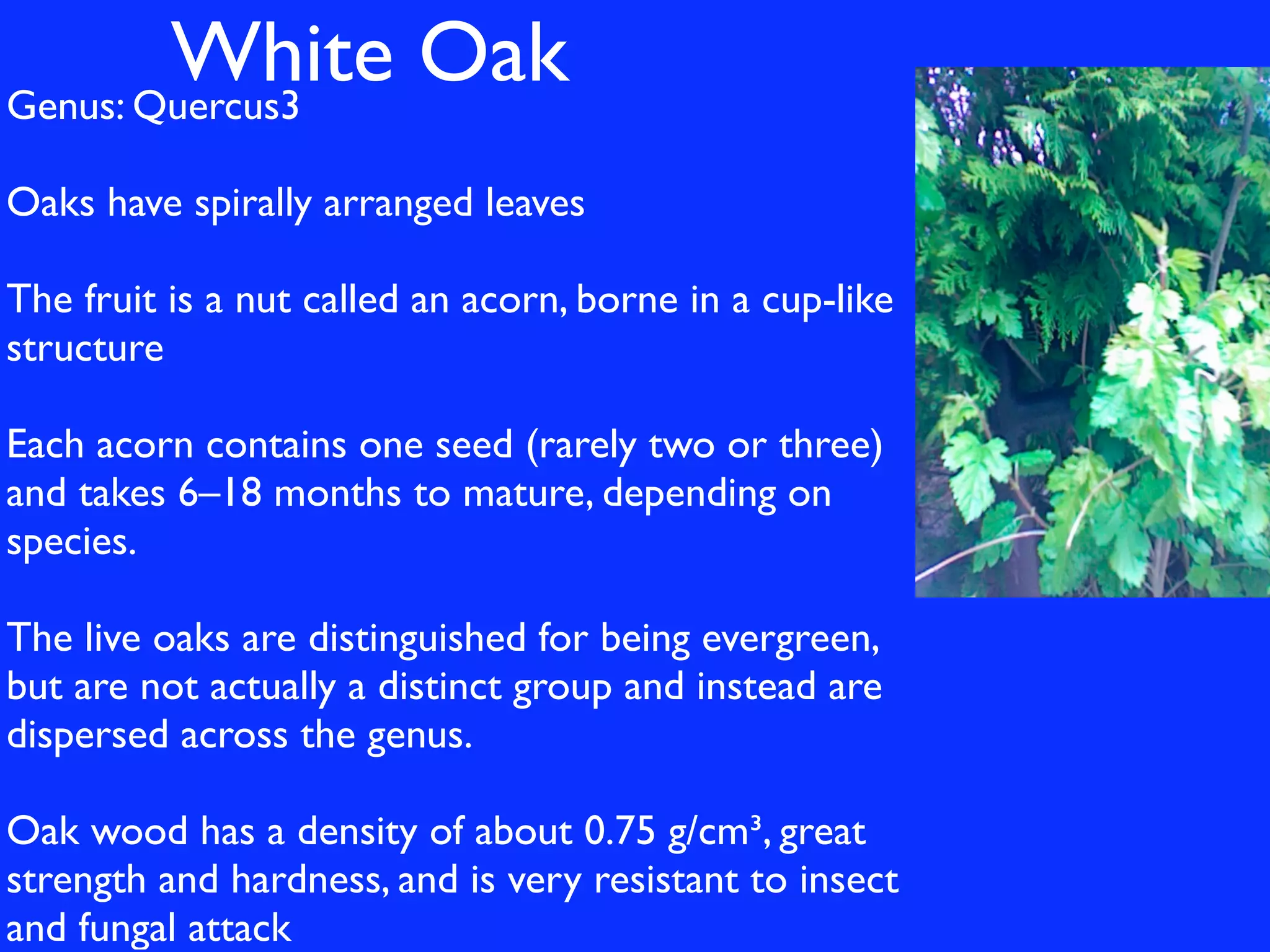
Genus: Quercus3

Oaks have spirally arranged leaves

The fruit is a nut called an acorn, borne in a cup-like
structure

Each acorn contains one seed (rarely two or three)
and takes 6–18 months to mature, depending on
species.

The live oaks are distinguished for being evergreen,
but are not actually a distinct group and instead are
dispersed across the genus.

Oak wood has a density of about 0.75 g/cm³, great
strength and hardness, and is very resistant to insect
and fungal attack
White Oak
Genus: Quercus3

Oaks have spirally arranged leaves

The fruit is a nut called an acorn, borne in a cup-like
structure

Each acorn contains one seed (rarely two or three)
and takes 6–18 months to mature, depending on
species.

The live oaks are distinguished for being evergreen,
but are not actually a distinct group and instead are
dispersed across the genus.

Oak wood has a density of about 0.75 g/cm³, great
strength and hardness, and is very resistant to insect
and fungal attack
White Oak
Genus: Quercus3                                 !
Oaks have spirally arranged leaves

The fruit is a nut called an acorn, borne in a cup-like
structure

Each acorn contains one seed (rarely two or three)
and takes 6–18 months to mature, depending on
species.

The live oaks are distinguished for being evergreen,
but are not actually a distinct group and instead are
dispersed across the genus.

Oak wood has a density of about 0.75 g/cm³, great
strength and hardness, and is very resistant to insect
and fungal attack
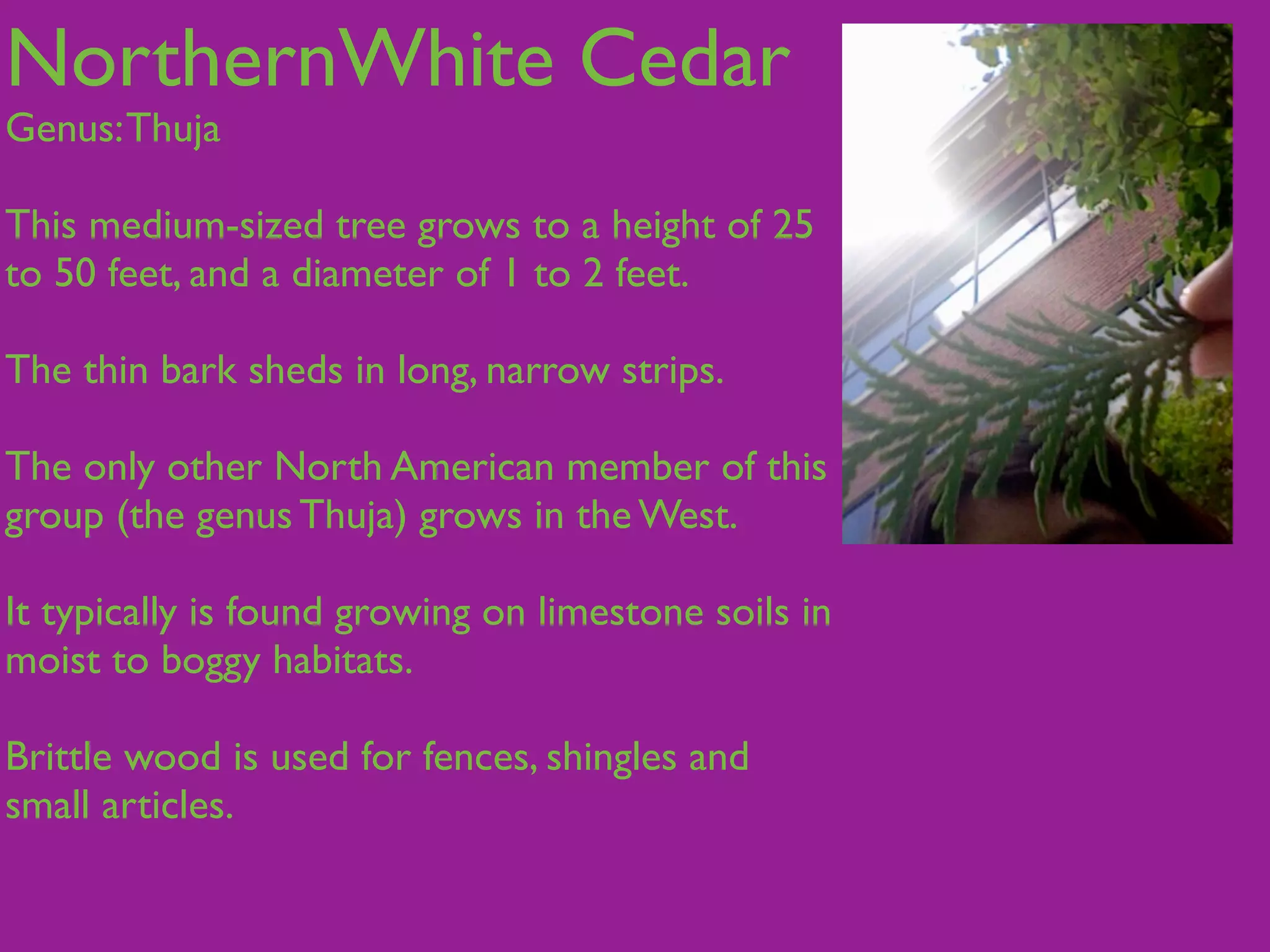
NorthernWhite Cedar
NorthernWhite Cedar
Genus: Thuja

This medium-sized tree grows to a height of 25
to 50 feet, and a diameter of 1 to 2 feet.

The thin bark sheds in long, narrow strips.

The only other North American member of this
group (the genus Thuja) grows in the West.

It typically is found growing on limestone soils in
moist to boggy habitats.

Brittle wood is used for fences, shingles and
small articles.
NorthernWhite Cedar
Genus: Thuja

This medium-sized tree grows to a height of 25
to 50 feet, and a diameter of 1 to 2 feet.

The thin bark sheds in long, narrow strips.

The only other North American member of this
group (the genus Thuja) grows in the West.

It typically is found growing on limestone soils in
moist to boggy habitats.

Brittle wood is used for fences, shingles and
small articles.
The End
  :D
The End
                   :D
•   Thank you Mr.Hanson
    and Mrs.Dorsey for
    helping us. Thank you for
    bieng the best science
    teachers we ever had.
    Mr.Hanson and
    Mrs.Dorsey thanks for
    the happy year we had in
    7th grade.

Trees Elena & Gloria

  • 2.
  • 3.
    TREES By: Gloria Martinez& Elena Virgilio Pd. 7
  • 5.
  • 6.
    Genus: Picea ! Spruces are large trees, from 20–60 metres (66–200 ft) tall The needles, or leaves, of spruce trees are attached singly to the branches in a spiral fashion The needles are shed when 4–10 years old, leaving the branches rough Spruces are used as food plants Scientists have found a cluster of Norway Spruce in the mountains in western Sweden
  • 7.
    White Spruce Genus: Picea ! Spruces are large trees, from 20–60 metres (66–200 ft) tall The needles, or leaves, of spruce trees are attached singly to the branches in a spiral fashion The needles are shed when 4–10 years old, leaving the branches rough Spruces are used as food plants Scientists have found a cluster of Norway Spruce in the mountains in western Sweden
  • 9.
    Genus: Juglans An easternNorth American tree having dark brown wood and a deeply furrowed nut. The wood of this tree is used especially for veneer, cabinets, furniture, and gunstocks. The nut of this tree, having an edible kernel used especially in confections. The black walnut is a large deciduous tree attaining heights of 30–40 feet (9.1–12 m. Fertile soils in mixed hardwood forests. Also grows well in pastures, meadows, and slopes.
  • 10.
    BlackWalnut Genus: Juglans An easternNorth American tree having dark brown wood and a deeply furrowed nut. The wood of this tree is used especially for veneer, cabinets, furniture, and gunstocks. The nut of this tree, having an edible kernel used especially in confections. The black walnut is a large deciduous tree attaining heights of 30–40 feet (9.1–12 m. Fertile soils in mixed hardwood forests. Also grows well in pastures, meadows, and slopes.
  • 11.
    BlackWalnut Genus: Juglans An easternNorth American tree having dark brown wood and a deeply furrowed nut. The wood of this tree is used especially for veneer, cabinets, furniture, and gunstocks. The nut of this tree, having an edible kernel used especially in confections. The black walnut is a large deciduous tree attaining heights of 30–40 feet (9.1–12 m. Fertile soils in mixed hardwood forests. Also grows well in pastures, meadows, and slopes.
  • 13.
  • 14.
    Black Cherry Leaf Alternate2 to 5 inches long, oval to oblong,lance-shaped. Fruit Flesh is dark purple,almost black when ripe,with a bitter-sweet taste. When the flowers are finished blooming, they are replaced by drooping clusters of small red cherries. The wood of the black cherry tree is hard and reddish brown. The black cherry tree is native to eastern North America Mexico and Central America.
  • 15.
    Black Cherry ! Leaf Alternate 2 to 5 inches long, oval to oblong,lance-shaped. Fruit Flesh is dark purple,almost black when ripe,with a bitter-sweet taste. When the flowers are finished blooming, they are replaced by drooping clusters of small red cherries. The wood of the black cherry tree is hard and reddish brown. The black cherry tree is native to eastern North America Mexico and Central America.
  • 17.
    Genus: Quercus3 Oaks havespirally arranged leaves The fruit is a nut called an acorn, borne in a cup-like structure Each acorn contains one seed (rarely two or three) and takes 6–18 months to mature, depending on species. The live oaks are distinguished for being evergreen, but are not actually a distinct group and instead are dispersed across the genus. Oak wood has a density of about 0.75 g/cm³, great strength and hardness, and is very resistant to insect and fungal attack
  • 18.
    White Oak Genus: Quercus3 Oakshave spirally arranged leaves The fruit is a nut called an acorn, borne in a cup-like structure Each acorn contains one seed (rarely two or three) and takes 6–18 months to mature, depending on species. The live oaks are distinguished for being evergreen, but are not actually a distinct group and instead are dispersed across the genus. Oak wood has a density of about 0.75 g/cm³, great strength and hardness, and is very resistant to insect and fungal attack
  • 19.
    White Oak Genus: Quercus3 ! Oaks have spirally arranged leaves The fruit is a nut called an acorn, borne in a cup-like structure Each acorn contains one seed (rarely two or three) and takes 6–18 months to mature, depending on species. The live oaks are distinguished for being evergreen, but are not actually a distinct group and instead are dispersed across the genus. Oak wood has a density of about 0.75 g/cm³, great strength and hardness, and is very resistant to insect and fungal attack
  • 21.
  • 22.
    NorthernWhite Cedar Genus: Thuja Thismedium-sized tree grows to a height of 25 to 50 feet, and a diameter of 1 to 2 feet. The thin bark sheds in long, narrow strips. The only other North American member of this group (the genus Thuja) grows in the West. It typically is found growing on limestone soils in moist to boggy habitats. Brittle wood is used for fences, shingles and small articles.
  • 23.
    NorthernWhite Cedar Genus: Thuja Thismedium-sized tree grows to a height of 25 to 50 feet, and a diameter of 1 to 2 feet. The thin bark sheds in long, narrow strips. The only other North American member of this group (the genus Thuja) grows in the West. It typically is found growing on limestone soils in moist to boggy habitats. Brittle wood is used for fences, shingles and small articles.
  • 25.
  • 26.
    The End :D • Thank you Mr.Hanson and Mrs.Dorsey for helping us. Thank you for bieng the best science teachers we ever had. Mr.Hanson and Mrs.Dorsey thanks for the happy year we had in 7th grade.