By: Kevin B.
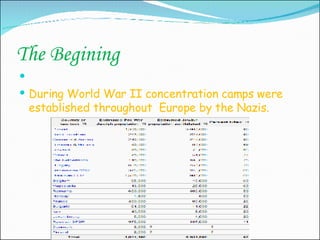
The Begining   During World War II concentration camps were established throughout  Europe by the Nazis.
The Camps Six death or extermination camps were constructed in Poland. These so-called death factories were Auschwitz-Birkenau, Treblinka, Belzek, Lublin, and Chelmno.
Camp notes In both  Nazi and Japanese camps inmates were exploited for slave labor and  medical experimentation, but the Nazis also established extermination  camps. In the best known of these—Majdanek, Treblinka, and Oświęcim  (Auschwitz), in Poland—more than six million mainly Jewish men, women,  and children were killed in gas chambers. Among the most notorious Nazi  camps liberated by U.S. and British troops in 1945 were Buchenwald,  Dachau, and Belsen.
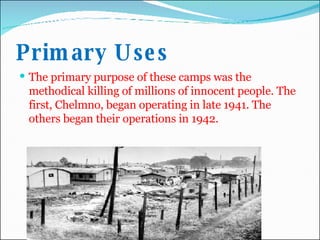
Primary Uses The primary purpose of these camps was the methodical killing of millions of innocent people. The first, Chelmno, began operating in late 1941. The others began their operations in 1942.
Primary Notes Camps were an adversaries, and others considered socially and racially undesirable. There were concentration camps, forced labor camps, extermination or death camps, transit camps, and prisoner-of-war camps. The living conditions of all camps were brutal.
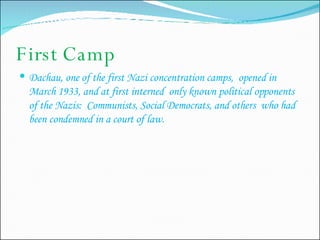
First Camp Dachau, one of the first Nazi concentration camps,  opened in March 1933, and at first interned  only known political opponents of the Nazis:  Communists, Social Democrats, and others  who had been condemned in a court of law.
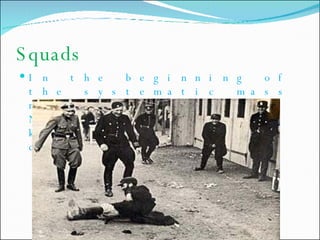
Squads In the beginning of the systematic mass murder of Jews, Nazis used mobile killing squads called  Einsatzgruppen.
The  Einsatzgruppen The  Einsatzgruppen  consisted of four units of between 500 and 900 men each which followed the invading German troops into the Soviet Union. By the time Hitler ordered a halt to the shooting in the fall of 1942, they had murdered approximately 1,500,000 Jews.
Finish

Holocaust Concentration Camps

  • 1.
  • 2.
    The Begining  During World War II concentration camps were established throughout Europe by the Nazis.
  • 3.
    The Camps Sixdeath or extermination camps were constructed in Poland. These so-called death factories were Auschwitz-Birkenau, Treblinka, Belzek, Lublin, and Chelmno.
  • 4.
    Camp notes Inboth Nazi and Japanese camps inmates were exploited for slave labor and medical experimentation, but the Nazis also established extermination camps. In the best known of these—Majdanek, Treblinka, and Oświęcim (Auschwitz), in Poland—more than six million mainly Jewish men, women, and children were killed in gas chambers. Among the most notorious Nazi camps liberated by U.S. and British troops in 1945 were Buchenwald, Dachau, and Belsen.
  • 5.
    Primary Uses Theprimary purpose of these camps was the methodical killing of millions of innocent people. The first, Chelmno, began operating in late 1941. The others began their operations in 1942.
  • 6.
    Primary Notes Campswere an adversaries, and others considered socially and racially undesirable. There were concentration camps, forced labor camps, extermination or death camps, transit camps, and prisoner-of-war camps. The living conditions of all camps were brutal.
  • 7.
    First Camp Dachau,one of the first Nazi concentration camps, opened in March 1933, and at first interned only known political opponents of the Nazis: Communists, Social Democrats, and others who had been condemned in a court of law.
  • 8.
    Squads In thebeginning of the systematic mass murder of Jews, Nazis used mobile killing squads called Einsatzgruppen.
  • 9.
    The EinsatzgruppenThe Einsatzgruppen consisted of four units of between 500 and 900 men each which followed the invading German troops into the Soviet Union. By the time Hitler ordered a halt to the shooting in the fall of 1942, they had murdered approximately 1,500,000 Jews.
  • 10.