P      A       R       T       N     E   R      S                    O       R      T     H      O      P      A     E      D      I       C


 Trauma Rounds
   Case Reports from the Mass General Hospital and Brigham &Women’s Hospital
	 A Quarterly Case Study	                                                                                                 Volume 1, Winter 2010


       Delivering Allograft Bone Chips
                      George Dyer, MD
                    This is a useful trick for simplifying the deliv-
                    ery of allograft bone chips into a small space.

                  The conventional method of delivering bone
                  chips into an area to be grafted typically in-
                  volves plucking them out of a little bowl with
                  forceps and trying to place them into the re-
cipient site without spilling them everywhere. This often re-
sults in a mess: graft falls out of the forceps while en route to the
surgical site, landing in soft tissues, on the drapes, or on the
floor. Graft and time are wasted. This process is especially
awkward when the recipient site is a small hole or window and
the surgeon is attempting to pack the graft into it.

Several brands of allograft bone chips are supplied in a rectan-
gular plastic tub. A simple solution to the delivery problem is
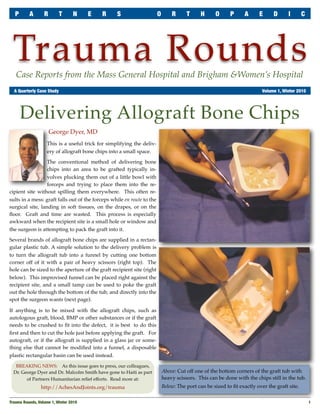
to turn the allograft tub into a funnel by cutting one bottom
corner off of it with a pair of heavy scissors (right top). The
hole can be sized to the aperture of the graft recipient site (right
below). This improvised funnel can be placed right against the
recipient site, and a small tamp can be used to poke the graft
out the hole through the bottom of the tub, and directly into the
spot the surgeon wants (next page).

If anything is to be mixed with the allograft chips, such as
autologous graft, blood, BMP or other substances or if the graft
needs to be crushed to fit into the defect, it is best to do this
first and then to cut the hole just before applying the graft. For
autograft, or if the allograft is supplied in a glass jar or some-
thing else that cannot be modified into a funnel, a disposable
plastic rectangular basin can be used instead.

   BREAKING NEWS: As this issue goes to press, our colleagues,
  Dr. George Dyer and Dr. Malcolm Smith have gone to Haiti as part          Above: Cut off one of the bottom corners of the graft tub with
        of Partners Humanitarian relief efforts. Read more at:              heavy scissors. This can be done with the chips still in the tub.
                 http://AchesAndJoints.org/trauma                           Below: The port can be sized to fit exactly over the graft site.


Trauma Rounds, Volume 1, Winter 2010
                                                                                                             1
P   A   R   T   N   E   R   S     O   R    T    H   O   P   A   E   D   I   C       T   R    A   U   M   A      R   O    U   N    D    S


Above: Use a small elevator or bone tamp to push graft               Left: Pre-op radiograph of a patient with a supracondylar humerus fracture.
through the hole into the recipient site. The tub acts as a          Right: Post-op radiograph of same patient s/p ORIF with allograft
funnel to direct the graft exactly where you want it to go.          placed using the above technique.


     Trauma Fellowship Program wins funding from OMeGA Medical Grants Association
                                               We are pleased and proud to report that our Brigham and Women’s Trauma
                                               Fellowship program was selected as one of the inaugural recipients of
                                               OMeGA Medical Grants Association’s fellowship grants. Our program was
                                               one of forty-four (44) selected nationally through a competitive process.

     The OMeGA Medical Grants Association was established through the efforts of the world’s longest standing
     orthopaedic professional organization, the American Orthopaedic Association (AOA). OMeGA is an inde-
     pendent legal entity whose singular mission is to award and manage grants for orthopaedic graduate medical
     education through an open, accessible process designed to safeguard against potential conflicts of interest and
     to ensure transparency in the allocation of resources.

     We are grateful to OMeGA for their support and generosity.

Trauma Faculty                                      David Ring, MD — 617-724-3953                     Editor in Chief
                                                    MGH Hand & Upper Extremity Service
Mark Vrahas, MD — 617-726-2943                                                                        Mark Vrahas, MD
                                                    dring@partners.org
Partners Chief of Orthopaedic Trauma
mvrahas@partners.org                                George Dyer, MD — 617-732-6607                    Program Director
Mitchel B Harris, MD — 617-732-5385                 BWH Hand & Upper Extremity Service
                                                                                                      Suzanne Morrison, MPH
Chief, BWH Orthopedic Trauma                        gdyer@partners.org
                                                                                                      (617) 525-8876
mbharris@partners.org                               Please send correspondence to:                    smmorrison@partners.org

R Malcolm Smith, MD, FRCS — 617-726-2794            Mark Vrahas, MD / Trauma Rounds
Chief, MGH Orthopaedic Trauma
                                                    Yawkey Center for Outpatient Care, Suite 3C       Editor, Publisher
                                                    55 Fruit Street, Boston, MA 02114
rmsmith1@partners.org                                                                                 Arun Shanbhag, PhD, MBA
David Lhowe, MD — 617-724-2800
MGH Orthopaedic Trauma
dlhowe@partners.org


2
                                                                                                                Trauma Rounds, Volume 1, Winter 2010

Trauma Rounds - 2

  • 1.
    P A R T N E R S O R T H O P A E D I C Trauma Rounds Case Reports from the Mass General Hospital and Brigham &Women’s Hospital A Quarterly Case Study Volume 1, Winter 2010 Delivering Allograft Bone Chips George Dyer, MD This is a useful trick for simplifying the deliv- ery of allograft bone chips into a small space. The conventional method of delivering bone chips into an area to be grafted typically in- volves plucking them out of a little bowl with forceps and trying to place them into the re- cipient site without spilling them everywhere. This often re- sults in a mess: graft falls out of the forceps while en route to the surgical site, landing in soft tissues, on the drapes, or on the floor. Graft and time are wasted. This process is especially awkward when the recipient site is a small hole or window and the surgeon is attempting to pack the graft into it. Several brands of allograft bone chips are supplied in a rectan- gular plastic tub. A simple solution to the delivery problem is to turn the allograft tub into a funnel by cutting one bottom corner off of it with a pair of heavy scissors (right top). The hole can be sized to the aperture of the graft recipient site (right below). This improvised funnel can be placed right against the recipient site, and a small tamp can be used to poke the graft out the hole through the bottom of the tub, and directly into the spot the surgeon wants (next page). If anything is to be mixed with the allograft chips, such as autologous graft, blood, BMP or other substances or if the graft needs to be crushed to fit into the defect, it is best to do this first and then to cut the hole just before applying the graft. For autograft, or if the allograft is supplied in a glass jar or some- thing else that cannot be modified into a funnel, a disposable plastic rectangular basin can be used instead. BREAKING NEWS: As this issue goes to press, our colleagues, Dr. George Dyer and Dr. Malcolm Smith have gone to Haiti as part Above: Cut off one of the bottom corners of the graft tub with of Partners Humanitarian relief efforts. Read more at: heavy scissors. This can be done with the chips still in the tub. http://AchesAndJoints.org/trauma Below: The port can be sized to fit exactly over the graft site. Trauma Rounds, Volume 1, Winter 2010 1
  • 2.
    P A R T N E R S O R T H O P A E D I C T R A U M A R O U N D S Above: Use a small elevator or bone tamp to push graft Left: Pre-op radiograph of a patient with a supracondylar humerus fracture. through the hole into the recipient site. The tub acts as a Right: Post-op radiograph of same patient s/p ORIF with allograft funnel to direct the graft exactly where you want it to go. placed using the above technique. Trauma Fellowship Program wins funding from OMeGA Medical Grants Association We are pleased and proud to report that our Brigham and Women’s Trauma Fellowship program was selected as one of the inaugural recipients of OMeGA Medical Grants Association’s fellowship grants. Our program was one of forty-four (44) selected nationally through a competitive process. The OMeGA Medical Grants Association was established through the efforts of the world’s longest standing orthopaedic professional organization, the American Orthopaedic Association (AOA). OMeGA is an inde- pendent legal entity whose singular mission is to award and manage grants for orthopaedic graduate medical education through an open, accessible process designed to safeguard against potential conflicts of interest and to ensure transparency in the allocation of resources. We are grateful to OMeGA for their support and generosity. Trauma Faculty David Ring, MD — 617-724-3953 Editor in Chief MGH Hand & Upper Extremity Service Mark Vrahas, MD — 617-726-2943 Mark Vrahas, MD dring@partners.org Partners Chief of Orthopaedic Trauma mvrahas@partners.org George Dyer, MD — 617-732-6607 Program Director Mitchel B Harris, MD — 617-732-5385 BWH Hand & Upper Extremity Service Suzanne Morrison, MPH Chief, BWH Orthopedic Trauma gdyer@partners.org (617) 525-8876 mbharris@partners.org Please send correspondence to: smmorrison@partners.org R Malcolm Smith, MD, FRCS — 617-726-2794 Mark Vrahas, MD / Trauma Rounds Chief, MGH Orthopaedic Trauma Yawkey Center for Outpatient Care, Suite 3C Editor, Publisher 55 Fruit Street, Boston, MA 02114 rmsmith1@partners.org Arun Shanbhag, PhD, MBA David Lhowe, MD — 617-724-2800 MGH Orthopaedic Trauma dlhowe@partners.org 2 Trauma Rounds, Volume 1, Winter 2010