Translational Regulation of Developmental
Process
Translational regulation is a widespread means of regulating gene expression in the
development and cellular process.
 Some of the most important cases of translational regulation of gene expression
occur in the oocyte. The oocyte often makes and stores mRNAs that will be used
only after fertilization occurs. These messages stay in the dormant state until
they are activated by ionic signals that spread through the egg during sperm-
binding.
 Some of these stored mRNAs are for proteins that will be needed during
cleavage, when the embryo makes enormous amount of chromatin, cell
membranes and cytoskeleton components. While some of them encode cyclin
proteins.
 In many species (including sea urchin and Drosophila) maintenance of the normal
rate and pattern of early cell divisions requires continuous protein synthesis from
stored material mRNA. Other stored messages encode proteins that determine
the fate of cells and provide positional information in the Drosophila embryo.
 In some cases these messages are prevented from being translated by the
binding of some inhibitory proteins. In other cases, the translatability of mRNA is
regulated by the length of its poly-A-tail. In the drosophila oocyte the messages
remain untranslated until signals at fertilization allow the cortex proteins to add
poly-A residues to the mRNA. At that point the message becomes translatable
and its product determines which part of the embryo become the head and the
thorax.
 Other organisms use different ways of regulating the translatability of their
messages. The oocyte of Tobacco moth makes some of its mRNA without their
methylated 5’caps. In this stage they cannot be efficiently translated, however at
fertilization a methyl transferase completes the formation of the caps and these
mRNAs can be translated.
Mechanism of regulation of translation
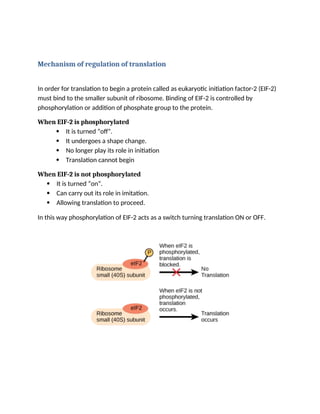
In order for translation to begin a protein called as eukaryotic initiation factor-2 (EIF-2)
must bind to the smaller subunit of ribosome. Binding of EIF-2 is controlled by
phosphorylation or addition of phosphate group to the protein.
When EIF-2 is phosphorylated
 It is turned “off”.
 It undergoes a shape change.
 No longer play its role in initiation
 Translation cannot begin
When EIF-2 is not phosphorylated
 It is turned “on”.
 Can carry out its role in imitation.
 Allowing translation to proceed.
In this way phosphorylation of EIF-2 acts as a switch turning translation ON or OFF.

Translational Regulation of Developmental Process.docx

  • 1.
    Translational Regulation ofDevelopmental Process Translational regulation is a widespread means of regulating gene expression in the development and cellular process.  Some of the most important cases of translational regulation of gene expression occur in the oocyte. The oocyte often makes and stores mRNAs that will be used only after fertilization occurs. These messages stay in the dormant state until they are activated by ionic signals that spread through the egg during sperm- binding.  Some of these stored mRNAs are for proteins that will be needed during cleavage, when the embryo makes enormous amount of chromatin, cell membranes and cytoskeleton components. While some of them encode cyclin proteins.  In many species (including sea urchin and Drosophila) maintenance of the normal rate and pattern of early cell divisions requires continuous protein synthesis from stored material mRNA. Other stored messages encode proteins that determine the fate of cells and provide positional information in the Drosophila embryo.  In some cases these messages are prevented from being translated by the binding of some inhibitory proteins. In other cases, the translatability of mRNA is regulated by the length of its poly-A-tail. In the drosophila oocyte the messages remain untranslated until signals at fertilization allow the cortex proteins to add poly-A residues to the mRNA. At that point the message becomes translatable and its product determines which part of the embryo become the head and the thorax.  Other organisms use different ways of regulating the translatability of their messages. The oocyte of Tobacco moth makes some of its mRNA without their methylated 5’caps. In this stage they cannot be efficiently translated, however at fertilization a methyl transferase completes the formation of the caps and these mRNAs can be translated.
  • 2.
    Mechanism of regulationof translation In order for translation to begin a protein called as eukaryotic initiation factor-2 (EIF-2) must bind to the smaller subunit of ribosome. Binding of EIF-2 is controlled by phosphorylation or addition of phosphate group to the protein. When EIF-2 is phosphorylated  It is turned “off”.  It undergoes a shape change.  No longer play its role in initiation  Translation cannot begin When EIF-2 is not phosphorylated  It is turned “on”.  Can carry out its role in imitation.  Allowing translation to proceed. In this way phosphorylation of EIF-2 acts as a switch turning translation ON or OFF.