Reading  Amadís  in Constantinople: Translation as Diasporic Cultural Production David Wacks University of Oregon MLA 2012 http://davidwacks.uoregon.edu
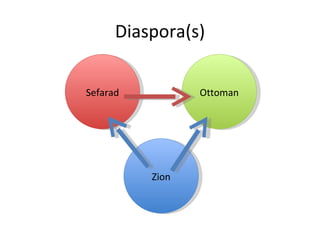
Diaspora(s) Sefarad Ottoman Zion
The cultural work of translation in diaspora What are the unique characteristics/functions of translation in diaspora? How does the work mediate between the diasporic communities and their cultures?
Amadís de Gaula Garci Rodríguez de Montalvo (Zaragoza 1508) Iberian adaptation of Arthurian romance  (12 th  c, Chrétien de Troyes) First chivalric novel published in Spain Numerous translations: Hebrew 1541, French 1544, Italian, English, German, etc Lampooned by Cervantes in  Don Quijote
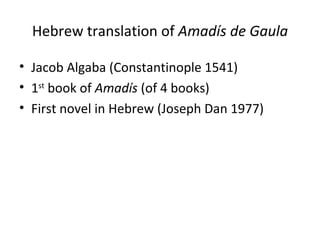
Hebrew translation of  Amadís de Gaula Jacob Algaba (Constantinople 1541) 1 st  book of  Amadís  (of 4 books) First novel in Hebrew (Joseph Dan 1977)
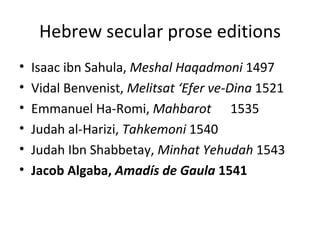
Hebrew secular prose editions Isaac ibn Sahula,  Meshal Haqadmoni  1497 Vidal Benvenist,  Melitsat  ‘Efer ve-Dina  1521 Emmanuel Ha-Romi,  Mahbarot   1535 Judah al-Harizi,  Tahkemoni  1540 Judah Ibn Shabbetay,  Minhat Yehudah  1543 Jacob Algaba,  Amadís de Gaula  1541
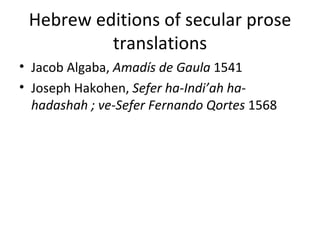
Hebrew editions of secular prose translations Jacob Algaba,  Amadís de Gaula  1541 Joseph Hakohen,  Sefer ha-Indi ’ah ha-hadashah ; ve-Sefer Fernando Qortes  1568
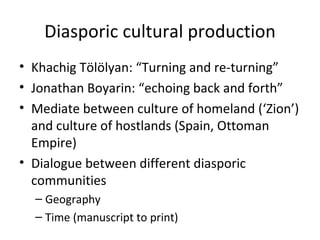
Diasporic cultural production Khachig Tölölyan:  “Turning and re-turning” Jonathan Boyarin:  “echoing back and forth” Mediate between culture of homeland ( ‘Zion’) and culture of hostlands (Spain, Ottoman Empire) Dialogue between different diasporic communities Geography Time (manuscript to print)
Packaging Sephardic culture Sephardic culture for wider diasporic audience inter-community communication Converts Sephardic prestige into common currency (print culture)
Audience? Sefaradim themselves would not need translation Romaniote Jews (Minna Rozen) Ottoman Jews beyond Constantinople (Avraham Ya ’ari) Buyers of Hebrew books like al-Harizi, et al
What does the text do? Literary system Bridges historiography and fiction (European) Novel Chivalry Text De-christianize Judaize Mediate conventions of chivalry/courtliness
First novel in Hebrew "there is no truth in the claim that it was the Jews of Ashkenaz that brought European culture to the tents of Israel” Dan, Joseph. “The First Hebrew Novel: Jacob Algabe’s  Amadis of Gaul .”  Moznayim  45 (1977): 181-188.
First novel in Hebrew “ It was the first time that long, detailed stories of the battles of knights, chivalry and love, friendship and long-standing enmity with evil wizards and powerful giants appeared in print in Hebrew.” Dan, Joseph. “The First Hebrew Novel: Jacob Algabe’s  Amadis of Gaul .”  Moznayim  45 (1977): 181-188. Print.
What does the work  do ? De-christianize “ Judaize” Adapt courtly/chivalric conventions
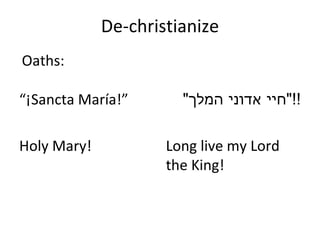
De-christianize “ ¡Sancta María! ” Holy Mary! " חיי אדוני המלך !!" Long live my Lord the King! Oaths:
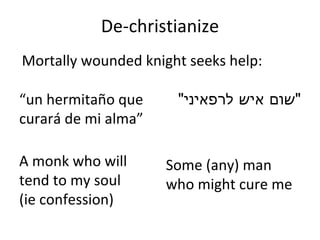
De-christianize “ un hermitaño que curará de mi alma ” A monk who will tend to my soul  (ie confession) " שום איש לרפאיני " Some (any) man who might cure me Mortally wounded knight seeks help:
De-christianize “ y mandóla quemar ”   and he ordered that she be burnt [to death] " יושמטוה ממגדל גבוה " So they dropped her from a tall tower Punishment for traitorous woman:
Judaize Almost completely free of Biblical and Rabbinical allusions Stands apart from other Soncino editions (Judah al-Harizi, Judah Ibn Shabbetay, etc)
Judaize “ que le oviesese memoria ” That he remember him " שלא ישכחו בתפילותיו " Asks that he not be forgotten in his prayers Hermit bids Galaor farewell, asks
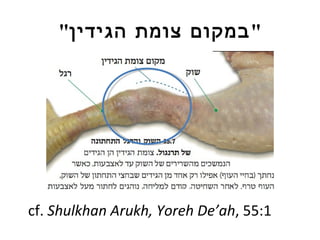
Judaize “ diole el Donzel del Mar en descubierto en la pierna izquierda tal herida…” The Knight of the Sea dealt him such a blow on his unprotected left leg… " ויך אותו על יריכו השמאלית  במקום צומת הגידין " Then he attacked him on his left thigh in the place where the tendons cross A serious thigh wound dealt by Amadís to his enemy
" במקום צומת הגידין " cf.  Shulkhan Arukh, Yoreh De ’ah , 55:1
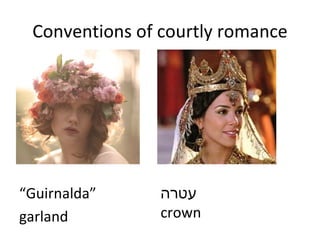
Conventions of courtly romance “ Guirnalda ” garland עטרה crown
Courtly language “ Muerto soy de corazón ” My [broken] heart has killed me!  " מה אנוכי ,  שנטרף לבי " Woe is me, for my heart is rent asunder!
Courtly language “ quiero que me digáis quién es y amarla he ”   I want you to tell me who she is, and  I will love her  (i.e. Instead of you) " הגד נא לי  מי הנשקפה - כמו - שחר  ואהוב אותה " Prithee tell me who is she  who appears like the dawn  (Song of Songs 6:1) and I will love her Knight challenges Amadís ’  love for Oriana:
De-christianize / Adapt courtly love “ mi juizio no puede resistir aquellos mortales deseos de quien cruelmente es atormentado ” My judgment cannot resist those mortal desires by which is it is cruelly tormented " להתרחק מחשבה הזאת ,  כי לבי תפוש ואסור בכבלי ברזל " [it is impossible]  “ To distance myself from that thought, for  my heart is bound and tied in iron chains ”
Conclusions Mediate between Zion-Sefarad-Ottoman Position Sephardic culture in Ottoman Jewish context Introduce European novel to Hebrew audience

Reading Amadís in Constantinople: Translation as Diasporic Cultural Production

  • 1.
    Reading Amadís in Constantinople: Translation as Diasporic Cultural Production David Wacks University of Oregon MLA 2012 http://davidwacks.uoregon.edu
  • 2.
  • 3.
    The cultural workof translation in diaspora What are the unique characteristics/functions of translation in diaspora? How does the work mediate between the diasporic communities and their cultures?
  • 4.
    Amadís de GaulaGarci Rodríguez de Montalvo (Zaragoza 1508) Iberian adaptation of Arthurian romance (12 th c, Chrétien de Troyes) First chivalric novel published in Spain Numerous translations: Hebrew 1541, French 1544, Italian, English, German, etc Lampooned by Cervantes in Don Quijote
  • 5.
    Hebrew translation of Amadís de Gaula Jacob Algaba (Constantinople 1541) 1 st book of Amadís (of 4 books) First novel in Hebrew (Joseph Dan 1977)
  • 6.
    Hebrew secular proseeditions Isaac ibn Sahula, Meshal Haqadmoni 1497 Vidal Benvenist, Melitsat ‘Efer ve-Dina 1521 Emmanuel Ha-Romi, Mahbarot 1535 Judah al-Harizi, Tahkemoni 1540 Judah Ibn Shabbetay, Minhat Yehudah 1543 Jacob Algaba, Amadís de Gaula 1541
  • 7.
    Hebrew editions ofsecular prose translations Jacob Algaba, Amadís de Gaula 1541 Joseph Hakohen, Sefer ha-Indi ’ah ha-hadashah ; ve-Sefer Fernando Qortes 1568
  • 8.
    Diasporic cultural productionKhachig Tölölyan: “Turning and re-turning” Jonathan Boyarin: “echoing back and forth” Mediate between culture of homeland ( ‘Zion’) and culture of hostlands (Spain, Ottoman Empire) Dialogue between different diasporic communities Geography Time (manuscript to print)
  • 9.
    Packaging Sephardic cultureSephardic culture for wider diasporic audience inter-community communication Converts Sephardic prestige into common currency (print culture)
  • 10.
    Audience? Sefaradim themselveswould not need translation Romaniote Jews (Minna Rozen) Ottoman Jews beyond Constantinople (Avraham Ya ’ari) Buyers of Hebrew books like al-Harizi, et al
  • 11.
    What does thetext do? Literary system Bridges historiography and fiction (European) Novel Chivalry Text De-christianize Judaize Mediate conventions of chivalry/courtliness
  • 12.
    First novel inHebrew "there is no truth in the claim that it was the Jews of Ashkenaz that brought European culture to the tents of Israel” Dan, Joseph. “The First Hebrew Novel: Jacob Algabe’s Amadis of Gaul .” Moznayim 45 (1977): 181-188.
  • 13.
    First novel inHebrew “ It was the first time that long, detailed stories of the battles of knights, chivalry and love, friendship and long-standing enmity with evil wizards and powerful giants appeared in print in Hebrew.” Dan, Joseph. “The First Hebrew Novel: Jacob Algabe’s Amadis of Gaul .” Moznayim 45 (1977): 181-188. Print.
  • 14.
    What does thework do ? De-christianize “ Judaize” Adapt courtly/chivalric conventions
  • 15.
    De-christianize “ ¡SanctaMaría! ” Holy Mary! " חיי אדוני המלך !!" Long live my Lord the King! Oaths:
  • 16.
    De-christianize “ unhermitaño que curará de mi alma ” A monk who will tend to my soul (ie confession) " שום איש לרפאיני " Some (any) man who might cure me Mortally wounded knight seeks help:
  • 17.
    De-christianize “ ymandóla quemar ” and he ordered that she be burnt [to death] " יושמטוה ממגדל גבוה " So they dropped her from a tall tower Punishment for traitorous woman:
  • 18.
    Judaize Almost completelyfree of Biblical and Rabbinical allusions Stands apart from other Soncino editions (Judah al-Harizi, Judah Ibn Shabbetay, etc)
  • 19.
    Judaize “ quele oviesese memoria ” That he remember him " שלא ישכחו בתפילותיו " Asks that he not be forgotten in his prayers Hermit bids Galaor farewell, asks
  • 20.
    Judaize “ dioleel Donzel del Mar en descubierto en la pierna izquierda tal herida…” The Knight of the Sea dealt him such a blow on his unprotected left leg… " ויך אותו על יריכו השמאלית במקום צומת הגידין " Then he attacked him on his left thigh in the place where the tendons cross A serious thigh wound dealt by Amadís to his enemy
  • 21.
    " במקום צומתהגידין " cf. Shulkhan Arukh, Yoreh De ’ah , 55:1
  • 22.
    Conventions of courtlyromance “ Guirnalda ” garland עטרה crown
  • 23.
    Courtly language “Muerto soy de corazón ” My [broken] heart has killed me! " מה אנוכי , שנטרף לבי " Woe is me, for my heart is rent asunder!
  • 24.
    Courtly language “quiero que me digáis quién es y amarla he ” I want you to tell me who she is, and I will love her (i.e. Instead of you) " הגד נא לי מי הנשקפה - כמו - שחר ואהוב אותה " Prithee tell me who is she who appears like the dawn (Song of Songs 6:1) and I will love her Knight challenges Amadís ’ love for Oriana:
  • 25.
    De-christianize / Adaptcourtly love “ mi juizio no puede resistir aquellos mortales deseos de quien cruelmente es atormentado ” My judgment cannot resist those mortal desires by which is it is cruelly tormented " להתרחק מחשבה הזאת , כי לבי תפוש ואסור בכבלי ברזל " [it is impossible] “ To distance myself from that thought, for my heart is bound and tied in iron chains ”
  • 26.
    Conclusions Mediate betweenZion-Sefarad-Ottoman Position Sephardic culture in Ottoman Jewish context Introduce European novel to Hebrew audience