SPEDCHAT WEBINAR SERIES
Transition Planning
How To Avoid the "Black-Hole" Between
Graduation and Adulthood
Tweet about the webinar using #SpedChatWeb
and follow us on social to find out about
future webinars, events, news, and contests.
@AccelifyLLCfacebook.com/Accelify linkedin.com/company/accelify-llc
We’re Social
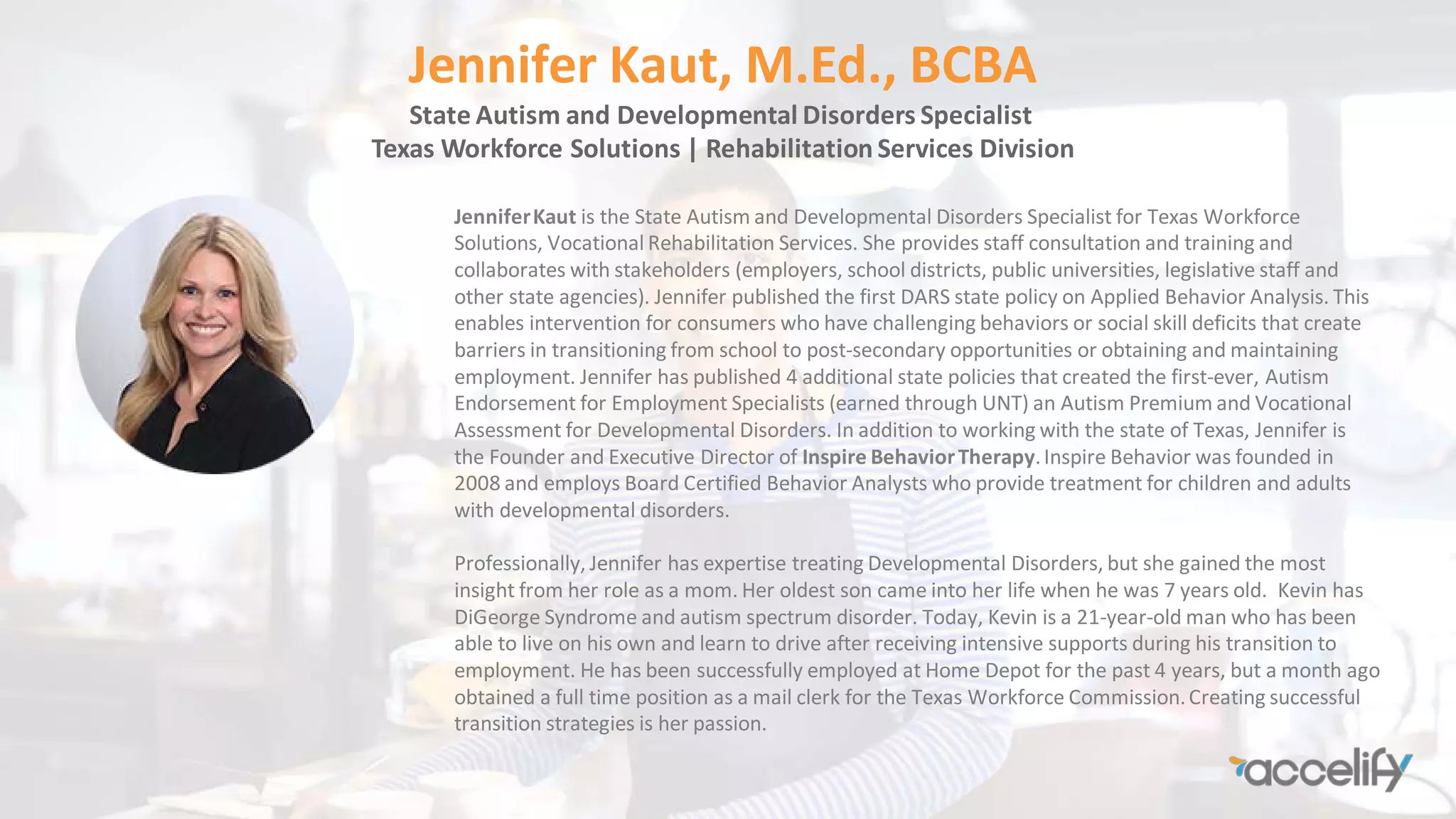
Jennifer Kaut, M.Ed., BCBA
State Autism and Developmental Disorders Specialist
Texas Workforce Solutions | Rehabilitation Services Division
JenniferKaut is the State Autism and Developmental Disorders Specialist for Texas Workforce
Solutions, Vocational Rehabilitation Services. She provides staff consultation and training and
collaborates with stakeholders (employers, school districts, public universities, legislative staff and
other state agencies). Jennifer published the first DARS state policy on Applied Behavior Analysis. This
enables intervention for consumers who have challenging behaviors or social skill deficits that create
barriers in transitioning from school to post-secondary opportunities or obtaining and maintaining
employment. Jennifer has published 4 additional state policies that created the first-ever, Autism
Endorsement for Employment Specialists (earned through UNT) an Autism Premium and Vocational
Assessment for Developmental Disorders. In addition to working with the state of Texas, Jennifer is
the Founder and Executive Director of Inspire BehaviorTherapy.Inspire Behavior was founded in
2008 and employs Board Certified Behavior Analysts who provide treatment for children and adults
with developmental disorders.
Professionally, Jennifer has expertise treating Developmental Disorders, but she gained the most
insight from her role as a mom. Her oldest son came into her life when he was 7 years old. Kevin has
DiGeorge Syndrome and autism spectrum disorder. Today, Kevin is a 21-year-old man who has been
able to live on his own and learn to drive after receiving intensive supports during his transition to
employment. He has been successfully employed at Home Depot for the past 4 years, but a month ago
obtained a full time position as a mail clerk for the Texas Workforce Commission.Creating successful
transition strategies is her passion.
SPEDCHAT WEBINAR SERIES
What is Transition?
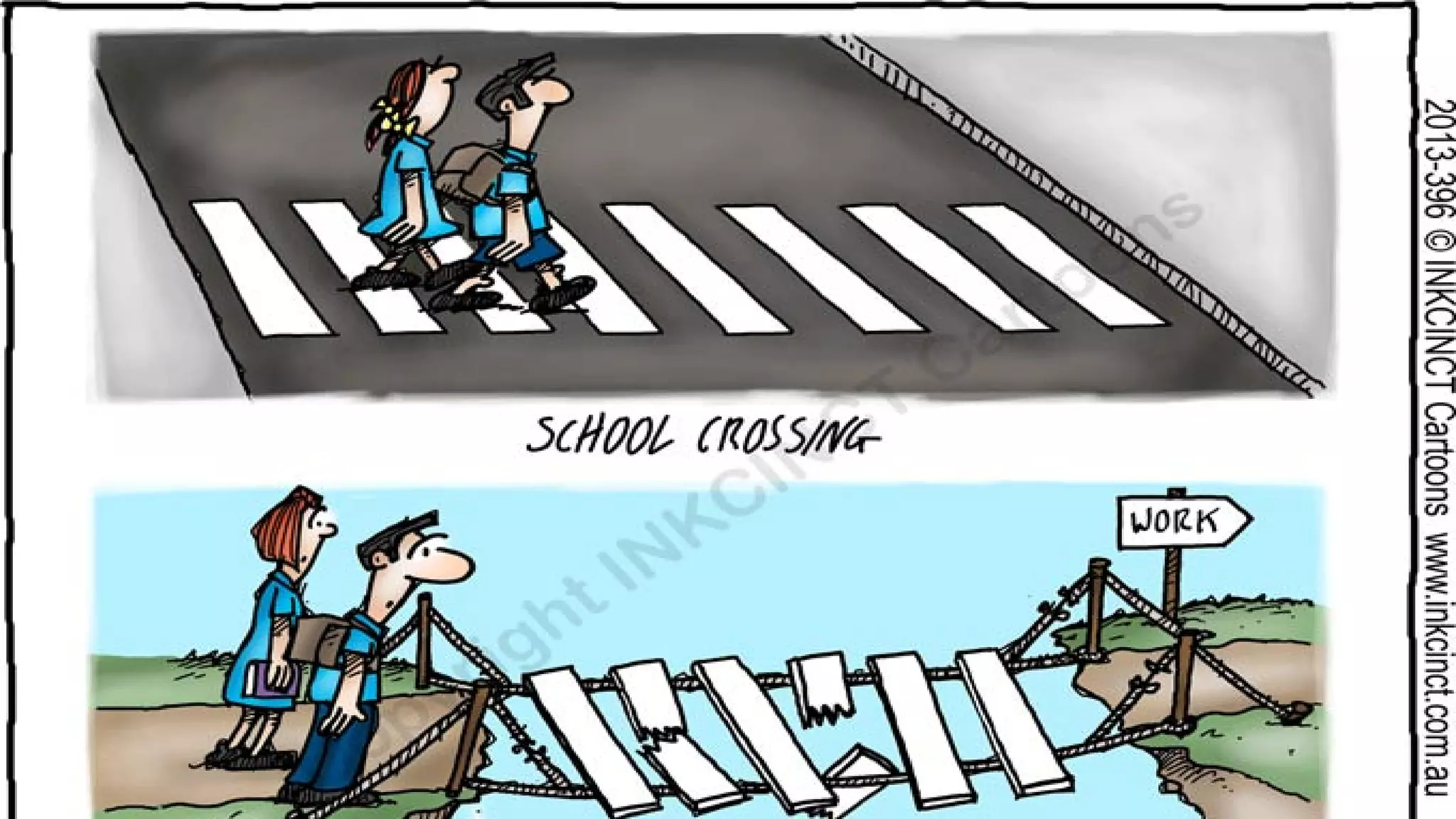
Should be a seamless Bridge
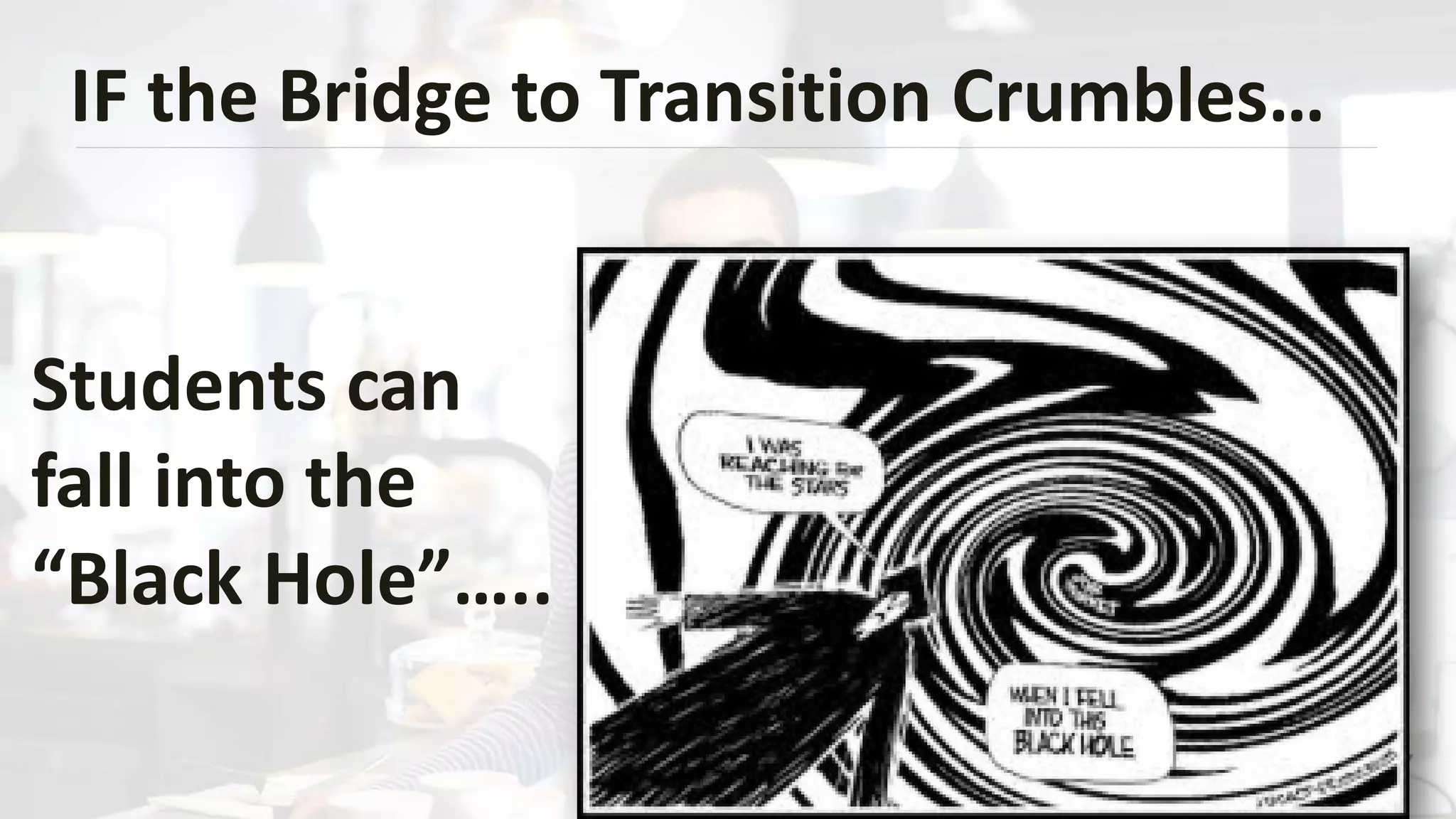
IF the Bridge to Transition Crumbles…
Students can
fall into the
“Black Hole”…..
Who is at Risk?
Students with a Neurodevelopmental Disorder….
(Learning Disorders, AD/HD, Autism and Intellectual Developmental
Disorders)
But who is the MOST at Risk?
Students with Autism Spectrum Disorder
Students with Autism
Only 55.1 percent of young adults with autism held paying jobs
during their first six years out of high school, the lowest
percentage among the disability categories examined.
9 out of 10 people with Autism are either unemployed or
underemployed
40% of those with Autism that do attempt college, less
than half will NOT complete it.
regardless of their IQ or education level
SPEDCHAT WEBINAR SERIES
Successful Transition Starts With A…
Successful Transition
 Is purposely driven with clear and concise objectives
 Contains a specific and detailed roadmap that
should be established by 9th grade.
Successful Transition
Step 1:
1. A baseline of the student’s strengths and deficits
must be determined. In order to obtain this
baseline, a thorough transition assessment should
be conducted.
Successful Transition
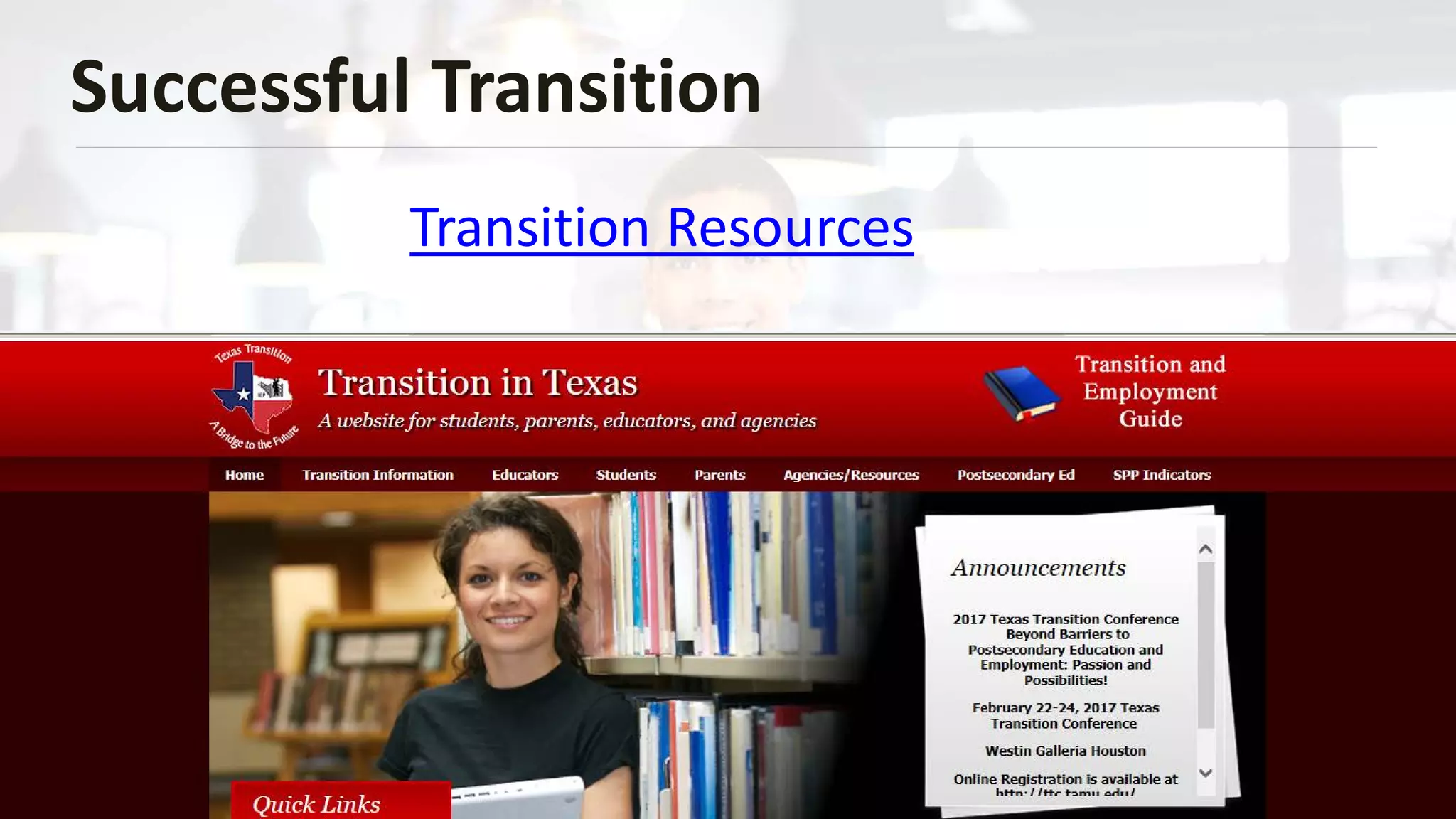
Transition Resources
Successful Transition
Step 2:
1. A working “road map” is established per the
results of the transition assessment/s. The “road
map” is adjusted year by year as progress is made
or new deficits are discovered.
Example of a Road Map: Autism
• 9th grade: severe generalized anxiety, cognitive
inflexibility and inability to engage people
• 10th grade: progress was made with overall anxiety
in the school setting, but had not generalized in
others
Kevin
Example of a Road Map: ASD
• 11th grade: inability to self advocate, inability to
identify his strengths and weakness, sudden increase
in cognitive inflexibly and still working on social anxiety
• 12th grade: peer social engagement , literalism and
work stamina
Kevin
SPEDCHAT WEBINAR SERIES
Vocational Rehabilitation (VR)
Vocational Rehabilitation
• Is a federal program
• Is available in all states
• Can be accessed if the student’s
disability is a barrier to post secondary
options
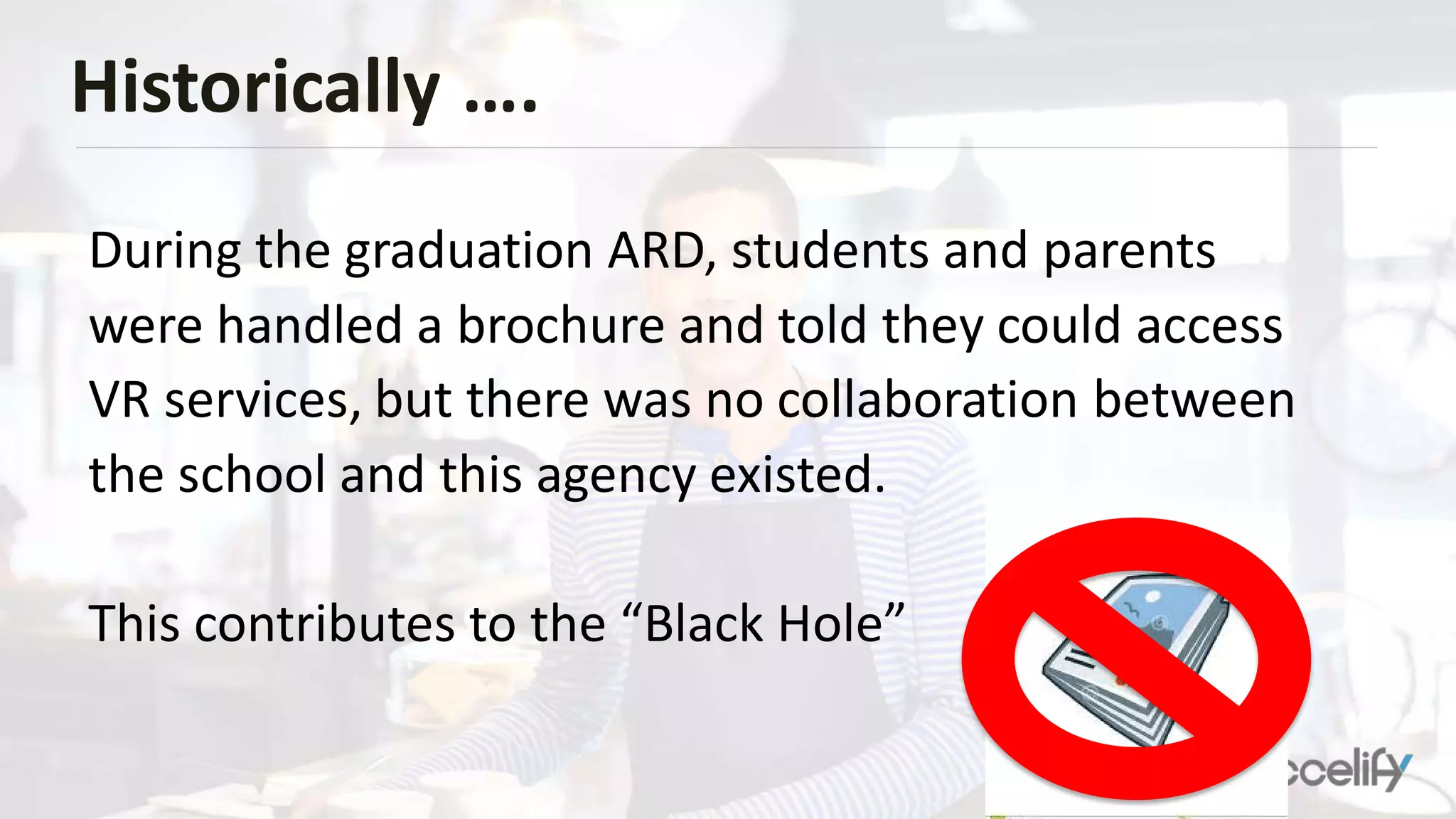
Historically ….
During the graduation ARD, students and parents
were handled a brochure and told they could access
VR services, but there was no collaboration between
the school and this agency existed.
This contributes to the “Black Hole”
SPEDCHAT WEBINAR SERIES
Specialized Services for Developmental Disorders
Specialized Services
Examples:
• Applied Behavior Analysis
• Statewide team of specially trained VR Counselors
• Autism endorsement for Employment Specialists
that can be earned through the University of North
Texas
Specialized Services
More Examples:
• If they earn the endorsement it enables Employment
Specialists to receive a premium for working with
Autism clients (of all ages, not just with students)
• New assessment called the “Environmental Work
Assessment” (EWA) is designed to identify variables
that effect the client’s ability to function at his or her
SPEDCHAT WEBINAR SERIES
WIOA Makes Transition a Priority
WIOA
• Stands for the Workforce Innovation and
Opportunity Act
• These new federal regulations contained in
WIOA, requires that all VR programs spend at
least 15 % of their federal dollars on PRE-
Employment Services for students ages 10-22
who have a disability
WIOA
• This establishes transition as a priority when before,
accessing students while still in school, were not.
• Provides Pre-Employment Services opportunities
that had not existed before or were not commonly
accessed.
• Creates the opportunity to bridge the gap between
transitioning from school to post secondary options
WIOA
• Provides the opportunity for a much needed collaboration
between schools and VR.
• While VR can not duplicate school services, we can fill in
service gaps when the school cannot.
• In Texas, are few examples of what we can provide: in home
support, pay for driving lessons, treatments such as Applied
Behavior Analysis and help obtaining their first job.
To learn more about Accelify find us online at www.accelify.com and on social media.
For additional information, contact: natalie@accelify.com
Thank you.
Transition Planning
How To Avoid the "Black-Hole" Between
Graduation and Adulthood
@AccelifyLLCfacebook.com/Accelify linkedin.com/company/accelify-llc

Transition Planning: How To Avoid the "Black-Hole" Between Graduation and Adulthood

  • 1.
    SPEDCHAT WEBINAR SERIES TransitionPlanning How To Avoid the "Black-Hole" Between Graduation and Adulthood
  • 2.
    Tweet about thewebinar using #SpedChatWeb and follow us on social to find out about future webinars, events, news, and contests. @AccelifyLLCfacebook.com/Accelify linkedin.com/company/accelify-llc We’re Social
  • 3.
    Jennifer Kaut, M.Ed.,BCBA State Autism and Developmental Disorders Specialist Texas Workforce Solutions | Rehabilitation Services Division JenniferKaut is the State Autism and Developmental Disorders Specialist for Texas Workforce Solutions, Vocational Rehabilitation Services. She provides staff consultation and training and collaborates with stakeholders (employers, school districts, public universities, legislative staff and other state agencies). Jennifer published the first DARS state policy on Applied Behavior Analysis. This enables intervention for consumers who have challenging behaviors or social skill deficits that create barriers in transitioning from school to post-secondary opportunities or obtaining and maintaining employment. Jennifer has published 4 additional state policies that created the first-ever, Autism Endorsement for Employment Specialists (earned through UNT) an Autism Premium and Vocational Assessment for Developmental Disorders. In addition to working with the state of Texas, Jennifer is the Founder and Executive Director of Inspire BehaviorTherapy.Inspire Behavior was founded in 2008 and employs Board Certified Behavior Analysts who provide treatment for children and adults with developmental disorders. Professionally, Jennifer has expertise treating Developmental Disorders, but she gained the most insight from her role as a mom. Her oldest son came into her life when he was 7 years old. Kevin has DiGeorge Syndrome and autism spectrum disorder. Today, Kevin is a 21-year-old man who has been able to live on his own and learn to drive after receiving intensive supports during his transition to employment. He has been successfully employed at Home Depot for the past 4 years, but a month ago obtained a full time position as a mail clerk for the Texas Workforce Commission.Creating successful transition strategies is her passion.
  • 4.
  • 5.
    Should be aseamless Bridge
  • 7.
    IF the Bridgeto Transition Crumbles… Students can fall into the “Black Hole”…..
  • 8.
    Who is atRisk? Students with a Neurodevelopmental Disorder…. (Learning Disorders, AD/HD, Autism and Intellectual Developmental Disorders) But who is the MOST at Risk? Students with Autism Spectrum Disorder
  • 9.
    Students with Autism Only55.1 percent of young adults with autism held paying jobs during their first six years out of high school, the lowest percentage among the disability categories examined. 9 out of 10 people with Autism are either unemployed or underemployed 40% of those with Autism that do attempt college, less than half will NOT complete it. regardless of their IQ or education level
  • 10.
    SPEDCHAT WEBINAR SERIES SuccessfulTransition Starts With A…
  • 11.
    Successful Transition  Ispurposely driven with clear and concise objectives  Contains a specific and detailed roadmap that should be established by 9th grade.
  • 12.
    Successful Transition Step 1: 1.A baseline of the student’s strengths and deficits must be determined. In order to obtain this baseline, a thorough transition assessment should be conducted.
  • 13.
  • 14.
    Successful Transition Step 2: 1.A working “road map” is established per the results of the transition assessment/s. The “road map” is adjusted year by year as progress is made or new deficits are discovered.
  • 15.
    Example of aRoad Map: Autism • 9th grade: severe generalized anxiety, cognitive inflexibility and inability to engage people • 10th grade: progress was made with overall anxiety in the school setting, but had not generalized in others Kevin
  • 16.
    Example of aRoad Map: ASD • 11th grade: inability to self advocate, inability to identify his strengths and weakness, sudden increase in cognitive inflexibly and still working on social anxiety • 12th grade: peer social engagement , literalism and work stamina Kevin
  • 17.
  • 18.
    Vocational Rehabilitation • Isa federal program • Is available in all states • Can be accessed if the student’s disability is a barrier to post secondary options
  • 19.
    Historically …. During thegraduation ARD, students and parents were handled a brochure and told they could access VR services, but there was no collaboration between the school and this agency existed. This contributes to the “Black Hole”
  • 20.
    SPEDCHAT WEBINAR SERIES SpecializedServices for Developmental Disorders
  • 21.
    Specialized Services Examples: • AppliedBehavior Analysis • Statewide team of specially trained VR Counselors • Autism endorsement for Employment Specialists that can be earned through the University of North Texas
  • 22.
    Specialized Services More Examples: •If they earn the endorsement it enables Employment Specialists to receive a premium for working with Autism clients (of all ages, not just with students) • New assessment called the “Environmental Work Assessment” (EWA) is designed to identify variables that effect the client’s ability to function at his or her
  • 23.
    SPEDCHAT WEBINAR SERIES WIOAMakes Transition a Priority
  • 24.
    WIOA • Stands forthe Workforce Innovation and Opportunity Act • These new federal regulations contained in WIOA, requires that all VR programs spend at least 15 % of their federal dollars on PRE- Employment Services for students ages 10-22 who have a disability
  • 25.
    WIOA • This establishestransition as a priority when before, accessing students while still in school, were not. • Provides Pre-Employment Services opportunities that had not existed before or were not commonly accessed. • Creates the opportunity to bridge the gap between transitioning from school to post secondary options
  • 26.
    WIOA • Provides theopportunity for a much needed collaboration between schools and VR. • While VR can not duplicate school services, we can fill in service gaps when the school cannot. • In Texas, are few examples of what we can provide: in home support, pay for driving lessons, treatments such as Applied Behavior Analysis and help obtaining their first job.
  • 27.
    To learn moreabout Accelify find us online at www.accelify.com and on social media. For additional information, contact: natalie@accelify.com Thank you. Transition Planning How To Avoid the "Black-Hole" Between Graduation and Adulthood @AccelifyLLCfacebook.com/Accelify linkedin.com/company/accelify-llc